
Climate emergencies surround us today. Students of the 2020s know: Climate change is real, here, and intensifying. They deserve opportunities to study its history, examine its root causes, and shape pathways to a more sustainable world.
Educators are creating these opportunities for students. Below are just a few of the stories we have received in the past weeks.
Testimonials

Our middle schoolers engaged in the The Climate Crisis Trial: A Role Play on the Roots of Global Warming lesson. We worked collaboratively across subjects to turn this lesson into a larger group learning project where our teachers expanded the lesson to include learning goals in science, social studies, and ELA classes.
Our students organized into small groups, each representing a different defendant in the lesson. They researched their assigned area, updated any data, and created arguments and rebuttals for their points of view. They worked with our science teacher to understand the environmental impacts of their assigned defendant character. They worked in social studies to understand the systemic roots of climate change and how systems like capitalism, patriarchy, and colonialism have influenced the climate crisis. Our ELA teacher worked alongside the groups to create their written arguments and rebuttals, cite sources, and edit.
One of our parents is a lawyer and, once the project was complete, he took a day to come facilitate a mock trial. All the teams emailed him their project ahead of time, and he came prepared with questions and feedback. The students dressed for court, presented their arguments, answered questions, and gave rebuttals. Based on their research and arguments, our guest lawyer declared a “winner” for the trial and also gave them all excellent feedback. Parents came to watch the trial, and it was absolutely a highlight of our school year!
—Jaime Peterson, Middle School Social Studies Administrator, Chattanooga, Tennessee

This year I designed and taught a 12th grade environmental justice course that was offered for the first time at my school. I found A People’s Curriculum for the Earth: Teaching Climate Change and the Environmental Crisis incredibly helpful in framing climate justice and exploring climate solutions.
Often, I opened a unit of study with one of the many interactive lessons from the Zinn Education Project. From the The Thingamabob Game: A Simulation on Capitalism vs. the Climate to ‘Don’t Take Our Voices Away’: A Role Play on the Indigenous Peoples’ Global Summit on Climate Change, students gained insight into the root issues driving the climate crisis in a fun and interactive way. The students were highly engaged and took ownership in their learning. I found that when the students learned about climate issues from a first-hand perspective, the impact of their learning was much more profound and inspiring than simply reading about climate change. Moreover, students’ key takeaways from these lessons served as reference points as we explored topics like the Green New Deal, divestment, and COP 30 more deeply.
These lessons, coupled with supplementary materials from a variety of climate writers, made for a fulfilling first year of teaching environmental justice. I plan to continue using these resources next year and highly suggest it to anyone teaching about climate change and/or climate justice.
— Jonas Denney, High School Social Studies Teacher, Los Angeles, California

I have used several lessons from the Zinn Education Project in my high school replacement Language Arts classes (grades 8–12). Two that have had a particularly powerful impact are Standing with Standing Rock: A Role Play on the Dakota Access Pipeline and the Climate Crisis Timeline. Both resources are accessible, justice centered, historically grounded, and rooted in student agency.
Because many of my students read below grade level, I always begin by adapting the reading materials by lowering the Lexile, adding vocabulary supports, and breaking complex texts into manageable chunks, while keeping the intellectual rigor fully intact.
The “Standing with Standing Rock” role play became one of the most meaningful units we did all year. The structure of the lesson gave students an accessible entry point into a complicated issue involving sovereignty, treaty rights, environmental risk, and competing interests in energy development. Even with support in place, the lesson pushed students to analyze power, consider multiple perspectives, and think critically about how infrastructure projects affect land, water, and communities. The council meeting simulation created a space where students could practice civic reasoning and ethical decision‑making in a way that felt authentic and grounded.
The “Climate Crisis Timeline” complemented this work beautifully. It helped students understand climate change not as an inevitable scientific phenomenon, but as a human‑made crisis shaped by colonialism, racial capitalism, fossil fuel expansion, and long histories of resistance. This framing is essential for my students, who often encounter climate change only through simplified scientific explanations that leave out questions of responsibility, justice, and power. The timeline allowed them to see the climate crisis as a story with authors, choices, and consequences — and one in which they have a role to play.
Both units culminated in persuasive writing on climate justice, and the quality of the writing was noticeably stronger because students had a deeper understanding of the issues. They weren’t just completing an assignment; they were responding to histories, communities, and movements they had spent time learning about. Their writing reflected a sense of responsibility and possibility that is often hard to capture in traditional curriculum.
These lessons have become resources I return to because they support accessibility, critical literacy, and meaningful engagement with Indigenous rights, environmental justice, and the climate crisis. They help my students step into complex conversations with confidence and clarity. I’m grateful for materials that honor their capacity to think deeply, question narratives, and imagine more just futures.
—Kari Matthies, High School Special Education Teacher, Red Wing, Minnesota
 One of my favorite lessons from the Zinn Education Project is The Thingamabob Game: A Simulation on Capitalism vs. the Climate! In this simulation, students act as competing companies whose goal is to make as much profit as possible by producing “thingamabobs.” However, every thingamabob they manufacture contributes to rising carbon dioxide levels which, consequently, is bringing the world closer to environmental catastrophe — and if the carbon dioxide levels get too high, disaster is certain.
To me, what makes this activity so powerful is that the students know what the different outcomes could be at the very beginning of the lesson. They are told that the companies with the most thingamabobs will receive candy as a reward, with first place receiving the best prize and last place receiving nothing. However, they are also made aware that if the game ends in a tie, every student receives candy, and the reward is only slightly smaller than what it would be if their company produced the most thingamabobs. At the same time, students must keep the rising carbon dioxide levels in check because if production gets too high, everyone loses. Despite knowing this, my students have always chosen to compete against each other for the bigger prize. So as expected, they focus on becoming the richest company by producing more and more thingamabobs, almost always ignoring the rising carbon dioxide levels even though they know that it is an imminent threat.
By the end of the game, students finally begin to recognize how difficult it can be to balance individual success with the collective good, which leads to some of the most meaningful discussions of the entire lesson. There’s this “OHHH” moment that happens when they realize that they all could have tied, won something, and kept the carbon dioxide levels at bay, especially if their thingamabob production made it so everyone lost in the end.
All in all, I love this lesson because it opens the door to conversations about capitalism, mass production, environmental responsibility, and what exactly drives this type of decision making in the real world. This is a lesson that I have and will continue to use every school year!
Books for Pre-K–12
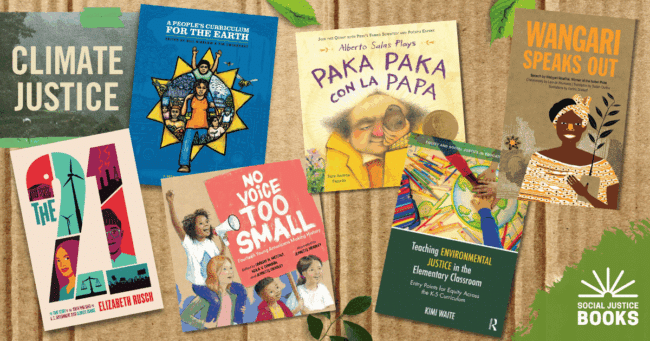
Find more lessons and teaching stories on environmental justice in the Rethinking Schools book, A People’s Curriculum for the Earth.
Plus, check out recommended books on the environment for pre-K–12 at Teaching for Change’s Social Justice Books.



Twitter
Google plus
LinkedIn