

On December 11, Rethinking Schools editor Jesse Hagopian spoke with historian Ned Blackhawk, author of The Rediscovery of America: Native Peoples and the Unmaking of U.S. History, about the Indigenous origins of the American Revolution. This class was in preparation for teaching about the American Revolution on the 250th anniversary of the Declaration of Independence in 2026.
In the excerpt below, Blackhawk discusses the centrality — and suppression — of Native American history in understanding the American Revolution and U.S. founding.
Event Recording
Transcript
Click below for the full transcript with resources mentioned in the discussion.
Transcript
Jesse Hagopian (he/him): On behalf of the Zinn Education Project, we would like to welcome everybody to our people’s history class on the Indigenous origins of the American Revolution with the great historian Ned Blackhawk. My name is Jesse Hagopian, I’m a campaign director with the Zinn Education Project, and an editor for Rethinking Schools. My new book is called Teach Truth: The Struggle for Anti-Racist Education.
Today’s class is hosted by the Zen Education Project. which is coordinated by Rethinking Schools and Teaching for Change, and we offer free, downloadable people’s history lessons that many of you have used for middle and high school classrooms from our Zinn Education Project website. We have so many important lessons on teaching Indigenous peoples’ history.
As we approach the 250th anniversary of the Declaration of Independence, we’ve put together resources for teaching about the American Revolution to invite inquiry, and to surface thoughtful discussions about the American Revolution and the founding of the United States. Meanwhile, the U.S. Department of Education has launched the America 250 Civics Coalition to celebrate what they call a new era of American greatness. And that coalition is made up of right-wing organizations like the Heritage Foundation, Hillsdale College, [and] PragerU, which whitewash history and lie to students in order to maintain our unjust status quo. So, let’s make visible the fact that teachers everywhere are teaching truthfully about the American Revolution, about the contradictions of it.
So sign up to participate. We’ll post a map to show the cities and states where teachers are participating. We will not share your name, your role, or your contact info. But please do help us fill the map so that it reflects the participation of those of you who want to teach honestly about the founding of this country, and the consequences of that.
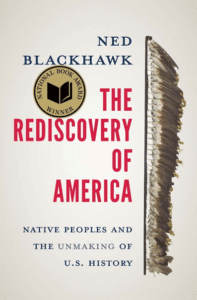
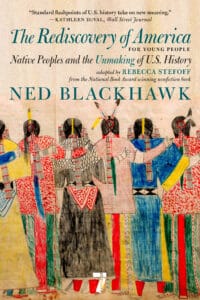
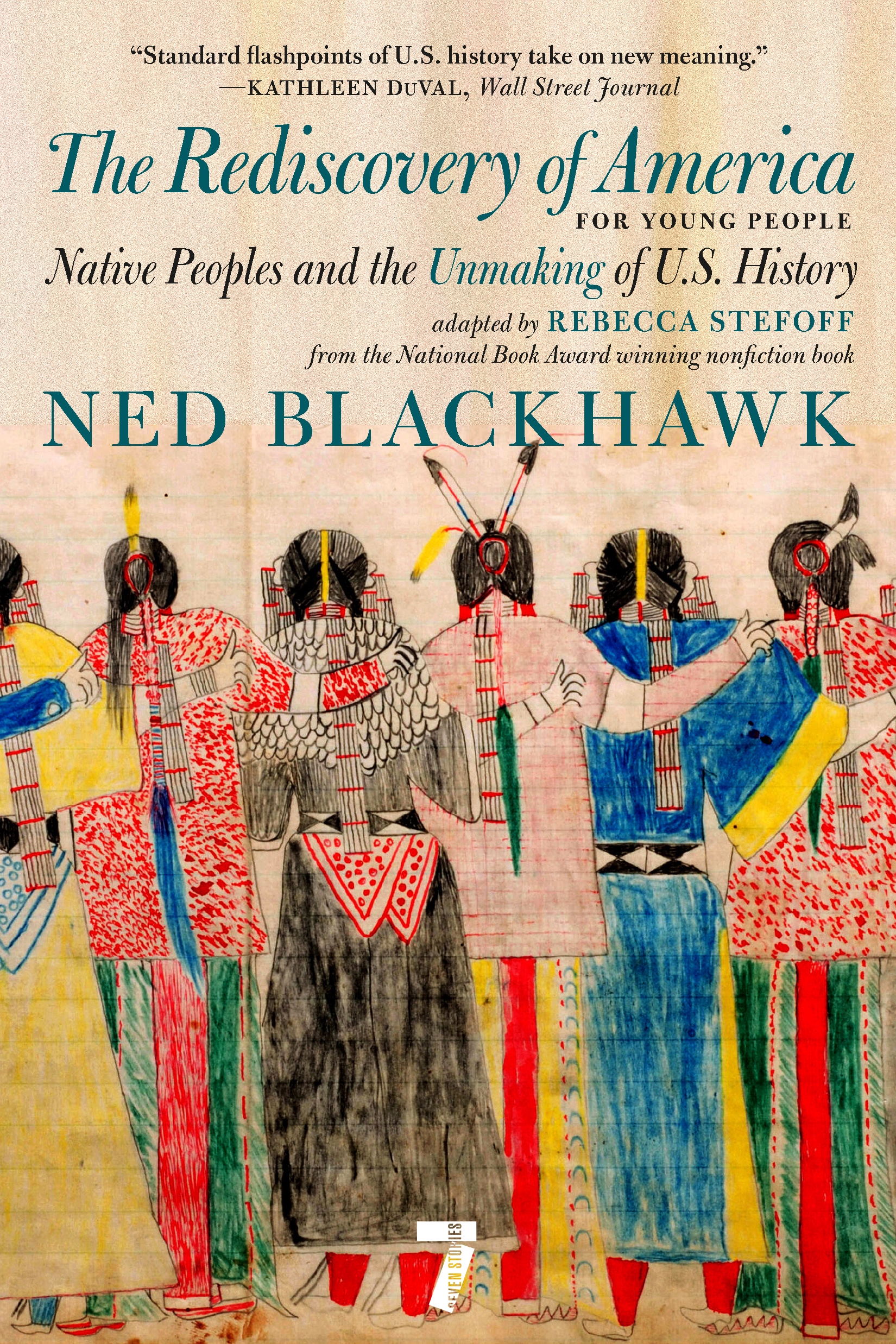
And now I am very honored to welcome Ned Blackhawk, a professor of history at Yale and author of The Rediscovery of America: Native Peoples and the Unmaking of U.S. History. I highly recommend everybody read and implement this book in your classroom. He has an upcoming YA edition via Seven Stories Press, and he’s also the author of Violence Over the Land: Indians and Empires in the Early American West. Thank you so much for being with us, Professor Blackhawk.
Ned Blackhawk: It’s a great honor to be among so many educators.
Hagopian: Right on. Well, let’s just dig into this conversation, because I have probably more questions than we have time to get to. But your writing just sparked so many ideas and questions for me. In the dominant histories of the United States, Native people, of course, are often portrayed as a constant thorn in the side of the state, or they’re just simply erased from the story altogether. There’s one video that I sometimes showed a clip of to make this point clear to my students. There’s the documentary called America: The Story of Us, and when it starts out showing the American continent, it has a sweeping scene of America and it talks about how many thousands of trees and buffalo existed. And it says nothing about any people existing there when the first Europeans landed. So that erasure is so real, and many of the texts that they ask us to teach with. But in The Rediscovery of America, you know how even scholarship that has contributed greatly to our understanding of global colonialism and of Native resistance still tends to emphasize Indigenous elimination as the defining aspect of Native American history, which ends up minimizing the extent of Native power and agency, but you and other Native scholars, I think, are really reorienting U.S. history by showing how Native people are central to it. So I hope you could talk to us about the significance of this idea of survivance and how you build on it in this book.
Blackhawk: I’d be happy to, and thank you for that generous introduction and this warm invitation. There are a lot of themes that you raised that are central purposes that the book is working towards. And the absence of clear and informed understandings of Native Americans is one of the most persistent problems confronting Native American communities today. Either tribal communities, urban communities, individual families, there’s something deeply seated in the American national consciousness that has a limited capacity to make sense of the ongoing presence and changing adaptations and nature of Native America.
There’s a famous literary Ojibwe author and literary theorist by the name of Gerald Vizenor, who in the mid to early 90s, wrote a book that came up with this idea of how to characterize the dynamic presence and constantly renewed sense of Native American presence and identity within modern America, and he coined the term survivance. Now, we should be telling Native American histories that are not just about either victimization or survival but about a process of ongoing, consistent reimagination and world-making in which Native peoples are active participants in their histories and the worlds around them. So that’s what the term survivance means.
Hagopian: Thank you. You’ve talked about how there are many distinct histories of Native communities, but also important linkages that form the unified historical experience for Native Americans. Some of these commonalities depend on whatever era we’re talking about. But what are some of the themes of commonality that Native peoples had in the 18th century, before the founding of the United States, and did those themes change during and after the American Revolution?
Blackhawk: Yes, there’s a misunderstanding in popular consciousness that there is a singular Native American subject in American history, often portrayed as a Plains Indian warrior, often seemingly on the precipice of decline, or despondency, or despair. When, in fact, Native America is an extraordinarily heterogeneous place, both contemporarily and historically. And it’s hard to understand the subject because we’re used to seeing somewhat simple categories of analysis rather than complex processes. If you were to spend time in Native American communities, or study Native American history in some form, you would see a great deal of intertribal differences, and sometimes, historically speaking, animosities.
One of the great transformations that the American Revolution unleashes that is not well understood is that the American Republic begins a process of self-definition during the Revolution, and particularly in the Declaration, where it establishes a singular vision of Native peoples as the last grievance of the Declaration reads, as, quote, “merciless Indian savages.” This vision of Native peoples as being inherently different from civilized society, as being inherently savage and or merciless or both characterizes peoples who, at the time, in places like Connecticut, where I now live, or Massachusetts. or down in New York State, or even into Virginia and the Carolinas, people who were themselves Christian, people who read and worshipped on Sunday, people who had traveled multiple times to England to lobby the Crown on behalf of their community’s needs. We’ve lost so much understanding about the diversity and pluralism within Native America that we’re trying to recapture it academically. But it’s not an easy challenge.
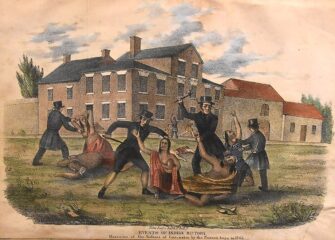
Hagopian: Yeah, no doubt. Thank you for those clarifications. Talking about the American Revolution, most of the historical narratives really pin the origins of the American Revolution on how the colonists resented over-taxation by the British government. These stories, I think, tend to focus on coastal colonies and seaports, but you wrote in the book, quote, “interior land concerns as well as Crown’s conciliatory relations with Indians upset settlers just as much, if not more, than policies of taxation,” which I thought was a really important observation which totally reframes how we think of the American Revolution. And you said in 1763, quote, “settlers’ fears revolved around concerns from the West, not the East.” So, tell us about 1763, from the Seven Years’ War to the Pontiac War to the Royal Proclamation of 1763, the Conestoga Massacre . . .
Blackhawk: There’s a short little book by my colleague at Dartmouth College named Colin Calloway. Colin, if some of you are watching the PBS series, is the curly-haired British commentator on Ken Burns’ The American Revolution who has lots of wry commentary throughout the show. He had a short book about 15 or 20 years ago called The Scratch of a Pen which chronicles how, in one year of North American history, the British Empire simultaneously defeated the French Empire in North America, acquired its vast colony known as New France; lost some of its interior forts during the uprising that summer, known as Pontiac’s War; [and] set in motion a series of initiatives, most notably the Royal Proclamation of October of 1763, that started limiting settler ambitions to settle west of the Appalachians.
So a year that started with so much euphoria ended for Native peoples, in particular in Pennsylvania, in destruction and violence. This is one year that is essential to understanding how the American Revolution began and unfolded, and how such things like “merciless Indian savages” and “inhabitants of our frontiers” made it into the Declaration itself 13 years later. There’s an origin point that we have not been sufficiently told in our national imagination and study that we should be told, and that is in the aftermath of the Seven Years’ War between England and France. England did not have the capacity to rule over Native peoples in the interior worlds in North America the way the French had. Many of you may not have spent much time in former parts of the French Empire in the United States, but words like Detroit, St. Louis, New Orleans, Quebec, Montreal, these are all words from the French Empire that were given to central features of a world that they had begun colonizing in the early 1600s. The loss of that colony for France is something we have never really seen in relation to our own national independence.
But England’s inability to rule in these interior spaces begins this process of conciliatory diplomatic trading and recognition that you just read about that begins upsetting colonists. So what do they do? Colonists immediately after the uprising of Pontiac’s forces in the summer of 1763 . . . Pontiac is an Odawa Indian leader. He’s around his mid-40s at the time. He’s lived through the changes of the Great Lakes world. He was fluent in multiple Indian and European languages, or at least in French, and could comprehend what it meant for the French Empire to be so quickly disposed of. And the Native peoples in places like Quebec, Ontario, Michigan, Illinois, Wisconsin, and down the Mississippi told the British when they came, “You may have defeated the French, but you’ve not defeated us.”
In fact, very few Native warriors and soldiers lost their lives in the Great Lakes region during the Seven Years’ War. Many, many more would die during the Revolution and the War of 1812 to follow. But in this crucible of war, as the famous historian Fred Anderson has called it, Pontiac and his forces surprised British officials. They destroy many of the forts that the British have inherited from the French Empire. They lay siege to places like Detroit. They don’t have the capacity to move further east of the Appalachians, but people east of the Appalachians get very, very worried. Militias start forming in backcountry regions that are not happy with the British Crown, and they’re particularly worried and fearful of Indian attacks becoming renewed as they had been during the previous years of war. So there’s a deep militaristic animosity that was already formed by the end of 1763 that we’ve never seen as part of the revolutionary struggle. But it’s those people, individuals and militia members in places like Lancaster County, Virginia and further west near Fort Pitt, down into the Carolinas, who are constantly fighting Indians throughout the 1760s and into the 1770s, and are defying British colonial policies. They are revolutionaries. They’re revolting against an established political system, and they’re often shooting at and at odds with colonial forces, or British colonial forces at the time.
Hagopian: That history you just recounted completely flips on its head what the majority of teachers are teaching about the origins of the American Revolution.
Blackhawk: And it helps us see how other protests form. We all may know that there are these tea protests in Boston Harbor in which the colonists dress like Indians, supposedly Mohawk Indians, to attack and destroy the tea shipments coming from England. There were similar types of masquerading and dress and costume adopting that other militias had been doing for years by then. So the Boston Tea Party is not a unique moment, the self-fashioning of an American identity using Indian imagery, but a continuation of patterns that had been going on for many, many years.
Here’s another anecdote that I’ve learned recently from a very accomplished historian by the name of Robert Parkinson. Robert Parkinson, whom I cite somewhat heavily in this Chapter 5 of The Rediscovery of America has written a series of recent books about this subject. The most influential for me was his first book called The Common Cause, about race and identity during the Revolutionary era. He went through all these newspapers that were circulating across the colonies and started looking at how frequently Indian attacks, or fears of them, became commonly circulated across the colonial world. In the process, he did subsequent work in another book, in which he started looking at when the term white people became first deployed through and in the colonial newspaper landscape. In his calculations, studying 70 years of newspapers from the early 17-teens until the 1770s, he found out that only about once a year before the Seven Years’ War, which begins in 1756, only once a year in colonial newspapers is the term white people ever really used, approximately. It almost increases exponentially. More than 10 times a year during the war and thereafter, this kind of common sense of a racialized colonial society in opposition to interior Native peoples who are being supplied or diplomatically recognized by a British sovereign and monarch, this term starts forming.
George Washington used the term for the first time in his correspondence in the later years of the war in 1757, when he wrote to governors in the South telling them that he’s concerned that the white people of their regions were going to be attacked by Indians. So all of a sudden this common vision of a white American colonial subject is forming in the aftermath of the Seven Years’ War. We’ve also not sufficiently seen how Indian affairs shape this kind of racialized self-understanding that the American colonists have. But by the end of the Declaration and Constitutional period, in their first year, Congress passes a new law, or statute, or form of legislation, that establishes how naturalization will work in the New Republic. Only people who are white can become naturalized subjects of the American Republic.
That’s a history of what we call racial formation over a 25-year period that has not been sufficiently understood or recognized. Because, as you were talking earlier, we’ve understood these histories in these discrete chapters. There’s the colonial era, there may be the French and Indian period, whatever that was, and then the revolution starts, maybe with the Boston Massacre or the Stamp Acts a couple years beforehand. Then the revolution’s over and the Republic is established. But the fears the colonists had, and their animosities, started taking not just racialized form in the Congress, but they started also forming federal Indian policy. And for generations thereafter, American state leaders and citizens will be articulating a vision of national identity that does not include Indians.
Hagopian: Yes. That’s so brilliant and so important for educators to begin to teach the American Revolutionary Era, not just as a reaction to the British, which it often gets stuck in, but as really a period of racial formation, of how whiteness was created to justify this new colony.
Blackhawk: And we’re not doing this to dismantle or indict the principles animating revolutionary ideas around liberty and self-representation, but to contextualize them, to understand them fully. As you were saying earlier, to tell a more truthful history of our republic. For someone who teaches Native American history, one of the shocking revelations is that in the Naturalization Act, in the Constitution, in the Declaration, in the 14th Amendment, in the Civil Rights Acts from the Reconstruction period, Native American Indians are mentioned. It’s not that they’re not mentioned in the text, it’s the last grievance of the Declaration of Independence. That guy Parkinson I mentioned, he calls it the climax of the Declaration itself. The whole document builds to this allegation that the Crown has incited these uncivilized peoples to mercilessly attack their subjects. It’s the culminating grievance of the most important document, or most famous at least, in American history. And then the Constitution mentions Indians in the Commerce Clause. So we can’t remain ignorant to the textual and contextual understandings that are embedded in the most consequential moments and texts of American history.
Hagopian: Yeah, absolutely. That’s just far too often overlooked. You’re mentioning how central the naming of the merciless savages is to the founding of our nation and the Declaration of Independence, so I thought maybe just flowing from that, the Declaration of Independence is often just thought of as the document that establishes that all it says men are created equal and that life, liberty, and the pursuit of happiness is cited as the cornerstone of the United States, of freedom and justice for all. But the Declaration, as you said, also culminates in this indictment of Indigenous people as being beyond human, just merciless savages. So, how did this racist attack specifically end up in the Declaration of Independence and how does it disrupt the mythology of the U.S. founding? I mean, I think you said some about the background of the wars, but is there anything you wanted to add to that?
Blackhawk: One of the real achievements that the revolutionary generation is able to orchestrate is that there’s so many different colonial worlds that are coming together throughout the early 1770s to share this struggle against England. One of the challenges is finding unified or unifying concerns, agreeing on shared principles, and this will be really very difficult once the war is over. The Articles of Confederation are extraordinarily weak forms of federal or national power, and many don’t anticipate that the American revolutionary experiment, both in the United States and particularly in Europe, is going to succeed. But that’s another kind of subject.
The real achievement that many of these colonists establish is convincing one another that their concerns are shared amongst each other. You talked earlier about seaports and merchant economies and the famous landed gentry of Virginia. These are the familiar worlds of people like Benjamin Franklin in Philadelphia or John Adams in Boston, and many leaders from Virginia. They are not as racially animated against Native peoples as are these Western settlers in places like South Carolina, Pennsylvania, and Virginia. They know about it. They hear about it. But Franklin, in fact, if you were to spend some time reading his biography, and this is in this chapter as well, he hates mob violence. He considers himself a gentleman. He got an honorary degree in the early 1760s, and he’s back in Philadelphia, aspiring to become potentially part of the British noble or aristocratic world. He has long been a printer and scientist or reasoned person for years, a kind of leading figure, we might call him, of the revolutionary generation’s educational initiatives. He writes in a 30-page pamphlet that condemns the violence that we were talking about earlier from 1763. It came out in January 1764.
So how does Franklin go from condemning violence and seeing the massacre of Christianized, relatively defenseless Native peoples as a sin and a crime to authoring or co-authoring the Declaration with Jefferson and others, which indicts these communities as merciless savages? That’s the transformation that the interior communities were able to achieve throughout the 1760s and into the 1770s. They convince more powerful, more reasoned, if we want to use that word, or more enlightened individuals, that there is in fact an uncivilized world in the interior. That’s why the word frontier means so much in American history. And it’s in the Declaration. We’ve lost sight that the term frontier is a concept, as we were saying earlier, that is all about the West and not about the East.
Hagopian: You write about the settler vigilante groups like the Paxton Boys and the Black Boys that formed in Pennsylvania in the 1760s to quell Indigenous resistance to settler invasions. They organized violence against Native peoples and wanted to forcibly remove them from the region. But the assaults these groups initiated against Native peoples also depended on divides between Western settlers and colonial leaders. You write, quote, “The start of the fall of the British Empire in North America began on the Pennsylvania frontier, and it occurred on March 5, 1765, with a raid by the Black Boys.” So tell us more about how these vigilante groups developed and what made this raid in 1765 a catalyst for the American Revolution.
Blackhawk: So two years before 1765, the British inherited the French Empire at the Treaty of Paris in February. That summer, Pontiac’s War destabilized the region, and the Proclamation Line came in the fall. Those are all interrelated phenomenon, historical developments. In the 18 months that follow, these interior settlers find themselves forced in their own minds to take law into their own hands. So they start organizing militias. They start essentially forming little micro-governments of individuals willing to obey each other, but not existing authorities. They take up arms, they wear uniforms, they even craft, as I write in the book, their own anthems. There’s a song that remains from this generation that calls Native peoples the enemies of all mankind. That’s the language of universalism that we haven’t been told and the discourse around universal rights that the Declaration is famous for.
By March 1765, these Black Boy militia units in western Pennsylvania were so sufficiently organized that they were burning British supply trains coming across this road in Pennsylvania known as Forbes Road that connects Philadelphia and what becomes Pittsburgh. They’re attacking these supply trains because those trains are filled with supplies that are heading to Pontiac and to Indians, and they don’t want them to have them. And they’re chasing the British soldiers back into the forts, they’re skirmishing with them, and they’re essentially conducting guerrilla warfare, insurgencies against British forces that will lead to counterinsurgency campaigns to quell the violence.
The British are a little confused because British subjects don’t generally take violent offense against Crown officials. The Crown officials aren’t sure, because these are military leaders, whether their military jurisdiction can be deployed against what they call common subjects. So they arrest them and they are surrounded by local townspeople to release them. Rather than forcing an altercation between Crown forces and civilians, so to speak, they exonerate them and they try to get the governor to come to western Pennsylvania and run trials, civil trials or criminal trials with civilian jurisdiction, to prosecute these people, because they’ve been destroying property, defying laws, and killing Indians. They’re all exonerated. There’s no criminal case throughout the 1760s in which someone in Pennsylvania and later Virginia murders an Indian and is ever held responsible. So, this is not American representational democracy as we’ve been told. Really the erosion of a possible British authority in this world is evident at this time.
Hagopian: Thank you so much for your corrections here, and for helping us understand some of the broader motivations for the American Revolution. It’s just so often absent from the textbooks that we’re issued to teach. If there’s anything about that, it was a colonial project of taking Native land rather than a reaction to high taxes from the British, which was a big part of the motivation for this revolution. I hope that our educators here can use some of your scholarship to help them reframe lesson plans and get a deeper context for what was going on there . . .
Blackhawk: And I would encourage the [Ken] Burns production. There’s three directors, but it’s his organization that’s leading it. They’ve done a good job bringing these ideas into conversation with the others. They don’t carry it as far as they could; that’s one of the challenges of documentary filmmaking, or this type of synthetic interpretive analysis. But the book, The Rediscovery of America, makes this case pretty powerfully that we can’t think of the revolution outside of Native American history.
[breakout rooms]
Hagopian: I just have a couple more questions for you, Professor Blackhawk. I wanted to start by saying that in the United States, the American Revolution is often just celebrated as this epic battle against British tyranny that culminates in the birth of a new, righteous republic. But to tell the fairytale version of the American Revolution is to ignore what it meant for Indigenous communities in a lot of the ways we’ve been discussing. You write that, quote, “For Native peoples, the revolution itself was not a beginning, nor was it an end, as its aftermath brought no semblance of peace.” So, I wanted you to expand on that. What did the revolution mean for Native communities and their sovereignty?
Blackhawk: We have been talking largely about Native nations who have been in conflict with the settler communities around them. And that is true largely in western portions of what we now call Pennsylvania, New York, Virginia, the Carolinas, up into even northern New England, into Canada, Maine, and the Quebec frontier. But there are also thousands of Native peoples who reside within British North America, which is a common misunderstanding or misunderstood element of this larger story. Those are the individuals who are perhaps most invisible in the Revolution’s current story. Native peoples who fought with the colonists against the British forces, who had traded with them, sometimes intermarried, worshipped and coexisted in places like someone was just talking earlier about, in our record room, about Narragansett, communities in Rhode Island, or among the Wampanoag of eastern Massachusetts. Or the Stockbridge community we hear about in the Burns documentary. There are lots of Native peoples in the colonial South who are not fighting with and against the colonists. So that’s one story of complexity that needs to be framed, because the more familiar one is . . .
One that I write about, the one where there is no peace and it continues, is a harrowing tale of smoldering resentments that are unfulfilled, or unresolved. Particularly among the most heavily hit communities in places like the Cherokee backcountry of Georgia and the Carolinas, the Haudenosaunee Confederacy of Western New York and Southern Canada, those communities were burned to the ground, many of them, throughout the Revolutionary War. Their citizens or subjects had to flee, literally, colonial forces and find shelter among British forts, in cold places like Niagara Falls in the winter of 1780. There’s no easy return for thousands of Indigenous peoples who’ve been driven from their homelands. Many migrate west, [like] the Brotherton or Stockbridge community that we referenced earlier. Many allied British forces migrate west. If you were to look at a map of contemporary Eastern North America you would see that there are tribal communities in places like Wisconsin, Oklahoma, and Canada itself that were formed in the aftermath of the Revolution by migratory peoples who were fleeing, essentially, or discarding space within the American Republic, given the limited opportunities therein. So it’s an extraordinarily unresolved moment that doesn’t have any clear determinant, celebratory conclusions. Quite the opposite.
Hagopian: Yeah, absolutely. We’ve been talking about the American Revolution, and it extends into this constitutional era as well. Every September, schools across the country celebrate Constitution Day, and usually it’s in a very celebratory way, by having students create posters praising the document.
Blackhawk: Watching patriotic videos, reciting the preamble. I had to memorize the preamble in 3rd grade.
Hagopian: We at the Zinn Education Project, and many of the teachers in our network, try to take a more critical approach to Constitution Day, where we ask students to analyze the origins and the limits of the Constitution. One thing is to learn how the Constitution shaped and was shaped by the struggles of Native people against settler invasions on their lands. You write that in the 1780s, quote, “the anticipated prosperity of the interior provided the canvas upon which the strokes of the Constitution were painted.” So the framers of the Constitution, quote, “legitimated the process of American colonialism unleashed by the Revolution.” Tell us more about how the founding document became really, you could say, colonialism’s Constitution.
Blackhawk: What a great chapter title that could be. This is Chapter 6 that follows the Revolution chapter. I was really immersed in these subjects when I was writing these chapters a few years ago, and really just startled to see how precarious the American Republic really was, both during the Revolution, but also afterwards. We know that Washington is famous for essentially keeping his army in the field, and that is an inherently precarious struggle, but we all know that it ends. So I began this chapter on the Constitution with his final acts as a commanding general of the Continental Army overseeing the demilitarization of Union forces, the departure of British forces from New York, and his eventual resignation, which is famous in the lore of early American history. We all know that Washington could have been king had he chosen to. There was no other premier political leader who had that kind of standing or that kind of authority or power, essentially. But he was not self-interested in these narratives. He was not self-aggrandizing. He was returning that authority back to the people when he tendered his resignation on December 23, 1783, and returned home, finally, to Mount Vernon for the first time in 6 years.
That moment afterwards? None of us in American history are really taught, except a small number of specialists. Because it’s in 1784, 1785, 1786, and into 1787, that the American Republic is governing itself for the first time. And it’s a miserable failure.
For example, when Washington tenders his resignation, there’s not even a quorum of congressional representatives there to receive his surrender. People didn’t even attend the Congress sufficient enough to have a quorum to pass laws, and disputes over trade and policy. We hear that there was this bank war, [but] we’re not quite sure what it really was because it wasn’t really a war, but these really deep ideas and conflicts over what to do with government resources, or how to structure the government so that resources can be allocated. It is a real mess. And that’s when, as we were talking about earlier, many commentators essentially thought that this experiment wasn’t going to succeed. The failures start becoming so evident, particularly when Washington has to put down the farmers’ rebellions over economic concerns, an uprising called Shays’ Rebellion, that there has to be a new federalized system, a new centralized authority that can govern this world.
And Indian affairs are among the top priorities. Because the Native peoples, during the Seven Years’ War, they’ve been defeated more heavily, but their lands have not been, in many ways, conquered, at least militarily, by the U.S. government. There are thousands of settlers swarming over the Appalachians, not the first time, but finally authorized to do so, because the Articles, to its credit, finally establish a land policy for incorporating the interior lands called the Northwest Ordinance 787. So the Constitution is becoming this kind of process of redefining the structure of government, and ideas about the West and lands and Indians and international trade and diplomacy are all currents of energy around them. The biggest disputes, as we know, between the North and the South over representative government and the place of slaves within it, there’s no dissension about the need for a federal government to govern Indians. So all the states very quickly cede that authority to the federal government. This is extraordinarily important for Indian affairs. I call the Constitution’s Commerce Clause the five most important words in American Indian history. With the Indian tribes the federal government has the exclusive, authorized delegated authority to handle American Indian relations and affairs — not the states, not the municipalities, and certainly not settlers themselves.
Our country’s history would look radically different if the federal government didn’t have that responsibility, or that authority. I’ll keep going, but this is the setting in which the Constitution is starting to unfold. The rest of the book, there’s a lot of American Indian legal history in it. The second half is almost like a legal history or policy history of the United States in certain ways. The irony is, Native peoples came to see that this new governing structure that was being established over them was one of their only mechanisms for redressing their concerns. So they kept fighting, particularly with the states, to get federal recognition through treaty practices established and enforced. We were talking earlier in our breakout room about the Northwest Coast and the treaty rights struggles of the 60s and 70s. Those are rooted in the Constitution. Federal Indian law and policy are the governing doctrines of how the federal government works with Native nations. It’s not in a space of romantic or happy historical development, but over time it’s become an interwoven set of principles, doctrines, actors, institutions, government agencies, and commitments and understandings that Native peoples have had to understand and then activate. So much of the 20th century was Native Americans forcibly getting the federal government and their allies to either enforce or reinterpret long-standing commitments to them.
Hagopian: And that resistance has never let up. We know that Native people have been organizing and fighting and struggling for their rights from before the American Revolution . . .
Blackhawk: And you know what? The struggle has been far more successful than we realize in the last half century, and the ability of tribal communities in places like the Northwest, or the Great Lakes, or in the Southwest. Even here in the Northeast the Lumbee may have gotten recognized today. The ability of tribal communities to navigate and get enforcement around these doctrines in particular has set in motion a new regulatory world that is rooted not in individual civil liberties, but upon mutually recognized principles and commitments that we call American Indian sovereignty.
Hagopian: I think that’s a great place to end. I can’t thank you enough for sharing this broad scope of history, invigorating us intellectually, and motivating us to teach truth and include Indigenous people in that story. Thank you so much for that.
Blackhawk: You’re very welcome. Very nice to meet you, Jesse, and thank you all so much. Take care.
While this transcript was edited, there may be minor errors or typos — if you notice something you believe to be incorrect, please contact us at [email protected].
Resources
Here are many of the lessons, books, and other resources recommended by the presenters and participants:
Lessons and Curriculum
|
|
“Founding” Documents We Don’t Learn About by Mimi Eisen Race, Class, and the Constitutional Convention by Bill Bigelow The Cherokee/Seminole Removal Role Play by Bill Bigelow Standing with Standing Rock: A Role Play on the Dakota Access Pipeline by Ursula Wolfe-Rocca, Bill Bigelow, and Andrew Duden The People vs. Columbus, et al. by Bill Bigelow with contributions from members of the Taíno Community (Rethinking Schools) ‘Don’t Take Our Voices Away’: A Role Play on the Indigenous Peoples’ Global Summit on Climate Change by Julie Treick O’Neill and Tim Swinehart (Rethinking Schools)
|

Books
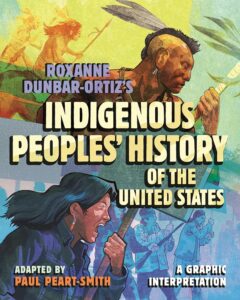
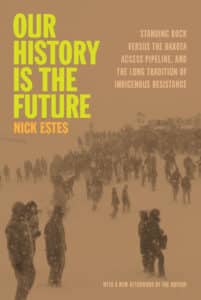
Films
|
|
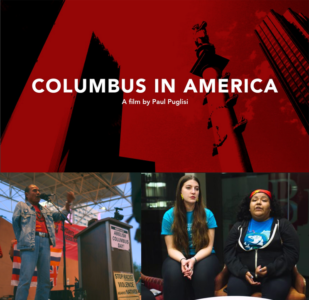
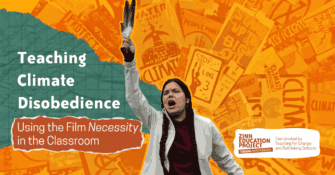
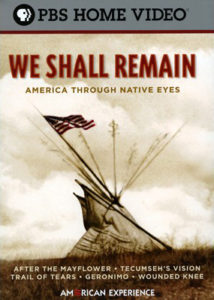
Columbus in America, by Paul Puglisi. 2017. 89 minutes. Documentary on the symbol of Columbus in the United States and the campaign for Indigenous Peoples’ Day. Alcatraz Is Not an Island, by James M. Fortier. 2001. 60 minutes. Documentary on a small group of Native American students and “Urban Indians” who occupied Alcatraz Island in November 1969, and how it forever changed the way Native Americans viewed themselves, their culture and their sovereign rights. First Light, by Upstander Project. 2015. 13 minutes. Story of forced removal of Native American children in Maine sent to boarding schools. NECESSITY: A Two-Part Documentary Series on Climate Resistance, directed by Jan Haaken and Samantha Praus. 58 minutes and 57 minutes. Oil, Water, and Climate Resistance explores the work of attorneys, valve turners, and other water protectors in Minnesota. Climate Justice and the Thin Green Line examines climate resistance in the Pacific Northwest. We Shall Remain: America Through Native Eyes, PBS. 2009. 450 minutes. Three hundred years of Native American history. |
Additional Resources
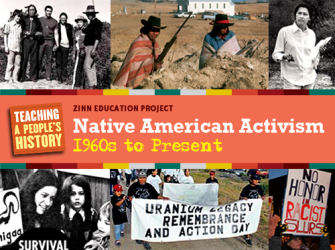 |
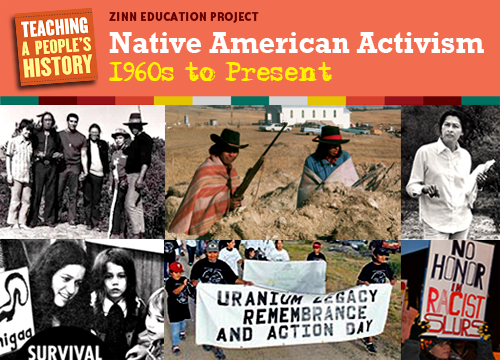
Instructor’s Guide and Discussion Questions (PDF) Chapter summaries, discussion questions, and primary documents for The Rediscovery of America: Native Peoples and the Unmaking of U.S. History. Native American Activism: 1960s to Present, an overview of Native American activism since the late 1960s, including protests at Mt. Rushmore, Alcatraz, Standing Rock, and more.
|
This Day In History
The dates below come from our This Day in People’s History collection, which contains hundreds of entries all searchable by date, state, theme, and keywords.

Participant Reflections
With more than 175 attendees, a poll of participants’ primary roles in education showed 23 percent teacher educators, 19 percent K–12 teachers, 14 percent historians, and more.
Here are more comments that participants shared in their end-of-session evaluation:
What was the most important thing (story, idea) you learned today?
The fact that the American Revolution was significantly influenced by settler colonial aspirations of expansion and Native erasure was fascinating and deeply affecting!
The overall reframing of the Revolution to incorporate “interior concerns” and the creation of whiteness to fill the need for a common identity. I will also emphasize the final grievance of the Declaration of Independence much more going forward!
Our breakout group discussed the intended erasure of Native people and how that was intentional. It’s important to talk about the history of Native people with our students and help them understand that they are still here and a part of U.S. history.
More authors and context for the erased and complex native history to learn and uplift in resistance to the whitewashed narrative of this country’s history.
I was very interested in Dr. Blackhawk’s analysis of Benjamin Franklin and his stance on being “against” mob violence and how many of these white leaders who are portrayed as benevolent were oppressing Native Americans during the American Revolution.
What was most interesting was learning more about indigenous resistance movements and also the concept of “racial formation” and the term “white people” coming up in the Revolutionary time period.
I think Ned Blackhawk speaking about how whiteness was defined during the era of the Revolution and helping us to better understand what our iconic founding documents say in relation to Native peoples is a very telling story and one that should be shared with our students.
The more I learn the more I realize how many lies and omissions and incomplete history I’ve learned. It feels like such a loss to us collectively and I feel reinvigorated to do more learning, and to do better in my own teaching.
The hidden history of Indigenous communities and their struggles and how they impacted the formation of this country.
It was affirming for me to listen to Dr. Blackhawk state very loudly and clearly that the American Revolutionary War cannot be taught outside of Native American/Indigenous history. It was a strong message from my elder in Native American/Indigenous Studies that I will think about for a long time to come.
What will you do with what you learned?
I will make more of an effort to continue to create a well-rounded course that doesn’t leave out the context, stories, and people of entire portions of this country. I will not lie by omission.
I am always trying to incorporate new information as I learn. These sessions help to spark my creative side to curriculum development after 24 years of teaching.
I was honestly amazed at the camaraderie. This was my first ZEP training. I’ll be bringing this info back to the class.
My first step will be looking much more closely at the final grievance of the Declaration of Independence with students. “Savages” must not be “men” and therefore must not be “created equal” and endowed with the same “inalienable rights.”
This analysis and the added sources will help me bridge the experiences of Indigenous people and my students, all of whom are immigrants. By teaching about the nascent U.S. republic’s self-definition as “white” in relation to Indigenous people, alongside the racist institution of slavery it was also established to protect, we can root the foundation of this country as a racist colonial project — the remnants of which we are still fighting in racist immigration policy and rhetoric.
It will help shape how I approach my teaching of sustainability and the role of Native Americans and their role since they have been here on this continent.
When I teach the Declaration of Independence, I will make sure to provide context and other voices. I also teach Tommy Orange’s There There, and passages from this will make a great supplement to that novel.
I am excited to provide students with tools to research and share out discoveries of the full Native story in this time period.
The information I learned today will help me to continue thinking about the roles that Indigenous people played throughout what we call American history. I am a school librarian in a PreK–6 school, and it is helpful for me to have a wide range of information to use in order to help my students gain more background knowledge for the history-related books that we read together.
We are incorporating this information and the Teaching for Black Lives studies into our classrooms. Moving forward, this will definitely be part of the instruction.
I’m looking forward to using this information to inform our programming for the 250th anniversary in Philadelphia and how we can expand who is represented in this history, and also expand the dialogue beyond patriotism and glorification to instead lift up Native American voices and art.
How was the format for the class?
Love the format. Breakout rooms are great.
Very well organized and facilitated.
The interview was great and I really felt the questions zeroed in on key information.
Presenters
Ned Blackhawk is a professor of history at Yale and was on the faculty from 1999 to 2009 at the University of Wisconsin, Madison. A graduate of McGill University, he holds graduate degrees in History from UCLA and the University of Washington and is the author of Violence over the Land: Indians and Empires in the Early American West and The Rediscovery of America: Native Peoples and the Unmaking of U.S. History.
In addition to serving in professional associations and on the editorial boards of American Quarterly and Ethnohistory, Professor Blackhawk has led the establishment of two fellowships, one for American Indian Students to attend the Western History Association’s annual conference, the other for doctoral students working on American Indian Studies dissertations at Yale named after Henry Roe Cloud (Winnebago, Class of 1910).
Jesse Hagopian is an editor for Rethinking Schools, co-editor of Teaching for Black Lives, editor of More Than a Score: The New Uprising Against High-Stakes Testing, author of Teach Truth: The Struggle for Antiracist Education, and the Teaching for Black Lives campaign director for the Zinn Education Project. He previously taught Ethnic Studies and was the co-adviser to the Black Student Union at Garfield High School in Seattle.



Twitter
Google plus
LinkedIn