

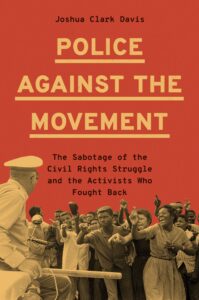
On November 10, historian Joshua Clark Davis spoke with educator Jessica A. Rucker about his new book Police Against the Movement: The Sabotage of the Civil Rights Struggle and the Activists Who Fought Back, an examination of the civil rights struggle through its work against police violence — challenging myths about the level of repression and resistance. This book offers a vital lens for any curriculum on the Civil Rights Movement.
Watch our previous Teach the Black Freedom Struggle online classes and register for upcoming classes here.
In the excerpt below, Davis discusses the wide scope of police violence against the Civil Rights Movement — and how activists fought back.
Participants shared what they learned and additional reflections on the session:
The most important thing I learned is how pervasive local police forces were involved in surveillance, disruption, and violence in the past, and how it points directly to the present time and local police violence today.
I think the overall idea of police as “against” the movement is the most valuable idea I came away from. I think people expect the police to be part of the movement itself, through their ideal role as protectors or supporters of the peace, but, like this presentation taught, it’s necessary to understand who the police really are, rather than who society has taught us to think of them as.
The most important idea I learned was how independent Black-owned bookstores and community spaces served as both educational and political hubs during the civil rights era. They were safe spaces that empowered people through access to ideas and collective action.
What stood out to me was how highly surveilled civil rights protests were and how the police acted toward Black children, like the Red Squads. In school, we never talked about this and only discussed MLK’s “I Have a Dream” speech when discussing the Civil Rights Movement.
The importance of exposing misinformation/disinformation and not allowing the police and other agents of the state to rewrite history.
Hurry up and read this book! I think there are a lot of ways I haven’t been thinking about the role of local police in the surveillance and I am looking forward to gaining new info.
Event Recording
Transcript
Click below for the full transcript with resources mentioned in the discussion.
Transcript
Jessica Rucker: Welcome everybody to our Teach the Black Freedom Struggle course with Joshua Clark Davis. My name is Jessica A. Rucker. I’m a Zinn Education Project Prentiss Charney Fellow and a doctoral student at the University of Maryland College Park, where I’m studying Black radicalisms.
I am happy to welcome scholar Joshua Clark Davis. He’s an associate professor of U.S. history at the University of Baltimore. In addition to Police Against the Movement, Davis authored From Head Shops to Whole Foods. Alright, Joshua, thank you so much for being here. I want to jump right in.
We often think of police violence as what we see in viral videos — body slams, shootings, chokeholds. But you push us to think about the violence that happens in the shadows, too. The kind we don’t see. Can you talk about what you call slow violence, and why it’s so important to expand our understanding of how state violence operates?
Joshua Davis: So, first of all, good evening everyone. This is a great turnout. I just want to commend every single educator and historian and student on this Zoom call. I’m really happy to be here in this just incredible webinar series. It’s just been having such great talks for several years now, and I commend all of you educators for taking the time. God knows you were very busy, and sometimes, in some states and districts, maybe not getting the credit, respect, or just freedom that you deserve as an educator. So I’m glad you’re here to learn and to listen, and just doing this. I know that you care a lot about your students and about education. So thank you.
Okay, so Police Against the Movement. The book that I tried to write was a retelling of the Civil Rights Movement through the movement’s work against police violence. It’s a big piece of the movement that has been left out of most histories of the movement. An interesting paradox is that police violence, the kind that Jessica was just referencing, hasn’t been left out of the narrative.
At least some of the most iconic moments of the Civil Rights Movement, sadly, are film footage of terrible police brutality against Black children in Birmingham, Alabama, for example, in 1963, [and] on the Edmund Pettus Bridge in Selma in 1965. Those are some of the most iconic moments of the movement, period.
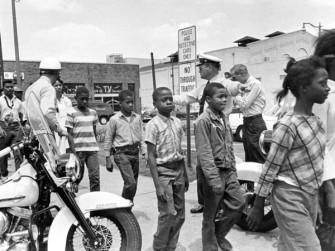 Police send a group of African American school children to jail in Birmingham, Ala. on May 4, 1963. Photo by Bill Hudson. Source: CRMVet |
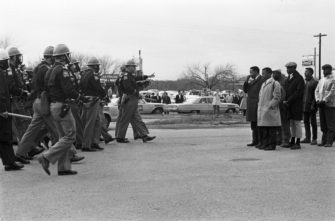 Spider Martin’s best known photograph, “Two Minute Warning,” shows marchers facing a line of state troopers in Selma moments before police beat the protesters on March 7, 1965. The day became known as Bloody Sunday. Source: High Museum of Art |
But they have become icons of nothing more than, I don’t want to say nothing more than suffering, but I think the message that is often portrayed is police violence: It happened to the Civil Rights Movement. They were non-violent. The narrative is this happened to civil rights activists. It was fast, it was furious, it was dehumanizing, it violated human rights. And the Civil Rights Movement didn’t really fight back, because that was the nonviolent movement. And that is antithetical to what I was writing about, in several ways.
One, this book is about the forgotten history of what the Civil Rights Movement did against police violence. And that’s in the early and mid-60s. That’s even before, for example, the Black Panther Party, who very famously stood up and confronted police violence. But to Jessica’s original question, key to this book is expanding our concept of violence beyond purely physical violence. That is not to say physical violence isn’t important, that it was devastating, that it hurt people, traumatized them, harmed them, and in some cases killed them.
But one of the main arguments of my book is what we could call slow violence. This is a concept that I didn’t invent. You can find it in other scholarly literature, but it’s the idea of different types of harm that are slow in their execution, slow in their effect, and often difficult to document. Maybe it is trumped up felony indictments that are intended to break a movement, to break a person, to break a family. Maybe it is years of surveillance, not only intended to gather information, but also to intimidate and to break the bonds of solidarity between activists. Maybe it’s infiltration, where undercover officers go into activist groups to try to disrupt and break up those groups. These are all forms of violence and what I would describe as slow violence.
It’s really kind of broadening our conception of the type of violence that was enacted against the Civil Rights Movement, but also, very importantly, one of the greatest myths that I’m disputing with this work is that all of this disruption was done by the FBI. That the sophisticated, sneaky well-thought-out and destructive work of espionage was carried out by Hoover and the FBI, and that police were left out of the really ugly, brutal acts of physical violence, and that’s why police got caught on camera and the FBI didn’t. Core to this argument of the book is that police departments all over the country, north, south, east, and west, were spying on the Civil Rights Movement, were bringing felony indictments against activists, and were infiltrating different groups. We have lulled ourselves into describing state repression against the Civil Rights Movement as a story of the FBI vs. activists. In some cases, sadly, the narrative that this is a story about Hoover vs. King, and that’s the story of the repression that Dr. King and his family endured, it is fascinating, it is horrific, and it is incredibly important that we document it and acknowledge it. But far too often we’re trying to get away from this idea of the great man history, and in the way in which we’re telling stories and histories of state repression. We’ve fallen back into that trap. So that’s my long answer. It wasn’t a slow answer, but it was hopefully responding to your question about slow violence.
Rucker: I want to stick with slow violence a little bit and transition to talk about your research methods, particularly local surveillance, because I think you do a great job at showing how local police were even more responsible for attacking the Black Freedom Struggle than the FBI. I found that absolutely striking, as did my comrade, Jesse Hogopian, in that records from local departments have often been harder to access than federal files. So, how did you conduct your research to uncover these stories, and what changes in our understanding of Black liberation movements when we fully grasp the role local police departments played in disrupting them?
Davis: Right, great question. I mean, again, this is a national story. We’ve been talking about this, us historians, for 20-plus years. Racism and discrimination were national, and so was the movement. And not just national, but, very strong in the North, very strong in the West.
By the same token, repression of the movement was very strong, for lack of a better term, in places like the North and West. A lot of this has to do with the fact that we don’t know exactly how many, but many, many, many police departments had secretive political intelligence units that were called Red Squads. They were initially created to track communists, often in the 1920s and 1930s. By the 1960s, they had really, really expanded to track and disrupt civil rights activists. And virtually every single police department in the country had one of these.
We have statistics from the late 1960s. These are not perfect, but the best estimates we have is that in the late 1960s, the FBI had roughly 3,000 agents, employees, dedicated to doing what we could call political intelligence. Political information gathering, espionage. Three thousand! Our best estimates of the local police departments, taken as a national whole, is that there were probably more like 4,700, close to 5,000, of those officers working in different police stations all over the country.
So, first of all, just the numbers are greater. Second of all, those undercover police detectives who belonged to these Red Squads, they lived and worked in their communities. I think by the mid to late 1960s, there were maybe about 50 FBI field offices across the country, and there were many, many more police departments that had these Red Squads. They were closer to the ground, they were more local, they got their hands dirty going to more protests and more rallies. The nitty-gritty of tracking movements is what these Red Squads are doing. So, these are at the center of my work.
I think a second part of your question was about the research part, like how did you do this and why has it been more difficult? Well, people complain about how hard it is to get FBI records, but truth be told, because of the Freedom of Information Act, yes it takes a lot of work, a lot of planning, a lot of time, a lot of persistence, but it still is less difficult than getting police department records. First of all, many police departments in the 1970s openly bragged that they were destroying thousands, hundreds of thousands, even in some cases 2 or 3 million police intelligence records. They bragged about it in LA, Tom Bradley did it in LA, bragged about it in New York, the NYPD bragged about destroying over a million. In Memphis, in places like Houston, many of these records were destroyed.
In addition, we have various state laws across the country that shield investigative records by police from public records requests. Sometimes even if the investigations aren’t even active, if it involved undercover work, they’re often shielded. If they’re not shielded, they’ve been destroyed. There’s only a handful of major archival collections of police intelligence records across the country.
But what I will say is, maybe ironically, FBI records are massive, and maybe it’s only 1 out of 100 pages on an activist that you get, where one of those pages is a memo from a police department that was copied by the FBI. I did a lot of searching through FBI records for which undercover police files did they copy? Which memos did they have? I went to some really big police department file collections. The best one is in New York. There’s one in Chicago, which is problematic because it’s basically protected by law from being discussed publicly in a lot of ways. I found some other great records and federal court records, but it was just a huge amount of work, going to a bunch of different cities to try to do this work, because there is nothing equivalent for local police departments like the federal Freedom of Information Act.
Rucker: I mean, this is stellar. It’s stellar, the time and effort you put in. And I’m saying this both as a nascent researcher, but as a former high school social studies teacher. As I was reading the book, particularly what you’re doing with pictures in the book, I found it absolutely compelling, and it reminded me of why it’s so important at the secondary level to teach using primary source documents, particularly photographs. But otherwise, like, you’re doing some really deep archival work.
Something I really want to stamp is that it’s important for us to understand the Red Squads and their centrality to the broader infrastructure of what you describe as political policing. I mean, this is central and not peripheral to the history of how the Black movement was targeted. That’s one of my hugest takeaways, in that police repression wasn’t just reactive, but it was a part of, again, what’s described as this continuous domestic counterinsurgency strategy. I was in class today and somebody was like, “Our movements, they move, and then they stall.” And I’m like, “No, they don’t move and stall. They’re sabotaged!” So it was amazing to have just such an incredible number of primary sources to refer folks to.
I want to change gears a little bit and talk about the March on Washington and state surveillance. Today, the March on Washington is largely celebrated, which I find very ironic considering it was not so celebrated at the time. It’s even celebrated by many conservatives as this kind of patriotic moment in United States history. But as you show in your book, the event was heavily surveilled, and not just by the FBI, but by local police departments from around the country. So, what does that level of surveillance tell us about how the state actually perceived the Civil Rights Movement at the time, and then how does that contrast with the way the March and the Civil Rights Movement in general have been canonized in our national memory?
Davis: Right, great question. The March on Washington is so important because even today, as Jessica just alluded to, it’s held up as this shining moment of a self-correcting democracy, for lack of a better term, and it was a shining moment of democracy. But I think the ways in which the right often have tried to utilize, even weaponize, Dr. King’s legacy, and especially by just obsessing over the “I Have a Dream” speech — and I’m not knocking it at all, it’s an incredible speech, but we all know the ways in which “I Have a Dream,” is like freezing Dr. King in time, as though that was his entire political career. It not only leaves things out, it distorts who he was, and it distorts the movement. But many people on the right do that because that’s probably one of the speeches that can be most easily manipulated to try to honestly support policies like colorblind opposition to affirmative action or opposition to DEI.
But I think I saw in New York for the first time when I was researching at their municipal archives in the Red Squad files, and these files are only publicly available because activists in the 1970s sued the hell out of the NYPD and ended up winning a 14-year-long court case. Part of it was to make some of those records that survived public, and they still weren’t public for another 40 years. But among other records, I came across an NYPD surveillance report where they were describing watching people, I believe it was at Penn Station, getting on trains to go to D.C. on the morning of August 28, 1963. It was very detailed descriptions of charter buses, chartered by different businesses and organizations that were sending folks to the March on Washington. So I thought to myself, I’d be really curious to find out any other police departments that did that. And I got a little lucky.
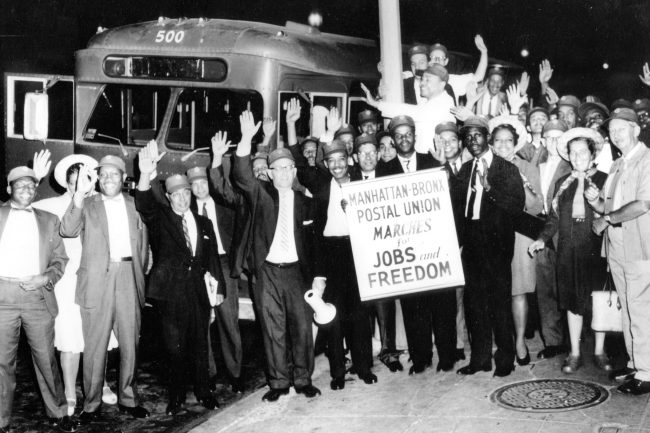
New York postal workers get on the bus for Washington. Source: New York Metro Area Postal Union Photographs Collection, Tamiment Library and Robert F. Wagner Labor Archives, NYU / Labor Notes
I mean, obviously, I was looking for it, but I found a memoir by a Philadelphia police officer, and this Philly cop talked about how one of his bosses just sent him down to the March in Washington and said, “Go there, take notes, let us know what happens. Come back and report to us.” And he was not a uniformed officer. I came across some photos in an archival collection at the Birmingham Public Library, and it showed that at least one Birmingham police officer went to the March on Washington and took secret photographs. I alluded to the Chicago files collection, which because of a federal court decision on these records, unfortunately, you’re not allowed to say who is in those records without getting a signed affidavit from that individual or the group.
For example, I think we’ll be hearing from Judy Richardson from the SNCC Legacy Project in a little bit, and in these records in Chicago, at the Chicago History Museum, I found like 15 records about the Chicago PD spying on the Student Nonviolent Coordinating Committee, SNCC. To follow this court settlement, I literally had to do something, and I’m glad that I had friends in high places at SLP, but it took a while to explain to Cortland Cox and to Judy Richardson, two veterans of the movement who are on the leadership of SNCC Legacy Project, “Hey, if I send you this paperwork, and you sign these affidavits, you get them notarized, and you send them back to me, then I send them to the Chicago History Museum, the Chicago History Museum can then follow the law laid out by this judicial decision, and now I’m allowed to say on this Zoom call that Chicago police spied on SNCC. I can also say, because this isn’t referring to a particular person or group, that the Chicago police spied on people headed from their train station to go to Washington for the March on Washington. There probably were others.
But again, that one day for me kind of crystallized this argument. As you said, it’s not just the FBI, and it’s not just in D.C. either. It’s like these police departments are spying on people in their own cities just for getting on a bus to go stand up for their rights on what’s supposedly the unimpeachable single greatest day in the Civil Rights Movement, and something that even people on the right hold up as, “Hey, wasn’t that just incredible?” But that doesn’t really reflect, as you said, how many local law enforcement treated that day, and treated the people attending the march that day.
Rucker: Yeah, this just makes me think of the song “It Always Feels like Somebody’s Watching Me” because it was true, and you’ve done a really great job documenting it. As you were sharing just now, I was thinking about the fact that the police, even the police archive, and just the great lengths you had to go to just to be able to present this truth to us.
Let’s talk a little bit about the notion of freedom now. Again, I mentioned earlier, photographs. The photograph of Walter Gadsden being attacked by police dogs in Birmingham became an iconic image that shocked the nation. Much like the video of George Floyd did in 2020. It seemed to galvanize public opinion in both moments. But there was a divide, right? Many liberals were outraged by the specific image, while more radical activists saw it as evidence of a deeper systemic problem.

Police dog attacking Walter Gadsden, a student at Parker High School, during a civil rights demonstration in downtown Birmingham, Alabama. Photograph by the Alabama Media Group. Source: Alabama Department of Archives and History
You write, and I quote, “The view that Birmingham police were less aberration than archetype resonated among radical civil rights organizers,” who by 1963 were rallying around the cry of “Freedom Now!” and demanding immediate racial justice. So I’m curious, how did that split between systemic critique and outrage over individual acts of brutality shape the Civil Rights Movement, and how do you see parallels in today’s movements in terms of how that tension is navigated? And then, depending on the amount of time we have, I might want to ask you about the role of pictures in the book, as well.
Davis: Okay, so I think there were three questions there. You said there was a question about pictures, there was a question about Freedom Now, and about this aberration versus archetype, I think.
Rucker: Exactly. And just this split between the critique of the system versus this outrage over individual acts, these bad actors, these bad apples, so to speak.

Bill Hudson’s image of Parker High School student Walter Gadsden being attacked by dogs was published in The New York Times on May 4, 1963. The threat of attack was so real that the high school students were trained to defend themselves. Source: Public domain
Davis: Right, exactly. So, to go to this really sad and powerful and important photograph of a young Black teenager from Birmingham, Alabama, Walter Gadsden. Probably most of you have seen it. It’s a police officer, Dick Middleton, who is carrying a German Shepherd, and the German Shepherd is lunging onto Walter Gadsden. That photograph appeared in newspapers around the world, on the front pages. It was, I believe, picked up by the Associated Press and all these major U.S. papers. Also international papers picked it up. There was television footage, too, of Black children being attacked. But in a way, I think it was this photograph that, as you said, was in some ways the George Floyd moment of the Civil Rights Movement.
I think people across the political spectrum, well, I shouldn’t say that. Not across the political spectrum, but liberals, even some people we might describe as centrists, and also people we would describe as leftists or radicals, there was outrage about that picture, about this TV footage, about how the Birmingham police were unapologetically attacking Black children with attack dogs, just pulverizing them with fire hoses, just beating these children. I think a lot of white liberals saw it, were outraged, and said, “My God, what’s happening in Birmingham? I can’t believe there’s a police department in the U.S. that would do that. This terrible man we’ve heard of, Bull Connor, who’s the Director of Public Safety, who’s leading that police department, if only we could get rid of him.” He was actually on his way out of office by that time, but there was a certain response from quite a few liberals, not all of them white, but many of them, that the Birmingham Police Department is just terrible. And it was. I mean, it was just incredibly brutal.
One thing that’s really been lost, and I think forgotten, is that many radical civil rights activists, particularly in SNCC, the Student Nonviolent Coordinating Committee, and also CORE, the Congress of Racial Equality, those two organizations really understood those photographs and those images differently. There’s a lot of stories about how the SCLC, they weren’t trying to put children in harm’s way, but I think the SCLC, the Southern Christian Leadership Conference, that’s Dr. King’s organization, they were very mindful about the power of the media to mobilize people. As terrible as those images were, they also, behind the scenes are said to have viewed them as a public relations victory, because some people were so dense in our country about what people were doing, white segregationists to stop the Civil Rights Movement, that it literally took a police department attacking Black children on national television to wake them up.
However, you had these radical activists from SNCC and CORE who said, “You know what, maybe Birmingham is more extreme, but this issue of police violence is an issue that is popping up in cities all over the country, and not just the South.” You had CORE organizers in New York, you had SNCC organizers in various parts of the country also — a group called Friends of SNCC, which was in a number of places. You had CORE organizers in particular who said, “Hey, it’s not just physical violence either. We might call it police malpractice. These are trumped-up felony indictments. These are illegal arrests. These are all kinds of things that police are doing to communities, especially, but not only Black communities. And hey, by the way, they’re really doing this to our movement.”
So the image, while some people saw it as, “Oh my god, Birmingham is terrible.,” if you move further to the left, more radical activists were saying, “This is the tip of the iceberg, and this is really reminding us we must make police violence a focal point of the movement.” And not everyone in the movement agreed about that, but if you look at the images from the March on Washington, for example, I think they only were allowed to carry a variety of maybe 10 or 12 or 15 pickets, but you couldn’t bring your own sign and you couldn’t handwrite signs at the March on Washington. They had an official approved list of signs. One of those signs denounces police violence.
What’s interesting is I have an image of a man in my book holding it at the march, but you’ll see a lot of pictures from the March on Washington where that sign doesn’t appear, and I think it really was a more radical wing of the movement that was pushing that cause. You know, Dr. King did denounce police violence quickly in his March on Washington speech, but it wasn’t a main part of it. John Lewis really condemned it. John Lewis’s speech is often notorious for being this moment of movement censorship, where he was told to turn it down. But the reality is that even in his quote-unquote toned-down speech he was breathing fire, and he denounced all kinds of acts of police violence in like 5 or 6 or 7 different sentences. If you listen to the footage, he brought the crowd to a standstill. I mean, there are standing ovations, loud cheers, where he has to stop again and again, where he denounces police violence. So, I answered the picture question.
Rucker: Oh Josh, my bad. I’m looking at the time, and I’ve bookmarked this literally in my book. There’s a picture on page 84, and then on page 115, but just because I want to bring up Judy [Richardson] to talk more about the role of primary sources. But one of the things that I’ll encourage folks to do if they don’t have the book yet — and if you do have the book hopefully you’ll go to this page with me — but on page 84 is one of Charles Moore’s photographs of a defiant Black teenager. So perhaps we’ll have a moment to come back to that particular picture. And then the image that you were describing with the signs is absolutely compelling.
But, we do have with us, as Josh mentioned, SNCC veteran and Eyes on the Prize, the whole 14-hour series, associate producer Judy Richardson. who can join us for about 2 or 3 minutes. She’s going to share some resources that teachers can access for free to explore more of the history that Josh is describing.
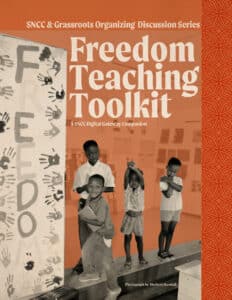 Judy Richardson: Yes, indeed. Okay, so first of all, I’m going to talk about these [SNCC Legacy Project] Toolkits. These are wonderful toolkits, all available as free downloads. They were produced as part of our SNCC and Grassroots Organizing Project. Initially, it was funded by the NEH until the crazy people took over and they eliminated the project. But, that project was a collaboration among our SNCC Legacy Project, Duke University’s John Hope Franklin Institute, and six Black History museums. For example, the National Museum on the Mall, aka the Blacksonian, the Memphis Civil Rights Museum, the Mississippi Civil Rights Museum, Birmingham, and six HBCUs — Howard, Morehouse, North Carolina Central, Claflin, Tougaloo, and Prairie View.
The toolkit themes highlight six areas of SNCC’s grassroots organizing tradition. You’ve got Arts & Culture; Freedom Teaching; Organizing Traditions; Voting Rights; Black Power; and Women & Gender. The booklets are based on the wealth of multimedia material that is available free on one of our main websites, which is SNCCdigital.org, which is hosted by Duke University.
And I’ve got to say, the wonderful Jessica Rucker was an invaluable member of our editorial committee. And also the very site that we’re on here, the Zinn Education Project provided this incredibly wonderful support, both technical and promotion-wise. So please go to the Teaching for Change website, because they have the best graphics on how to access these free, free, free downloads on each of these materials.
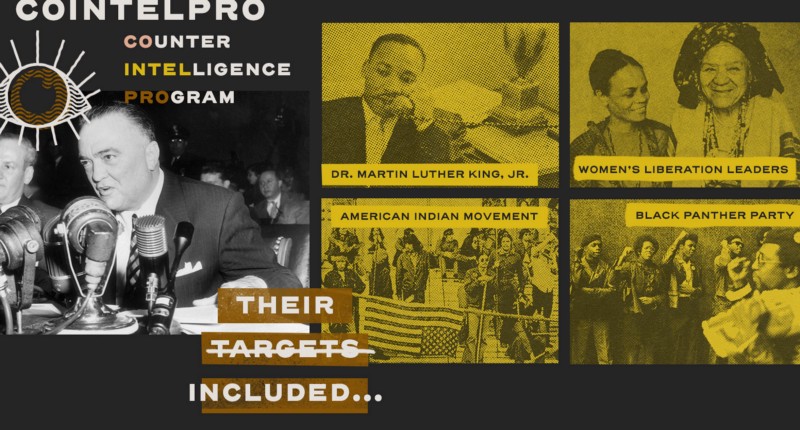
And then I was going to say something about Josh. I did two bookstore programs with him, and every time I listened to him I learned more. He has been so gender-rous in terms of sharing his research with us SNCC people. One of the reasons I have a number of things from my COINTELPRO files is because when he was researching his earlier book, From Head Shops to Whole Foods: The Rise and Fall of Activist Entrepreneurs, it includes our Drum & Spear bookstore here in D.C., which was started by SNCC people. I got all of these COINTELPRO files because, as part of his research for that book, he got all these files.
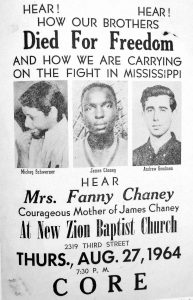
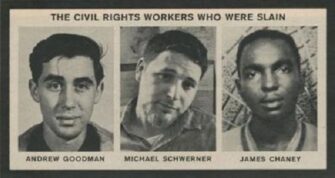
Missing persons poster created by the FBI in 1964, shows the photographs of Goodman, Chaney, and Schwerner.
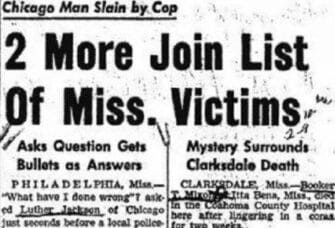
I will just say I lived [and] I documented this history, [and] I have still learned so much from this book. I will just say two things. There’s this one scene where you have Jim Forman, our executive secretary, in a story about how he is calling this press conference when the cops are trying to jack up the SNCC people. It was chilling when I’m looking at CORE’s work in New York City, and I see . . . when we were really reading typed note reports that had the names of CORE people who were arrested in this particular demo, and it included Mickey Schwerner, who, of course, is one of the three who were killed by sheriffs and others in Mississippi when we were there in 1964, and his wife, Rita. So you see, in this CORE thing, just weeks before he comes down to Mississippi, there’s Mickey Schwerner and Rita Schwerner. And Reverend Shuttlesworth’s resistance. Anyway, it’s a wonderful book. Buy the book!
Rucker: It is a wonderful book, and I think it speaks volumes that somebody who lived the history that we are all gathered together to study feels so strongly and passionately about it. So shoutouts to you, Josh. And thank you so much, Judy.
[breakout rooms]
Welcome back, everyone. I hope you had rich discussions.
Now I want to kick it back over to Josh. I want to talk a little bit about northern policing and the case of Ray Wood. The dominant narrative that tends to associate police repression of the Black Freedom Struggle with Jim Crow is to associate police repression with the Jim Crow South. But your book makes clear that northern cities like New York played a central role as well. And you referenced this a little bit earlier.
In New York City, BOSS, the NYPD’s Bureau of Special Services, played a major role in infiltrating and disrupting the Black Freedom Movement. One of the most emphasized examples is Ray Wood, whose work as a provocateur included orchestrating a bogus plot to bomb the Statue of Liberty. How do you think the use of Black undercover operatives and this kind of municipal-level repression shape both the strategies and the vulnerabilities of northern civil rights organizing?
Davis: Yeah, it’s a really important question. The NYPD is the largest police department in the country, and its Red Squad, its political intelligence unit, was actually older than the FBI itself, dating back to, I think, 1904. It had kind of waxed and waned at different times. The Communist Party in the United States was almost destroyed by the late 1950s. It was very, very small. And in a sense, I think that these political intelligence units were looking for a new reason to live. Yes, they had certainly targeted Black activists for a very long time, but I would say often with a particular emphasis on Black communists. Communists were the focus.

Bronx CORE chairman Herb Callender in 1964: Source: CORE NYC
It’s more complicated than that, but I think in the 1960s, what happened was the New York Police Department, for example, said, “Yeah, we’ve got this existing unit, but we’ve got to make it more aggressive. We’ve got to make it more disruptive. We especially want to target activists who are protesting the police.” They were looking at groups like the Congress of Racial Equality, CORE, which had a bunch of chapters in New York City. One of them was in the Bronx. There was a guy named Herb Callender who was leading a lot of protests against the police. In late 1963, early 1964, Judy, who referenced the surveillance report that I shared of Mickey Schwerner several months before he was killed, where a police officer goes to a rally that rallies against police violence, and the police officer takes down names of everyone he identifies. And two of them are Michael Schwerner and Rita Schwerner. Eight months later, Michael Schwerner is murdered, and it’s documented that at least one police officer assisted with that murder. Not an NYPD officer of course, an officer in Philadelphia, Mississippi. But the fact that Michael Schwerner experienced that slow violence of surveillance from police for protesting the police months before he experienced the fatal violence that was facilitated by a police officer.
This is a long story about Ray Wood, but I’m going to try to make it brief. Basically, the Bureau of Special Services said, “We want to infiltrate a few civil rights groups.” One of them was the Bronx chapter of the CORE. One of them was Malcolm X’s circle. Basically, in April 1964, the NYPD hired two unseasoned, unwitting Black officers who skipped even the police academy and sent them straight into the field and said, “We need you to go into these groups and pretend you’re an activist.” And Ray Wood did that for almost a year. He basically encouraged Herb Callender to do something very reckless, which was to try to perform a citizen’s arrest on the mayor of New York, Robert Wagner. Herb Callender got sent for about a week to the psychiatric board in Bellevue Hospital.
Then Ray Wood infiltrated another even more radical group called the Black Liberation Front, and he strongly encouraged them to basically blow up the Statue of Liberty. He got them gasoline, he got them an explosives manual, he even drove one of those activists with a car paid for by the NYPD across international borders to Montreal to try to get dynamite. Long story short, three men were arrested by the NYPD on the testimony of Ray Wood, and one of them was holding dynamite that Ray Wood had helped procure. Those three men were charged in federal court with trying to blow up the Statue of Liberty, and all three of them served several years in prison. Ray Wood was held up as a hero. He appeared on the front pages of newspapers all over the country, with his face shielded of course. He later testified to Congress, and things like that. On the same day that Ray Wood was hired, a guy named Gene Roberts was hired, who ended up infiltrating Malcolm X’s circle. He was an undercover officer for like 8 years, and he infiltrated the Panthers as well. That’s a whole other story.
Rucker: Wow. There’s so much to be said there, but I’m going to leave it there. There was a question in the chat that is related, while we’re talking about mass surveillance. This particular teacher includes a unit on COINTELPRO, or a section within a broader unit on COINTELPRO. What forms of surveillance were used, and was there technological surveillance used back then as well? And if so, what types of technology? And we know, yes, technology, but I guess maybe, perhaps, were they digital technologies, or . . . If you could define technologies broadly when you describe what was used, that might be helpful.
Davis: Great question, and let me just commend the teacher who said that for bringing COINTELPRO into your lessons. One thing I will say is that the COINTELPRO initiative against so-called Black extremists was launched in 1967, and the Red Squads that appear in my book were doing that type of disruption work and surveillance work years before COINTELPRO. So COINTELPRO is not the first time the FBI is doing that type of work. But it’s a big part of my book to say COINTELPRO is important, but it didn’t start with that, it was much bigger than that, and we need to know that local police were innovating, for lack of a better word, doing things just as extreme, if not more extreme and harmful than COINTELPRO, even before it. I think that’s something that this book offers for a unit on COINTELPRO.
But technologies, great question. I mean, there are things like phone taps, there is long lens photography, [and] I think in some cases very likely, hidden cameras. I think there’s audio field recordings. There’s an interesting documentary from 1969 called Red Squad, [where] two New York leftist filmmakers catch, I believe, the NYPD and maybe the Chicago PD, both of them at different rallies, using soundtrucks. Kind of the stuff that you think of to catch drug dealers. A lot of undercover work against “drug dealers” was really inspired by a lot of this political work. But Reverend Fred Shuttlesworth from Birmingham, Alabama, some of the folks around him, they caught the Birmingham police using things like soundtrucks against them in like 1959, 1960. Fred Shuttlesworth pursued the Birmingham Police Department in 1960 and put Bull Connor on the stand. [He was] doing his own legal work, pro se. He didn’t win, but he cross-examined the most unapologetic segregationist police chief in the country on the federal stand in 1960. That was one of many things that just was extremely eye-opening, finding that court testimony and seeing how it went.
Rucker: And then you caught him looking dapper. That’s, again, going back to the photographs in this book. If I were still a high school teacher, I would absolutely have to pull in some of these pictures. So, Josh, we just have a few minutes left. I do want to ask you [about] the image that makes it to the cover of the book. If you could just share briefly about why it was important to not just include the image in the book, but how and why this image made the front.
Then I want to ask another question, as time and circumstance permits, about teaching resistance and historical memory. But I think the way you describe this particular scene, it’s so important.
Davis: Before I forget, I just want to say thanks again to the Zinn Education Project. I really want to thank Judy for coming and saying really nice things, and for just doing these great book talks with me that we did. I want to also just say that books cost money. They’re expensive. This one is fairly affordably priced, but I think one thing you can do to help spread the book is to request that your local library purchase it. I think that the role of helping libraries have a rationale for getting these types of works is very much appreciated. Every public library has a web form where you can say, “Would you buy this book?”
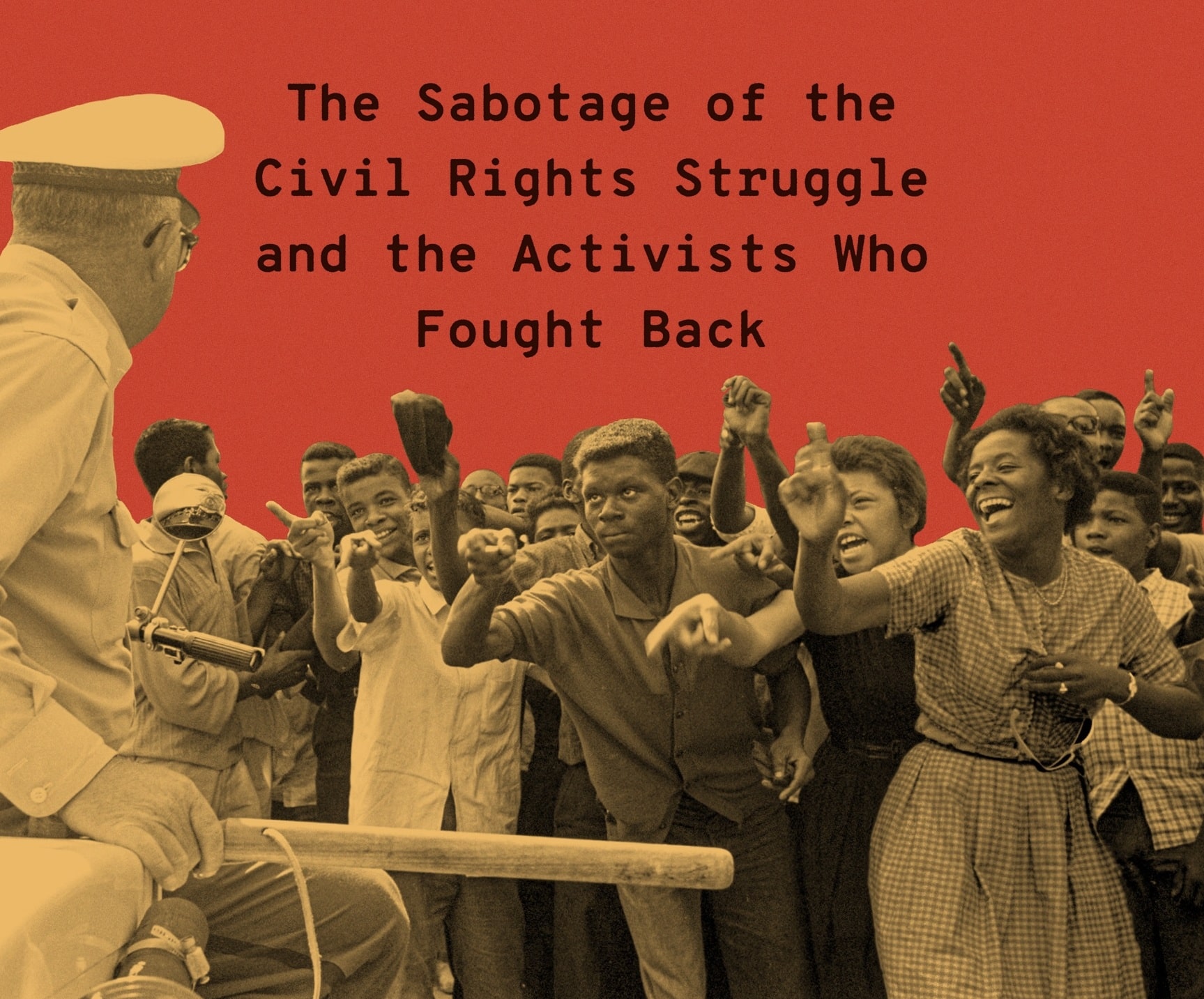
But to the question, the front cover of the book is . . . Okay, so the picture of Walter Gadsden being attacked by the Birmingham police was held up as this image of nonviolent suffering. Even though, if you look carefully at the picture, Walter Gadsden is kneeing the dog under his chin. Walter Gadsden knows how to handle dogs, he is defending himself, and his hand is gripping the arm of the police officer. And most people didn’t even catch that. I believe the date is May 8, 1963, the very same day as the picture that appears on the cover of my book. It’s a picture of a group of Black teenagers and young adults surrounding a white officer. Here, I’ll just pull it off the shelf. It’s taken the very same day as the picture of Walter Gadsden. The picture of Walter Gadsden appeared on the front page of newspapers all over the world.
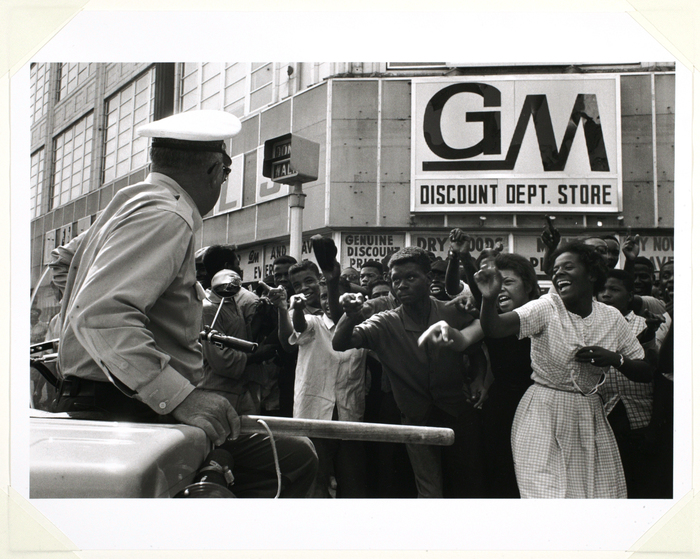
Protesters taunting police officer during civil rights demonstration in Birmingham, Alabama, 1963. Photograph by Charles Moore
This picture was taken by a photographer named Charles Moore, same city, same day. It is a very different image of Black Birminghamians, teenagers, young adults, who are confronting police violence. They are pointing at him, they are laughing at him. We’ll never know exactly what they were thinking, but to me, this image says, “We are on to you. We are not afraid.” I think you can see the officer is uneasy. They’re pointing at him, and they said, “We’re not going to take this.” The picture by Charles Moore appeared in the lower corner of a page of Life magazine. Life magazine was one of the most popular magazines in America, but it was at the end of a picture portfolio. And the caption says something like, “Youth jeering at police officer threatening to start a riot.” I can’t remember the exact terminology, but it was basically extremely dismissive and saying they are crossing a line. But to me, this was, again, one of the core narratives of this book, which is that the Civil Rights Movement did not just endure police violence, it resisted it also. It’s not just suffering police violence, it is pushing back against it, picketing it, sit-ins in police stations, going to police chiefs’ homes and saying “This is wrong,” [and] sit-ins on the roads. And we’ve just kind of left this issue out of our larger story about the Civil Rights Movement. Most people have, at least.
Rucker: Powerful. And this is a great place for me to pose my last question, although I just saw one in the chat. Your book very powerfully documents the scale of police repression, but it also documents and amplifies the courage and the strategies of those who resisted it. From SNCC organizers to student activists to community defenders, we see people who refused to back down, and that particular image will forever be on my mind, because I’ve never seen it prior to reading your book. Which I think speaks volumes. So, what do you think teachers and students most need to understand about this legacy of resistance, and how can educators responsibly teach the history of political policing in a way that empowers rather than paralyzes?
Davis: That is a great question. I think empowering instead of paralyzing is important, not to create this image of the all-powerful police apparatus that just spies on activists with impunity. I think one of the big messages is that activists did fight back, and that it took a lot of work and a lot of research. For example, there are activists across the country who sued the NYPD, who sued the Memphis police, who sued the Houston police, who sued the Detroit police, and said, “We saw you at this protest spying on us, and we believe that what you’re doing violates our First Amendment rights to free speech, to public assembly. We believe that it might be violating our Fourth Amendment rights against unreasonable search and seizure.” To me, one of the big pieces that I learned a lot was the effort to make these records public, and this act of research as a tool of political organizing. So that’s one important lesson.
I think another important lesson is just that the Civil Rights Movement people fought back against police violence. I think even today we’ve made such great advances in understanding the Black Panther Party, and just how brilliant so much of their work was. And yet we’ve really shortchanged, given short shrift, to the fact that [during] the Civil Rights Movement, some people were doing some of those things even before the Panthers existed. For example, you had SNCC organizers in Seattle, CORE organizers in Seattle, [and] some SNCC folks in LA who were following the police in cars, watching them, observing them. This is what people are doing today with ICE.
It is citizen documentary work, it is citizen research, it is taking the time to record something and to say, “We don’t care if you are going to hide your face, if you’re going to snatch people away from their families and from schools. We are citizens. We are paying for this. We have a right to know. We have a right to watch, and we have a right to record.” In some school systems that may not play as a popular message, but there’s many ways to safely, legally record what representatives of the state are doing. When we see one of these terrible videos of someone being taken by ICE, we need to think about the person behind the phone, behind the camera. It was the same thing with the young woman [Darnella Frazier] who got targeted for recording when the Minneapolis police killed George Floyd.
So we should be thinking about those researchers, those documentary makers, in a sense, and think about the work they’re doing. I don’t recommend it to everyone, but there are people who are ready to do that work, and I think the seeds of that work are in this book. People who were doing that in the 1960s.
Rucker: Incredible, Josh. Thank you. Thank you so much.
While this transcript was edited, there may be minor errors or typos — if you notice something you believe to be incorrect, please contact us at [email protected].
Audio
Listen to the recording of the session on these additional platforms.


Resources
Here are many of the lessons, books, and other resources recommended by the presenters and participants:
Lessons
|
|
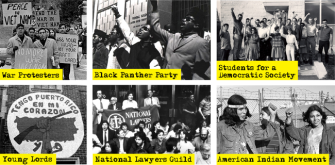
COINTELPRO: Teaching the FBI’s War on the Black Freedom Movement by Ursula Wolfe-Rocca “Riots,” Racism, and the Police: Students Explore a Century of Police Conduct and Racial Violence by Ursula Wolfe-Rocca Teaching SNCC: The Organization at the Heart of the Civil Rights Revolution by Adam Sanchez Teaching A People’s History of the March on Washington by Jessica Lovaas and Adam Sanchez What We Don’t Learn About the Black Panther Party — but Should by Adam Sanchez and Jesse Hagopian ‘What We Want, What We Believe’: Teaching with the Black Panthers’ 10-Point Program by Wayne Au |

Books
Articles and Interviews
|
|
What Happened to the Civil Rights Movement After 1965? Don’t Ask Your Textbook by Adam Sanchez (If We Knew Our History series) Why We Should Teach About the FBI’s War on the Civil Rights Movement by Ursula Wolfe-Rocca (If We Knew Our History series) The Condemnation of Blackness: Lies We’re Told About Crime with Khalil Gibran Muhammad |
Additional Resources
|
|
Zinn Education Project resource collections on:
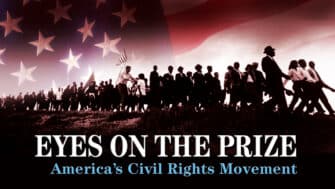
The Roots of the 2020 Rebellion A People’s History of the March on Washington SNCC Digital Gateway and SNCC Legacy Project (and SNCC Legacy Project Toolkits) Eyes on the Prize documentary, produced by Henry Hampton, with Judy Richardson as associate producer |
This Day In History
The dates below come from our This Day in People’s History collection, which contains hundreds of entries all searchable by date, state, theme, and keywords.
Participant Reflections
With more than 140 attendees, a poll of participants’ primary roles in education showed 33 percent K–12 teachers, 16 percent teacher educators, 11 percent K–12 students, and more.
Here are more comments that participants shared in their end-of-session evaluation:
What was the most important thing (story, idea) you learned today?
I have never heard of the term “slow violence,” which intrigues me. We talked about this a lot in our breakout room. It is very identifiable in our world today and connects directly to what has happened in the past.
How the police had an active role in interfering with the Civil Rights Act and that it wasn’t just the FBI.
The repeating pattern of surveillance throughout our nation’s history strikes me hard. Surveillance has been a daily practice of police and business my whole life, and it has also been a practice since before the beginnings.
Ray Wood’s work in trying to stop the Black Freedom Movement.
I am thinking about the parallels to what is happening today and how I can learn from the lessons of the past to resist today.
The strategies of police repression used are similar to those they use today. They have no shame in hiding and lying to society.
I really appreciated Judy Richardson noting that police adopted and adapted tactics from one another, refining their tactics in repressing movement work. I also really appreciated the way Professor Davis reminded us that today we might use our own tools (videotaping, filing open records requests, targeted protests of local agents) in the service of justice. The story of Ray Wood, who attempted to get activists to blow up the Statue of Liberty, is astounding.
What will you do with what you learned?
I want to highlight resistance whenever I can so that students feel empowered and realize they have agency.
I’m really interested in exploring the connection between former police infiltration and disruption during the Civil Rights Movement with what is happening today. There is a big connection today with police forces being trained by Israel and Israel teaching our police forces tactics of brutality they use against Palestinians. These are not just U.S. issues, but world and systemic issues.
I will continue to add more stories that are often overlooked from history. This session offered more opportunities to focus on the resistance to oppression.
One compelling thing I will use in my classroom is John Lewis’s speech during the March on Washington. I always teach King’s speech and show excerpts from Brother Outsider about Bayard Rustin’s role in organizing the march. However, I think John Lewis will resonate with my high school students because he was so young when he became a civil rights activist.
I will sit with all this amazing history, the ability to sit with the idea of surveillance, and how important it is to uncover these historical documents, and look at how many people were being spied on for standing up for their rights. The idea of policing the archives and how to uncover the truth will impact me to always value being curious and uncovering the truth, looking at many perspectives.
I teach about policing and will incorporate this book into my lesson and discussion with students.
I will look up the resources on the SNCC Legacy Project and the Zinn Education Project to enhance my mass surveillance unit in my 10th grade English class.
I am going to use the many primary source pictures to help my students understand that they learn a very sanitized version of the Civil Rights Movement, which causes them to think it was just smooth sailing to get to the Civil Rights Act.
After hearing from Joshua Clark Davis, I want to continue exploring how grassroots activism and community organizing can create lasting change. His discussion reminded me that history isn’t just about famous figures; it’s built by everyday people challenging systems. I plan to apply this by focusing more on local activism and connecting what I learn in class to real-world movements.
I am considering how I can add this surveillance to my lessons. I think there is a lesson to be had that shows this tactic used against people in the Civil Rights Movement and American Indian Movement. I am also considering reaching out to my local historical society and professors to see if there is any local history to be used with this topic as well.
How was the format for the class?
I love the format, and it is one of the major reasons I return to sessions. I love being able to talk and connect with others on the topics that are presented.
Loving the breakout groups more and more each time.
The format is always great.
I appreciate the format, and so much information in such a short amount of time. I love the interview format and the time to reflect in a smaller group.
I really liked the breakout rooms because they allowed us to discuss what we learned.
The presentation was engaging and well-paced. I especially liked the combination of visuals and real historical examples.
As always, I appreciate the chance to actively process my thinking with other educators.
Presenters
Joshua Clark Davis is an associate professor of U.S. history at the University of Baltimore. In addition to Police Against the Movement, Davis authored From Head Shops to Whole Foods, examines organic food stores, feminist enterprises, Black bookstores and other businesses that emerged from movements of the 1960s and 1970s. His research has earned awards from the Fulbright Program, the Silvers Foundation, and the NEH Public Scholars Program, and he has written for The Atlantic, The Nation, Slate, Jacobin, and The Washington Post.
Jessica A. Rucker is a doctoral student in the Department of American Studies at the University of Maryland, College Park, and a Prentiss Charney Fellow. Prior to her graduate work, she was a high school teacher in Washington, D.C.


Twitter
Google plus
LinkedIn