
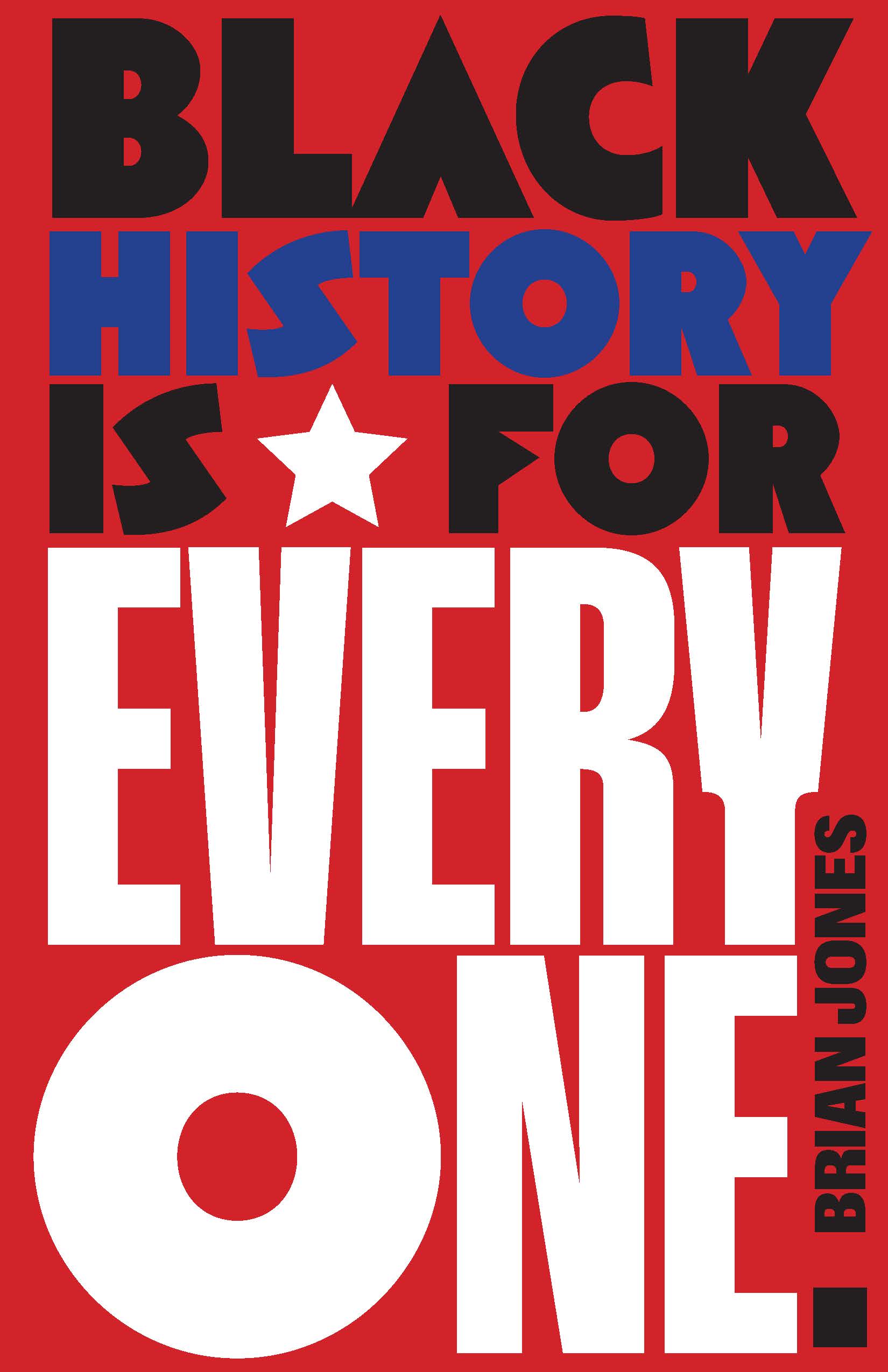
Amid widespread political censorship and attacks, Black History Is for Everyone pulses with love, insight, and possibility. Brian Jones shares how Black history has challenged and energized his own thinking, inviting each of us to reflect on what we learn, why we learn it, and how it shapes our understanding of the nation and our place in the world. From Bacon’s Rebellion to the Haitian Revolution, this book reveals how those who came before us resisted oppression — and reminds us that study and struggle have always gone hand in hand. — Ruha Benjamin, author of Imagination: A Manifesto
On January 26, educator Brian Jones spoke with Rethinking Schools editor Jesse Hagopian about his latest book, Black History Is for Everyone, a look at how the study of Black history challenges our understanding of race, nation, and the stories we tell about who we are. (Watch our previous Teach the Black Freedom Struggle online classes and register for upcoming classes here.)
In the excerpt below, Jones discusses voices in the long Black Freedom Struggle who embraced a form of patriotism, others who rejected the framework of nationalism and championed international solidarity — and why it’s crucial to study these different perspectives in the classroom.
Participants shared what they learned and additional reflections on the session:
I appreciated when Brian Jones confronted the question, “Is Black history American history?” because it made me reflect on the work I do with my students as a culturally responsive U.S. history teacher whose entire student body identifies as either Black or Latinx. It made me reflect on ways that my resources and conversations can allow for more flexibility when it comes to racial identity formation and my students seeing themselves as either part of, or antithetical to, the Corporation of the United States of America.
It is important to wrestle with — and honestly teach our students about — the tension in Black social movements between unsettling or working within the state to advance the fight for Black freedom.
People have actively tried to erase Black Freedom Struggles, like Bacon’s Rebellion and the Haitian Revolution.
Event Recording
Transcript
Click below for the full transcript with resources mentioned in the discussion.
Transcript
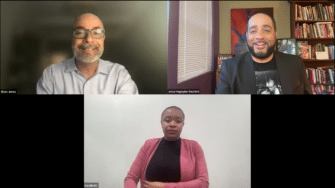
Jesse Hagopian (he/him): Today’s class is hosted by the Zinn Education Project, which is coordinated by Rethinking Schools and Teaching for Change. . . . Thank you all so much for being with us this evening. I’m so glad you’re with us. You chose the right session to come to. I’m very happy to welcome educator and my dear friend, Brian Jones. He was an elementary school teacher for 9 years, the inaugural director at the Center for Educators and Schools of the New York Public Library, and associate director of education at the Schomburg Center for Research in Black Culture. He’s the author of two great books, The Tuskegee Student Uprising: A History, and today’s discussion centers around his latest book, Black History Is for Everyone.
I also just have to say that anytime I got into some good trouble around the fight for education, Brian always had my back. There is no national mobilization for the MAP test boycott or Black Lives Matter at School without the hard work that Brian put in to help us spread the movement. So thank you so much, Brian, for being here with us this evening.
Brian Jones: Wow, thanks for that generous introduction. Thanks for having me. It’s an honor, really, to be a part of this community. I mean, when you look at the lineup of these classes and the speakers, I’m thrilled to be here. There’s so much knowledge in the room. I’m really excited for this conversation.
Hagopian: No doubt. Thanks for being here. I love your new book, you know that, and I’m just glad to get another opportunity to ask you some more questions about it, learn more, and share those with this community. I wanted to start with the moment that we’re in. We’re in a moment where books are being banned, [and] Black history courses are being canceled. They just tore down the exhibit on slavery at President George Washington’s house in Philadelphia. The Trump administration is just seeking to erase Black history from museums [and] public websites, so your book feels especially urgent right now. So I wanted to just start with asking you, why did you title the book Black History Is for Everyone and why did you choose to organize it around the major themes of race, nation, revolution, and education.
Jones: Thank you for that question, or series of questions. Let me try to dive into that. I thought that this title, Black History Is for Everyone, in some ways that’s the title of the meeting that I wanted to have. Everywhere I go speak they say, “Well, what’s the title of the meeting?” I say, “It’s just the title of the book. That’s the meeting we need to have. Black History Is for Everyone is the starting point. This history is something that we all should be grappling with.” So I thought that that was almost like a slogan that people could grab onto, and I pictured, if you’re a librarian, or you’re working in a school, you’re a guidance counselor or you’re a parent, and people are trying to ban something, ban Black history, and you want to rally people together and talk about this book, that by putting this title out there, you’re sending a signal that actually this is something that’s for all of us to grapple with, and it’s a way to stand for learning and knowledge.
But then to your second part of the question, why those chapters — race, nation, revolution, [and] education? Well, you could write this book a million different ways, and so this is [one] of the things that sticks in my head about it all, which tends to be Black social movement history. And that’s why it makes sense for me to be here, I think, in this series, which is about Black social movement history.
Starting with race, one of the lies they’re telling about Black history is that what we’re out here doing is putting kids in little identity boxes, and we’re trying to say that Black people are good and white people are bad, and all this reductive stuff that is not what we’re doing. But I thought, as they’re attacking Black history, as they’re attacking diversity, equity, inclusion, as they’re trying to tear down everything we’ve been building, what is the strongest basis for us to go forward? What do we actually think about all these things, about the U.S. as a nation, about the question of race (like are there races of people), about blackness? What do we think about all these things? And I think we’re on the strongest possible footing when we approach those questions historically. So when they come for us and try to say, “Oh, no, you’re teaching this. Oh no, you’re teaching that,” we can say, “No, no, no, actually what we’re doing is trying to examine what has happened here and the way that these things played out over time.”
And one of the things that’s maybe the most surprising. I know we have a lot of bad faith gaslighting attacks on us, but I think that people don’t really know. One of the things that’s most surprising is that actually a lot of the scholarship in Black history is showing how race was made. It’s showing how they create the categories, how they keep recreating them and constructing them, and reconstructing them. And most people probably don’t know that. They think there’s something else that we’re doing here that’s about freezing people in their identities. Actually, what we’re showing is how identities are constructed, how complicated they are, how negotiated they are. And I think it’s really revealing that Black history is under attack. It’s revealing, first of all, how powerful it is. Anyway, let me stop. There’s so much more to say about this.
Hagopian: It is definitely revealing. The attack on Black history and Critical Race Theory just proved so many of our scholars correct about the nature of white supremacy in this country. But I wanted to jump into some of the main arguments, and in Black History Is for Everyone you caution against limiting Black history just to stories that fit neatly into this kind of proud contributions to national greatness, as you put it. And especially this year, in the 250th anniversary of America, there is going to be endless praise of the founding of America, and many efforts will be made to fit the Black story neatly into contributing to that national greatness.
But you pose this provocative question in the book. You say, quote, “The enemies of Black history like to claim that it’s anti-American. But is Black history necessarily American? Does the study of Black history tend to be pro or anti the United States in some meaningful sense?” And I just wanted to ask you, how would you answer those questions today? Is the project of Black liberation primarily about making the United States live up to its ideals, or does it really reject the framework of nationalism altogether and embrace international solidarity?
Jones: That’s a deep question, and it’s one that, as you say, I’m wrestling with in the book. What’s interesting to me, and I think helpful for us today, is to recognize that a lot of leading lights in Black social movement history have answered that question in different ways. Some of them, many of them, arguably most of them, do frame their appeals, their logics, their arguments in terms of the nation’s official frameworks, the Declaration of Independence and the U.S. Constitution, as they say over and over again, just be true to what you put on paper. King says this, Fannie Lou Hamer says this, we could go on and on. Frederick Douglass. Some of them think of themselves as patriots, as people who are loyal to the United States and trying to help it live up to those ideals.
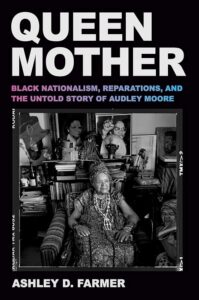
But when we’re under attack for teaching anti-American ideas, like that slavery happened and things like that, one of the ways we defend ourselves is by saying, “No, no, no. Black history is American history.” I’ve done this myself in conversation, just to try to protect Black history and try to build a bridge with somebody, or make space for it. So it’s an understandable impulse. But the problem is that there’s so many other people who, like you say, don’t fit that category, whose project is not national reform. Malcolm X is not trying to help the United States live up to its stated ideals. That’s not his project. There’s a wonderful new biography about Queen Mother Audley Moore, who has this incredible activist journey. It’s by the brilliant historian Ashley Farmer. It’s about her incredible journey from the Garvey Movement, the Communist Party, she becomes a Pan-Africanist, she’s one of the leading advocates for Reparations. She’s not trying to make the United States live up to its ideals. That’s not her project. Her project is global. So what do we do with figures like that?
As a defensive stance to defend Black history, if we accept patriotism and loyalty to the American project as a thematic starting point, then first of all, either we’re not going to teach those people or we’re going to teach them as villains, and we can’t take them seriously on their own terms. I just think there’s such a clear pattern all over Black history of people reaching beyond the borders of the nation — for thinking about solidarity, for political ideas and inspiration, for thinking about what our future holds. While I am somebody whose sympathies are much more with the internationalist camp, I totally understand people — and by the way, more strength and power to the lawyers going into court right now as we sit here, who are trying to keep people safe, using all of the official frameworks of the U.S. Constitution to do so. But ultimately, as a species, can we figure this out and survive as a species within this framework of competitive nation states? I’m skeptical.
Just as race is something pretty new in human history, so are nations. So, I think if there’s going to be any place where we’re allowed to just ask the question about nations, and not have to assume their automaticness and their goodness in advance, it ought to be the classroom. Nations ought to be an object of study, something we step back from and look at critically. And I think we can also have curiosity about the American Revolution. Another amazing event. A lot of people tried to get their freedom through the American Revolution, who ultimately didn’t. Certainly a very contradictory revolution, but to start from a place of chest-thumping. It’s just like, well, here we are, again with superiority, and national superiority certainly feels like a close cousin of racial superiority. Both of them are poisonous to real learning. For real learning, you have to have humility. You have to be willing to admit that maybe you’re just a human, like others.
Hagopian: Yeah. This has been such an important framework for me, Brian, to have this outlook. Because, Malcolm X said, “I’m not an American. I’m one of 22 million victims of Americanism.” And we have to be able to teach that. And of course, we’re going to teach the many people in the Black Freedom Struggle who wanted America to live up to its ideals. But I love the way you frame that, that we have to make space for the internationalists who wanted to get rid of nation-states because they saw them as a barrier to achieving Black liberation and human freedom. And not limit our horizons with what capitalist nation-states have declared is the thing that you should be obedient and loyal to.
That is, I think, a profound insight in your book that can help educators think about how to organize the discussion of the Black Freedom Struggle. I think a really important point you drive home is the social construction of race. You write that Bacon’s Rebellion should be taught alongside the American Revolution and the Civil War as a crucial turning point in this country’s history. So, I was hoping you could explain what Bacon’s Rebellion was, how the backlash to it helped create this modern concept of race, and why that racial framework has lasted from the mid-1600s all the way to our own time.
Jones: We just celebrated Dr. King’s birthday, so I was going back through his writing and speeches, and he has this line of saying, I’m going to paraphrase it, that “racism is a tenacious evil, but it is not immutable.” I think that couplet is a really helpful way for thinking about racism. It is tenacious, it hangs on and it changes form, it’s still with us, and we try to fight it and kill it, and it rears itself again and again. But it’s also not unchanging and/or unchangeable, or something that is just with us for eternity. In his last book, Where Do We Go From Here?, he puts his finger on the same thing that a lot of the scholars I’m citing in this book put their finger on. People like Edmund Morgan, or Barbara and Karen Fields, which is in Virginia. The very first cell of the organism that is going to become the United States is this colony.
If Nicole Hannah-Jones has directed our attention to this year, 1619, then let’s look at what happens in the years that follow. What’s so interesting, and I’ve been teaching this for years in different ages and grades, and usually what I do is I’m using the timeline. You can Google this and find the colonial laws — I think they’re often called the slave laws or slave codes of colonial Virginia — and there’s certain key ones that developed throughout the 1600s, and it’s just really revealing. Because you only write down a law for something that people are doing. You don’t write down a law about stuff people are not doing.
First, let me just back up. Bacon’s Rebellion. Colonial Virginia almost fails multiple times, but one time it almost fails, it almost ends because of an uprising. It’s an uprising that we would, in our modern-day language, describe as multiracial. It wasn’t very progressive necessarily, but it did involve a man named Nathaniel Bacon whipping up anger. His own policy was to try to be more aggressive towards the Indigenous people, but he, in the course of doing so, got this populist movement going of any promised freedom to indentures servants, then called Christians, most of them from Europe, from Britain, and two Africans. They joined together and they sacked Jamestown. They burned it to the ground, together. Now, after that, since that’s 1676, it took months for them to put this down. They had to bring troops over from England. But once the dust settles and they’ve restored order, they look around and are like, “Never again. We can never allow these people to make common cause.” These Africans on one side, and these, what we then call Christians, on the other side, the people from England. To keep them away from each other, they have to politicize Black skin in a systematic way, so they start passing laws about who’s allowed to own weapons, [and] who’s allowed to hold public office. These all just follow, one after the other. If a Christian and an African get married, they’re banished from the colony.
Again, these are all activities that people are obviously doing. They’re trying to hold public office. Africans and Christians are getting married. I usually ask students, if we notice this year, 1619, when the first Africans are kidnapped and brought to this first British colony, we know Africans came to North America sooner, but to the first British colony. What year would you suppose? How long do you think it would take the Virginia legislature to pass a law that those Africans cannot vote? Usually the kids are like, “1620,” 1621.” But if they’ve been paying attention to the development of the laws and all the things that came after 1676, even if they’re paying attention, they’re usually surprised to learn that it doesn’t happen until 1723. First of all, they pass a law. That means they have to take this right away. That means people are exercising this right. And so we know that it wasn’t easy to become a landowner, or to rise to the status where you would be able to hold public office, or vote, or do these things. But some Africans did.
One of the most surprising things to me, I mean I’ve been teaching this for years, but I didn’t know that my own family had a connection to this story. Working on this book I realized that tracing my family back on both sides, my mom and my dad’s side, and realizing that some of my ancestors were among the people who fled the Virginia colony and tried to settle in places like North Carolina because they were trying to carve out spaces where free people of color could live when the increasingly racialized regime of colonial Virginia was hardening and making life impossible for them. So, I take from that history that this is not something that emerged overnight; this was something that was built brick by brick, that it had to be built, that it was built for a specific purpose, to restore the profitability of the Virginia colony at a time when solidarity was threatening, in a certain kind of form, to burn it to the ground. And that, therefore, this weapon of assigning blame and a lower status to people of Black skin has been a project, obviously, and the rise of white supremacy has been a project that’s deeply connected to the history of this country, and a project that’s been about trying to thwart solidarity from the beginning.
Hagopian: I love how in the book you explain how racism and white supremacy are a project. It’s not a natural occurrence; it’s something that took many years to develop. And developed in response to specific historical events, like Bacon’s Rebellion. That history is so crucial for understanding the racism we see today with ICE agents shooting people down in the streets, with disproportionate discipline in our schools and everything else. The kids I’ve seen, when you teach them about Bacon’s Rebellion and how race was developed out of that, it unlocks their world around them today in a way that is just not possible without understanding that history. So, I love the way you break it down so, so clearly. And I hope teachers will go to the book and use it as a source to help teach that history. We have a lesson also at the Zinn Education Project to help teachers with that history, too.
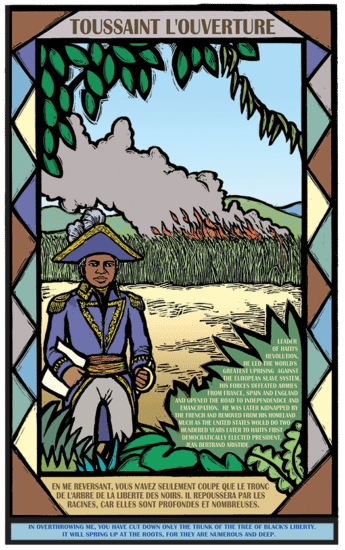
But I wanted to have us begin to think more in depth about the American Revolution, especially as the anniversary approaches. You write that, “whereas the American Revolution consolidated the system of slavery, the Haitian Revolution destroyed it.” And you also describe how the Haitian Revolution has been hidden from students. I love this passage. You wrote, quote, “Just as the citizens of Savannah tried to stop the spread of information about the Haitian Revolution at their ports, today we stop information about the revolution from arriving in our classrooms.” So, I hope that we can put an end to that tonight with every teacher that is here with us today. As this anniversary approaches, what can we learn by comparing the American Revolution to the Haitian Revolution, and must students be allowed to make these comparisons if they’re going to understand the history of this nation?
Jones: This whole book I wrote with teachers in mind. So throughout the book I’m dropping sources, not just footnotes, but explicitly in the text, naming sources and resources for teaching. One of them that I start the chapter on the Haitian Revolution with is with an item from a new collection called Teaching with the Schomburg Center’s Archives that’s about helping teachers teach with the Schomburg Center’s Archives. As you mentioned, there’s this petition of these citizens of Savannah trying to stop ships from Saint-Domingue from coming because they’re terrified of the Haitian Revolution. I think it’s so important in world history. The importance of the Haitian Revolution is hard to overstate. And yet you would contrast that with how we learn about it, and how little it’s discussed, and how little people have information or access to it. Definitely in my education. I mean, this is not something I learned about until I was a grown-up.
To write a chapter about it, I thought, let me try to write a chapter in a way that will help people who want to teach it. But it’s complex. It has many parts, and so I thought, let me give you a simple version, and then let me complicate it a little bit. Again, I’m dropping sources and footnotes throughout. But to me, one of the things I do is, I hold them up against each other, and certainly, I let you hear the voices of the founders of the United States — George Washington, James Madison, Alexander Hamilton, [and] Thomas Jefferson. Those are quotes that don’t age well, just to put it bluntly. And that’s why it’s so helpful to think about the Haitian Revolution. Both the French and the American Revolutions talked a really good game about universal rights. I mean, that’s beautiful things to name, that everyone should be free and equal. Great! That’s a wonderful ideal. But it’s only the Haitian Revolution that did it. For both the American and French revolutions, both of them made an exception for Black people. Both of them put Africans in a category of exception to those freedoms. And if they were enlightened and considered themselves abolitionists, many of those people in America and France were kind of gradualists, like, “We’ll get to it eventually. We’ll have a plan for many generations from now for slowly winding down slavery.” The revolutionaries in Saint-Domingue broke with all of that. They broke the pattern of the modern world by immediately declaring Black freedom and making it a reality. And that’s why it just sent shockwaves everywhere and inspired people of African descent all over the world.
There are just so many stories about the way it traveled on ships and boats, and landed in every port and led to other slave uprisings, as I mentioned. It’s a revolution like no other. Not being Haitian myself, and not reading or speaking Creole, I tried to get closer to Haitian sources about it, and one of the things I found most fascinating about reading their work was to see the African-ness of this revolution. To see that because of the brutality of slavery in Saint-Domingue, most of the people who made that revolution not only were born in Africa, most of them grew up there. That is, it’s not like the North American revolts we celebrate, carried out by people who endured generations of enslavement and knew nothing else. These are people who remembered another way to live. They were, in one lifetime, kidnapped, thrust into a cruel society, and broke it apart, and made something new, in one lifetime. We often try to brace ourselves for the long struggle. It’s a long, long road we’re traveling, but sometimes it’s inspiring to remember that sometimes people get it done quickly. Things do happen in a person’s lifetime, and these revolutionaries . . . I mean, one of the scholars I quote a lot in the book, Jean Casimir, says, honestly, that you shouldn’t even call them slaves because they weren’t there long enough to absorb that as their identity. We should call them captives, African captives. This wasn’t even a slave revolt, this was a revolt of captives who got there and were like, “Hell no,” and tore it up.
Hagopian: Wow. There’s so many lessons from that history that are powerful. I love, speaking of the social construction of race, how you talked about after the Haitian Revolution, there’s a group of Europeans who are deemed Black by the revolution, because everybody gets to be free, so everybody can just be a free Black person. Who was that group again?
Jones: Polish!
Hagopian: Polish, yeah.
Jones: They totally flipped the script. I mean, this is an incredible story. Their 1805 constitution, if I remember correctly, says, if America’s going to be a white nation, where everyone’s trying to get admission to whiteness, they’re like, “We have no more distinctions of color. This is now official.” It’s the first Constitution in the world to abolish slavery. At the same time they say, “No more distinctions of color. Everyone here is the same. We’re all Black. And yes, you several hundred Polish revolutionaries, you’re good too.”
Hagopian: I love it. Let’s follow up on this by talking about Frederick Douglass’s role as the U.S. Ambassador to Haiti. The only nation born from a successful slave revolution, and Douglass was tasked with representing a country that had once enslaved him. And now he has to go engage with Haiti, a nation that really struck a global blow for Black freedom. The stories you tell about him are so fascinating. Why is this central to understanding Black history, and what do we learn by studying Douglass’s relationship with Haiti?
Jones: Well, there’s so many people . . . I mean, just people in my family and people I know who really are Black folks who consider themselves really loyal to the United States. And I wanted to push back on this question of national loyalty, but I wanted to write it in a way that they could read it. I thought, who better to help people who consider themselves deeply patriotic to help people wrestle with that than Douglass? Douglass is trying so hard to be patriotic. For him, after the Civil War, the country was reborn. It’s a totally different country. The country means something different. The flag means something different to him. So yeah, he’s willing to be the official ambassador from the nation to another nation. And what does he want for Haiti? He wants brotherhood, mutual progress, equality, development, supporting each other, [and] solidarity.
But unfortunately, the people he works for do not want any of that. The people in Washington, D.C, in the government, do not want any of that. They want to keep their thumb on Haiti. They do not see Haiti as political equals. They never walk into a room and speak to them like equals. They want Haiti for the Navy. They want to have a fueling station there. They see it as property. And so they are undermining Frederick Douglass from the beginning. This whole tension erupts and he gets accused in the press. They start undermining him. He’s accused of being disloyal. He’s accused of being more loyal to Haiti than to America. So here we are again, back to this question of loyalty, back to this question of what’s our relationship to the nation. And I think the dilemma that Frederick Douglass finds himself in, somebody trying to be a patriot, is really helpful for people who are today wrestling with it.
Hagopian: Yeah, that’s a great point. We can dedicate our lives to trying to redefine patriotism to make it about these wonderful goals, and then sometimes the nation has other plans. That’s a great example.
[breakout rooms]
Hagopian: Welcome back, Brian. Did you have a good breakout room?
Jones: Oh, yeah, that was fun. It was really well facilitated, and it was really fun to hear, and enlightening to hear teachers talk about what they took away, and their ideas for teaching.
Hagopian: That’s great. I know they’ll have a lot of ideas from this book. I wanted to jump back into some of the history you cover. I love all the history of Haiti, that’s so important. But you also really look at Reconstruction, and you look at the importance of education at that time. You write, quote, “Despite Black people’s unrelenting efforts, our society has consistently attempted to thwart our access to literacy, to stifle, contain, and constrain it. Perhaps the clearest example of this historic dynamic is to be found in what was also the most consequential and pivotal moment for the nation as a whole, Reconstruction.” And then you write, quote, “The record of achievements of Black people and their allies in building the infrastructure of public education for all in the U.S. South is a story everyone should know.” So, can you tell us that revolutionary story of Black people creating public education during Reconstruction, and then contrast it with what you call the, quote, “counter-revolutionary educational ideal of industrial education”? How do we see those two traditions even still in conflict today?
Jones: Still a conflict today. Whew! Well, I mean, yeah, there’s so many ways in which now is the moment to go back and take a fresh look at Reconstruction. Rethinking Schools and the Zinn Education Project have done such a great job of helping us do that, and exposing the way in which the curriculum is just totally whitewashed, or skips over it altogether. It’s really important, especially to talk about loyalty and disloyalty. Because the way in which the disloyal Confederates were allowed to come back into power, and through terror, murder, intimidation, kidnapping, assassinations, overthrowing democratically elected governments. I mean, it is helpful to think about that period as a revolution, because that explains the violence. The violence isn’t just mad, irrational hatred; the violence is what’s necessary for a counterrevolution. To put the cat of revolution back in the bag is not easy once people have gotten a taste of change, of freedom, and of the democracy they’re trying to build in the South.
What they cried was Negro domination. “Black people are going to be in charge. Watch out! They’re going to do to you what we’ve been doing to them for hundreds of years!” But that’s not what we did at all. The minute we get free, what do we try to do? We start setting up hospitals, and schools, and we say the rule is everybody can go. It’s astounding. As you pointed out in one of our recent discussions, we couldn’t even go to a lot of the schools in the North. Massachusetts gets credit for starting public education, but we couldn’t go to those schools. So it might just be that it’s more accurate to say that the first truly public schools were started by Black people and their allies in places like Louisiana, Texas, Florida, and Alabama. It turns the whole story upside down.
It’s really a story of Black power. What happened when you get Black power is a whole bunch of white kids got to go to school for the first time thanks to the advocacy of their Black neighbors. To me, this was like trying to come to terms with not only this history, but also my own family story. My parents went to what we would call segregated schools, and I was always taught that that was a bad thing. And the period of Brown, and reckoning with what it meant to think about what happened in desegregation, the way so many communities experienced it, unfortunately, as loss, as taking away what Black people had built up. But it didn’t have to be that way. I learned so much from Jeanne [Theoharis]’s work about the North and other scholars studying northern racism and segregation in the North. Anyway, long story short, yes, it’s a revolutionary period that’s understudied, ‘and that] held out so much hope for democracy, really. This disloyal faction of Confederates were allowed to come back into power, and the loyalty of Black people proved, once again, to be wholly unrequited.
Hagopian: Such important history that you talk about, especially for our students to learn how the schools that they’re in got set up and what have been the checks on expanding access to education. You tell another powerful story about discovering that there was a Harlem Black Panther Party that was organized around fighting for education. So I want you to talk about that history, and more broadly about the central role that educators and students have played in the Black Freedom Struggle.
Jones: I’m realizing I didn’t answer your second part of your other question about the counter-revolutionary industrial ideal. Just to say something quickly about that. So, after Reconstruction, once the education for liberation tradition is stifled, Black people don’t lose everything in the country. We lose a lot, but we don’t lose everything in the counterrevolution. What’s really amazing is that we gained, we built so much in the way of schooling so quickly that despite burning hundreds of schools, despite the counterrevolution, despite everything they threw at us, a number of educational institutions endured. I mean, it’s remarkable. But yes, there are new people who came up in the moment of counter-revolution. People who rose at the pinnacle of counterrevolution went about it a different way, and those are people like Booker T. Washington. It’s helpful to understand him in his career, because when he first came along, he was part of the Republican Party. He would consider himself an activist. He aspired to take office and be part of this democratic surge. But when all of that got crushed, he changed tack and went to a, yes, what you could call a counter-revolutionary ideal. Which was Black people are going to submit themselves to political inequality. And just try to, like learn the value of hard labor, that kind of stuff. It’s really unfortunate to say the least.
But anyway, sorry, you asked about the Black Panther Party. The throughline is education. The throughline is . . . it doesn’t matter what decade you pick, or what year on the calendar. It really doesn’t matter, because there is an uninterrupted struggle for schooling in Black history. Uninterrupted. Pick a date on the calendar, scratch a movement that you’ve heard of, and you’re going to find education and schooling somewhere in the mix. Either the school is the site for organizing and launching a movement that’s going to primarily be off-campus, [like the] Black Panther Party in Oakland, or the school is itself the battleground, the thing everybody’s fighting over. And the reason that we’re fighting and the cause of the movement is education and formal schooling. Or, in the context of the movement, they have to create another learning structure, and freedom schools, and things that are outside of school. So there’s always this learning component that’s part of it.
It was surprising to me, when I first started working at the Schomburg Center, to crack open a box in the archives that’s about the Black Panther Party in Harlem and find a letter — and I write about it in the book — from the Harlem Panthers to the Harlem community announcing that they’re going to start a party called the Black Panther Party and they’re going to focus on school. I just couldn’t believe it. I’d never heard of this. I thought the Panthers got started by policing the police. I thought that’s what it was about, police brutality [and] defending themselves. Huey Newton [and] Bobby Seale. But then I looked more closely at the document. The date? It’s August 1966. Two months before Huey Newton and Bobby Seale launched their party in Oakland. Then I was like, “Wait a minute, that means they weren’t trying to imitate Huey and Bobby.” They were more like Huey and Bobby themselves. They were just trying to take the party idea that they had learned in Alabama, the Lowndes County Freedom Organization, an independent political party that used the Panther as its symbol. They were just like them, just went to a different place, trying to bring the Panther idea. They just had a different way of going about it. It’s like a different freedom dream.
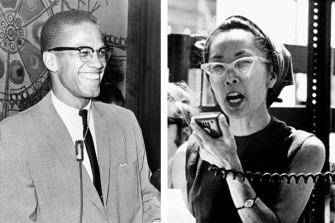
And I actually got so curious about this. I mean, I read about it, I talked to historians like Donna Murch, who told me things about it, and I actually met some people who were part of typing this letter. They told me, by the way, that they typed it at Yuri Kochiyama’s house. I was like, “What were you doing at Yuri Kochiyama’s apartment?” And they were like, “Well, she was the only one we knew with a typewriter.” I asked them, “Why schooling? Why not some other conception? Why focus on education?” And they said, “Because that’s what everybody was organizing around in Harlem at the time.” In other words, we’re going to launch a new party we want to be relevant. And in order to be relevant, we’ve got to focus on this thing. So they’re fighting for Black studies, [and] fighting for community control of the schools. I was surprised, but I shouldn’t have been surprised, because this happens all over Black history, that there’s a learning and liberation story in every part of the Black Freedom Struggle.
Hagopian: I love how you foreground the lessons that the Black liberation movement has always been closely tied to education, and I think we would do well to recognize that today, and for organizers and activists to really figure out how to center that fight again. Many teachers, students, union members, and community organizers are increasingly joining social movements. ICE is attacking our schools and trying to kidnap 5-year-old students. We are thrust into positions of having to be organizers and activists, and I think that your book offers a lot for students and educators to think about how to participate in social movements. So, I was hoping you could tell us more about what you hope that those education organizers take away from Black History Is for Everyone and what lessons from the Black Freedom Struggle — especially around education, solidarity, and organizing under repression, like we’re facing today — feel most urgent for the moment that is taking shape right now.
Jones: Really, in some ways, it’s what you just said. It’s a big picture attitudinal shift. We talk, and we should, about how we’re going to teach this history. But another way in which Black History Is for Everyone right now is that it’s also for us. Like, guess what? There’s a history of people teaching under repressive conditions, where they could be fired for doing the right thing in the classroom, where they and their communities are under attack in multiple senses of the word. There’s a history of this. There’s another sense in which Black history, if you’re not Black, you can still learn from this history. This is a resource for you educators nationwide who are dealing with the conditions that Black Americans have endured now for a very long time.
So now we can look at this history with different eyes. We can and must teach it, but we can also think about how to be and how to move. Some of what you might have to do is what Jarvis Givens and others would call fugitive pedagogy. Then there’s other moments when there’s an open confrontation, where you have to openly decide to band together with other people and try to change something in a more explicit way. There’s all kinds of things that people will do, and different strategies. But there’s a rich history of what Black educators . . . I mean, and what you’re going to take up in your next session on 100 years of Black history. Guess what? For most of the time, that was not allowed. So Black History was nurtured by communities of activist educators, really just like this community that you’re in here. A community of people who are aligned with each other and deciding that we’re going to focus on this. We’re going to think about this together. We’re going to support each other, even if there is no official support for what we’re doing.
Now, of course, it’s great to get official support. We should fight for official sanction. We should fight to get the curriculum changed. We have to undo the laws in half of the states that are banning Black history. All of that is important. We also have to take care of each other, and sometimes that means we have to have spaces outside that are unofficial spaces where people can nurture their thoughts and ideas and strategies together. I hope this book is a modest contribution to all of that, for teaching and for teachers.
Hagopian: Yes, no doubt, Brian. Thank you so much for your insights this evening. What a great conversation. . . . [There are] so many lessons for our movements and for our classrooms in this book. If you don’t have it yet, you need to pick up Black History Is for Everyone!
While this transcript was edited, there may be minor errors or typos — if you notice something you believe to be incorrect, please contact us at [email protected].
Audio
Listen to the recording of the session on these additional platforms.


Resources
Here are many of the lessons, books, and other resources recommended by the presenters and participants:
Lessons
|
|
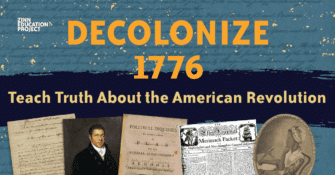
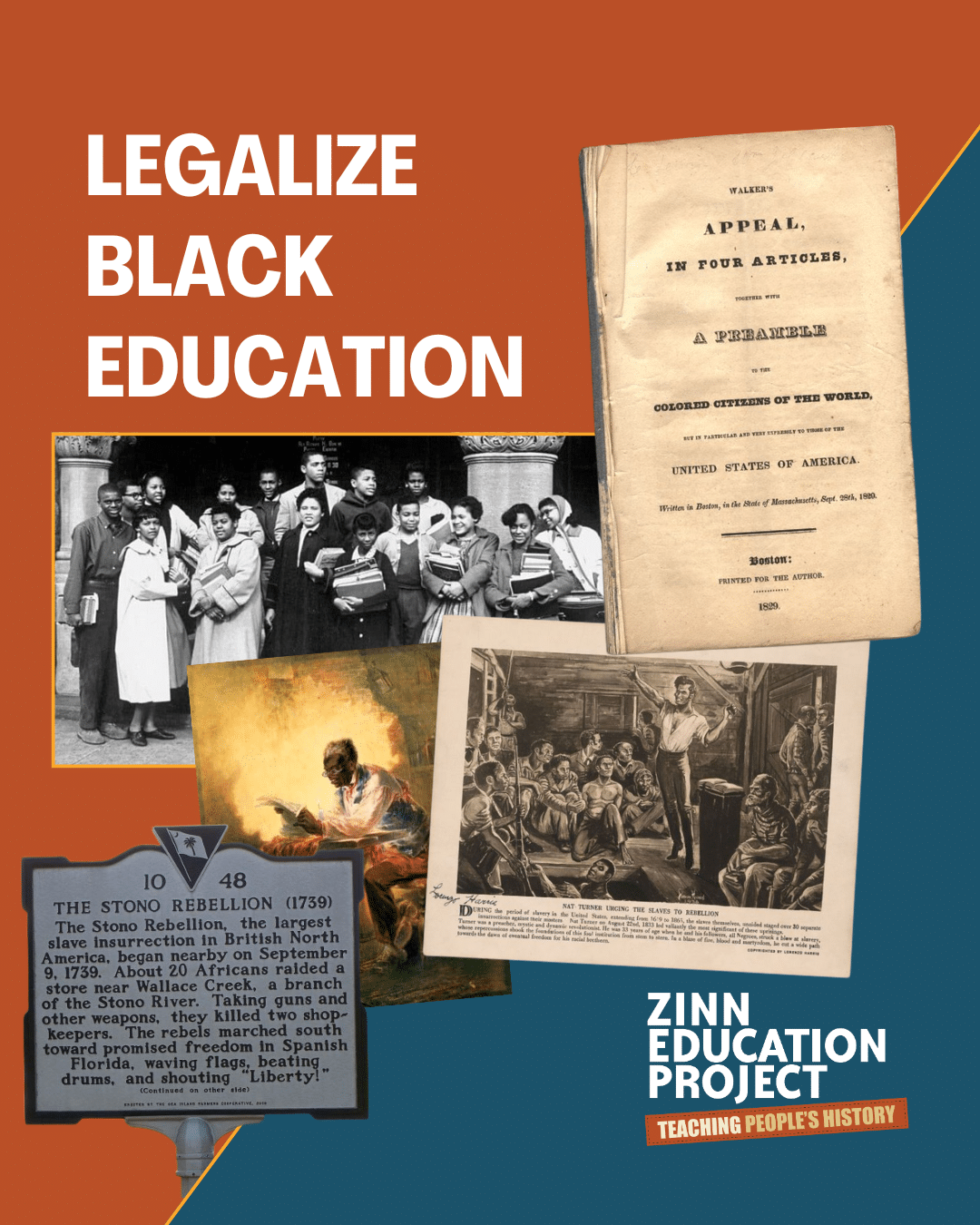
Legalize Black Education: The Long Fight for the Right to Learn by Jesse Hagopian The Color Line by Bill Bigelow “Founding” Documents We Don’t Learn About by Mimi Eisen COINTELPRO: Teaching the FBI’s War on the Black Freedom Movement by Ursula Wolfe-Rocca ‘What We Want, What We Believe’: Teaching with the Black Panthers’ 10-Point Program by Wayne Au Discussion questions for Kellie Carter Jackson’s We Refuse chapter on revolutions. Questions for reflection by Mimi Eisen Teach Reconstruction Campaign, including lessons, books and films, student projects compiled by the Zinn Education Project, and a national report, Erasing the Black Freedom Struggle: How State Standards Fail to Teach the Truth About Reconstruction Teaching the American Revolution, a collection of lessons, books, articles, videos, discussion questions, and other resources compiled by the Zinn Education Project |

Books
|
|
In addition to Black History Is for Everyone (Haymarket Books), the following books were referenced.
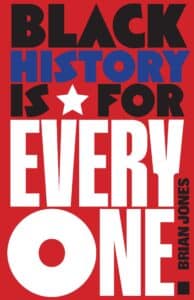
Black Lives Matter at School: An Uprising for Educational Justice edited by Denisha Jones and Jesse Hagopian (Haymarket Books) The Tuskegee Student Uprising: A History by Brian Jones (New York University Press) Never Caught: The Story of Ona Judge by Erica Armstrong Dunbar and Kathleen Van Cleve (Aladdin Books) Queen Mother: Black Nationalism, Reparations, and the Untold Story of Audley Moore by Ashley D. Farmer (Pantheon) Teaching for Black Lives edited by Dyan Watson, Jesse Hagopian, Wayne Au (Rethinking Schools) |
Additional Resources
|
|
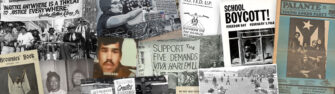
New York City Civil Rights History Project, a digital history of educational activism in New York City Racism and Resistance in the North During the Civil Rights Movement, a previous Teach the Black Freedom Struggle online class with Brian Jones |
This Day In History
The dates below come from our This Day in People’s History collection, which contains hundreds of entries all searchable by date, state, theme, and keywords.
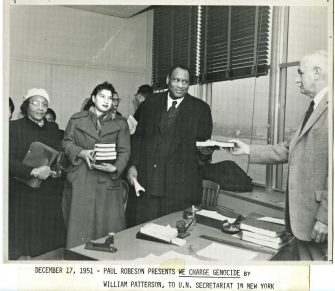
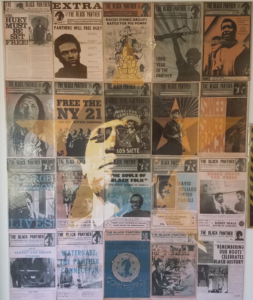
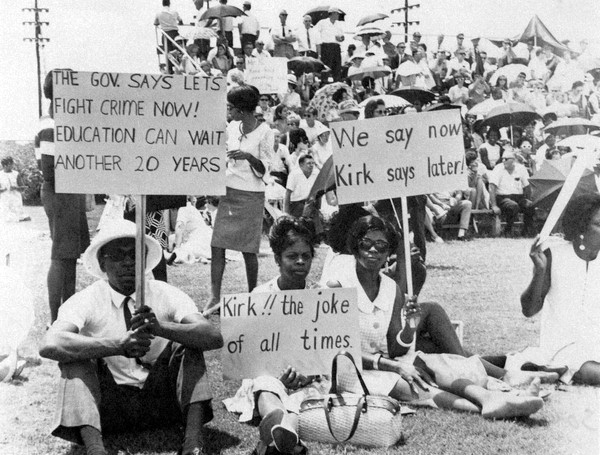
Participant Reflections
With more than 140 attendees, a poll of participants’ primary roles in education showed 33 percent K–12 teachers, 16 percent teacher educators, 11 percent K–12 students, and more.
Here are more comments that participants shared in their end-of-session evaluation:
What was the most important thing (story, idea) you learned today?
Hearing about the Haitian Revolution and how information was stopped resonated with what is happening today with regards to Gaza and the ICE murders in Minneapolis. There is so much of what has happened in the past that can inform the present.
How information about Black history is considered threatening in school because knowledge is power, and how much the power of white supremacy seeks to control the narrative and does not want people of different races to come together and see their connections.
How important and interconnected history and education are.
The layering of the Haitian Revolution and Bacon’s Rebellion into the story of the American Revolution is huge, and the big take away for me is the ways to draw direct connections between their motives, actions, and outcomes. I also appreciate the importance placed on education in the revolutionary movement.
The record of achievement of Black people and their revolutionary ideas, and the whitewashing of our history.
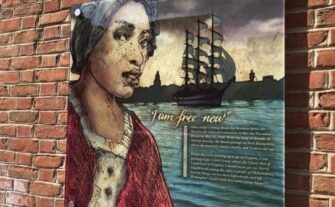
I found it fascinating that the recent plaques taken down by the current regime in Philadelphia taught about the people George Washington enslaved — including his desire to prevent them from thinking about freedom.
The most important thing I learned is how interconnected are events like the Haitian Revolution, the American Revolution, Bacon’s Rebellion, and the development of slave codes. We need to teach our students how these events are connected and how there is a through line to events today.
What will you do with what you learned?
The discussion regarding national history and internationalism — I sometimes try to avoid the tension. I will be bringing the tension back in.
I am making sure that my students, even at a 1st-grade level, are taught perspective and truth. As the equity advocate for my teachers’ union, I always reach out and share what I have learned. I encourage colleagues to check out the book and the many others on the Zinn Education Project website and through these fantastic sessions!
I want to be more flexible in the ways in which my students see themselves in my lessons. I have been teaching them to see themselves as part of the nation’s history, and I will continue to do so. But the conversation today inspires me to continue to include Black and Brown voices that were not only critical of their own oppression but of the “American project” in general, and to be more willing to explore my students’ ideas about their own position in relation to the U.S. government (since the kids already think about it given the current political climate and social media allowing for heightened youth awareness).
Being in a call with people who are committed to this work reinvigorates me to keep learning as much as possible to teach kids Black history, despite the major gaps in my knowledge. And it inspires me to go beyond the classroom to school-wide celebrations of Black History Month.
I want to look into Bill Bigelow’s The Color Line lesson.
I teach 8th grade U.S. history so I’m definitely going to work in a lesson about Bacon’s Rebellion.
This will definitely help my future teaching by being more open and honest with students. By not sugar-coating what has happened it actually informs them more.
I will use excerpts from the book to tie into other parts of history such as women’s struggle for equality, the injustices toward Indigenous people, and the impact racism still has on our society today.
I am an art teacher and I love to find ways to bring this history into the art room. I was so blessed to have a facilitator in the break out room to tell me about Gee’s Bend quilters and their connection to MLK. I hadn’t known about them!
I plan to have my students (pre-service social studies teachers) engage with these resources in their lesson plans. I also have them attending workshops this semester as we continue our conversation about how we teach holistic history.
How was the format for the class?
This was fabulous! Thank you for keeping us engaged and connected. We need this more than ever in times like these.
Amazing as always. Jesse Hagopian’s excellent questions kept the conversation focused and allowed Brian Jones’ brilliant work and connections and great voice to shine.
The breakout sessions were great. I also like the interview style of discussion. It worked well.
I love the format and the opportunity to meet others from different states to discuss these important ideas.
I really enjoyed the breakout rooms. It helped to hear from teachers all over the country on what they are doing to improve education.
Presenters
Brian Jones is the inaugural director of the Center for Educators and Schools of the New York Public Library, and formerly the associate director of Education at the Schomburg Center for Research in Black Culture. Jones was an elementary school teacher for nine years and earned a PhD in Urban Education at the CUNY Graduate Center. He has contributed to numerous publications, including Black Lives Matter at School: An Uprising for Educational Justice and is the author of The Tuskegee Student Uprising: A History.
Jesse Hagopian is an editor for Rethinking Schools, co-editor of Teaching for Black Lives, editor of More Than a Score: The New Uprising Against High-Stakes Testing, author of Teach Truth: The Struggle for Antiracist Education, and the Teaching for Black Lives campaign director for the Zinn Education Project. He previously taught Ethnic Studies and was the co-adviser to the Black Student Union at Garfield High School in Seattle.


Twitter
Google plus
LinkedIn