

Benjamin Banneker was born free in Baltimore to an African American woman and a formerly enslaved West African man. In his youth, Banneker taught himself a wide range of subjects, including math, science, astronomy, natural history, and farming. He went on to become a land surveyor, almanac writer, and correspondent of Thomas Jefferson’s.
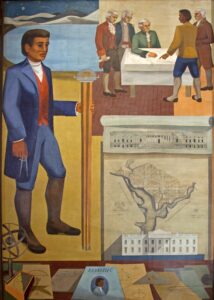
“Benjamin Banneker: Surveyor-Inventor-Astronomer,” mural by Maxime Seelbinder, at the Recorder of Deeds building in Washington, D.C., built in 1943. Source: Library of Congress
On Aug. 19, 1791, Banneker penned a letter to Jefferson, who was then secretary of state in George Washington’s administration. Banneker questioned the motives of Jefferson and other Founders who asserted in the Declaration of Independence that “all men are created equal,” only to weave the institution of slavery into the fabric of the new United States. Banneker called for justice for African Americans from “tyrannical thraldom” and “narrow prejudices”; he also enclosed a draft of his new astronomy almanac.
Two weeks later, Jefferson replied with a short, evasive letter. He thanked Banneker and claimed to support “raising the condition [of] our black brethren,” but ignored Banneker’s direct criticisms and demands.
Read more in the lesson “Founding” Documents We Don’t Learn About.






Twitter
Google plus
LinkedIn