

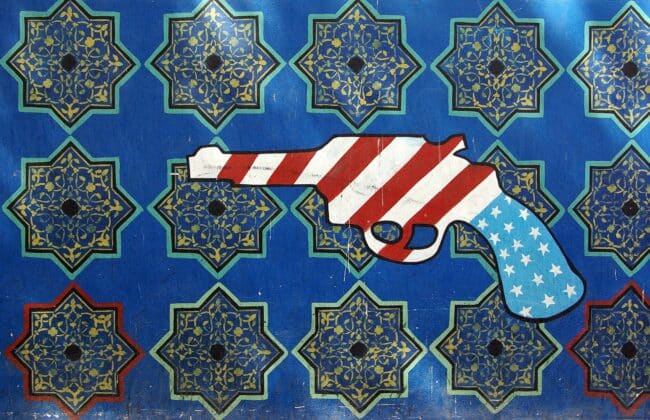
After the takeover of the U.S. Embassy, Iranian students and organizers covered the embassy walls in mostly anti-U.S. murals. This is one of the many murals. Photograph by Phillip Maiwald. Source: Public domain

Portrait of Ayatollah Ruhollah Khomeini by Ali Kaveh, 1981. Source Public domain
Supported diplomatically, financially, and militarily by the United States for decades, Iran’s authoritarian leader Shah Mohammad Reza Pahlavi was dying of cancer and struggling to maintain power in a country that had tired of his strongarm regime. To quell dissent, in Oct. 1978, the Shah implemented a general amnesty for all political dissidents, though this was too little, too late. He sought exile in Egypt and then Mexico, watching both his medical health and his political power crumble.
On Feb. 1, 1979, after a 14-year exile in France, the firebrand Shia cleric Ayatollah Ruhollah Khomeini was welcomed home to Iran by millions of followers. Within two weeks, Shah Pahlavi — who had been in power since the 1953 U.S.-backed coup to overthrow the democratically elected Iranian Premier Mohammad Mossadegh — was deposed and the Iranian revolution was successful in creating an Islamic republic with Ayatollah Khomeini as its supreme leader.
In Oct. 1979, the ailing Shah was permitted into the United States for medical care, which angered Iranian revolutionaries and the new Iranian government, which demanded the extradition of the Shah back to Iran.
On Sunday, Nov. 4, 1979, Muslim students and followers of the Ayatollah Khomeini calling themselves the “Muslim Students Following the Line of the Imam” stormed the U.S. Embassy in Tehran, quickly occupying the buildings and securing dozens of hostages. They demanded that the U.S. government return the Shah to Iran to face justice for his years of military rule.


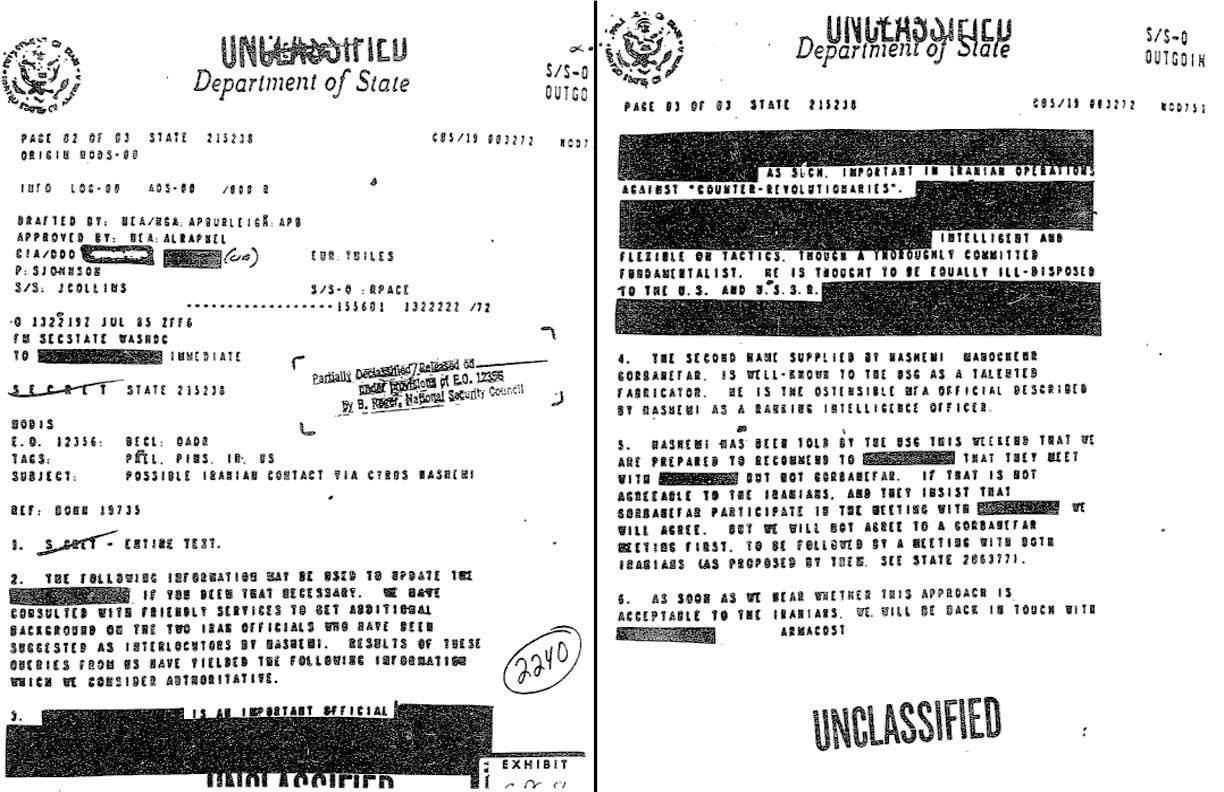
In the midst of the embassy takeover, embassy staff used paper shredders and a furnace to destroy classified documents. The shredded remains were discovered by Iranian students and for several years after, trained carpet weavers were used to reconstruct the documents, resulting in the publication by the Iranian regime of several books documenting U.S. espionage in the region.
In addition to a failed rescue mission in which eight soldiers were killed, Kirstin Butler describes the lengths the U.S. government was willing to go to end the hostage crisis.
The Carter administration tried a range of policy options to pressure Iran’s interim government to release the remaining hostages, including a boycott of Iranian oil, enlisting international diplomatic support, and freezing billions of dollars of Iranian assets held in U.S. banks. At the end of November, the United States also filed suit against Iran in the International Court of Justice. However, Khomeini’s assent to the head of Iran’s newly theocratic state in early December precluded all American attempts at negotiation.
Fifty-two U.S. hostages were held for 444 days, crippling the Carter administration, his hopes for a second term, and U.S.-Iran relations, and culminating in the release of all hostages on Jan. 20, 1981, the same day that right-wing Republican Ronald Reagan took office as president of the United States.


Additional Resources
Inside Iran: The Real History and Politics of the Islamic Republic of Iran by Medea Benjamin
Guests of the Ayatollah: The Iran Hostage Crisis: The First Battle in America’s War with Militant Islam by Mark Bowden
Iranian Students Take Over U.S. Embassy in Tehran by Nicholas Cumming-Bruce at The Guardian
Explore the Iran Hostage Crisis Through Its Iconic Images by Kirstin Butler at PBS
In the lesson The Iran Hostage Crisis from C-SPAN Classroom, students view archival video and hear from experts and eyewitnesses to learn about this event.
Watch the 7-minute Associated Press video Revolution in Iran, Episode 4: The Embassy Takeover below.




Twitter
Google plus
LinkedIn