
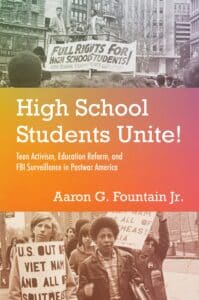
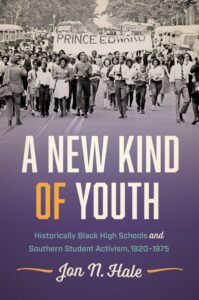
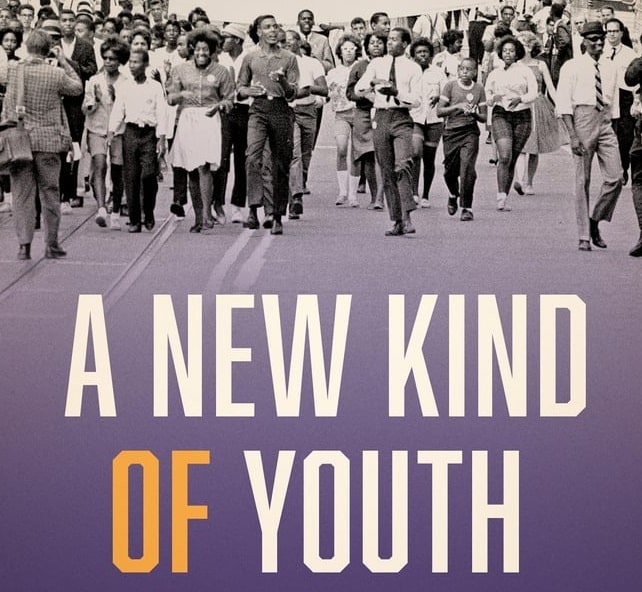
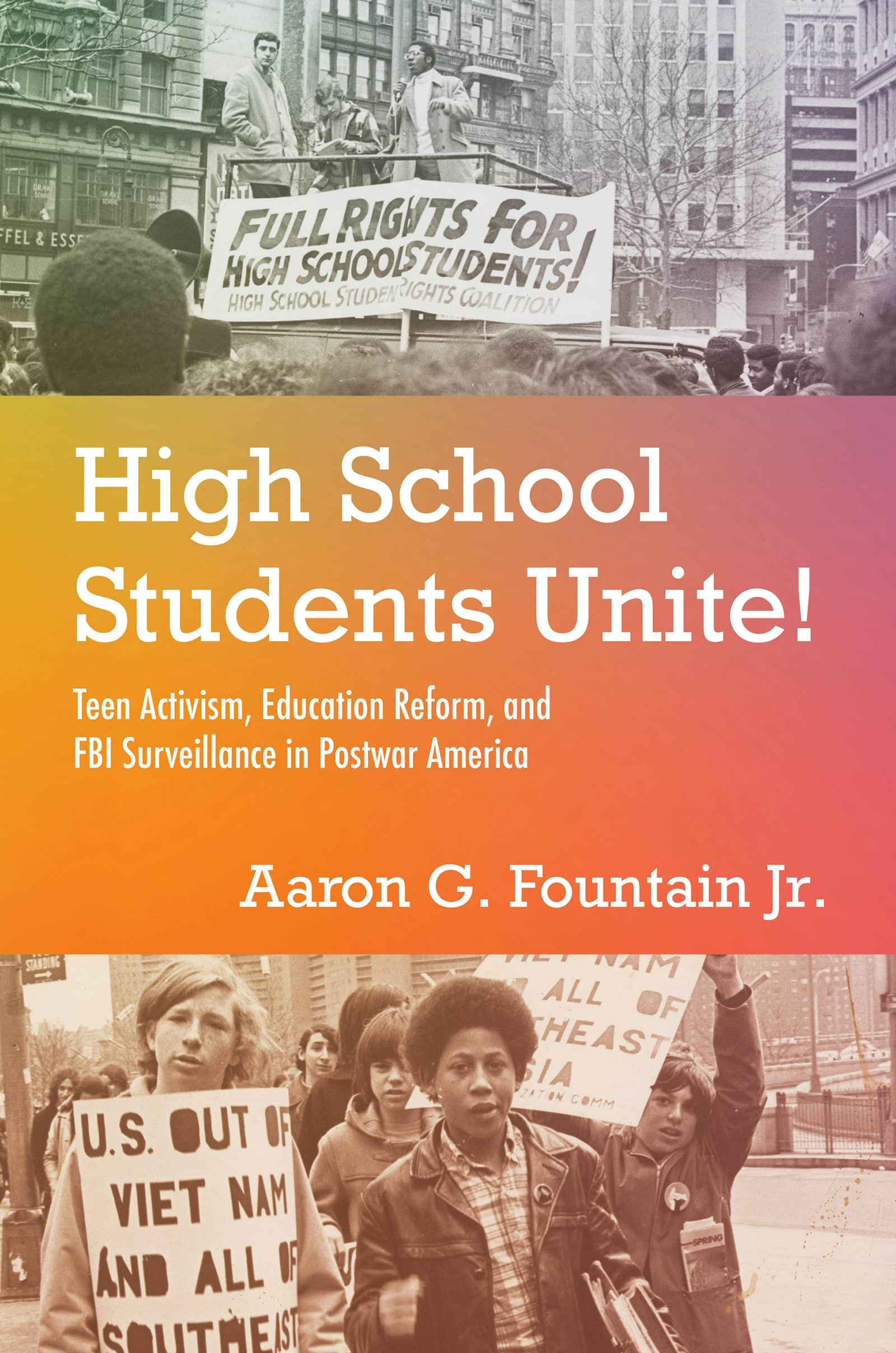
On September 28, historians Aaron G. Fountain Jr. and Jon N. Hale joined Rethinking Schools editor Jesse Hagopian to talk about high school student organizing and state repression, and their new books, High School Students Unite!: Teen Activism, Education Reform, and FBI Surveillance in Postwar America and A New Kind of Youth: Historically Black High Schools and Southern Student Activism, 1920–1975.
(Watch our previous Teach the Black Freedom Struggle online classes and register for upcoming classes here.)
In the excerpts below, Fountain and Hale describe the importance of high school student activism in creating a more just society.
Participants shared what they learned and additional reflections on the session:
This class was a great reminder to always keep students at the center of all organizing.
This was a truly inspiring session. Each of the presenters shared really important ideas and stories that brought this history to life. The focus of their books also complimented each other really well.
I think the most important thing I learned is that 38,000 Black teachers were fired in the wake of Brown v. Board of Education, which shows that there might be a win in the law, but the struggle continues for the execution of the spirit of the struggle, and also explains how we arrived at the disparity in teachers of color versus white teachers today.
I am inspired to center student organizing when I teach about the Civil Rights Movement, and to work with local leaders and experts to co-construct lessons to empower students to be leaders and activists today.
Event Recording
Transcript
Click below for the full transcript with resources mentioned in the discussion.
Transcript
Jesse Hagopian (he/him): It’s great to be back for a new season of Teaching the Black Freedom Struggle. My name is Jesse Hagopian. I am a Zinn Education Project campaign director and an editor for Rethinking Schools.
I’m happy to welcome historians Aaron G. Fountain Jr. and Jon N. Hale. Aaron is a historian and public scholar. His book, High School Students Unite!, was a finalist for the 2025 Los Angeles Times Book Prize for History. If you don’t yet have this book, it’s another must-read from our series. And then also joining us, Jon is a professor and associate head of education policy, organization, and leadership at the University of Illinois at Urbana-Champaign, and the author of many books, including A New Kind of Youth. You’ve got to pick this one up, too, to really understand the potential of our young people. Alright, welcome both, thanks for being with us!
I’m so excited to have you both. You all did some brilliant research that really expanded my understanding of the youth struggle and struggles around education. And your books together, I think, allow us to look across roughly a century of high school student organizing — from earlier 20th century Black student activism through the freedom struggles of the 60s and 70s — and towards the movements today.
But I think when a lot of people think about student activism they think about college students rather than high school students. So what are some of the major turning points in this 100 year history? I know we can’t hit every detail, but some of the major turning points and across very different generations, what continuities do you see in what students have fought for, how they’ve organized, and how school authorities have responded?
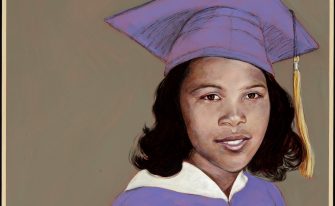
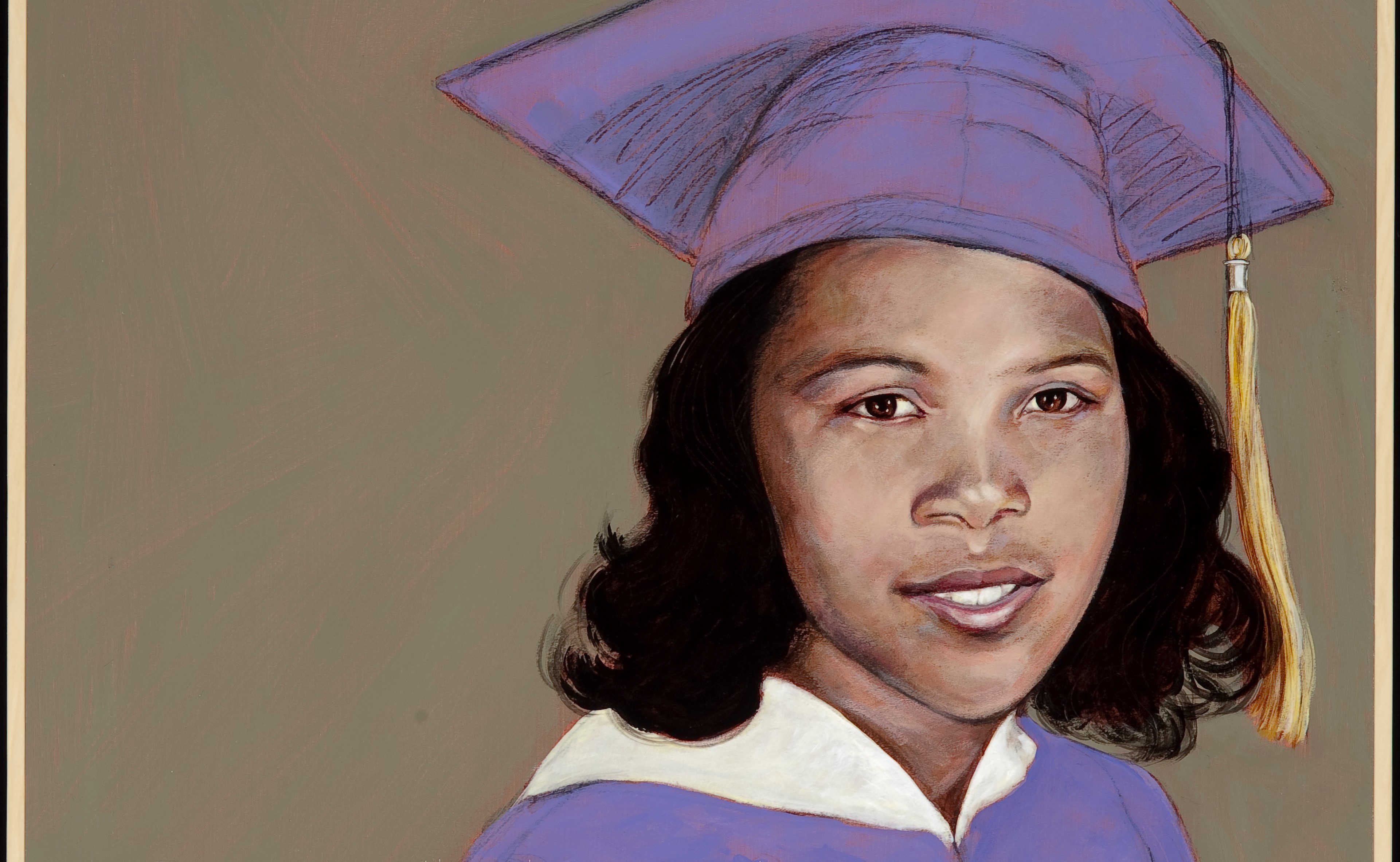
Jon Hale: Well, I’ll start just quickly with some of the earlier milestones. I think about when the NAACP started documenting its work with youth beginning in 1921, when they first started reporting junior councils as an active student population that were fighting for change, textbook revisions, they were protesting police brutality in the 1920s and 1930s, that they were organized enough to get into these sort of official reports. But a lot has been without voice; there’s a lot of paternalism. And then they’re organized through the 30s. None other than Dr. W. E. B. Du Bois organizes conferences in the South, specifically with youth. He has a speech called “Behold the Land” where he’s specifically calling on young people in 1944 to ignite a freedom struggle. And they respond. Another moment is Barbara Johns walking out in Virginia in 1951, really demonstrating that youth just weren’t passive recipients, that they were ready, to not only join but lead and inspire elders in the movement. So, I think those are some key movements. I’ll kick it over to Aaron for his thoughts.
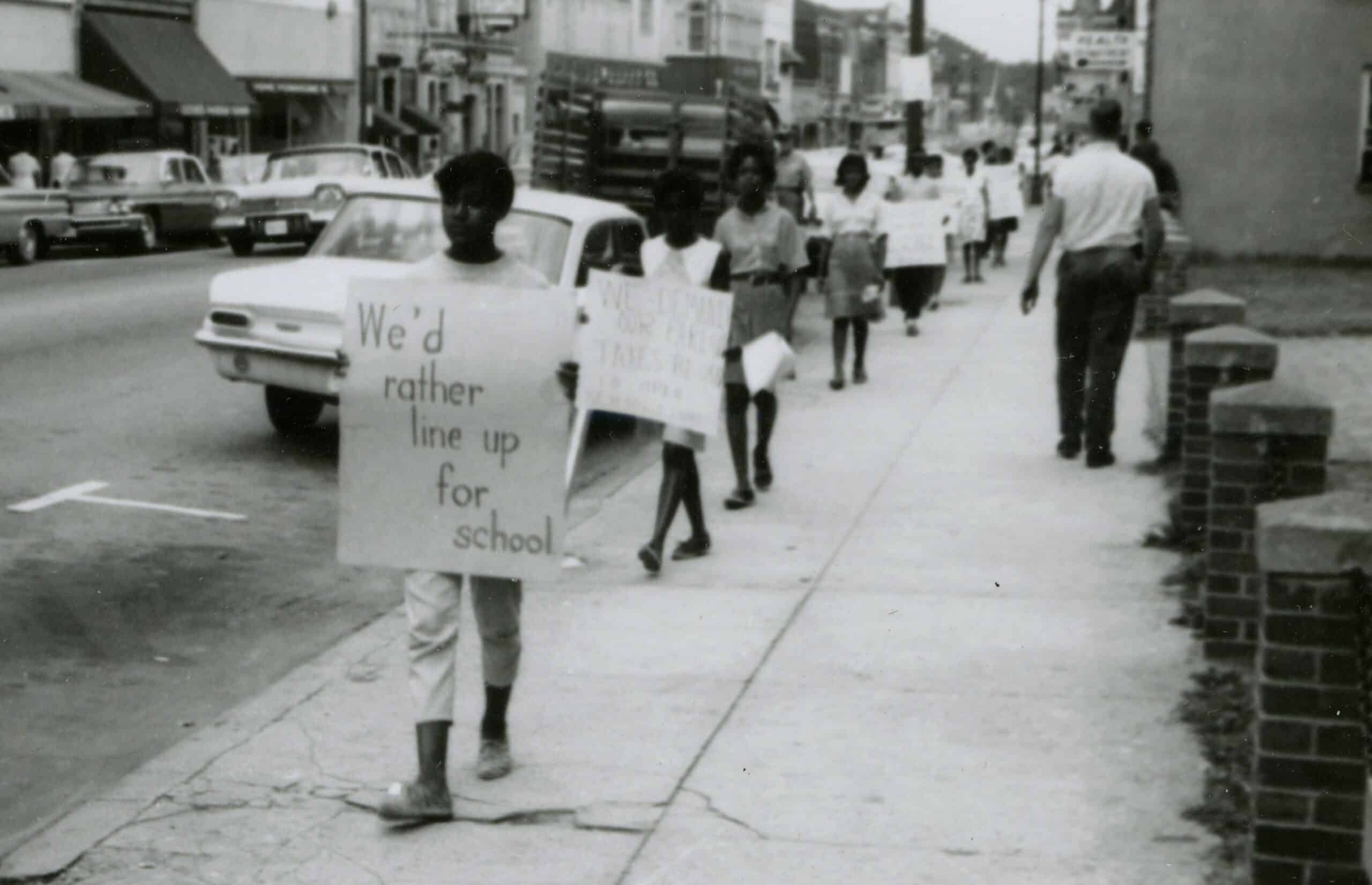
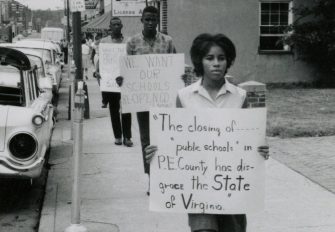
Students on Main Street, Farmville, Virginia, July 1963, #014, VCU Libraries Digital Collections.
Aaron Fountain: My book, I started in 1965, and of course, as Jon stated, high school student activism didn’t begin then, it goes back several decades prior. The reason why I started in 1965 is because, primarily, [that’s when] the Vietnam War [started]. Teenagers’ attitudes about the Vietnam War reflect the American public at large, where you do have a minority of students who are speaking out against it, they’re writing in underground newspapers — like one I have here from Bloomington, Indiana, the New American Mercury. By the way, I have over 100 high school underground newspapers in my personal possession, mostly given through donations over the course of 10 years. And when they are writing about this, they do encounter repression from school administrators who believe that they don’t necessarily have the right to speak out about partisan political topics, particularly on school campuses. Because these underground newspapers were distributed on high school campuses, where you can reach the majority of your peers.
That starts a free speech controversy, so you start to see the identity of a student become politicized. But also in 1960, you get the rise of the Black Power Movement, so rather than call for integration, Black students, along with their parents, are demanding community control of the schools. Same thing with the Chicano Movement [and] the Asian American Movement. Offset printing becomes much cheaper, so organizations are creating underground newspapers, and teenagers follow suit, which I document in the book. They actually created a network of underground newspapers that connected teenagers across over 40 states in the United States, as well as several Canadian provinces, with outreach to students in Australia, England, New Zealand, and the territory of Puerto Rico. So those are some of the big changes. Of course, you get the Tinker v. Des Moines Supreme Court case in 1969 involving . . . actually, I think Mary Beth Tinker’s here, actually.
Hagopian: Shout out to Mary Beth. That’s amazing.
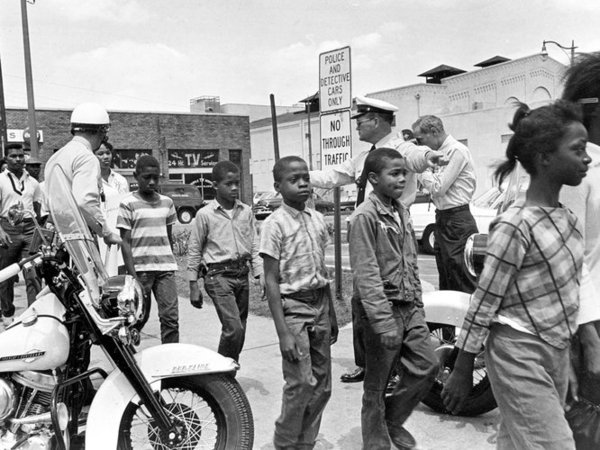
Police send a group of African American school children to jail in Birmingham, Ala. on May 4, 1963 during the Birmingham Children’s Crusade. (Bill Hudson/AP)
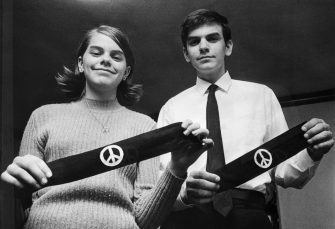
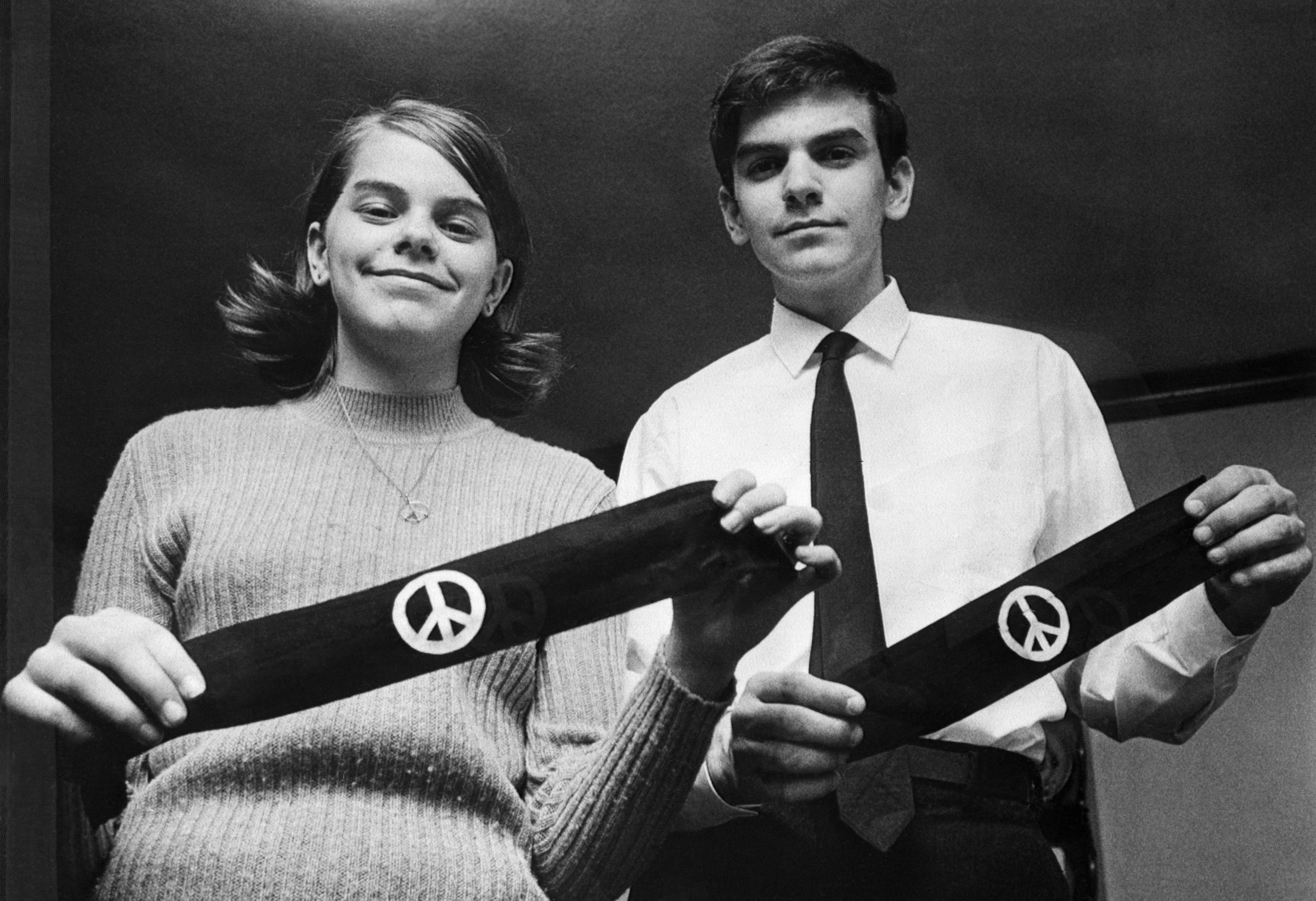
Fountain: Yeah, a group of students that wear black armbands to protest the Vietnam War get suspended. Lawyers from the ACLU represent them and it goes all the way up to the U.S. Supreme Court in 1969, which declares that students do not shed their constitutional rights at the schoolhouse gate. Of course there’s a caveat — as long as it doesn’t cause any disruption. Which leads to a lot of controversies going forward, where people are narrowly interpreting what that means. There are some funny stories of principals reinterpreting the Tinker decision.
So those are the major milestones in the book that I look at. Now, today you still see a lot of students who are walking out of school to protest the termination of a popular teacher or administrators, aligning themselves with labor disputes. There was a lot of high school student participation in the Israeli-Gaza conflict. And you still have a lot of these controversies over [whether] students have the right to walk out of school, [or] do they have a right to dress in a certain way in school. And of course, the allegation that they must be manipulated by outside agitators has been a persistent theme throughout the 100-year history of high school student activism.
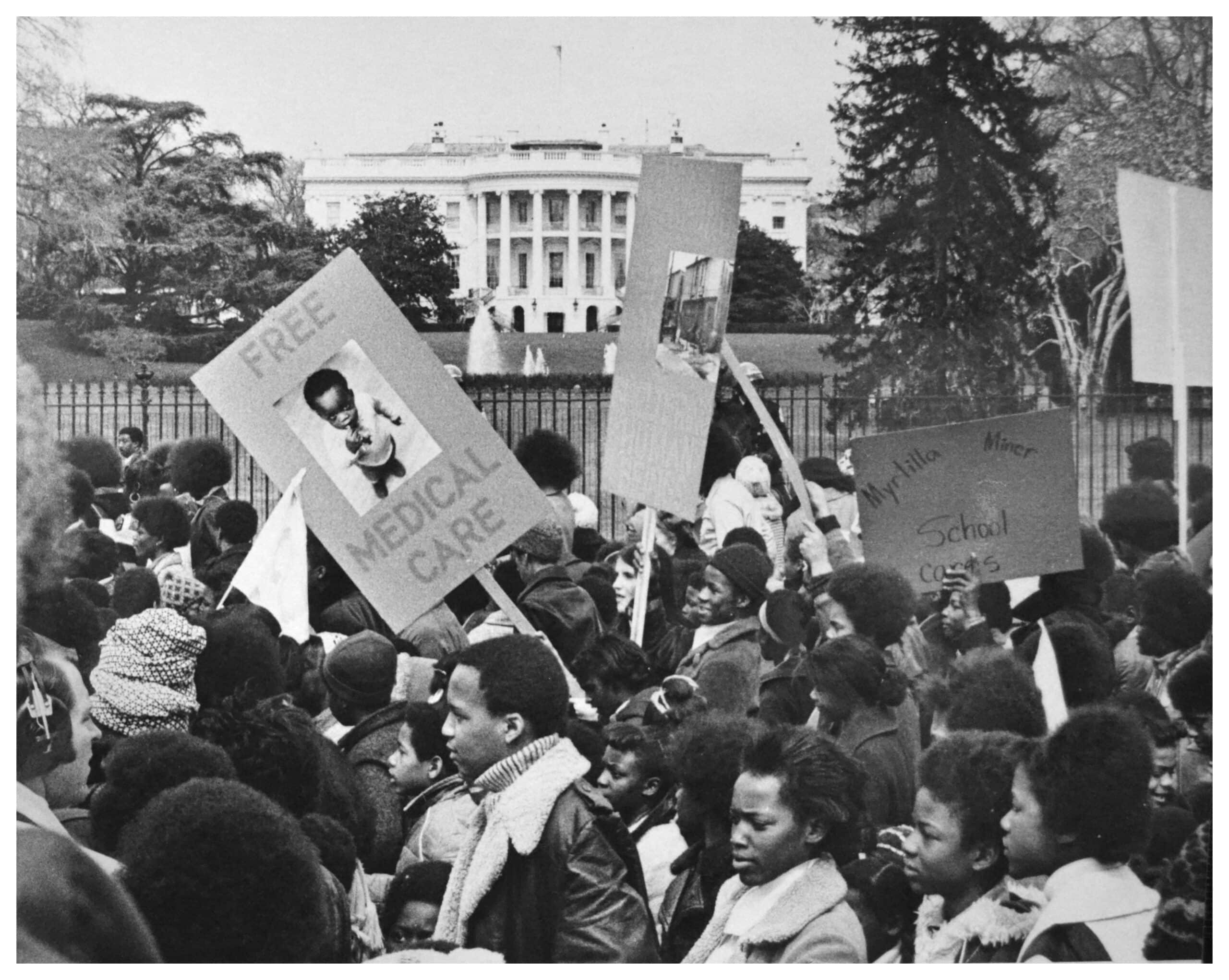
The Children’s March for Survival passes by the White House in Washington, D.C March 25, 1972. Source: Washington Area Spark
Hagopian: It’s so condescending. Any educator knows students aren’t that easily manipulated. They have strong wills. They don’t always do what they’re told. Which is a good thing because they make a lot of good trouble.
The history that you all have detailed is just really inspiring. You also talk about the repression, though. The attacks on students who are trying to exercise their rights and create collective struggle. I think many histories of police in schools that I’ve seen point to how the Great Migration was part of a racist backlash that followed, and then police would come into schools, especially where there were white students, to supposedly protect them from this integration.
But your research taught me a lot, from both of you, about how there’s another part of this history, that policing and surveillance were also in response to student activism. Jon, you show how Black student activism was treated by authorities as delinquency and disorder, and even violent behavior. And Aaron, you document school administrators working with police and the FBI to monitor student organizing and underground newspapers and target individual teenagers, including by COINTELPRO. So if y’all could talk a little bit about what did the authorities find so threatening about teenagers, and their response to school discipline, surveillance, and policing.
Hale: Something that comes to mind, especially when you’re reading transcripts and oral histories of what students were discussing publicly throughout the 20th century, is high schoolers specifically were unapologetically speaking truth to power. Whether it was after the Brown decision, the Civil Rights Act, or the Voting Rights Act, they weren’t afraid to step up and make demands of the institution. And I think that inherently provokes fear in school administrators. Because schooling in the United States has historically been designed to create or channel children, adolescents, and students into low paying work, if they were providing an education. So, schools are supposed to work for the elites — the 1 percent, those who control the means of production — and students who stepped outside of that, especially in historically marginalized communities, really got under the skin of school authorities.
What happens after Brown is we see this repressive apparatus, including what we know today as school resource officers. It was white supremacists reasserting racial dominance in desegregated schools by creating a surveillance and police force to keep that in line. I mean, Barbara Johns and her cohort of youthful peers brought on the most salient aspects of the Black Freedom Struggle because they were speaking from power, and white supremacists responded in the era of desegregation with this repressive apparatus. At the forefront of that is school resource officers, and I just also have to say, too, I also see two very inspiring individuals, activists, and educators that I learned from throughout the past 20 years. Judy Richardson of SNCC is in the audience, and Mark Levy, a Freedom School teacher of 1964, who has an amazing collection at Queens College. Good to see you, and I appreciate your inspiring work as activists in helping push forward our analysis today.
Hagopian: We’ve got a great group here, y’all.
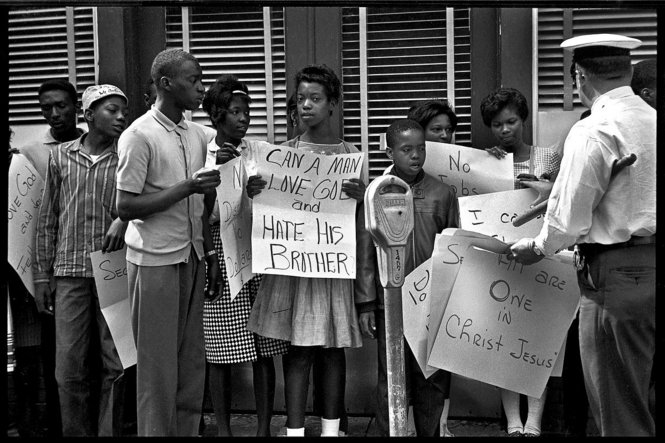
A police officer taking picket signs from young students protesting against segregation on May 3, 1963, during the Birmingham Children’s Crusade in Alabama. Source: Alabama Department of Archives and History. Donated by Alabama Media Group. Photo by Ed Jones, Birmingham News.
Fountain: In my book, I also include surveillance of teenagers. I should say, when it comes to the history of policing in schools, I’m not the first person, of course, to say that student activism was a response to that. But I did document the fact that surveillance should be incorporated in that history.
So in the late 1960s and early 1970s, there were a lot of student uprisings. I mean, over a thousand Black or Latino student uprisings. There’s plenty of underground newspapers and protests over the Vietnam War. So, school administrators, police officers, parents, etcetera, are wondering what’s causing all this disruption. And of course, the allegation was that it must be outside agitators.
Now, who were these outside agitators? Originally, it was labeled just as communists. But by the late 1960s, it particularly became the Black Panther Party and Students for a Democratic Society (SDS). This is a forgotten moral panic. I don’t think many people in the audience remember, but in 1969, there were a plethora of newspaper articles about SDS plans to radicalize high school students and infiltrate the schools. There was congressional testimony about it, the Toastmasters organization in Jackson, Mississippi pledged to go across the state to warn teenagers about the dangers of SDS. And the motivation for a lot of FBI surveillance operations was about SDS, the Black Panthers, or other local groups, like the Seattle Liberation Front.
School administrators, along with parents and fellow classmates, are actually contacting the FBI and police intelligence officials to monitor and spy on teenagers involved in political activism. And it occurred differently. Sometimes you will get a school principal [who] might invite an FBI agent to the school to talk to them. Or Catholic school officials in Milwaukee, Wisconsin [who] had secret meetings with police intelligence to strategize ways to undermine student radicalism in the city, to prevent it from spreading to other schools. And of course, you had secretaries as well as security officials and school board members and district-level administrators who would actually forward private information — like the student’s residence, where they live, their parents’ names, their parents’ professions, their physical description, and sometimes even giving character assessments, like,”Oh, this student is a radical, and they probably will end up like this in life later on.”
Sometimes the FBI does reach out to school principals and they don’t cooperate, [but] in many cases, they actually do cooperate. The FBI surveillance of teenagers occurred from 1961 to 1976. School administrators were largely there from 1967 to 1970. And they also are targeted in COINTELPRO operations. The FBI would mail packages to school principals in districts like Los Angeles or Washington, DC or Albuquerque, New Mexico, sending them literature about SDS. And in many cases they would successfully get school districts to ban the formation of the political group in their schools. So, this was something I only uncovered, not inadvertently, I was suspicious about it, but I tell the story in the book how I even came across this history and found that at least 371 groups were under some form of surveillance.
Hagopian: It’s incredible how much the armed state fears high school students being able to speak their mind. That tells you a lot about our country. I just love the brilliance and passion and creativity of our young people. I mean, Jon, you talked about Barbara Johns. Her story just cracks me up and it fills me with joy. Like calling her principal from a payphone downtown, saying there was a fight, and he goes to find it, and then she comes to the school and holds an assembly to say, “We gotta walk out, y’all. These segregated schools ain’t it. We’re getting the worst services.” And that goes all the way to the Supreme Court and Brown v. Board. I mean, this is how history has changed, but we only get the stories about generals and officials, and that’s what fills our textbooks.
Can you talk to us about what’s really creating change? I think that when we hear about the student protests of the 60s and 70s, they often get reduced to images of walkouts. We hear about a couple of the big walkouts that were really important. But beyond demonstrations and demands for integration, your books show students using a range of organizing strategies and making sophisticated demands around curriculum, Black history, school governance, policing and discipline, and so many other things. So, could you all talk about what these students believed education should be for and what kind of schools and perhaps what kind of society were they trying to create?
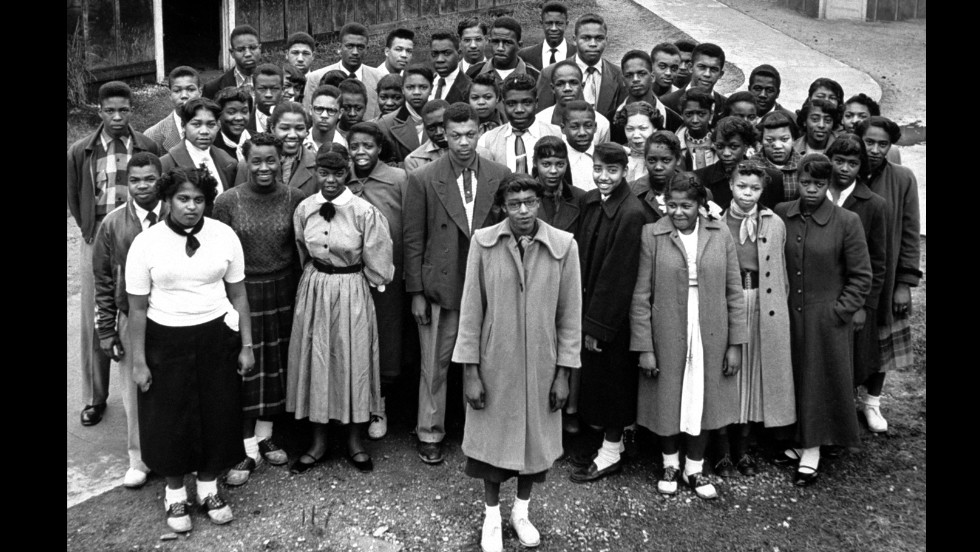
Group portrait of some of the more than 100 students named in the legal case Dorothy Davis, et al. v. County School Board of Prince Edward County, Virginia, a lawsuit filed to seek, initially, repairs for Robert Moton High School, a segregated school in Farmville, Virginia, March 1953. The case was later, on appeal, attached to the landmark Brown v. Board of Education case. Among those pictured is Dorothy E. Davis (center, with glasses), for whom the suit was named. Source: Moton Museum
Hale: I think about that question and I go back to the Freedom Schools in 1964. At the completion of Freedom School Summer, students gathered at the end of the summer and basically wrote a declaration of what could be read as a declaration of student rights. They decided to go back to desegregated schools and not maintain an alternative structure, because student activists in the 1960s were articulating an alternative to Brown that we had that I think elders had really yet to anticipate, which was they wanted access to resources, they wanted teachers who cared, they wanted a curriculum that reflected their values, their communities, and their families. That you follow the voice of youth and what they were demanding.
Especially what they were envisioning for quality public education was the models that we try to implement in schools today. It wasn’t trying to sit next to white students, it was to break down these structural barriers, and that included myriad possibilities. It included drawing on Vanessa Salcedo-Walker’s work, compassionate teachers who lived in the community, loving families, the families of their students. That included the right to fire racist teachers who are now teaching children of color in schools. It included basic principles of shared governance. If you think about it, if we would have listened to students, we could have implemented Brown in the desegregation process in a much more humane way, to really integrate youth voices into our decision-making processes. I think we’d be in a much more humane schooling system, if not a larger humane society right now.
Hagopian: No doubt.
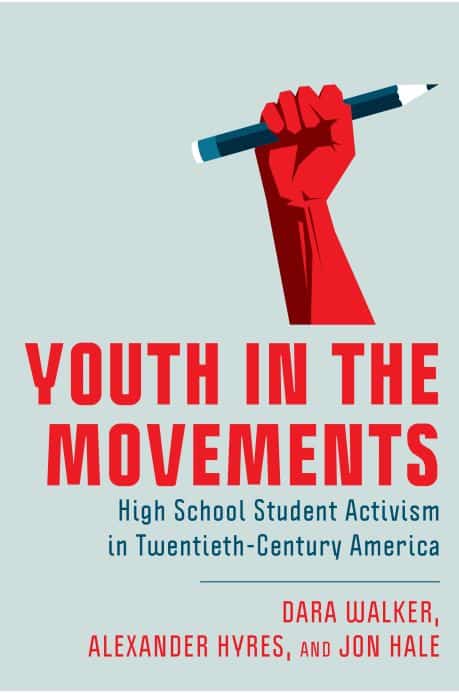
Fountain: I look at that in a book I called [Youth in the Movements], which I argue has two components. The first one is that high school students constituted an oppressed group analogous to poor people, women, and minorities. And the second idea was that you cannot truly reform society unless you first reform the high schools, which I think is what makes the high school movement a pretty distinct social movement for the 1960s and 70s.
So, throughout this movement students are arguing that they should be able to have democratic rights to practice in schools as well as the freedom to hear controversial speakers. There are incidents of students trying to invite anti-war speakers and even open communists to schools, arguing that they were mature enough to not only hear controversial ideas, but to arrive at their own conclusions. But there are also other things, too. They want the freedom to eliminate dress codes, which I know seems kind of frivolous. In fact, a lot of the literature I look at by contemporaries, students would complain that it’s hard to get students organized around serious issues. They just love to address dress codes.
But dress codes are quite political, because when you read feminist magazines you would see girls write letters complaining that boys would purposely drop their pencils on the floor to pick it up, and obviously look up their skirts. I talked to my aunt about this, and she went to school in New York City, where if you had two girls fighting, boys would drop small mirrors on the floor, and you get the drift of what they’re trying to do. So, they were much more political than people might think. But also, too, they’re articulating we want freedom from harassment by police officers or security guards who were notorious for sexually harassing female students. It’s a period where their ideas are taken seriously, and they’re actually just arguing that to forge a truly egalitarian society you first have to reform the school. So, school reform is actually rooted in the effort to build a better society for them.
Hagopian: Yeah, no doubt. Especially when schools too often are just organized around integrating kids into an inequitable economy, preparing them for low wage jobs rather than empowering them to change the world. Aaron, one of the things that really struck me in your book, High School Students Unite!, is the struggle for a student’s bill of rights that happened in Philadelphia. Students weren’t simply demanding better treatment, they were asserting that they had rights inside the school, including rights to speech, organization, protest, and due process. So, can you talk to the educators here this evening about Black student organizing, how it helped produce this student bill of rights, and what the struggle tells us about the role of high school students in expanding the meaning of civil rights?
Fountain: Yeah, high school bill of rights campaigns [are] not well-remembered because they’re not very theatrical. A lot of it’s just committees and negotiations. They normally followed a student uprising, and student uprisings can consist of a dozen to a thousand to tens of thousands of students walking out or boycotting school for a list of racial grievances. But they had really mixed results. Some were quite successful, students might achieve their demands immediately, but quite often you would get school boards who would say, “Yeah, we’ll look at the issue.” Then they just put it on the back burner, and then the summertime comes, and it’s just never brought up again.
These high school bills of rights were formal declarations that were drafted to become official school policy, so they had much more teeth and muscle. They occurred in big and large cities like New York City and Jeffersonville, Indiana, which is a suburb north of Louisville, Kentucky, and in Philadelphia. I follow a woman named Susan Bailey, who comes from a pretty middle-upper-middle class Black family, and lives in Mount Airy, which is the only intentionally racially integrated neighborhood in Philadelphia. That’s where many of the leaders came following the 1967 Black student walkout in Philadelphia, where 3,500 students congregated downtown at the school board to demand courses and other educational demands.
A police riot occurred. Frank Rizzo, the police chief, orders the police to attack the students, and dozens of students are injured and arrested. It caused a huge controversy. And there’s other student uprisings that are occurring in Philadelphia. The school district aligns itself with the police department to have police cars stationed in “troubled schools.” So, inspired by New York City students who created a high school bill of rights, the superintendent at the time, Mark Shedd, formed a committee of students, teachers, and administrators, to draft a bill of rights.
What were the high school bills of rights? It was largely policies that regarded discipline, due process, free speech, and more empowered, student government, etcetera. It kind of ran the gamut. And it’s controversial, there’s a lot of debates and discussions that occur at the school board. But the school board eventually adopts it 5 to 3. It comes under a lot of attacks by the teacher union, but eventually it actually is adopted as formal policy after a survey came out showing that administrators and teachers believe that it closed the communication gap.
But one reason why I find this story so intriguing is because students in Philadelphia, even though some of them are privileged, it’s a citywide effort, so it’s kids from the ghetto, kids from middle-class households, and Black, white, Puerto Rican. They come together in this racially polarized city and they articulate their grievances that schools were prioritizing memorialization over critical thinking, or there was a lot of wasteful spending on administrative thrills. Also, they thought that teachers had too low expectations of them, and they wanted to read a book that was beyond their grade level. They just felt that many teachers would restrict them from it. And it runs a gamut of all these issues that they’re talking about, but it’s a really unique time when you get very disadvantaged youth that are on an equal playing field with adults to give their critiques about education are taken seriously, and are actually quite successful. The document existed for at least 6 years, but some of this residue still continues to this day.
Hagopian: Yeah, it’s a fascinating history and you really have to read it to understand how widespread high school activism was and the range of their demands. So thank you so much for sharing that. I want to ask one more question before our breakout rooms.
Jon, one of the contradictions you explore is that victories against legally segregated schooling could also result in the closing of Black schools or the displacement of Black educators, and just generally the weakening of institutions rooted in Black communities. You describe a tripartite attack on Black students, teachers, and schools. At the same time, you show that Black schools and Black educators helped nurture political consciousness and student activism. So I wanted to ask you, how does this history complicate the conventional story of school desegregation, just as an uncomplicated victory? And what was lost when Black schools and educators were displaced that had helped nurture generations of young activists?
Hale: I think a standard narrative out there in the United States about public education — outside of those who know what the Zinn Education Project is, and not enough people know about Zinn Education Project — but I think those outside of a more critical awareness of United States history see Brown as a sort of celebratory, inclusive narrative. That Brown was reached by the good graces of a federal government and the Supreme Court, and the system grew to be more inclusive.
But when you follow student activism, you can see that this wasn’t a top-down decision. It was youth and youth working with community elders who have been organized for decades to create public schools in their communities. That took an organizing effort, right? In the first two chapters of my book, I discuss how youth were involved with that institution building that really carried the legacy from Reconstruction of building schools. There’s a history there that a lot of times history starts with Brown, but we can complicate it by showing that education was an organizing tool. Communities were building capacity for activism around creating better schooling opportunities. You miss out on that with the Brown narrative.
But at the same time, you have to see that the legacy of Brown is not this inclusive, celebratory narrative. I think the principles should be valorized to some extent, but the execution among white supremacists, or among those invested in white racial domination, reacted to Brown, where they attacked Black communities and schools, a robust Black professional teaching class, a middle class across, especially the United States South, but across the United States. That devastated an economic incentive, it devastated institutions that were built around educators who cared for their students. That was a devastating blow in the sense where, when white supremacists reacted to it, they put a wrecking ball to community organizing, a middle class that was sustaining itself through professional work.
It also created, again, a surveillance or a police state in schools. A lot was lost, and I’ll point to the work, of course, of Leslie Fenwick, in addition to the work discussed here today. Leslie Fenwick’s Jim Crow’s Pink Slip articulates and identifies the numbers. Conservative estimates suggest that 38,000 Black teachers lost their jobs in the first 10 years after Brown. That’s not an inclusive narrative, but a sort of white-controlled push out of Black educators. No wonder we look around the United States today and nearly 80 percent of our teachers are white. That’s not an accident, that’s not inevitable, there’s nothing natural about that. That was white supremacist calculation after Brown to remove teachers of color because they were working with youth to change the entire structure. So the hope is still there, I feel, in that youth activism at Marjory Stoneman in 2018, the youth in Montana speaking to environmental justice, youth continuing to push the boundary that continues and rests alongside racial domination that still exists in schools today.
Hagopian: I really appreciate that context you gave to Brown because too often people just uncritically celebrate it. The way that you just phrased that, that it wasn’t just that they were firing Black teachers because they were racist and they were Black, it’s also because they were so good at empowering their youth to be part of the Civil Rights Movement. That formulation really hit me, and I really appreciate that you framed it that way. Thank you for that insight.
I’m just so glad for this conversation. My son is on this call, and he helped to found the Seattle Student Union and has led different efforts around support for Palestine, or against ICE, or for mental health counseling. I’m so glad that he’s learning this history that you all are laying out, and I know that teachers here are going to have a lot to pass on to their students.
[breakout rooms]
Hagopian: I want to welcome our authors back. We’re going to continue the conversation. I have a question for you both. One thing I found fascinating reading these books together is that neither of you present student activism as simply spontaneous. Jon, you show teachers, Black schools, churches, and NAACP youth councils, families, community institutions, all helping to nurture young people’s political consciousness. And Aaron, you show teenagers also building their own organizations, newspapers, conferences, and national networks. How should we understand the relationship between youth agency and the adults, especially teachers, who supported and sometimes organized alongside them? What did the most productive student-teacher relationships look like? And what can teachers today learn from them about how to support student activism without trying to control it?
Fountain: One thing I will say, when I wrote this book, I didn’t want to do the stereotypical thing that a lot of scholars of the 1960s do, where you paint administrators as the bad guys. It’s a collaborative effort; they do need each other’s cooperation to achieve their goals. I will say with teachers, interestingly, a lot of it definitely was a generation gap. You definitely see a lot more conservatism among older teachers. But a lot of younger teachers in the 60s were just fresh out of college and had been political activists while they were in college, and even as teachers.
Many of the schools I looked at had educators who were involved in the anti-Vietnam War movement or involved in civil rights organizing. So indeed, they did somewhat collaborate with the students. Believe it or not, teachers sometimes had their own underground newspapers. I had literally seen educators contribute articles in underground newspapers that were published by the students to give their critiques of the paper, or to tell students, “Okay, you might think about this issue, in this type of way.” Normally anonymous, because again these were illicit documents that were distributed on campus.
When it came to the anti-Vietnam War movement, interestingly, I’ve seen incidents of teachers who would literally not punish students for participating or walking out of school, even though they were told to do so. Or sometimes they might take a leave of absence to join a demonstration that was going on. So, it’s a relationship. It’s there, but it still doesn’t cross professional boundaries. They’re still professionals, and they have to do their jobs. But there definitely is a generational gap that occurs among the educators at various schools.
Hagopian: Right on.
Hale: I’ll quickly add, too, I think for the teachers in the room, that . . . and Aaron, I appreciate your point about administrators, too. And a quick shout out to Janel Moore-Almond, who’s in the room, who’s doing phenomenal work in Philadelphia. Her dissertation will be out soon, check it out on the development of curriculum in Philadelphia, but also what that meant to organizing and public education overall.
But with student activism it was never in a vacuum. It was always connected. I mean, it was autonomous, yes, but they were always almost . . . I mean for the quantitative folks in the room, I’m not going to say always, but there were a lot of notable instances, rather, of teachers working with youth. I’m thinking of Charleston, South Carolina, where you have Miss Lois Simms. She was an active member in her church, where she played organ. She was writing history at the church, where she knew her community. She was there until the day she transitioned and passed in Charleston in the same family home. She was there, she was a member of the community, but oftentimes supporting the young activists in her classrooms.
I’m also thinking of Mr. Eugene Hunt, who was a critical educator from Charleston, South Carolina. But a lot of the activists pointed to these two educators as providing support for their efforts. Sometimes, way back when, speaking of newspapers, they’d share newspapers that they had with the students. They’d encourage students to meet in places like church basements. They would open up spaces. They weren’t on the front lines necessarily, that’s something we have to remember too. Activism is a spectrum. You can go to a meeting and talk about bylaws, but that is a form of activism if you’re shaping constitutions for the public good. That is a form of activism that’s often overlooked. Same with teachers who may be implicitly supporting young scholars by pointing to chapters of Students for Justice in Palestine to call out the genocide, for instance, to organizing units in neighborhoods who are calling out ICE when they see them. So teachers were present in these spaces, too. They’re not often on the front pages of all of our books, but they’re there and present. And there’s a strong continuity that I think a lot of educators and administrators are carrying forth today.
Hagopian: Y’all are making me think about the day that a young Black mother was shot by police in Seattle and I decided to just stop my teaching that day and turn it over to the youth to talk about what they thought about it. They organized a rally right there in my classroom, and the next day got hundreds of students rallying on the steps. And I know that kind of thing has happened in countless classrooms where injustice occurs throughout U.S. history. And those actions really matter. My students built a connection with her family, and went on to build a city-wide rally that really helped change the debate. So, I appreciate you lifting up that work of educators.
We’ve been talking about history stretching across roughly a century, yet most students, and probably many teachers, have never learned that high school students have repeatedly organized. All of this history is often completely absent in corporate textbooks. A little bit around the anti-Vietnam War movement or some around the Civil Rights Movement, usually with college students, though. And so much of this is just invisible to our youth. I wanted to ask you, why should teachers teach this 100-year history of high school student activism, and what might young people understand differently about themselves and their own power if they know how young people have repeatedly challenged authority and won changes and helped make history themselves?
Fountain: One person I love to quote is civil rights activist Diane Nash, who once said, “The biggest problem with the Civil Rights Movement is that many people view it as a Martin Luther King movement and not a people’s movement. And when that happens, rather than asking, what can I do, they just sit around and say, ‘Oh, can somebody like Dr. King come along?’” I think it’s really important for many young people to see folks like themselves make a change in the past. There’s a rich history, of course. I wrote an article in Time Magazine where I talked about the fact that there were numerous articles about ICE agents showing up on junior high and high school campuses, and how these stories were just portraying students as passive victims. But there were accounts of protests on high school campuses against ICE raids or ICE officials coming on campus, too. And I think those stories, you need to highlight that, not just contemporary, but also, historical. And when teaching this history, it’s important to understand that you don’t want to romanticize the past, that these protests, they’re not all 100 percent successful. Some of them win demands immediately, and others, it takes weeks, months, and even years. In fact, I think of the 1972 student walkout in London, which had a range of issues, but mainly about corporal punishment. While it didn’t eliminate corporal punishment until over a decade later, it did raise the issue in the public consciousness to get people to question it. So, some of the impacts happened maybe some years after the students organized, but at the end of the day, these are still stories that need to be told.
Hale: You’d like to hope that this history provides a map for future activism, that students can look back and see themselves, or see young people like them and can identify, that hopefully that is a map for them to follow as they look toward the future. I want to uplift the work of one of my inspiring colleagues, Dr. Asif Wilson, at University of Illinois, who talks a lot about the co-construction of knowledge. I feel that if teachers can center youth, community, and community elders in the process, they can de-center themselves and open themselves up to this co-construction of knowledge that has been lost after Brown. I think in some sense an act of recovery. I feel like going through this history of youth asking teachers to consider United States history from a different perspective arguably opens up new ways of teaching, which includes co-construction of knowledge with local activists who aren’t Dr. King, who aren’t on the covers of our history textbooks. But we know every community has local organizers there, and their stories remain to be told. If teachers, and again, I’m calling on white teachers specifically, who benefited from the transition after Brown, to consider what it’s like to co-create lesson plans and work with community elders to build a new curriculum that ultimately facilitates activism and rebuilding a lot of these structures.
Hagopian: I love that you talked about co-constructing knowledge. It’s just such a powerful idea and paradigm shift around what education can be. And intergenerational struggle is just an incredible force when you can draw on the power of young folks and some of the experience of older educators. You put those together, I mean, I’ve seen incredible things happen, and your book highlights what’s possible throughout history. And we have to recover these lessons right now because there’s too many crises in our society that need those struggles. I’m just struck by the incredible wealth of knowledge that’s on this call right now. I just wanted to ask Mary Beth Tinker if you’re able to unmute and just say a word about what it was like to be a high school student and what happened in your struggle before we move to the evaluation.
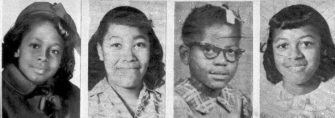
Mary Beth Tinker: Thank you, Jesse. It’s so good to be here tonight. This is just an ongoing campaign of students to speak up for their rights and for their dignity. Students have been discriminated against for years, young people, children, teenagers. And I do want to mention that the Tinker v. Des Moines case. Actually, the first time we wore black armbands to school was to mourn for the dead little girls — Cynthia, Addie Mae, Carol, and Denise — who were murdered in a 1963 bombing in Birmingham, Alabama. That was the first time we learned about black armbands, and we wore them around the country because James Baldwin and Bayard Rustin suggested that people wear black armbands to mourn for them. So that’s when it started.
But also, I just want to mention the Burnside v. Byars case, after Freedom Summer, when students wore buttons to schools in Mississippi. They became two cases, Burnside and also there was Blackwell from Anita Blackwell. Those cases became precedent cases for the Tinker v. Des Moines ruling later at the Supreme Court in 1969. So it was all so much tied in with the Black Freedom Movement. Growing up, it was so clear to us that it was all connected, the anti-war and peace movement, and the fight for civil rights, and I was very lucky that our family was very immersed in both of those, and we had lots of support from adults and young people as well in the Iowa community. So, thank you so much for your work here. I appreciate it so much. Thank you.
Hagopian: Thank you so much, Mary Beth. Hearing what that struggle was like for you and how you connected anti-war and racial justice struggles is really inspiring. We’ve got to do the same thing today with genocide in Gaza and the bombing of Iran, and connecting that to attacks on immigrants and Black folks here. We’ve got to do the same thing. So I hope people will study your story.
And maybe we could just end with Judy Richardson. Judy, I don’t know if you want to say a word of advice to educators here today about how to support young folks? Judy helped produce Eyes on the Prize and helped, as a leader in the Student Nonviolent Coordinating Committee (SNCC), and I know your work has been an inspiration to so many.
Judy Richardson: Well, first of all, I was not a leader. I really was not, but I appreciate that. I learned from all the leaders who were 18, 19 years old like I was, but I was not one of them. But I will say, you all are on the front lines. There’s nothing I can tell you. The fact that you’re here. The main thing for me was that I found my people. And those people have been with me, and I’ve been with them, for the last 65 years. So, when we do the NEH SNCC toolkits, when we work with Teaching for Change, all of that is because we are, as we used to call it, “brothers and sisters in a circle of trust.” And it’s really important because this is hard. And those folks will come after you every which way. They know how. It is important that you have a group that you can be part of that will help support you, and you support them. And for me, it was the SNCC folks that I’ve known for the last 63 years. And this is what this group is. And I just cannot tell you how much I appreciate it and how much I get energized by it. We’ve all got to keep going because these people are crazy!
Hagopian: No doubt. Judy, thanks for firing us up. We’re going to all continue this struggle against curriculum banning and censorship of books, and fighting to teach the truth, fighting against this rising fascism, fighting for our immigrant siblings, and connecting all these struggles. So thank you all for being here engaging in this conversation.
While this transcript was edited, there may be minor errors or typos — if you notice something you believe to be incorrect, please contact us at [email protected].
Resources
Here are many of the lessons, books, and other resources recommended by the presenters and participants:
Lessons
|
|
“A School Year Like No Other”: Eyes on the Prize: “Fighting Back: 1957-1962” by Bill Bigelow. Rethinking Schools. This is a companion lesson for the Eyes on the Prize segment “Fighting Back: 1957-1962” The History All Around Us: Roosevelt High School and the 1968 Eastside Blowouts by Brian C. Gibbs COINTELPRO: Teaching the FBI’s War on the Black Freedom Movement by Ursula Wolfe-Rocca Teaching SNCC: The Organization at the Heart of the Civil Rights Revolution by Adam Sanchez Teaching the 1964 New York City School Boycott by Adam Sanchez |
Books
Articles
|
|
Newly Declassified Records Suggest Parents Collaborated With the FBI to Spy on Their Rebellious Teens During the 1960s by Aaron G. Fountain Jr. in Smithsonian Magazine The African American Roots of Betsy DeVos’s Education Platform by Jon N. Hale in The Atlantic The Forgotten History of High School Student Activism by Aaron G. Fountain Jr. in Time Magazine Tinker v. Des Moines: Youth Rights in a Time of Plausible Genocide by Mary Beth Tinker |
/https://tf-cmsv2-smithsonianmag-media.s3.amazonaws.com/filer_public/5a/f8/5af8aeb4-a1e1-4e24-88a7-fab1fefb8ce2/gettyimages-615964846.jpg)
This Day In History
The dates below come from our This Day in People’s History collection, which contains hundreds of entries all searchable by date, state, theme, and keywords.
|
|
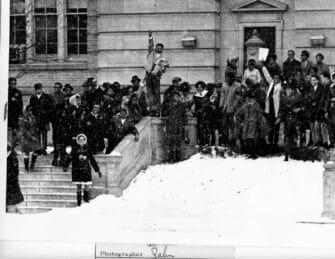
April 14, 1947: Mendez, et al. v. Westminster Ruling June 5, 1950: The Supreme Court and School Segregation Cases April 23, 1951: 16-Year-Old Barbara Johns Leads a Student Strike May 17, 1954: Brown v. Board Ruling April 18, 1959: Students Petition and March for Integrated Schools June 26, 1959: Prince Edward County Closes Public Schools May 2, 1963: Children of Birmingham Fill the Jails Sept. 15, 1963: 16th Street Baptist Church Bombing Oct. 22, 1963: Chicago School Boycott Feb. 3, 1964: New York City School Children Boycott School April 1, 1965: Blackwell v. Issaquena Board of Education June 11, 1965: Chicago School Boycott Dec. 16, 1965: Students Suspended for Anti-War Armbands Sept. 16, 1968: Harrison High School Student Uprising Sept. 21, 1968: New York High School Student Union Founded Nov. 25, 1968: John Hay HS Walkout Feb. 24, 1969: Tinker v. Des Moines Case Wins Free Speech Rights for Students |
Participant Reflections
With more than 110 attendees, a poll of participants’ primary roles in education showed 38 percent K–12 teachers, 14 percent teacher educators, 12 percent historians, and more.
Here are more comments that participants shared in their end-of-session evaluation:
What was the most important thing (story, idea) you learned today?
The fact that teens faced FBI repression! That’s wild!
The student protest movement dating back to the 1920s was a revelation!
That so many students were organizing, using demos and newspapers.
I didn’t know that administrators were collaborating with the FBI.
The breadth of student organizing, even including underground newspapers, between the United States and Canadian provinces.
About Barbara Johns, Mary Beth Tinker, and the history being made in our schools today!
Learned how many Black teachers lost their jobs during integration which has led directly to the fact that a predominant number of teachers today are white.
High school students in New York formed and presented their “student bill of rights.”
The creativity and determination of student activism — such as the student who called her principal away from school to convene an assembly and organize protests.
About all the amazing ways that young people step into their power to organize and hold folks accountable.
The idea that not all activism is remembered because it is less flashy (e.g. meetings about bylaws) but it is still very important!
The idea that students have always been organizing and we need to encourage that to continue.
What will you do with what you learned?
I work in teacher education and will add these resources and insights with my future educators.
I’ll include all this amazing info when sharing Movement-writ-large history.
I will integrate information learned here into my teaching of the Constitution, the Bill of Rights, and reform movements.
I’ll encourage youth to follow their beliefs and concerns.
Add on to my unit on Educational Justice for Ethnic Studies. I’m going to get these books.
I will be creating a resource to use about Barbara Johns to share with my teacher PLT for incorporation into our classrooms.
I will find ways to help students redirect their voices and energies toward radical change. I will try to also help students know how powerful their voices can be collectively.
I am going to invite my students to learn about high school activism as part of their study of U.S. young people’s roles in civic participation.
I will keep an eye out for news events that affect my students closely and do my best to allow class time to talk about them.
This history gave me the information to empower youth that sit in chairs before me. To give real examples of others who stood for the betterment of others. . . for them.
I will incorporate notes from this talk (and my reading of the two books) into a unit I teach (alongside my grade 10 ELA colleagues) about nonviolent direct action. I will also share this information with student groups in my school (particularly the practical know-how or “maps,” as Jon Hale said).
How was the format for the class?
Smooth as always! Y’all rock.
I think this should have been three hours!
The breakout room was great. Perhaps a way to keep networking.
Grateful for the breakout groups as a time to connect more personally and process, though there’s never enough time.
I always use these forums as an opportunity to thank you all for continuing to provide the opportunity for what Zaretta Hammond calls “active processing.” Thank you. It is a politically and pedagogically essential practice.
The breakout room facilitator was really great. I have been in those rooms before where no one speaks up and everyone has their cameras off. However, with the facilitator, everyone felt empowered to share.
I came to listen to the authors but enjoyed a short breakout session for reflection sharing ideas. Jesse’s facilitation is always insightful.
The structure of everything was useful, and the breakouts gave me an opportunity to process. Articulating what I was thinking about was particularly useful for moving beyond passive listening.
I thought the format worked really well. I loved that Mary Beth Tinker and Judy Richardson were able to speak at the end. And I loved the conversation between both of the historians providing a broader continuum of historical perspective.
Presenters
Aaron G. Fountain Jr. is a historian and public scholar. His book High School Students Unite! was a finalist for the 2025 Los Angeles Times Book Prize for History. His articles have been published in Time, Smithsonian Magazine, Al Jazeera, The Hill, and more. He has begun work on his second book, which is a cultural and political history of teenagers and the Vietnam War in North America, Australia, and New Zealand.
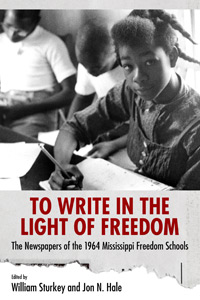
Jon N. Hale is professor and associate head of education policy, organization and leadership at the University of Illinois at Urbana-Champaign. In addition to A New Kind of Youth, Hale is also the author of The Choice We Face: How Segregation, Race, and Power Have Shaped America’s Most Controversial Education Reform Movement and The Freedom Schools: Student Activists in the Mississippi Civil Rights Movement, and co-editor of Schooling the Movement: The Activism of Southern Black Educators from Reconstruction Through the Civil Rights Era, To Write in the Light of Freedom: The Newspapers of the 1964 Mississippi Freedom Schools, and Youth in the Movements: High School Student Activism in Twentieth-Century America.
Jesse Hagopian is an editor for Rethinking Schools, co-editor of Teaching for Black Lives, editor of More Than a Score: The New Uprising Against High-Stakes Testing, author of Teach Truth: The Struggle for Antiracist Education, and the Teaching for Black Lives campaign director for the Zinn Education Project. He previously taught Ethnic Studies and was the co-adviser to the Black Student Union at Garfield High School in Seattle.
Twitter
Google plus
LinkedIn