
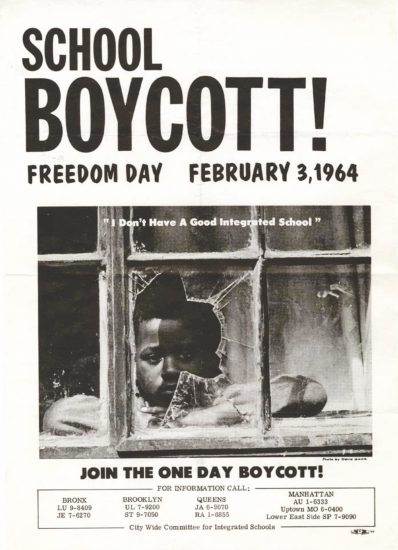
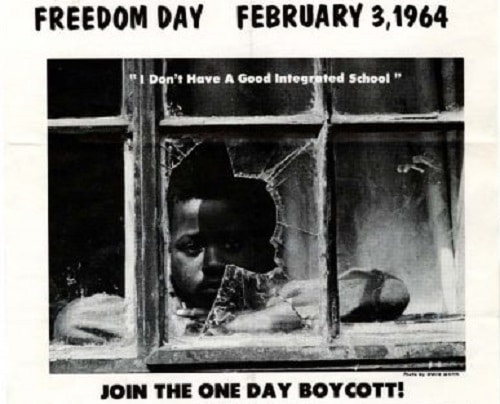
New York City school boycott flier, January, 1964. Source: Queens College Civil Rights Archives, public domain
By Adam Sanchez
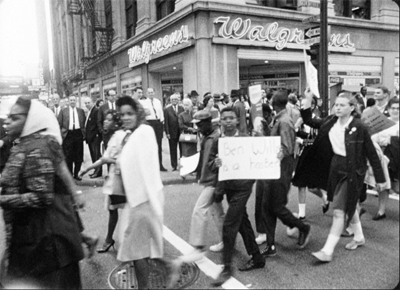
Despite obligatory coverage of the Civil Rights Movement in every history textbook, I have yet to find a single K-12 textbook that mentions the largest civil rights protest of the 1960s. So it is no shock to me when I ask my New York City students where they think the largest civil rights protest of the 1960s occurred, they guess Washington, D.C., Selma, Alabama, or other Southern cities. The real answer, however, is New York City, the city where most of my students were born and raised.
The traditional narrative of the Civil Rights Movement tells a story of a movement that exclusively fought against racist laws in the South. This narrative tells a story of American progress, one in which most Americans, especially those in the North, responded positively to the demands of the Civil Rights Movement and righted the wrongs of lingering Southern racism.
The movement, in this story, triumphantly wins when the Civil Rights Act of 1964 and Voting Rights Act of 1965 strike down Jim Crow laws in the South. This narrative ignores more than it reveals.
The real Civil Rights Movement was not just about tearing down legal barriers but about economic inequality, police brutality, and access to quality education and healthcare. This movement was national in scope, led by young people, and confronted segregation and racism in both the North and the South. In many ways, this movement was unsuccessful in places like New York City, leading to a deepening of some aspects of structural racism and segregation that exist to this day.
The real history of the Civil Rights Movement, therefore, is not simply a narrative of success. It’s a narrative that helps us understand today’s institutional racism, because many aspects of racial injustice that the Civil Rights Movement fought against were never remedied. . .
Continue reading at Rethinking Schools.
Adam Sanchez teaches at Abraham Lincoln High School in Philadelphia. He is a Rethinking Schools editor, a Zinn Education Project teacher leader, and is also editor of Teaching a People’s History of Abolition and the Civil War.
 This lesson and accompanying article is in the Winter 2020 issue of Rethinking Schools. Subscribe to the Rethinking Schools magazine today.
Classroom Story
I thoroughly enjoyed using the Teaching the 1964 New York City School Boycott lesson in my classroom, as did my students. This past school year, with all of the political turmoil that came with the year, my students were uniquely interested in political involvement and protest. This lesson allowed me to teach about the power of the youth throughout history and how critical their involvement in issues like desegregation were to making real and lasting change. It is my hope that through more lessons like these, students will learn that it is alright to speak up and speak out, no matter their age. All citizens of the United States are allowed to participate in its government.
Twitter
Google plus
LinkedIn