
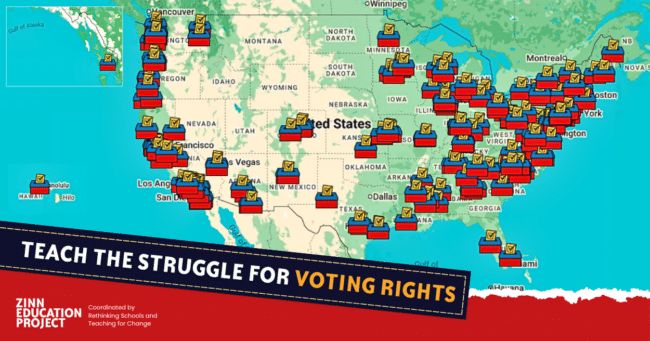
Teachers around the country are requesting our Voting Rights Teaching Toolkit to help young people see voting as part of a broader effort to improve their lives and communities — and to see themselves as agents of change rather than spectators to politics. The National Education Association printed the lessons, voting rights organizations provided additional resources, and individual donors are contributing to the cost of postage.
Our goal is to send at least 500 toolkits and reach all 50 states and territories. Your donation can make that possible.
Each request for a toolkit includes a note about how or why the educator plans to teach about voting rights from September through the election. Here are a few responses:
My goal is for my students to be informed, involved members of society, and consider how to have a meaningful social impact. This includes being informed about the pitfalls and shortcomings of this country, such as the fact that the Constitution was not designed with all in mind, and voting rights have been, and continue to be undermined. This feels particularly important considering that I teach in the South, and that voting rights are being actively threatened here. — high school social studies teacher, Durham, North Carolina
Locally, our borough assembly is anti-education and has been withholding funds leading to massive teacher layoffs in our district. I’ve already started working with NEA Campaign Lab to elect pro-public education candidates and improve the public perception of education in Ketchikan, Alaska. We need to teach our students early about the importance of voting and educating yourself on the platforms of candidates and choosing the issues that matter most to you. — middle school special education teacher, Ketchikan, Alaska
The families of English learners are really struggling right now with their rights, given ICE activity in our area. I would like to emphasize what is supposed to happen in a democracy, and the history of how we formed our government and democratic norms. — Elementary ESL teacher, Sharon, Massachusetts
I want students to leave these lessons with a stronger understanding of the Constitution, the rights and responsibilities of citizenship, how elections and government institutions work, and how to distinguish credible information from misinformation or partisan persuasion. This is especially important in an alternative learning setting, where students may have had different experiences with school, government, and other institutions. — middle and high school social studies teacher, Cass Lake, Minnesota
Many of my students, as well as their parents, live in poverty and also are illiterate. They rely heavily on community resources to survive. Being informed and able to vote would be very relevant to these families and my students. — teacher educator, Richmondville, New York
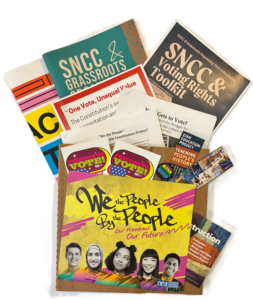 Each box includes:
- “Who Gets to Vote? Teaching About the Struggle for Voting Rights in the United States” 3-lesson unit
- “We the People” Constitution lesson
- Constitution Gallery Walk
- SNCC Legacy Project Voting Rights and Interpretive Booklet
- Teach Banned History button
- Teach Reconstruction Campaign postcard
- “Teach. Vote. Resist. Organize” poster
- “We the People By the People” poster from the NEA
- Social Justice Books list on voting rights for grades pre-K–12
- Resources from ACLU, NAACP Legal Defense Fund, Taskforce for Democracy, and more
We need your help to send more voting rights teaching toolkits. Donate today to provide young people with the tools to defend voting rights.
Classroom Stories
Finding materials that explain the critical timeline of voting history without whitewashing it is tough. I believe the Zinn Education Project’s Voting Rights Toolkit fills that gap.
I used the Who Gets to Vote? Teaching About the Struggle for Voting Rights in the United States lessons, and what worked best was the focus on primary sources. Having students read firsthand accounts from activists like Fannie Lou Hamer gave them a critical look at what voter suppression actually looked like on the ground. The timeline activities and posters helped break down a complex legal history into something that students could easily understand. Creating graphic organizers that complement this also helped in the classroom.
It’s a solid well-researched resource that has saved me hours of preparation and has helped my students understand the reality of voting rights always being contested depending on the historical context. Thanks for all these resources, they have helped me so much in my class. Thanks to these resources, my students now have a deeper understanding of voting history in this country.
In my role as a teaching and learning coach, I am using this Voting Rights Toolkit to share with my government and U.S. history teachers. We have already worked on getting our students registered to vote this week and we have reached out to multiple organizations including the League of Women Voters. We’re using this information in our Center for Democracy and Civic Education organization and we are using it with the New Mexico Council for Social Studies to support teachers.
We have an event this coming week and we will be sharing the documents and the book with them there, particularly highlighting pieces of it in our weekly newsletters. So this one material is being used not just with students in the school where I work but with students and teachers across the state of New Mexico. Posters, stickers, and flyers have already been hung up and we have been discussing voting rights in all the different organizations and in my school classrooms. We are also using this material as a resource as we work on the New Mexico diplomacy legislation as well as the Freedom to Read legislation that we are trying to push in the next 60-day session.
These materials were instrumental in my unit on the unfinished revolution that is the fight for civil rights. I’ve used both Teaching About Unsung Heroes, Resistance 101: A Lesson and Activists and Strategies and the Woman Make History lessons that were shared and I will tell you that it’s been a really exciting exercise for my students to engage with. Students are currently in the process of studying change-makers and defenders that were part of that role play, doing a deep dive into their lives so that they can share what they learned with the larger school community. The posters will be displayed in the hallway so that they will be available for kids as young as 2 to see and engage with.
I’m planning on using What Does the Constitution Mean to Me Today? with my study of the constitution later this year and I love the updated resources that are allowing me to bring diverse viewpoints into the classroom in a way that feels safe for everybody. It has given my students broader view of what change looks like and how they can be apart of it.
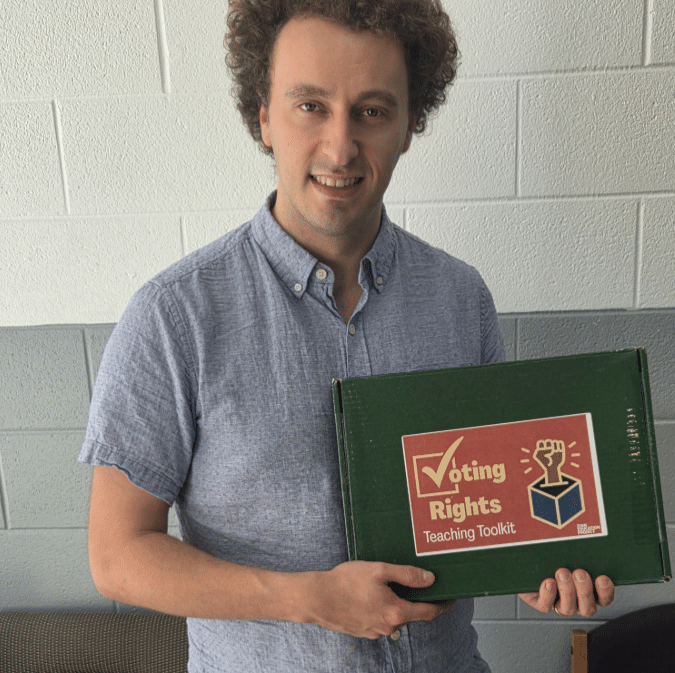
I used Jesse Hagopian’s “We the People”: Whose Rights Does the Constitution Protect? lesson with high school students at my small community school in the Metro Detroit area. This lesson was eye-opening to say the least. My students have only heard history teachers say positive things about the U.S. Constitution. They groan whenever the word ‘Constitution’ is uttered because the incessant glorification of this foundational document is, to be frank, a mind-numbing and boring tradition. Students are instinctively turned off by the uncritical praise that is too often heaped on the Constitution.
Hagopian’s lesson sheds much-needed light on everything that the Constitution does (not) guarantee to the American people. When I provided my students with the list of 25 rights, most of them assumed that a majority of these rights had been written into the Constitutional amendments. Surely basic needs such as clean water, food, and housing must be written into the famous document, right? They were shocked and dismayed to learn just how few of these rights are indeed guaranteed. Furthermore, the lesson did a great job of exposing how the federal government has neglected to protect even the rights that are guaranteed in the amendments.
The mixer discussion format of the lesson made the learning experience active and fun for my students. Each child became an expert on one particular right, and was tasked with educating their peers. This lesson format is far more engaging and memorable than a lecture would have been. Thank you Zinn Education Project for helping my students think critically about a key document that has been too often over-glorified!
Recently, I spent the week launching some of the content in the Voting Rights Toolkit to augment the Constitution Day lessons I already teach. After a brief discussion regarding the history of the Constitution, the students completed the “yes/no” sheet asking them if particular rights were in the Constitution. After that, they circulated around the room to find the answers.
I used the sheets provided by Zinn and, as they are only 10 and 11, I highlighted particular passages and lines on each excerpt for ease of reading. In addition, I wrote a few guiding questions on the bottom of each excerpt to encourage deeper thinking. Our vice principal came in to engage with the kids, and they loved it. She really pushed their thinking also. The whole class discussion phase was fantastic and surpassed what I thought would happen (we had only been in school for two weeks at this point).
We spent much time talking about the “why” of “missing rights,” especially ones that they hear their parents talking about — particularly healthcare and childcare. Our vice principal shared her monthly daycare costs and they were stunned! So much rich conversation resulted and they remained focused for an hour! We also had a jigsaw lesson using the excerpts from Fannie Lou Hamer and they were eye opening. I shared examples of literacy tests from the era and a wonderful discussion followed.
In the coming weeks, we have guest speakers from the Washington Secretary of State regarding voting rights and we will be participating in a mock election for kids.
Overall, the lessons we used that you provided really enhanced and enriched previous work. We used these to launch topics that are, quite honestly, a stretch in some respects for fifth graders. We will be utilizing more of these resources throughout the year. These were easy lessons to implement and required little prep other than reading the material. As a very busy teacher, that means a lot. We also focus on facts, truth and using primary resources; thus, these documents also aligned with those goals.
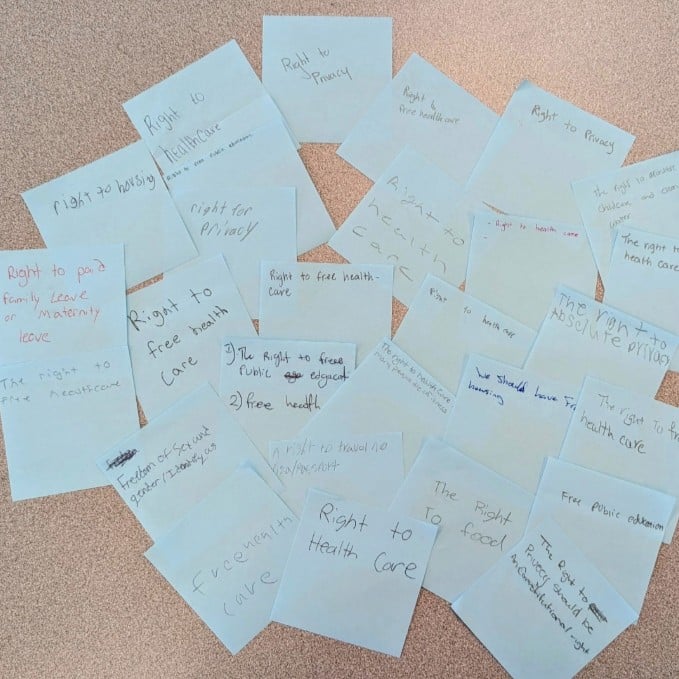
This year for Constitution Day, I incorporated components of the lesson “We the People”: Whose Rights Does the Constitution Protect?. I used the lesson in my twelfth grade government classes, my eleventh grade U.S. history classes, and even in my twelfth grade economics and dual-enrollment psychology classes. Every student needs to learn their rights to be sure they are protected, so I figured it was important to engage all 125 of them in dialogue. If I don’t, who will?
Having students determine what rights they believed were guaranteed by the Constitution was a wonderful conversation starter. They started responding individually, but then slowly engaged each other in spontaneous chatting. As I shared what statements were their Constitutional rights and those that are not, their disbelief was honestly encouraging. It gave me more hope that this generation is ready to dig in, do the work, and create positive change.
As a result of their small conversations, I adjusted the lesson so that instead of completing a written response to the prompt, “Do you think any of the rights from the list that are not guaranteed by the U.S. Constitution should be?”, I had them write their responses on sticky notes. Once everyone was finished, I collected them and shared them with the class. We looked for trends and discussed who would benefit from the change.

Twitter
Google plus
LinkedIn