
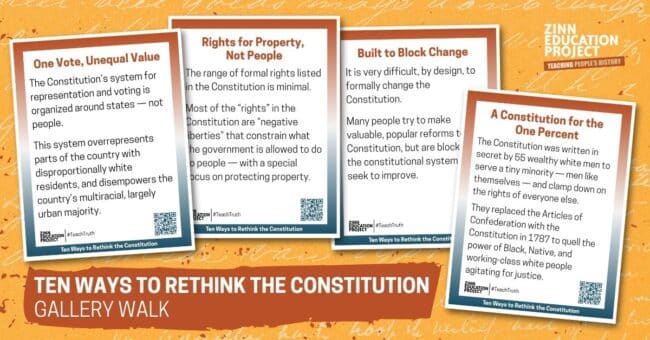
The Ten Ways to Rethink the Constitution framework is available in a shortened form for participatory gallery walks.
You can make visible the history we are defending the right to teach. This gallery walk can serve as an affirmation that we defy censorship by teaching “banned history” in a public space. Participants benefit from becoming informed about key issues and inspired to take action.
Read how to conduct a gallery walk.
Host the gallery walk in a classroom, professional development, union meeting, house party, town hall, library, or other public place.
Please send us feedback about how it went and photos.
We can send you postcards, buttons, and posters to share at your event.
Note, you will need to log in to the ZEP site (it is free) to download the gallery walk from the Download to Read in Full button below.
Classroom Stories
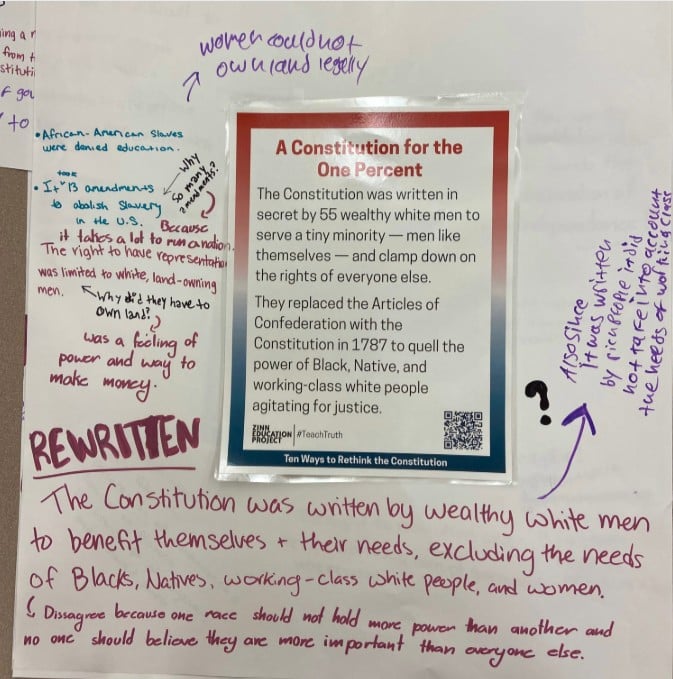
Today we used the “Ten Ways to Rethink the Constitution” Gallery Walk in my U.S. history classes in order to explore the Constitution, review its key components, and help place it in the context of history.
I had the students work on what I called “poster conversations.” Putting each of the “Ten Ways” posters on a larger piece of paper, I asked small groups to rotate between them. At the start, I had them work on rewriting the students in their own words, then I had them look for evidence in the Constitution and the textbook that could help support those statements. I had the larger essay/article on hand if students were struggling to find evidence.
Finally, as they rotated through later rounds of the posters, I had them consider what questions came to mind and whether they agreed with the statements made or not. This is where the thinking (and magic!) really happened. Students started responding to each other’s statements on the paper, identifying cycles and patterns of history that we are stuck in as a nation, and sparking questions for further research.
This was an excellent lesson for a U.S. history class that has some familiarity with the Constitution from their Civics days, but needs to think about the founding era and how the framers of the Constitution preserved and protected their own status and wealth. It’s also a great opportunity to get students thinking about what could look different and how things could change moving forward.
I used the materials from “Founding” Documents We Don’t Learn About and the Ten Ways to Rethink the Constitution gallery walk activity for my 11th grade language arts class. Seeing the students engage with the documents from the 1700s and have meaningful conversations during the lesson was gratifying.
Students came up with poignant connections and questions to discuss with one another as they moved about the room. I love how the resource included a diversity of voices based on gender, race, and nationality. This resource helped students to see that more than just the framers of the Constitution were involved in establishing the nation.
The day I did the lesson, our advisory (or homeroom) lesson was also about the Constitution, which allowed students to generalize what they learned in homeroom to our classroom. I found that working in tangent with another class’s curriculum enriched the experience for students. I hope that I can find other ways to connect our American Literature curriculum to other subjects, especially U.S. history.
For Constitution Day, I did the Ten Ways to Rethink the Constitution Gallery Walk. I asked students to silently read as they walked around, and afterwards we gave them time to share their thoughts.
Students commented on how the Constitution was written in secret and how the system of checks and balances helped only certain groups of people. In addition, students felt it was important to know the Constitution to protect themselves. Others felt that the Constitution was an old document that should be continued to be revised and compared it to the Bible.
I appreciated this opportunity because students were able to share their thoughts about current events when this class was mostly about ancient history. Students are really afraid for their future, and I am too. Having direct evidence from the Constitution and showing the changes in the Constitution was helpful.
Twitter
Google plus
LinkedIn