
We are witnessing a vicious attack on voting rights, democratic participation, and truthful education. History reminds us that we must organize to protect the gains won through generations of struggle. We can help young people see voting as part of a broader effort to improve their lives and communities, and see themselves as agents of change rather than spectators to politics.
We seek to make voting rights meaningful — not simply protecting access to the ballot box, but by helping young people and communities understand how collective power is built and how ordinary people can influence the decisions that affect their lives.
Teachers can make that happen with lessons on voting and the Constitution, including how to get out the vote, defend election results, and expand voting rights.
Join Us: Educating Youth to Protect Voting Rights and for the Ongoing Freedom Struggle
 Are you committed to teaching truthfully about voting rights and the Constitution this year?
This call to action began in September, with a focus on Constitution Day (September 17), and continues through Election Day. Sign up now.
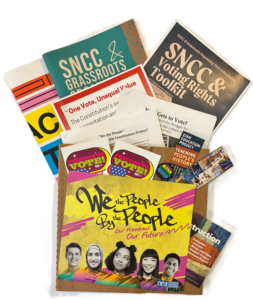
We are offering toolkits — including two lessons, Constitution gallery walk, SNCC Legacy Project Interpretive Booklet and Voting Rights Toolkit, two posters, stickers, and information sheets — while supplies last.
Encourage friends and family to donate so we can offer more kits.
Call to Action Goals

Artwork by Ricardo Levins Morales, available as a poster.
The fight over voting rights is also a fight over historical memory, political imagination, and the meaning of freedom itself. Young people deserve an education that helps them understand not only how power operates — but how ordinary people, working together, have always had the power to transform it.
Our goal is not only to teach the history of voting rights, but to help build informed, engaged communities capable of defending and expanding freedom today. Toward that end, we will help young people:
-
- Understand the long history of collective struggle that expanded political participation, from Reconstruction to the Civil Rights Movement to the present.
- Recognize that voting rights have never been secured by courts or elected officials alone, but have been won and defended through grassroots organizing, social movements, and community action.
- Explore how concentrated wealth, corporate power, and the growing influence of billionaires in elections can undermine meaningful political participation and limit the ability of ordinary people to shape public policy.
- Connect voting rights to broader struggles for economic justice, racial justice, educational justice, and human rights.
- Develop the knowledge, skills, and confidence needed to participate in civic life, community organizing, and collective action.
- Find an antidote to cynicism by studying historical examples of people who organized together and won transformative social change against seemingly impossible odds.
- See themselves not simply as voters, but as participants in the ongoing work of expanding freedom and shaping the future.
Background

Twitter
Google plus
LinkedIn