
In this slim volume, Howard Zinn lays out a clear and dynamic case for civil disobedience and protest, and challenges the dominant arguments against forms of protest that challenge the status quo. Zinn explores the politics of direct action, nonviolent civil disobedience, and strikes, and draws lessons for today.
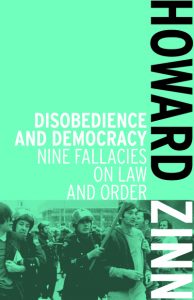 In a 2002 edition, Zinn wrote preface to explain his reasoning for writing the book in 1968:
When David O’Brien burned his draft card on the steps of the courthouse in South Boston, he was prosecuted, and the Supreme Court, by a vote of 7-1, upheld his conviction, rejecting his claim that it was an act of free speech protected by the Constitution. When Abe Fortas, one of those justices condemning David O’Brien, wrote a booklet on civil disobedience, justifying such prosecutions, I decided to write a response.
Disobedience and Democracy: Nine Fallacies on Law and Order presents nine fallacies about civil disobedience and the law that Zinn found in Judge Fortas’ booklet. [Adapted from publishers’ description.]
ISBN: 9781608463046 | Haymarket Books
Voices of a People’s History Story
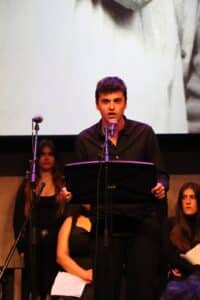
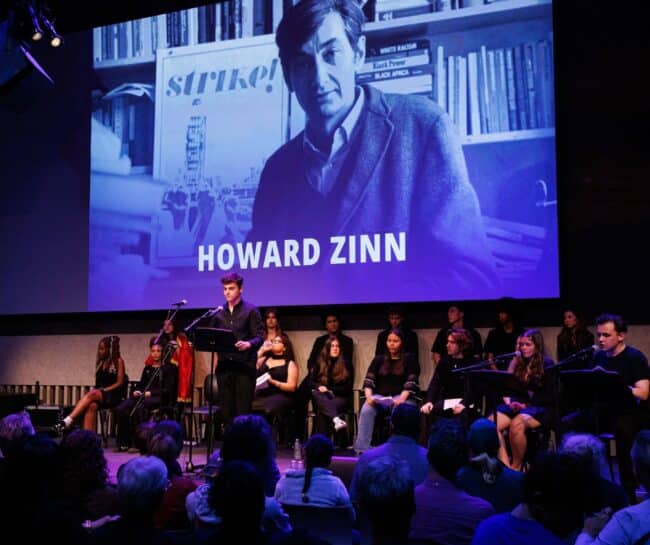
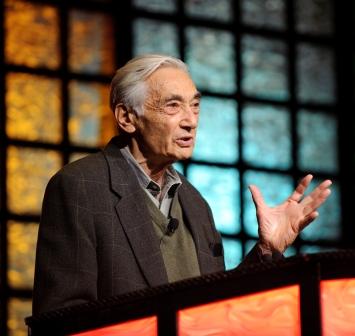
On May 28, 2026, as part of the Voices of a People’s History performances, high school junior Holden Ellenberg performed an excerpt of “The Problem is Civil Obedience” by Howard Zinn at Lincoln Center. Read Holden’s reflections of his experiences participating in this Voices of a People’s History performance below, followed by a recording of his reading. Photographs below by Sachyn Mital.
 For months, my search history looked less like that of a high school student and more like that of an exhausted historian. I spent hours reading speeches, essays, and historical documents, searching for something worth bringing to a modern audience. Through the VOICES program, students were not simply assigned speeches; we were asked to choose one ourselves. I approached that task with a question that became increasingly difficult to answer: If I had a stage at Lincoln Center and a room full of people willing to listen, what idea was worth their attention?
I ultimately chose Howard Zinn’s “Civil Disobedience.”
What drew me to the speech was not complete agreement. If anything, some of Zinn’s arguments made me uncomfortable. But I was fascinated by his refusal to accept conventional wisdom at face value. From the opening line — his claim that “the world is topsy-turvy” — Zinn challenges his audience to question assumptions about power, wealth, justice, and authority. Whether one agrees with his conclusions or not, his questions are difficult to dismiss. They demand engagement.
As I condensed the speech into a shorter performance, I found myself acting less like a speaker and more like an editor. Every passage I included meant leaving something else out. I wanted to preserve the sections that felt most provocative, particularly Zinn’s discussion of the Mỹ Lai massacre and the Kent State shootings. Before preparing the speech, I understood these events primarily as historical episodes. Through repeated reading and research, they became something more: examples of how societies struggle to reconcile their ideals with their actions. I began to realize that history is not simply a record of what happened. It is also a record of debates about what should have happened.
The argument that lingered with me longest was Zinn’s assertion that “our problem is civil obedience.” At first, the statement felt almost contradictory. Most of us grow up hearing that responsible citizenship means following rules, respecting institutions, and participating constructively in society. Yet Zinn asks a more unsettling question: What happens when obedience itself becomes a moral failure? History offers countless examples of injustice carried out not by rebels, but by ordinary people following orders, procedures, and expectations. While I am not certain I agree with every conclusion Zinn reaches, I found the question impossible to ignore. The speech forced me to think more carefully about the distinction between what is legal and what is just.
As a teenager, that question feels particularly relevant. It is easy to assume that meaningful change is driven entirely by elected officials, judges, or other people whose names appear in textbooks. Yet the more history I study, the more I notice the role played by students, activists, journalists, and ordinary citizens who decided that remaining silent was not enough. Reading about those individuals made me think differently about civic engagement. Advocacy does not begin when someone gains power; it begins when someone decides to pay attention.
Ironically, by the time I stepped onto the stage, I had become so invested in the ideas behind the speech that worrying about stage fright almost felt secondary. Almost. Standing in front of an audience at Lincoln Center is still intimidating. But what mattered most to me was not delivering every line perfectly. It was sharing a set of questions that had occupied my thoughts for months.
That, ultimately, is what I took away from the experience. History is often taught as though its major debates have already been resolved. Studying and performing Zinn’s speech reminded me that many of them remain open. Questions about justice, accountability, power, and citizenship continue to shape public life, even when the circumstances look different from those of the past.
More than fifty years after Howard Zinn delivered “Civil Disobedience,” I found myself wrestling with many of the same issues he raised. I left the stage with a deeper appreciation for history, not as a collection of facts to memorize, but as an ongoing conversation. The experience reinforced my belief that learning about the past carries a responsibility to engage with the present. Understanding history matters, but so does deciding what to do with that understanding.

Twitter
Google plus
LinkedIn