

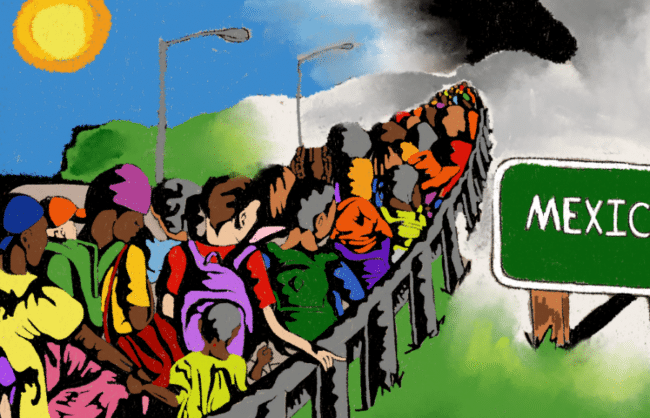
“Unspoken Horror,” a painting by Kaelyn Savard. Source: The Foothill Dragon Press
Looking back on the fire hose of outrages of the Trump presidency can make it hard to remember that though his actions were often called “unprecedented,” they were not always out of sync with past policy or an aberration from the consensus of political elites in both parties. For example, Trump’s rhetoric about migrants (and the countries from which they traveled) may have been uniquely bombastic and barefaced, but when it comes to the policies controlling U.S. borders, his were not so different from his Democratic predecessors or from his successor.
It was under President Bill Clinton, a Democrat, that the U.S. border patrol tripled in size, and border deaths from hypothermia, dehydration, and drowning skyrocketed. And more recently, it was President Obama’s Homeland Security that deported 2.7 million people — an average of about a thousand immigrants a day, for eight years — earning him the title from immigration activists of “Deporter in Chief.” President Biden’s rhetoric has been kinder, but deportations continue while tens of thousands of asylum seekers are detained each year and languish behind bars for months.
So what drives this political consensus about migration, immigration, and the border that leads to so much misery for so many people fleeing war, climate catastrophe, and poverty? This is a question for which it is helpful to look to history.
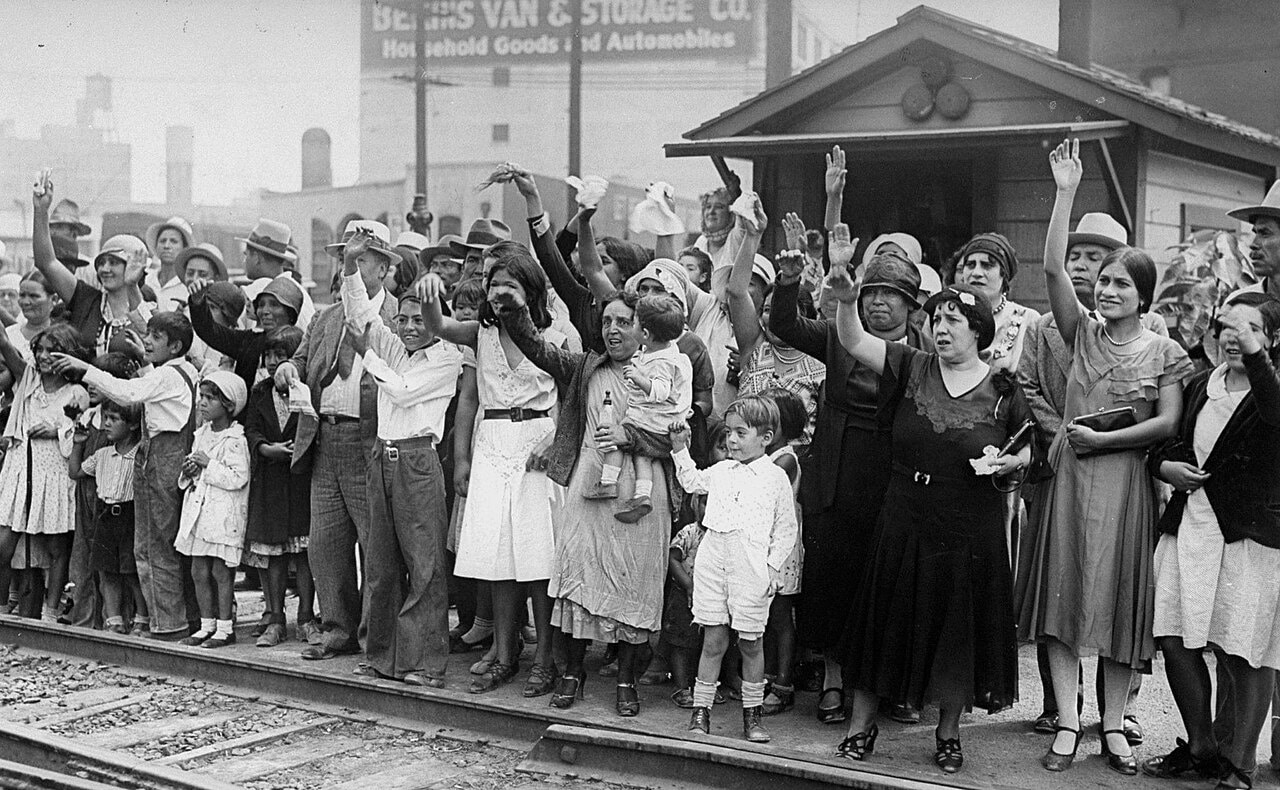
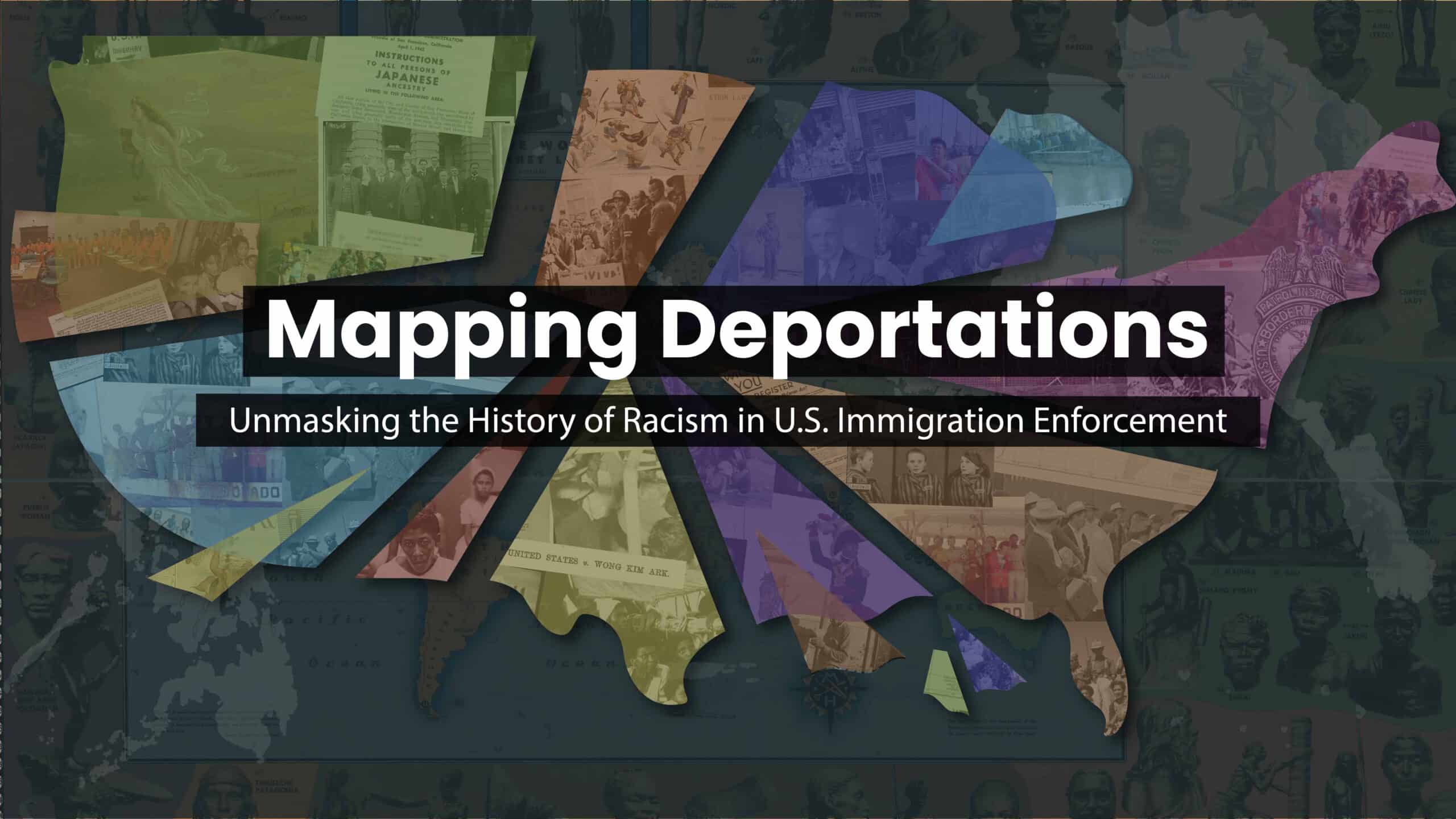
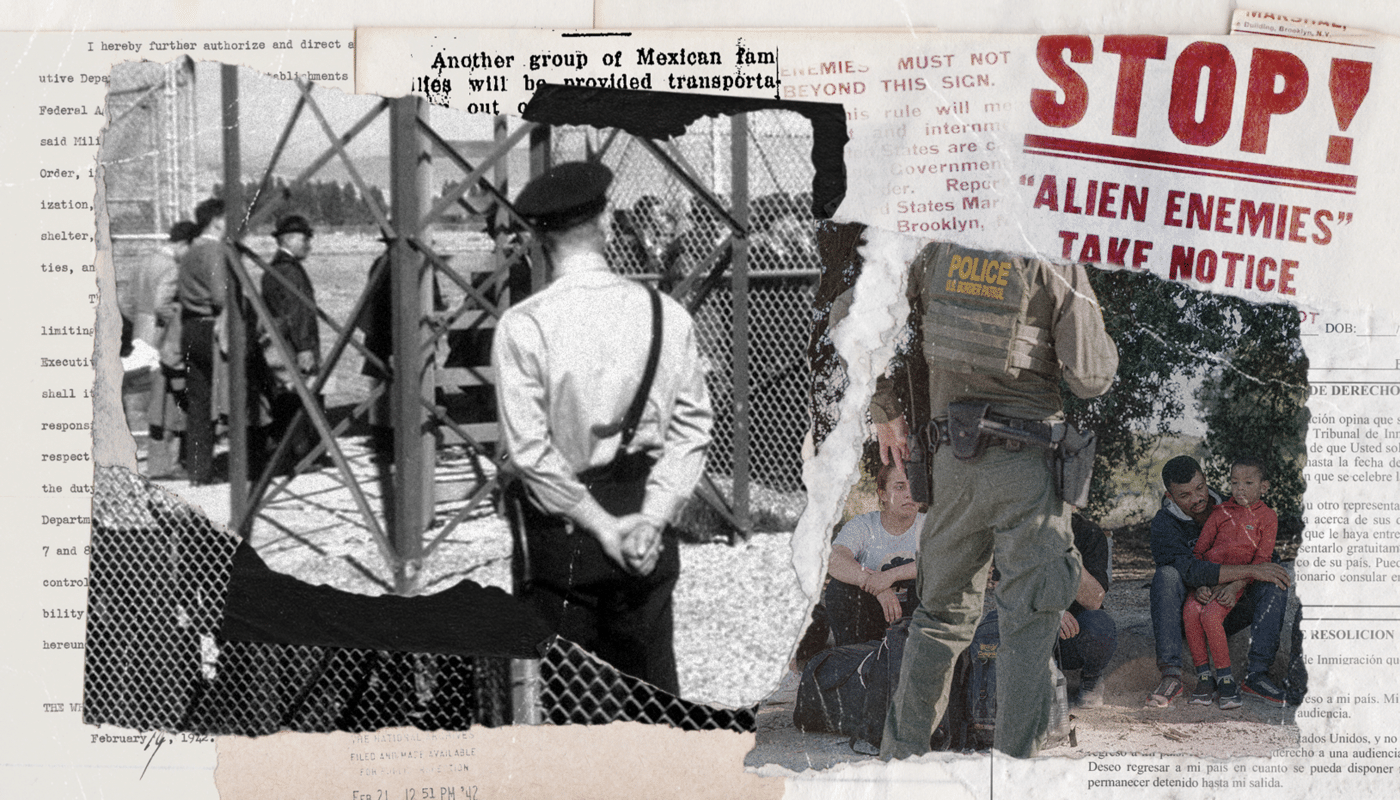
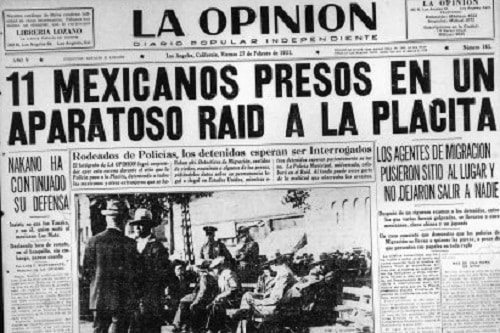
From the late 1920s to the late 1930s, men, women, and children, immigrant and U.S.- born, citizen and noncitizen, longtime residents and temporary workers all became the targets of a massive campaign of forced relocation, based solely on their perceived status as “Mexican.” They were rounded up in parks, at work sites, and in hospitals, betrayed by local relief agencies who reported anyone with a “Mexican sounding” name to what was then called the Immigration Service, tricked and terrorized into “voluntary” deportation by municipal and state officials, and forcibly deported in trains and buses, to a country some hadn’t lived in for decades and others never at all.
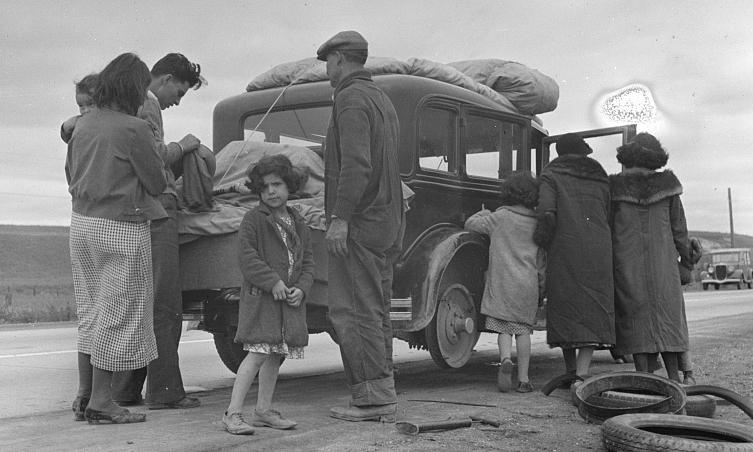
Some families relocated “voluntarily,” driven out by joblessness, harassment, and nativist fear-mongering, rather than the Immigration Service. By Dorothea Lange. Source: Library of Congress
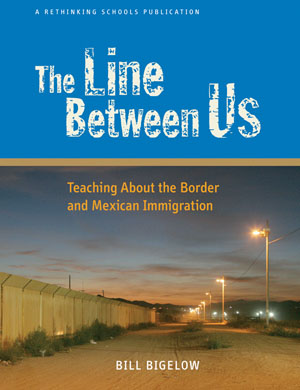
Historian Mae M. Ngai argues that this 1930s campaign of mass deportations had little to do with law; it was a program of “racial expulsion,” rooted in racism. But unlike other racist and nativist efforts of the era, these deportations were not symbolized or driven by any signature piece of legislation like the Chinese Exclusion Act of 1882 or the Immigration Act of 1924. Rather, they were orchestrated using a patchwork of federal and local authority, existing but seldom used deportation rules, and simple mob action against a vulnerable population. It is precisely this messiness that is fruitful to surface with students. If no single law or leader ordered these deportations, then why and how did they happen and who or what is responsible for the damage they wrought? These are the questions raised in the Deportations on Trial lesson (modeled after Bill Bigelow’s Rethinking Schools lesson The People vs. Columbus).
Classroom Stories

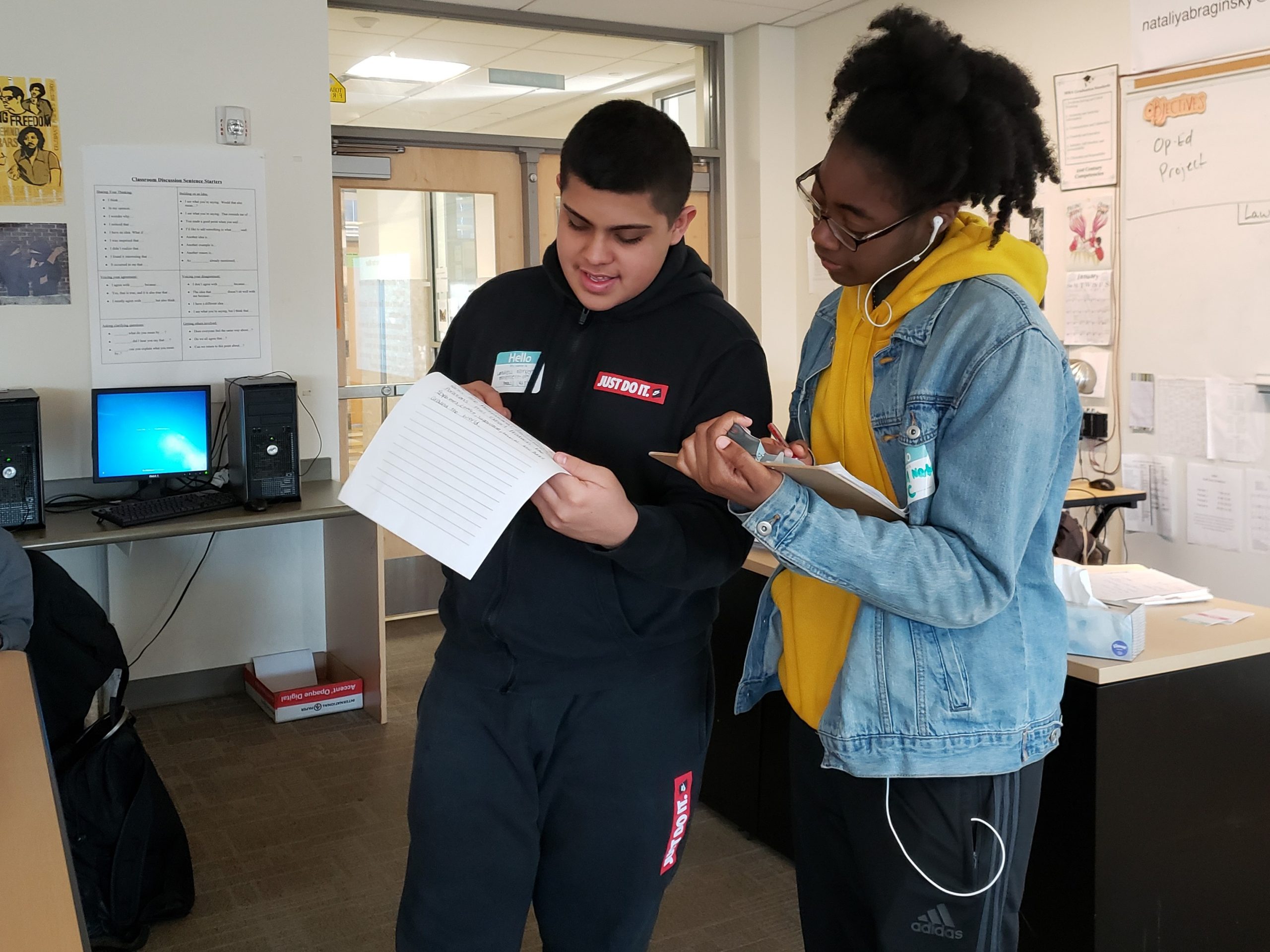
I used the Deportations on Trial lesson with my Virginia history class this semester. We set up our classroom like a courtroom, with some students as the jury and other students grouped according to who was being tried.
The students were shocked to learn that hundreds of thousands of native born Mexican Americans were deported during the Great Depression, even though they were lawful citizens.
At the end of the trial, each class concluded with who they believed was responsible for the deportation of millions of Mexican Americans. The verdicts differed based on each class, but students felt stern in convicting the federal government and the police for having the power to stop these acts, yet deciding to carry them out anyway.
The readings were simple and helped students in developing their defense. The level of academic discourse was perfectly grade appropriate for my juniors and seniors. Overall, it was a great way to expose the students to more details about the topic, practice critical thinking skills, collaboration, and reading comprehension.

Zinn Education Project resources help me stay honest and focused, and ensure that I am checking for a biased narrative in my classroom. When I couldn’t find materials related to Mexican American studies, the Zinn Education Project had those lessons done and done well, like the Deportations on Trial lesson.

Of all the labor lessons at the Zinn Education Project, the one I use most regularly is Deportations on Trial: Mexican Americans During the Great Depression. This takes place in our American Dream: Identity and Immigration unit, where we look at the treatment of different ethnic groups in Ethnic Studies U.S. history II. This includes looking at Japanese incarceration, push and pull factors of the Great Migration, and Puerto Rican migration after World War II. We follow this with a week of looking at the experiences of Mexican immigrants and Mexican-American experiences in the 20th century. I typically spend a day doing some context with students, where we use the story from the Zinn Education Project of a man being deported when he was 6 years old. Then we do two vocabulary words — repatriation and deportee — followed by the Atlantic article mentioned in the activity.
After that I usually give one and a half to two days for groups to prep their defenses and I give the jury the packet with every group on it. Jury roles, I tell students, are the most grueling because they have to know every group.
The day of the trial, I don a gray wig from our cosmetology shop and a robe, which the kids usually get a kick out of along with my gavel from our union office. The jury takes their place along the front of the room with my desk in the center and a witness stand for the group being questioned. The jury starts with questions, then I have a few prepared, and then we open it up to other groups. After the first year I did it, I realized I needed a time limit for each group, or the last group or two would not have nearly enough time. Because we only have 57 minutes and the jury needs time to deliberate in the end, I give 7 minutes per group.
After all five groups have been questioned, the jury goes in the hallway to deliberate, and the other students work on their reflective writing. We end class by the dramatic reading of the verdict, which tends to rile the class up very much.
Most of my students generally enjoy this activity and have a lot of fun posing questions to their peers. This year we even had a member of the businesses group try to bribe a member of the jury! This resulted in their group being found guilty, of course, because the rest of the jury found out about it.
It is a memorable and enjoyable activity for my students, that many get a lot out of it. I find it is a good way to introduce them to another layer of what is happening in the Great Depression.
Students absolutely loved the Deportations on Trial: Mexican Americans During the Great Depression lesson! For many, this was the first time that they had known about Mexican American immigration outside of the modern era.
Students were easily able to connect the recent string of ICE arrests and detention centers with the forced deportation of entire Mexican communities. They studied how people resisted or didn’t resist and connected the lesson to how communities today are resisting ICE oppression.
I used the materials almost word for word from the Zinn Education Project. The only changes I made were to have the materials translated into Spanish for multilingual students.

United States Citizenship and Immigration Services (USCIS) does not have any major lessons to help drive home the desperation that many people in the United States were feeling during the Great Depression. In fact, there are only three questions in total about the Depression on the 2025 exam, and one of which is about FDR.
Given that my grandparents were both migrant farm workers born in Mexico in the wake of the Depression, the Deportations on Trial lesson module has provided an excellent way for me to fill in some of the gaps left between what USCIS asks on the test, the materials they have provided, and the actual history that students might never know if they studied only the practice test questions.
Another important takeaway from this lesson beyond the connection to the Great Depression is the lesson’s frank discussion of the Presidents’ deportation records. Many of my students assume that the Trump presidencies have been an aberration and are surprised to learn that Obama and Clinton each were responsible for myriad deportations and other cruelty towards migrants. This information helps my students better contextualize the presidents as deeply flawed individuals, rather than falling into the trap of deifying them as so many educational resources tend to.
I teach at a Hispanic Serving Institution so I am always looking for ways to be more inclusive in my curriculum. I came across the free Deportations on Trial: Mexican Americans During the Great Depression lesson and decided to incorporate it into my unit on the Great Depression. It is a great extension on Zinn’s chapter on the Great Depression [in A People’s History of the United States] and focuses on people’s history from the experiences of Mexican Americans. I used this activity in class after my students had read Zinn’s chapter “Self Help in Hard Times” to examine the Great Depression through the historical lenses of race, citizenship, and immigration. The students were excited to jump into their historical roles for the mock trial that we held in class. The energy was palpable!
The activity allowed every student to demonstrate their understanding of the unlawful mass deportations during the 1930s coupled with an examination of primary documents like the 1930 U.S Census — the only year that the “Mexican” was ever listed as a choice for the “color or race” question. Students also got a chance to experience being part of a U.S. institution: from the federal government to the media to law enforcement. In this way, students started to understand that institutions don’t act on their own, but are driven by the people within who have the ability and power to act on behalf of justice or not. Overall, this was a powerful teaching activity because it was so immersive.
As an Ethnic Studies history teacher I have used multiple different lessons and activities from the Zinn Education Project. I have used lessons including Simulating Redlining, Independence or Catastrophe? Teaching Palestine Through Multiple Perspectives, Deportations on Trial, Who Fought to End Slavery? Meet the Abolitionists, and What We Don’t Learn About the Black Panther Party — but Should. The most popular one with my students was Deportations on Trial, because students were so invested in it and took their preparation and learning so seriously. I went to lunch the day before our trial to see one student talking with multiple administrators about her defense strategy for the next day.
What I love about these activities is that they are so highly adaptable. For instance, with the Black Panther Party lesson, I did a short introduction with students, had them take some notes on their accomplishments, and then we did a gallery walk in the hallway. This allowed them to read on their own time and did not push shy students into having to talk about something they might not be super comfortable with. I have also started printing out packets of the mixer roles when I do them, so that there is that option if a student would prefer to read to themselves quietly.
Another thing I appreciate is that the learning is typically very communal whenever we do these activities. If students are stuck trying to find a person who did something in particular, we will ask the class if anyone could answer the questions.
I appreciate how these activities are engaging, multi-faceted, and relational and how they allow students to dive into the depth of a topic by learning about specific historical actors who dominant narratives traditionally leave out.
Lastly, as someone who always strives to learn more about our histories, I learn something new every time I do these activities. Thank you all so much for the immense amount of labor, time, and energy it surely must take to put them together. I look forward to continuing to use these resources and others in the future.
In my Latinx Studies class I used the Deportations on Trial: Mexican Americans During the Great Depression lesson as part of a unit on the effects of the Great Depression on migrants. This lesson allowed us to dive deep into mass deportations and the effect it had on the Mexican population. It allowed the students to critically think and put into perspective the role that different people played in the deportations.
This lesson also paved the way and helped us connect the media’s role in the Sleepy Lagoon court case and the Zoot Suit Riots. All these events also allowed the connection to what is happening in modern times. I will definitely use this lesson again as students really enjoy putting past historical events on triall and it helps grow their critical thinking skills.
 This is a revised (in 2023) version of a lesson that was originally published in the 2018-2019 Winter issue of Rethinking Schools.




Twitter
Google plus
LinkedIn