

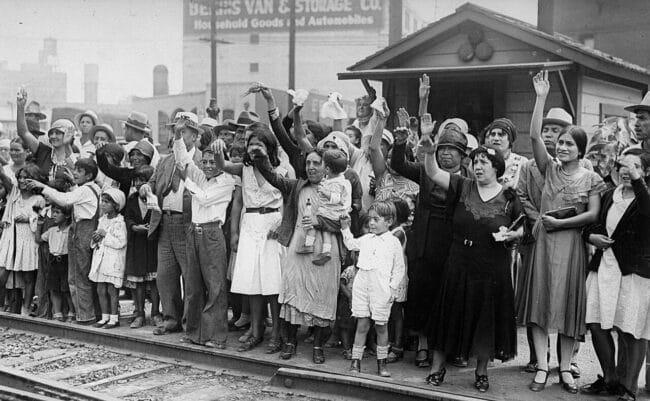
Relatives and friends wave goodbye to a train carrying 1,500 persons being expelled from Los Angeles back to Mexico on August 20, 1931. Source: Public domain
By Erin Green
I first learned about “Mexican repatriation” during the Great Depression while studying for my master’s degree. It had never been mentioned in any history class I had taken before. This erasure supports the dominant narrative of the United States as a land of opportunity, while sidelining the realities of racialized labor exploitation and state violence.
Between 1930 and 1933, up to 2 million Mexicans and Mexican Americans were forcibly taken from their homes and sent to Mexico. An estimated 60 percent of those expelled were U.S. citizens. The U.S. government justified these mass raids and expulsions by blaming Mexicans for widespread unemployment, claiming that they were taking jobs from American workers. This rhetoric is not new — it has been a mechanism of control wielded throughout U.S. history to scapegoat immigrants, justify exclusionary policies, and uphold white supremacy. The same logic that fueled mass deportations in the 1930s persists today, shaping contemporary immigration debates and reinforcing systemic inequality.
Mainstream historical narratives often frame the Great Depression as a universal crisis, emphasizing the impact of the stock market crash of 1929 on U.S. unemployment. The Great Depression, a trade book for elementary and middle school students, includes this typical passage: “By 1932, one out of every four workers in the United States was unemployed. . . . They were good, hardworking men who wanted to earn an honest living. But there were no jobs for them.” These descriptions, often paired with images of white men lined up outside of soup kitchens, obscure the racialized dimensions of the Great Depression. The statistic that one out of every four men were unemployed is true only for white men. Black men experienced unemployment at twice that rate, reaching as high as 60 percent in cities like Philadelphia and Detroit, and soup kitchens often refused service to Black folks. Mexican and Mexican American communities faced not only higher rates of unemployment than white communities, but also lived under the fear of deportation — regardless of their status of citizenship.
The omission of these stories reinforces a version of history that centers white, working-class suffering while ignoring racial and class divisions and erasing state-sanctioned violence inflicted upon communities of color. So-called Mexican repatriation reveals how economic recovery efforts were explicitly designed to reinforce white supremacy and economic exclusion. As white workers lost jobs, public and private institutions targeted Mexican and Mexican American communities as scapegoats, claiming they were taking jobs from “real” Americans. Mass deportations — many illegal — ensued, with little regard for citizenship status or legal protections.
Disrupting these misconceptions is essential, not just to fill in historical gaps, but to challenge how history is used to justify present-day policies. The term “repatriation,” defined by the Oxford English Dictionary as “the return of someone to their own country,” is misleading, as it implies a willing home-going, a voluntary process. Yet the reality of Mexican repatriation in the 1930s was not a willing choice made by Mexican and Mexican American families. Many were forcibly removed through raids, coercion, and threats, paralleling contemporary anti-immigrant policies.
Continue reading at Rethinking Schools.
Erin Green is an educator, writer, and researcher. Her research explores justice-oriented teacher preparation and critical approaches to elementary social studies education. She is a former 5th-grade teacher.
 This lesson is in the Summer 2025 issue of Rethinking Schools. Subscribe to the Rethinking Schools magazine today.
Classroom Story
I used the Teaching “Mexican Repatriation”: Uncovering Histories of Deportation and Belonging in my Intermediate Spanish I class to teach about immigration and deportation in our unit on immigration and the Latinx experience. Students engaged in a study of the 2 million people deported during World War II and made comparisons to current immigration policy issues in the United States. The discussion and research concluded in a human rights debate about the legality of deportations and limiting migration in the modern world.






Twitter
Google plus
LinkedIn