
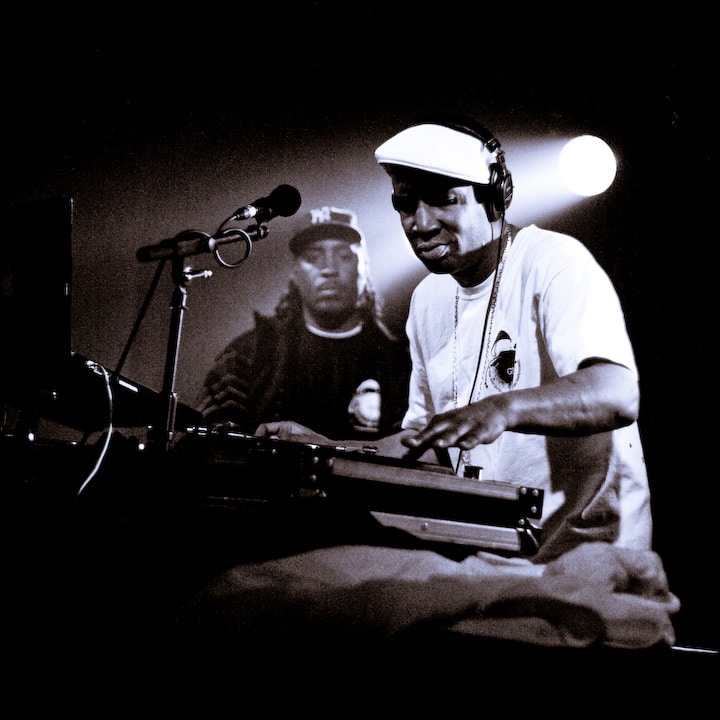
GrandMaster Flash, an innovator of many DJ techniques, performing on his turntables in the 1980s. Source: The McGill International Review / Public domain
By Jessica A. Rucker
“So, Ms. Rucker, those companies profit off of culture they appropriated? And we purchase the music that we grew up with, but it’s not truly our music, but it comes from our culture?”
Natasha raised these questions during our study of the commercialization of the hip-hop industry. She and other students were dismayed to learn that four major record labels, the Big Four — Universal Music Group, Sony BMG, EMI Group, and Warner Music Group — produce and distribute more than 80 percent of the music that is sold and purchased. (Since I originally wrote this lesson, the industry has further consolidated and the Big Four has become the Big Three.)
Hip-hop music was conceived by impoverished Black and Brown youth, a score of whom were immigrants or the children of immigrants in the South Bronx, New York, in the 1970s following the Black Freedom Struggle of the 1950s and 1960s. But the hip-hop industry is neither owned nor controlled by the people who create the music; this is reflected in much of the content of commercial hip-hop music. The relationship between most emcees with record deals from major industry labels can be likened to the relationship between Pinocchio and Geppetto: The industry pulls strings, dictates what gets promoted, and what gets sold, and many emcees with record deals lip-sync to the tune of whatever sells, even at the expense of their personhood and/or community.
I teach primarily Black and Brown students — a number of whom are growing up cash-poor and under similar circumstances as me when I was in high school. Several years prior to becoming a high school electives teacher at a charter school in my home city of Washington, D.C., I started to learn about the hip-hop industry, particularly from M. K. Asante Jr.’s book It’s Bigger Than Hip Hop: The Rise of the Post-Hip-Hop Generation and from Tricia Rose’s book The Hip Hop Wars: What We Talk About When We Talk About Hip Hop — and Why It Matters.
In my prior use of hip-hop music in my classroom, I used rap lyrics as texts to strengthen skills in critical reading and writing, and to assist students’ comprehension and application of concepts, ideologies, and frameworks. That was a great first approach to using hip-hop music as a learning resource.
However, many students expressed dissatisfaction when I selected artists or songs that included content that was explicitly political, not expressly intended for entertainment, or from artists that were older than 30. Specifically, students seemed disgruntled when we listened to and analyzed songs or music videos by Jay-Z, and they dismissed him as being too old. However, as they listened and began closely studying the songs I introduced, students came to appreciate some of the content he explored. With some exceptions, students often seemed to identify with lyrics that promoted notions of capitalism, patriarchy, domination, and violence. Students did not often interrogate the contradictions in some of the lyrics they consumed, like me at one time, even when those lyrics were clearly in contrast to their own realities and values. I wondered how students’ consumption of commercialized hip-hop music would shift if they knew what I came to learn: that old wealthy white men own and control the hip-hop industry and dictate much of what gets produced, played, distributed, and purchased. In fall 2018, I decided to have students in my Introduction to African American History and Culture course study hip-hop music, the hip-hop industry, and the impact the commercialization of hip-hop music has on Black and Brown hip-hop artists and our respective communities.
I wanted students to be able to think about how and why most commercial hip-hop music promoted notions of intracommunity violence, the objectification of women and the trivialization of femmeness, capitalist and individual pursuits at the expense of entire communities, and other unhealthy practices. And I wanted students to understand why such songs, and the artists who produced them, became such commercial successes. The goal was to get students to understand that the hip-hop artists they often hear on the radio or see featured in commercials, or whose music is often celebrated through music award shows, are usually commercially successful artists whose content disproportionately exploits Black and Brown culture and perpetuates some of the most damaging stereotypes about our cultures.
Continue reading at Rethinking Schools.
Jessica A. Rucker is a doctoral student in the Department of American Studies at the University of Maryland, College Park, and a Prentiss Charney Fellow. Prior to her graduate work, she was a high school teacher in Washington, D.C.
 This lesson is in the Fall 2021 issue of Rethinking Schools. Subscribe to the Rethinking Schools magazine today.





Twitter
Google plus
LinkedIn