
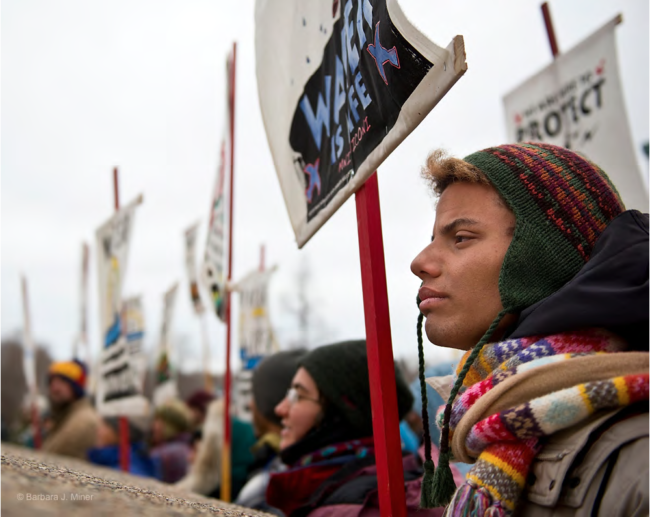
A demonstration in Bismarck, North Dakota, on Nov. 21, 2016, to protest police violence against Standing Rock Water Protectors. Source: Barbara Miner.
The more I read and learned about the Standing Rock resistance to the Dakota Access Pipeline, the more obvious it became that this story must make its way into my curriculum. Here was a fascinating and important story — a story that literally cannot be told without recognizing Native peoples as full participants in their own, and U.S., history.
I put out a call to other teachers, educators, and activists who might be interested in collaborating on some curriculum. I wanted to roll out the lessons in the days before or after Thanksgiving. This timing, I believed, would be a powerful symbolic rejection of the lies about Indian people promulgated in our national Thanksgiving myths, in favor of a real story, about real Indians, leading a powerful movement in the 21st century. Joined in the work by my fellow Lake Oswego High School teacher, Andrew Duden, and Rethinking Schools curriculum editor Bill Bigelow, we quickly agreed that the story lent itself well to a role play and got to work.
 Before launching the role play, we wanted to give students a visceral and visual sense of the resistance under way along the Missouri River. We thought immediately of Amy Goodman’s wonderful coverage on Democracy Now!, and specifically, of the horrifying footage of the use of dogs against protestors/Water Protectors by a private security firm (Democracy Now!, 2016). We also used “The Standing Rock Protests by the Numbers,” a short documentary posted at the Los Angeles Times (Etehad and Tchekmedyian, 2016). We asked students to jot down questions that emerged as they watched. Afterward, students shared out their questions and it didn’t take long for them to recognize and frame many of the fundamental issues at stake. Gavin asked, “Are the protestors more angry about the possibility of oil spills or that they’re building on burial grounds?” Kisa asked, “What guarantee does the pipeline company have against the breaking or leaking of the pipe?” Tatum wrote, “Is this pipeline really needed? What is it for? Can they move it somewhere else?” Vivian asked, “Who owns the land the pipeline is being built through?” Finally, Callie wondered, “Does the government care about what could happen to the water of these tribes?” These questions not only built toward the role play to come, but also generated possible research questions for the entire unit.
The Role Play
We liked the idea of a role play for a couple reasons. Our first and most important goal was to create a context for students to confront the complex social reality of the Dakota Access Pipeline and the resistance movement to which it has given rise. That social reality includes the history and contemporary status of Indigenous rights, the power of the fossil fuel industry, the support for pipeline infrastructure from segments of organized labor, and the extent to which our government is protecting — or failing to protect — the land, water, and air. The role play asks students to explore these complicated dynamics as active participants. Reading about historical figures is like standing on the sidewalk looking at a house: You can recognize its basic shape, color, and perhaps how many levels it has. Actually assuming the identity of these historical figures allows you to step through the front door and explore what’s inside: How many rooms does it have? What’s the function of each? How are they connected? Which is the most spacious and light? Which the darkest and most cramped? Is it well-built or flimsy? We hoped this role play would enable students to navigate the #noDAPL movement from inside the house, rather than as a bystander peering in from outside. Another of our considerations was that at the moment we were writing, there was little mainstream media attention directed toward Standing Rock, so in some way, the role play was aspirational — a way of insisting that this is a Big Deal, even if that is not reflected in the media. Our aim was for students to know what was happening, but also, perhaps what was not happening, and to begin to wonder about why.
The setting of the role play is a meeting, called by the president, to hear input on whether the Dakota Access Pipeline should be completed. Students, representing five different groups, must convince him that the project should be abandoned or allowed to proceed. Two of the groups are in direct conflict:
- Members of the Standing Rock Sioux Tribe, protesting the pipeline and encamped along the Missouri River in North Dakota
- Energy Transfer Partners, the oil company building the pipeline
The other three groups we selected provide additional context on the question of whether the pipeline should be built:
- Iowa farmers who have brought lawsuits and protested another section of the same pipeline
- Our Children’s Trust, youth activists suing the federal government over its insufficient responses to and action on climate change
- North America’s Building Trades Unions, which represent the workers who consider themselves direct beneficiaries from the pipeline’s construction
After sorting students into five table groups, we distributed the role sheets, which outline each group’s beliefs and interests. We asked students to read and underline important information in their roles. Next we had students answer three questions:
- Do you support the building of the Dakota Access Pipeline? Why or why not?
- What are the three most compelling arguments or pieces of information that you want the president to consider when making his decision to proceed with or halt the construction of the pipeline?
- How do you think the president should respond to the Standing Rock Sioux protesters (and other protesters) currently blocking the way of the pipeline’s construction?
 This lesson was published in the Spring 2017 issue of Rethinking Schools.
 In addition to the lesson above, Standing Rock: For the Love of Water, 2016–2026: A Ten-Year Retrospective is an important resource that documents the history, legal landscape, and continuing consequences of the Indigenous-led resistance to the Dakota Access Pipeline.
Classroom Stories
I recommend Standing with Standing Rock: A Role Play on the Dakota Access Pipeline, whether it be for teaching current issues Native communities face and/or building empathy and the importance of considering multiple perspectives.
While I don’t love many role playing lessons I’ve witnessed, I found this one to be effective and created with thoughtfulness. As a Native educator, I found that not only did this lesson seem valuable for a group of students, but I actually took away a lot for myself. As someone who views pipelines as very real threats to my communities and wholeheartedly supports pipeline opposition efforts, it was powerful for me to try on the perspective of a pipeline worker for this activity. I still strongly oppose pipelines, but this lesson forced me to humanize another side of this complex issue, to see the workers as people with not vastly different needs than mine and my family’s.
I will say that if you have Native students in your class, please be mindful of how this experience could be triggering for them, particularly with one of the media sources used in the beginning of the lesson of DAPL workers setting dogs on the water protectors. I found this to be emotional and hard to watch in the presence of others.

I cannot thank you enough for your Standing with Standing Rock Role Play activity. It was the perfect way to open my new Native Voices unit for my junior English class. Our school is a very small rural school with a nearly all white population. With reservations all around our area, I felt the need to educate my students on Native communities and the issues they face.
The role play was amazing to witness. It opened their eyes to all perspectives on the issue and they were very much invested in the group that they were assigned to. I changed the assignment a bit and had each group use a large poster to display their group name and their beliefs/values. These posters hung on the walls until the debate was over. We did a gallery walk and each group visited each poster and wrote down questions they had for other groups. Then, at the meeting, each group got to ask the other groups their questions.

I used the Standing with Standing Rock: A Role Play on the Dakota Access Pipeline lesson with my sixth grade class.
The students were extremely engaged and excited to prepare their presentation for “the president” (our school security guard, a former debate champ, served in this role) and to form alliances with other stakeholders. They really did a lot of thinking, talking, and review of primary sources. We live near a pipeline that is still being contested, so they were really invested in the topic.
After the lesson, I got the following email from a parent:
[my student] was telling me all about the project and was really enjoying working on it. We had a great conversation about advocacy and how all big things like this are never easy decisions. Thank you so much for guiding them on such valuable topics and helping them think critically about current events.
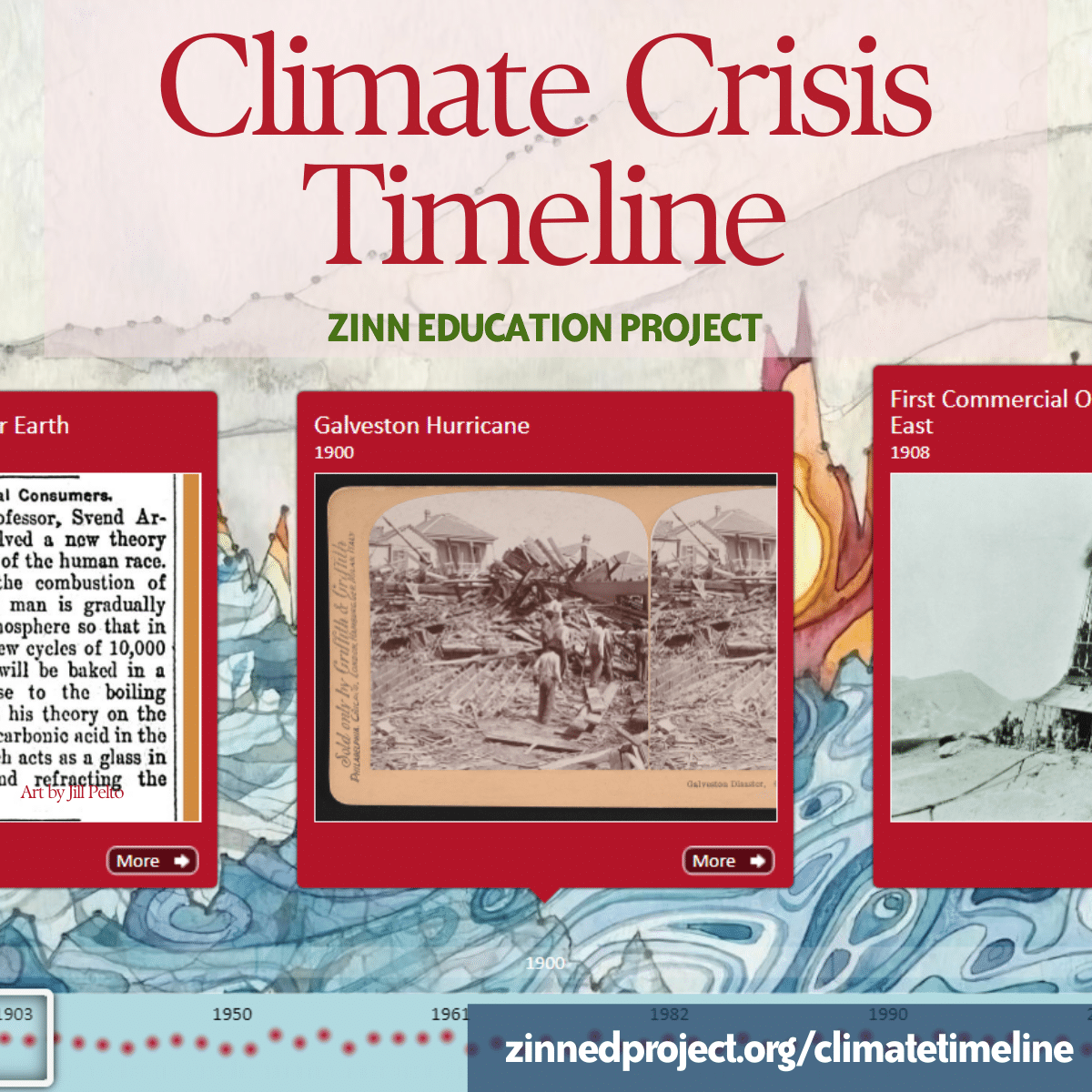
I have used several lessons from the Zinn Education Project in my high school replacement Language Arts classes (grades 8–12). Two that have had a particularly powerful impact are Standing with Standing Rock: A Role Play on the Dakota Access Pipeline and the Climate Crisis Timeline. Both resources are accessible, justice‑centered, historically grounded, and rooted in student agency.
Because many of my students read below grade level, I always begin by adapting the reading materials by lowering the Lexile, adding vocabulary supports, and breaking complex texts into manageable chunks, while keeping the intellectual rigor fully intact.
The Standing with Standing Rock role play became one of the most meaningful units we did all year. The structure of the lesson gave students an accessible entry point into a complicated issue involving sovereignty, treaty rights, environmental risk, and competing interests in energy development. Even with support in place, the lesson pushed students to analyze power, consider multiple perspectives, and think critically about how infrastructure projects affect land, water, and communities. The council meeting simulation created a space where students could practice civic reasoning and ethical decision‑making in a way that felt authentic and grounded.
The Climate Crisis Timeline complemented this work beautifully. It helped students understand climate change not as an inevitable scientific phenomenon, but as a human‑made crisis shaped by colonialism, racial capitalism, fossil fuel expansion, and long histories of resistance. This framing is essential for my students, who often encounter climate change only through simplified scientific explanations that leave out questions of responsibility, justice, and power. The timeline allowed them to see the climate crisis as a story with authors, choices, and consequences — and one in which they have a role to play.
Both units culminated in persuasive writing on climate justice, and the quality of the writing was noticeably stronger because students had a deeper understanding of the issues. They weren’t just completing an assignment; they were responding to histories, communities, and movements they had spent time learning about. Their writing reflected a sense of responsibility and possibility that is often hard to capture in traditional curriculum.
These lessons have become resources I return to because they support accessibility, critical literacy, and meaningful engagement with Indigenous rights, environmental justice, and the climate crisis. They help my students step into complex conversations with confidence and clarity. I’m grateful for materials that honor their capacity to think deeply, question narratives, and imagine more just futures.
This year I am piloting an ethnic studies course in my district, as the California Assembly Bill 101 has made the course a future graduation requirement for all students. Native American history is such an important part of the course material as well as California history. The Zinn Ed Project has a wealth of resources in dealing with this.
The Standing with Standing Rock: A Role Play on the Dakota Access Pipeline lesson in particular is excellent at bringing a contemporary issue into the classroom. One of the most important things I can teach my students is that history is not always in the past, and that every day history is being made.
One of the most glaring things my students realized during the lesson is just how hard it is to be a young Native American in the U.S. today. When they look at the ways in which the state and federal governments are constantly encroaching on Native American territory it really puts things into perspective. By placing them into these situations it gives them more insight into how young people are creating change across the country. Some of my female students also appreciated how important women’s leadership roles are within the Lakota and other tribes, particularly LaDonna Brave Bull Allard.
Using this lesson in conjunction with great documentaries like On A Knife Edge also gives my students insight into how young people just like them are a part of these movements. In the case of Native Americans it is a very long and sad story of mistreatment and mistrust, and the only way that gets better is if future generations are able to understand this and learn from our nation’s previous mistakes.

This week I am teaching about access to freshwater, the extraction of resources from Indigenous lands, and the Dakota Access Pipeline controversy. Our school is using Google Meet and Zoom to facilitate classes. Over five days, 8th grade students work on answering the questions: “Why should we learn about freshwater distribution today?” and “How does the Dakota Access Pipeline debate relate to water availability?”
We start by building background knowledge about freshwater distribution and scarcity and then we dive into the Dakota Access pipeline controversy by watching a CNN context video from 2016 and the suggested LA Times context video. I project slides to present a short mini-lecture about Native American sovereignty using information from a course I took with Dr. Ned Blackhawk and from the Smithsonian’s Native Knowledge 360° website. Finally, we look at a map of how the pipeline’s route was changed after the mostly white town of Bismark, North Dakota, complained about the original route — paying particular attention to water sources.
We then use the Zinn Education Project’s Standing with Standing Rock: A Role Play on the Dakota Access Pipeline lesson. I assigned students groups to learn about the five different roles and used Zoom breakout rooms for students to close-read, answer comprehension questions together, and to discuss their roles’ stance on building or halting construction on the pipeline. The next day, I mixed up the breakout rooms so that one student per interest group was represented, and the students filled out the graphic organizer to collect information about each interest group, noting potential allies and those groups they would be arguing against. Finally, the activity culminated in persuasive speeches that the kids wrote together in breakout rooms before presenting them to each other on Zoom. Students could use the chatbox to ask for points of clarification during the debate or to put in data from the readings that they sourced. The curriculum didn’t need to be adapted all that much thanks to the breakout rooms!

Finding lessons that examine modern issues facing Indigenous peoples is often challenging, so I was happy to find Standing with Standing Rock: A Role Play on the Dakota Access Pipeline.
It is important to me that the resources I share with students accurately represent a multiplicity of perspectives. Standing with Standing Rock represents balanced perspectives, allowing students to really grapple with the complexity of this significant historical event. Since this is such a recent event, this resource helps my students contextualize history.
A few of my Indigenous students were aware of the protests at Standing Rock or had family who had participated. They were able to see themselves in this history. I was able to leverage their interest to expand their learning.
I teach a semester long elective course of Indigenous people’s history at our school. We discuss a full breadth of lessons and topics around Native issues both locally in Illinois and on a continental scale including all of the Americas. In one of our first lessons, we discuss the importance of land to Native nations and how various nations are tied to their land in ancestral and spiritual ways that are very different from the understanding of land by white European Americans.
In bringing this conversation to the present day, the fight against the Dakota Access Pipeline is the perfect avenue for this very discussion. Not only does the Standing with Standing Rock: A Role Play on the Dakota Access Pipeline lesson provide an important perspective on the importance of land and resources to Native peoples, but it also provides an important look at issues of sovereignty between Indigenous nations and the U.S. government.
The fight against the DAPL — and more specifically, putting students into the roles of that very lesson — really gave my students a different perspective of this fight and the importance of water to the people of Standing Rock. They quickly understood that the fight against the DAPL was not just about Native water sources but potentially the entire Mississippi River valley and the need for clean resources for all. This lesson really set the tone for the whole course and students came each day ready to see how what they were learning was going to make them want to see real change in their own local communities.
Maplewood, New Jersey Middle School Teacher
For several years now, the Arizona Indian Education Association holds a Youth Protecting Our Land Summer Camp for Native American youth. The youth camps focus on leadership, advocacy, and environmental stewardship for the Native youth that encourage future leaders of the next generation.
At one of the camps, the planning committee wanted to highlight the NODAPL movement, as it pertains to protection of the tribal lands for the Standing Rock Sioux, and used the Standing with Standing Rock: A Role Play on the Dakota Access Pipeline lesson to help prepare students for a final project — a moving NODAPL legal play.
The first few days were spent with students reviewing the testimonials from tribal leaders, cultural leaders, tribal members, medical first responders, pipeline workers, law enforcement, etc. Students were able to immerse themselves in the roles as they read each one. The end project was an emotionally moving legal play, directed and played out solely by the youth. It was a summer that left a lasting impression of how one voice can make a big difference.

In teaching my Grade 12 Law class, there is a large component that deals with international law in two different senses — the first is how nations interact with one another, and the second is how laws are applied in other countries compared to similar laws here in Canada. I have used the Standing with Standing Rock: A Role Play on the Dakota Access Pipeline lesson for several years now in my classes and have always had great success with my students in helping them to understand the issues that are involved.
Part of our curriculum is helping students better understand the idea of “legal perspectives” — how events and laws are both influenced by and impact various groups in a community. This mixer helps students understand the views and influences the various groups have with respect to the DAPL and opens their eyes to different groups that they may not otherwise consider.
This is also an important resource in my class because I use it in conjunction with our look at the TPX pipeline project here in Canada and how Indigenous groups are impacted because of pipelines, how they respond to threats against their land, and how the legal/political system treats these groups. We also bring in the text This Place: 150 Years Retold, which is a telling of Canadian history from an Indigenous perspective; the chapter “Like a Razor Slash” mirrors much of what is told in the Standing Rock mixer, so this helps students to understand that the issues and concerns do not exist in a silo or vacuum but apply to many different groups. It also shows that there are groups of people all around the world who try to exploit Indigenous peoples and their resources and that this is not just a local issue.
I have loved using this resource and will continue to use it to help my students really understand the nature of these problems and to expose them to the various perspectives that exist within this complex issue.
I developed a curriculum that I called “Colonial Roots of the Climate Crisis” so students could link our current climate crisis and modern colonialism. We started in the late 15th century, when European powers aimed at becoming richer and more powerful by taking control of countries in Africa and in the Americas in order to exploit the people as well as plunder the resources the land provided to make profit. We studied the pillage of resources in the Global South, the exploitative purposes of neocolonialism, and the role they play in our climate crisis.
I used the role play Standing with Standing Rock: A Role Play on the Dakota Access Pipeline to talk about the colonization of water. The students watched clips from Democracy Now!, studied and researched for their roles, and expressed a variety of perspectives in the trial. It was definitely a success and highlighted challenges when the two students representing the Energy Transfer Partners really brought their case forward and made some strong arguments, which generated insightful discussion.
This served as a foundation for our study of the chapter “A Fish-Eye Episteme: Seeing Below the River’s Colonization” in The Extractive Zone: Social Ecologies and Decolonial Perspectives written by Macarena Gómez-Barris and the documentary and artwork by Carolina Caycedo, YUMA, or the Land of Friends. The goal was for the students to understand that local fights for water rights are also global, that colonization impacts Indigenous peoples and the natural environment in the same way it did hundreds of years ago.
Later in the same semester, after having talked about the colonization of water, and waste colonialism and mass tourism as a colonizing process destroying ecosystems, the students reviewed the Climate Crisis Timeline. In pairs, they chose to add one topic that ties colonialism to the climate crisis and to research it over the course of the two-month long project. Four projects that stood out were: the extinction of the dodo bird, whaling, EV batteries, and the use of fur in the fashion industry. My students claimed that learning about how colonialism is everywhere around them was “life-changing,” “completely altered my way of viewing the world,” and was “eye-opening.”

Video Clip:
FULL Exclusive Report: Dakota Access Pipeline Co. Attacks Native Americans with Dogs & Pepper Spray | Democracy Now!
Related Video
“Stand With Standing Rock” by David Rovics
Excellent. Need more teachers to teach our children how relevant education is and how applies to their life. This is great!