
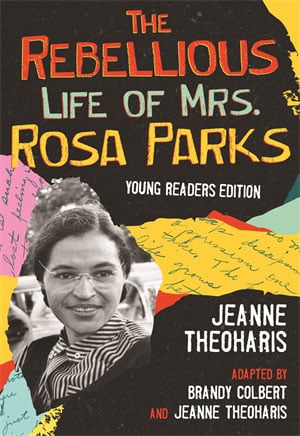
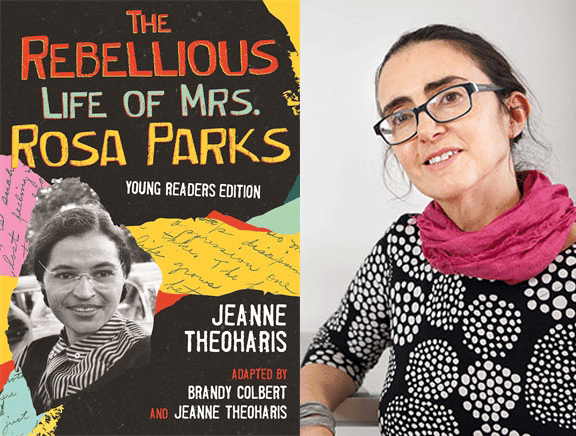
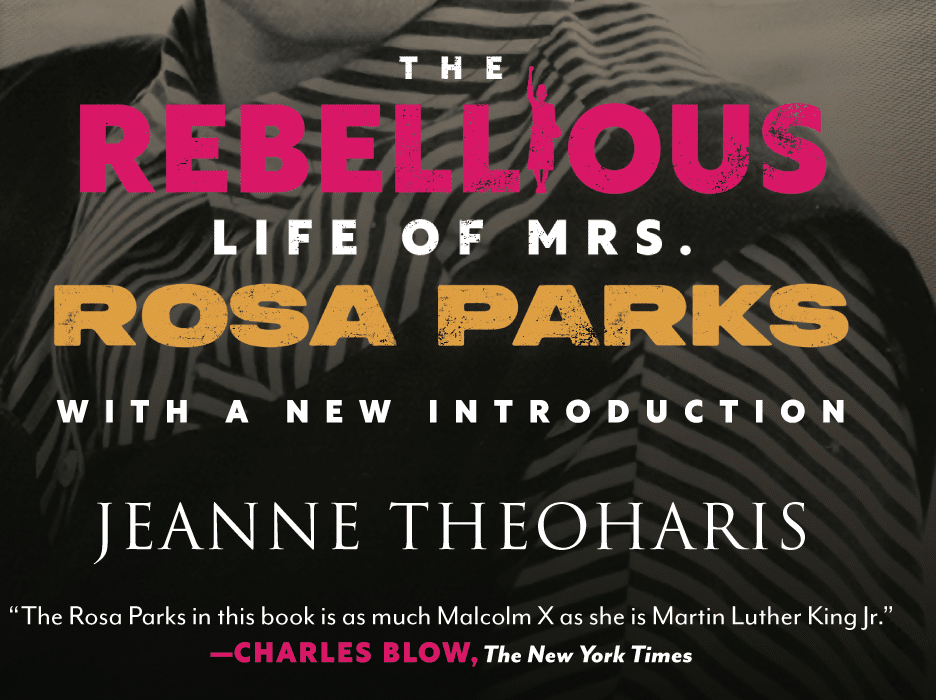
Finally, a book about the real Rosa Parks — the Rosa Parks who was a lifelong activist, tireless organizer, and who did so much more than refuse to give up her seat on that bus in Montgomery, Alabama. In story after story, Jeanne Theoharis and Brandy Colbert breathe life into the rebellious Mrs. Rosa Parks, a fighter for justice who will intrigue and inspire young people. And for all of us who want to teach honestly about Rosa Parks and the Civil Rights Movement, this is an essential resource. — Bill Bigelow, curriculum editor, Rethinking Schools; co-director, Zinn Education Project
Presenting a corrective to the popular notion of Rosa Parks as the quiet seamstress who performed a single act that sparked the Montgomery Bus Boycott and birthed the modern Civil Rights Movement, Jeanne Theoharis provides a revealing window into Parks’ politics and decades of activism. She shows readers how the movement radically sought — for more than a half a century — to expose and eradicate the racial-caste system in jobs, schools, public services, and criminal justice and how Rosa Parks was a key player throughout.
The original text is fully adapted by Theoharis and the award-winning young adult author Brandy Colbert, for middle-grade and young adult readers to include archival images and personal papers of Rosa Parks, and to provide the necessary historical context to bring the multi-faceted, decades-long Civil Rights Movement to life. [Publisher’s description.]
Endorsements
Rosa Parks was a powerful, strategic, and dedicated activist whose witness inspired this nation to do things previously thought impossible. Jeanne Theoharis and Brandy Colbert have overturned simplistic descriptions of Mrs. Parks with extraordinary research, writing, and compassion. This is a must-read for young people hoping to understand the power we all have to make a difference. — Bryan Stevenson, author of Just Mercy
To truly honor Mrs. Rosa Parks is to set the record straight. She was not an accidental heroine or just a tired old lady; she was a lifelong rebellious freedom fighter in every sense of the word. Theoharis has captured the beauty and complexity of Mrs. Parks’s life. Deeply researched and engaging, this rich chronicle of Mrs. Parks’s life is a page-turner for adults and youth alike. Theoharis and Colbert have told Mrs. Parks’s life with so much love, care, and truth telling. Bravo! — Bettina L. Love, author of We Want to Do More Than Survive: Abolitionist Teaching and the Pursuit of Educational Freedom
ISBN: 978-080706757-4 | Beacon Press
More on Rosa Parks by Jeanne Theoharis
Rosa Parks Was a Radical in The Jacobin
Rosa Parks: What to Know About the Lifelong Activist and Civil Rights Icon in Teen Vogue
Pitting Rosa Parks against Claudette Colvin distorts history in The Washington Post with Say Burgin
Book Launch with Jeanne Theoharis and Jesse Hagopian
Teacher Testimonials and Stories
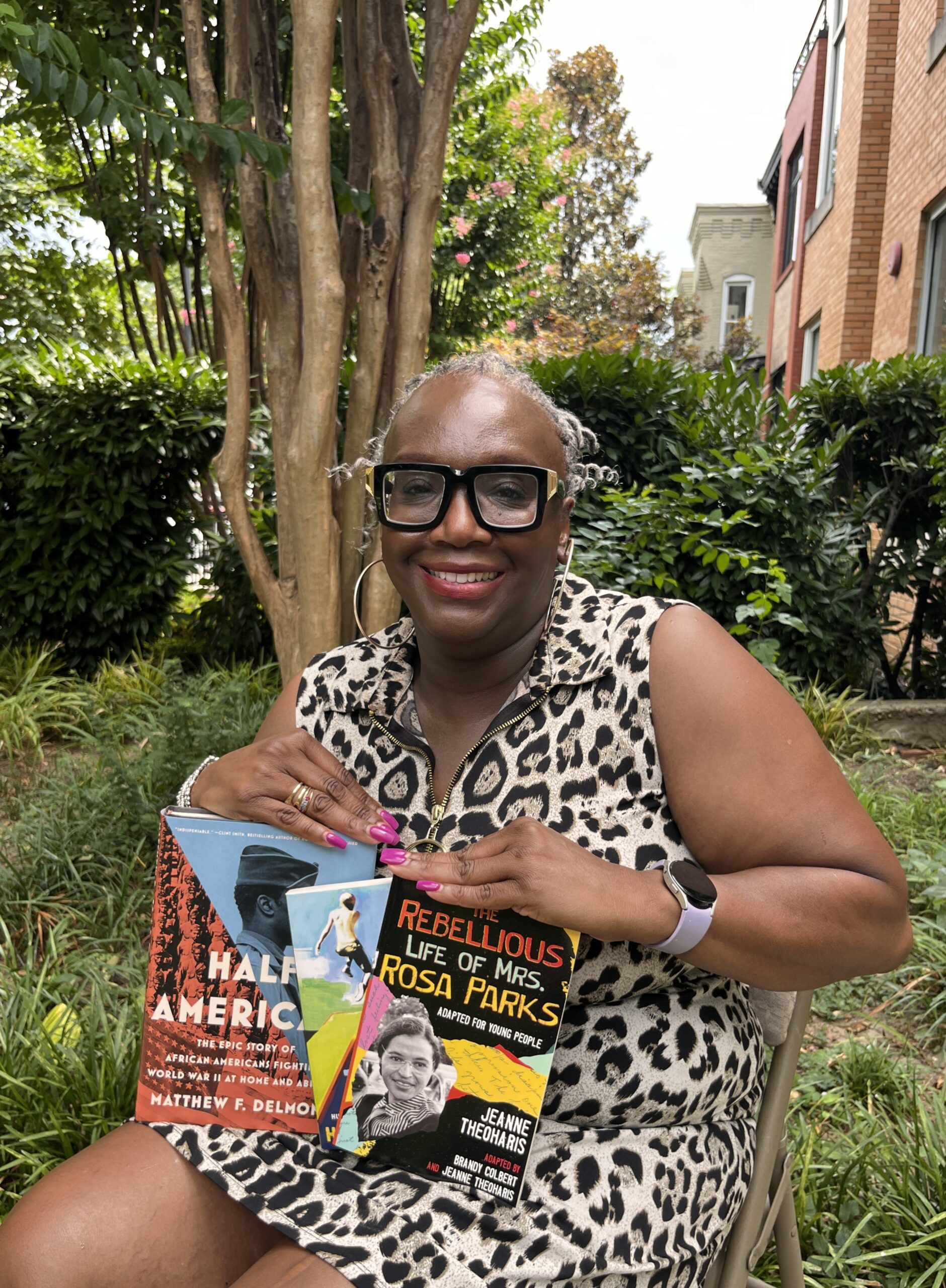
I initially placed the book on my classroom shelf. I use books not only as a way to decorate my class but to inform students as well. I switch out the display every month; so for March, the focus was Women’s History Month. The History Club officers decided that we would view the Rebellious Life of Mrs. Rosa Parks documentary for our monthly meeting. The Rebellious Life of Mrs. Rosa Parks: Young Readers Edition certainly fit this year’s theme, “Celebrating Women Who Tell Our Stories.”
As with every program that we do, our community service element was to once again collect donations for Help, Inc., the only domestic abuse center in our county. We have been doing it for seven years now. The other element of our program involves member-created posters that document the stories of varied female voices that were placed around campus.
As a teacher, I added the book to the reading choice for my civic literacy class for the unit 2nd section focus (Immigration, Identity, Citizenship, and Nationalism) which covers the three branches of government.

I loved the young readers edition of The Rebellious Life of Mrs. Rosa Parks! From time to time a book comes along that inspires me with a missionary-like zeal. I want everyone to read it. I want teachers to teach it and students to learn it.
It’s one of those books I wish I could hand out to random people on the street, and tell them, “You need to know this!” We need myth-busting books! The author asks, “So why do we get the ‘tired bus lady’ version when that story isn’t true?”
The truth of course is that there was so much to tell about Rosa Parks pre- and post- the bus. Not only is her story illuminated, light is shed on the era encompassing her entire life as well as the events in which we are currently engaged. This book teaches the truth!
My students responded to this lesson with a noticeable shift in how they understood both Rosa Parks and the Civil Rights Movement as a whole. Many were surprised to learn that Parks’s activism extended far beyond Montgomery and were especially struck by the “intolerable conditions” she faced in Detroit, which challenged their assumptions that racism was primarily a Southern problem.
As they examined issues like housing discrimination, policing, and unequal schools, students asked deeper questions and made thoughtful connections to present-day inequalities, often expressing frustration but also empathy and curiosity. Overall, this lesson prompted students to see Rosa Parks as a lifelong activist and helped them recognize that resistance to injustice is ongoing, complex, and deeply relevant to their own lives.
In connection, students read The Rebellious Life of Mrs. Rosa Parks, which was especially impactful for students because it reframed a figure they thought they already knew. Many students commented that the book “changed everything” about how they viewed Rosa Parks, moving her from a one-day act of courage to a lifetime of deliberate resistance and activism. As they read, students were drawn to Parks’s persistence, sacrifices, and moral clarity, and they began to understand how ordinary people can commit to extraordinary change over time.

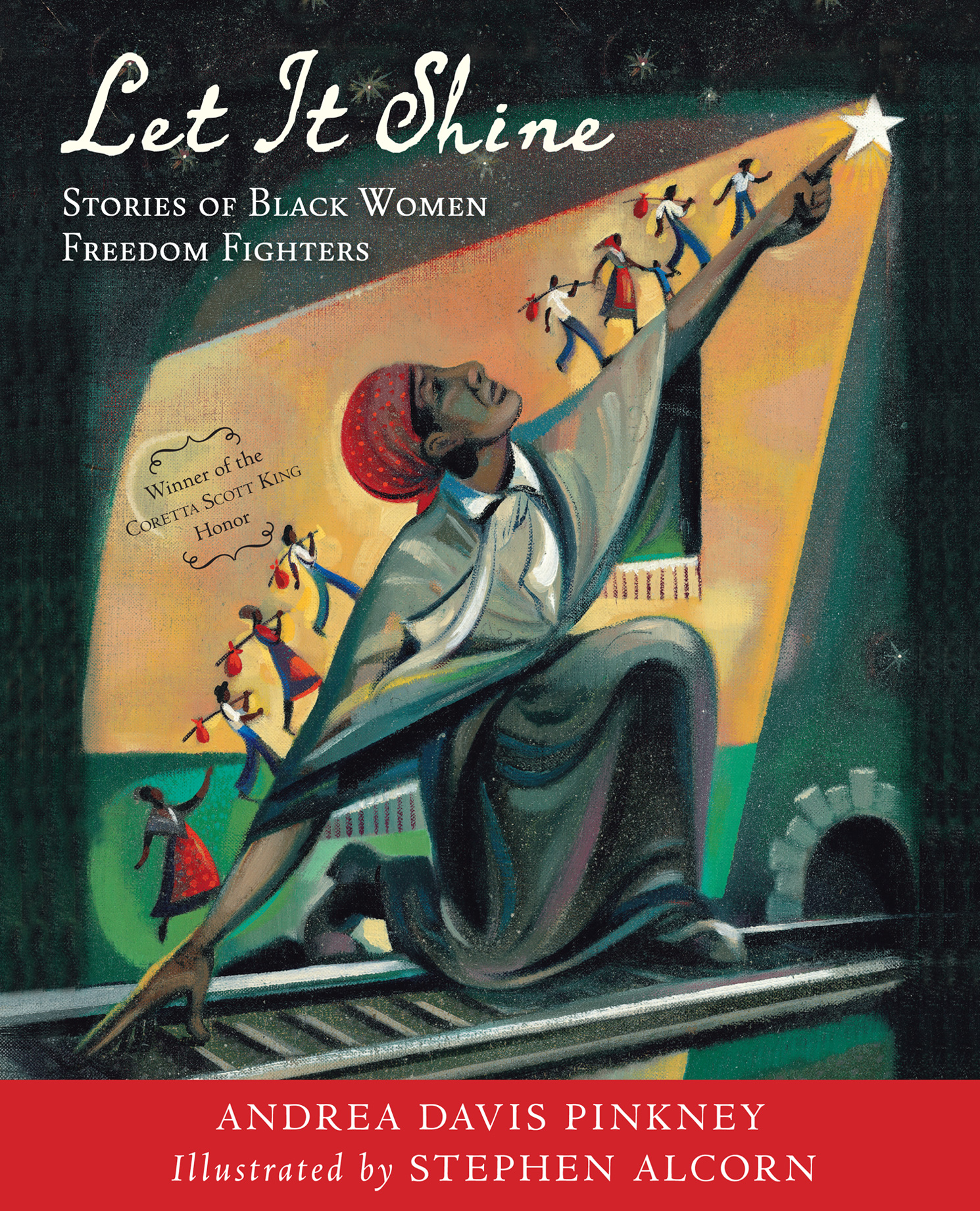
When I taught my lesson on Rosa Parks, I wanted students to see the Montgomery Bus Boycott as part of a larger movement rather than a single event. To deepen their understanding, I introduced Claudette Colvin, a courageous teenager who refused to give up her seat months before Parks. I shared a powerful excerpt from the Zinn Education Project that explained Colvin’s role and why her case didn’t become the catalyst for the boycott.
After reading, I guided students through critical thinking questions such as: Why did Rosa Parks become the face of the movement instead of Claudette Colvin? How do age, race, and social status influence whose stories are remembered? What does this reveal about how history is shaped? Students worked collaboratively to compare the two women’s experiences and analyze the broader implications for civil rights history. By the end of the lesson, they recognized that history is not just about individual heroes — it is about context, choices, and the narratives that shape our understanding of justice.
I introduced book clubs this year, where students had a list of books to choose from. I created groups of no more than four students, and the students read and the book together and regularly met to discuss it. I used the young readers edition of The Rebellious Life of Rosa Parks as an option in my class book club this year and had several students who chose, on their own, to read this book. The students came away with not only new knowledge but a “wow” moment when they realized all they did not know.
Most of the student’s book club options were fictional novels, but there was still interest in this book, this account of Rosa Parks’ life. The students realized this person was not just a woman who sat on a bus, but a woman who had a life filled with many moments of inspiration.
Having this book available for my students to read and check out on their own was great. I would not have had that option without the generosity of the Zinn Education Project.

I’m pleased to share that one of my senior students is excelling in her International Baccalaureate (IB) Diploma Program (DP) History Internal Assessment, a comprehensive 2,200-word exploration. She is effectively utilizing multiple resources from the Zinn Education Project, such as “Intolerable Conditions”: Teaching About Northern Racism Through Rosa Parks’ Detroit and The Rebellious Life of Mrs. Rosa Parks: Adapted for Young People, to thoughtfully address her Research Question: Beyond her pivotal role in the 1955 Montgomery Bus Boycott, what were Rosa Parks’s other major contributions to the Civil Rights Movement?
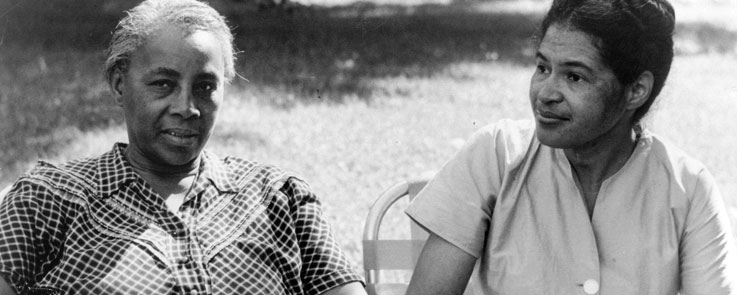
My 12th grader is highlighting the breadth of Mrs. Parks’s impact, emphasizing her significant actions both prior to (like her involvement in Recy Taylor’s 1944 case) and following the boycott (notably in Detroit). Her research and the consideration of diverse historiographical views showcase her development as both a researcher and writer.
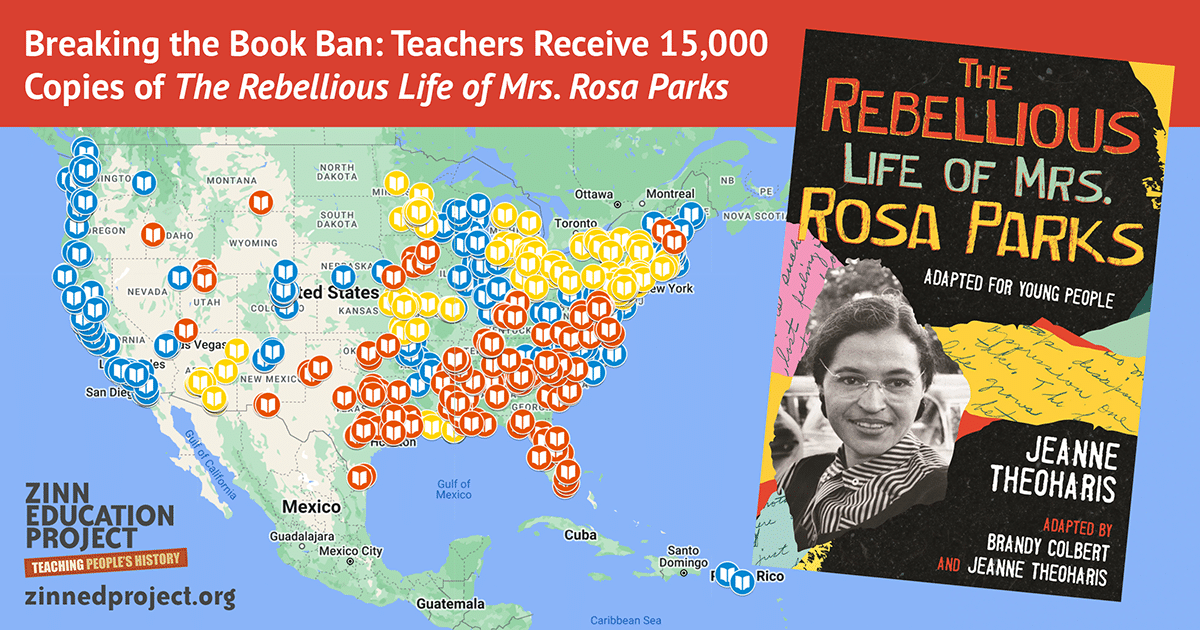
The Zinn Education Project provides so many resources that allow me to teach social studies with a variety of perspectives to ensure truth, balance, and harmony. They recently sent copies of The Rebellious Life of Rosa Parks and I was amazed by how much I did not know about Rosa Parks. I used the book in my history of Detroit class to discuss Parks’ accomplishments beyond the Montgomery Bus Boycott and how her legacy was extended from her roots in the South all the way to Detroit.
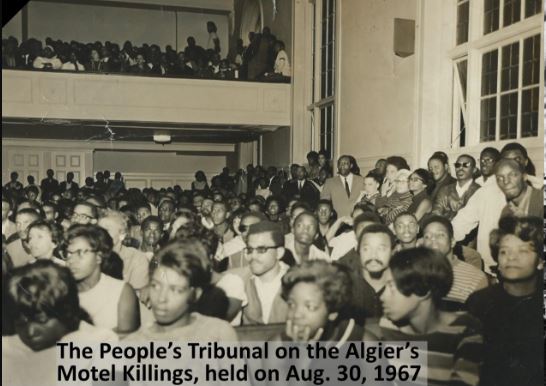


As a twelve year old, living in Greenwood, Mississippi, my parents gave my siblings and I permission to march and protest for civil rights. My siblings and I heard about the voting rights act from our parents. Protesting and boycotting white businesses were our way of expressing our outrage about racism. My sister Barbara and I were arrested downtown for protesting, I was twelve and my sister Barbara was fourteen.
I could have been arrested earlier when my friends and I were boycotting several businesses owned by white families, however, the policemen could never catch me. I was a fast runner, the police caught my friend Vera who was short, sassy and chubby.
As the policeman was chasing me, he was shouting at me to stop or he would shoot me. I was thirteen at the time, I could hear the people sitting on their porches shouting run baby run.
My heart was beating fast. I didn’t want to die. I knocked on Mr. & Mrs. Griffin house, she said I was beating on her door. I shouted “hide me, hide me” the cop is chasing me. I was grateful she was home to protect me. She told me to hide under the bed and don’t move.
Of course, I was so nervous and frantic, you heard so many horror stories about blacks being murdered in MS. I didn’t want to be a victim, I wanted to be a survivor. I was five when I heard my parents talked about Emmett Till which was 30 miles (Money, MS) from Greenwood.
After hiding under the bed for approximately 15 terrifying minutes, Mrs. Griffin, my guardian angel said it was ok to leave. I ran home to let my mom know Vera had been arrested. She immediately went to Vera’s family home to let them know. No one was home, my mom went back to the house an hour later.
When Vera’s mom arrived at the police station, she was told Vera wasn’t there. She let them know she wasn’t leaving without her daughter. Vera said they took her to the police station to view an 8mm film, they wanted her to identify me. She gave them a fake name, lied and said I lived in another community. They threatened to throw her into Yahoo River if she didn’t identify me. I know she didn’t tell them because they never came to my home looking for me. She was a great friend and life saver.