
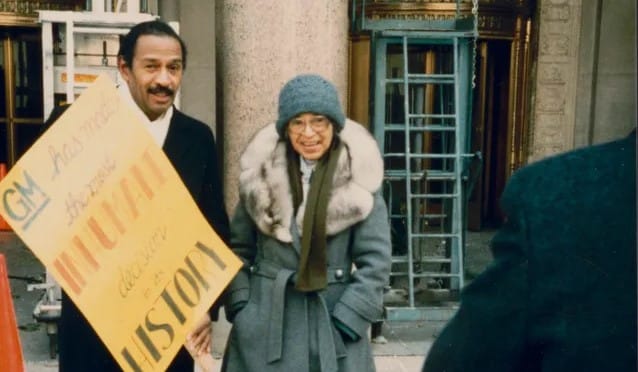
Rosa Parks with Congressman John Conyers in Detroit. Source: Library of Congress
On July 24, 1967, the New York Times reported, “Thousands of rampaging Negroes firebombed and looted huge sections of Detroit last night and early today. Gov. George Romney ordered 1,500 National Guardsmen, backed by tanks, to quell the riot.” It took 10 paragraphs (and required reading beyond the front page) to learn anything about causes: “The trouble began when the police raided a ‘blind pig,’ or after-hours drinking spot, on 12th Street near Clairmount and arrested 73 persons.”
The Times offered no context for the salient social facts of that sentence — the long history of police harassment of Black Detroiters and the conditions that pushed people to recreate in unpermitted bars — nor did the coverage note the steely resistance of the patrons of the blind pig. The crowd at the bar refused to leave (and in fact grew in size) when the police showed up and started arresting people. Rep. John Conyers said, “People were letting feelings out that had never been let out before, that had been bottled up. . . . It was the whole desperate situation of being Black in Detroit.”
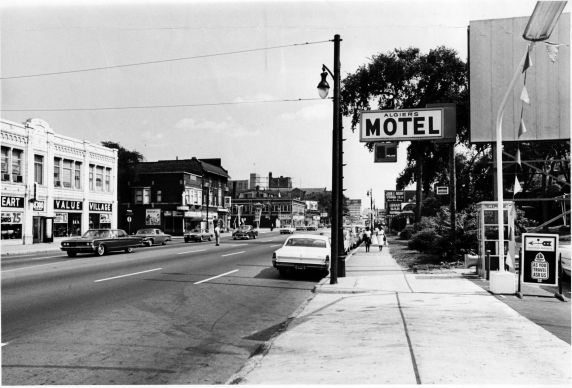
Algiers Motel, July 26, 1967. Courtesy: Detroit News Photographs, Walter P. Reuther Library, Wayne State University.
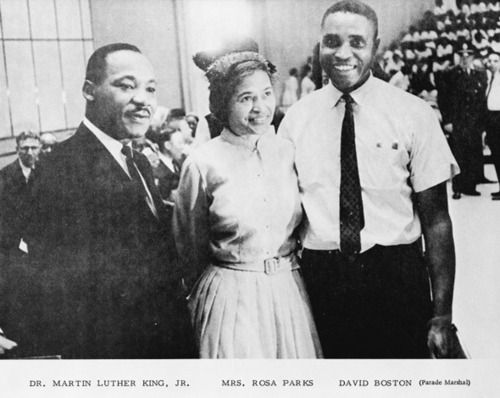
Rosa Parks’s apartment was only about a mile away from the raided blind pig. She and her family had been forced to leave Montgomery, Alabama, a decade earlier because even after the bus boycott’s successful end, she and her husband (who had both lost their jobs) still couldn’t find work and were still getting death threats. She had joined movements in Detroit challenging school and housing segregation and said the uprising was “the result of resistance to change that was needed long beforehand.” While Rosa Parks is typically associated with Montgomery and the Southern Civil Rights Movement, she actually spent half of her life fighting Northern racism, what Conyers called “the whole desperate situation of being Black in Detroit.”
This lesson, which focuses on the Detroit Uprising of 1967, equips students to “talk back” to official accounts of the riot — like the one quoted from The Times above — by focusing on its root causes. Additionally, the lesson provides students an opportunity to get a fuller sense of Rosa Parks’s life and politics and to learn about the Black freedom struggle outside of the South.

Detroit Free Press, April 27, 1966. “Students State Views: What’s Wrong at Northern?” This is one of the dozens of documents available to students in the lesson handouts.
The lesson asks students to investigate four crucial sites of racial inequality — schools, housing, jobs, and policing — drawing upon excerpts from The Rebellious Life of Mrs. Rosa Parks: Young Readers Edition and several primary sources: tax records, redlining maps, oral histories, newspaper stories, and more. In conversation with each other, students will learn how inequality and segregation was created and maintained, shaped Black lives in the city, and how people — like Rosa Parks and the vibrant Black community in Detroit of which she was a part — responded to it.
Film Clips
Below are film clips that we recommend using with this lesson from the 2022 documentary, The Rebellious Life of Mrs. Rosa Parks.
0:59:09 – 1:03:39 |Introduction to Detroit and Parks in Detroit
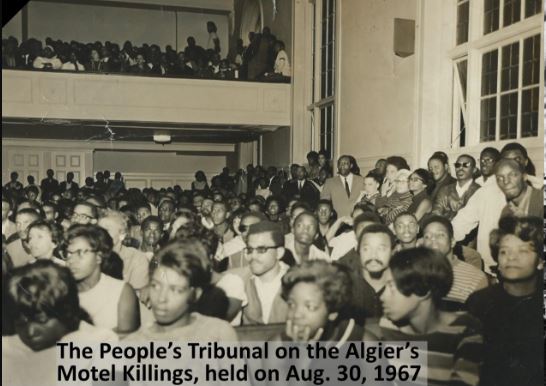
1:09:01 – 1:13:00 | Detroit uprising and People’s Tribunal
1:13:00 – 1:16:24 | Representative John Conyers
1:19:13 – 1:23:10 | Dearborn and running for Detroit NAACP
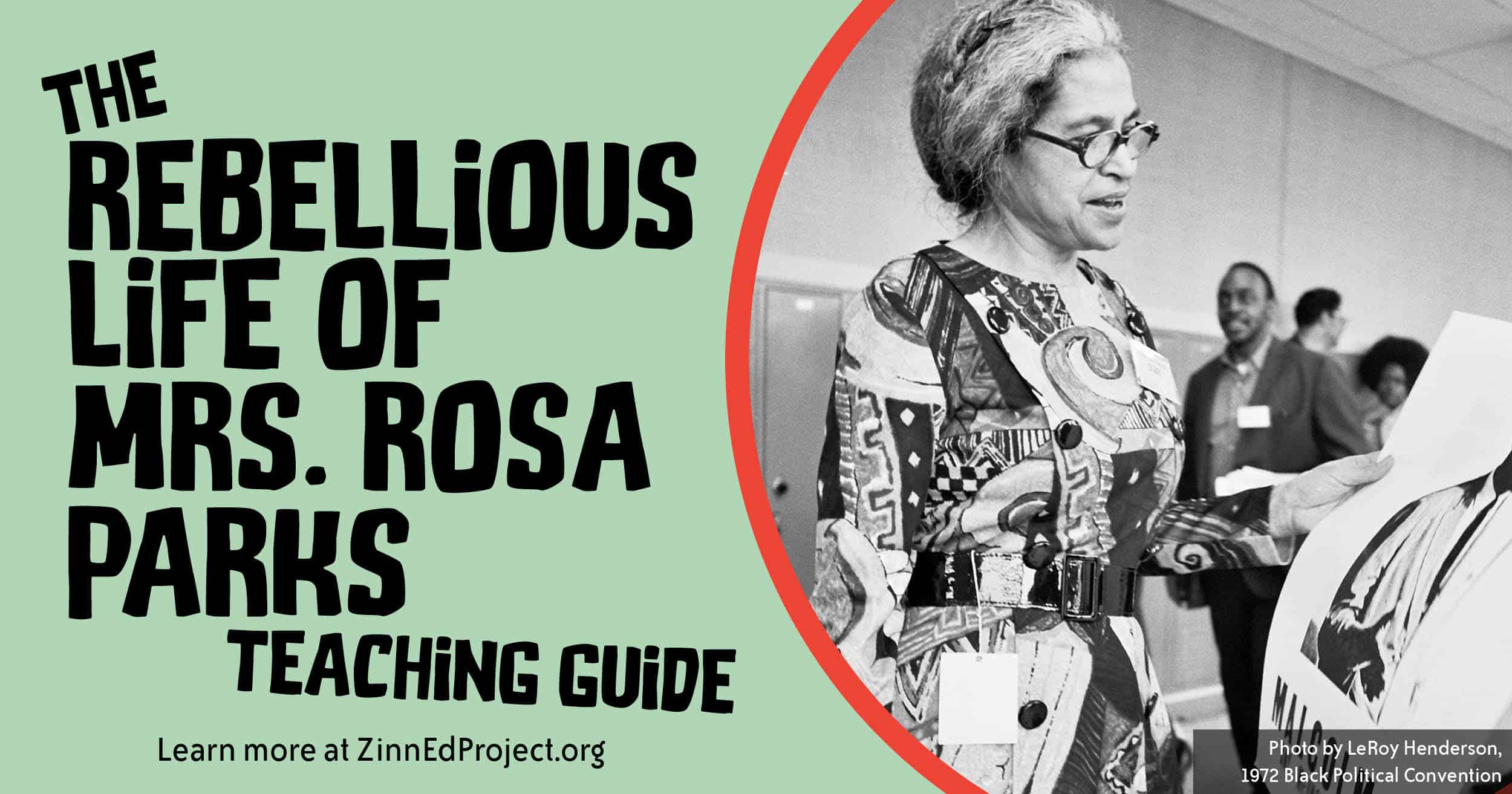
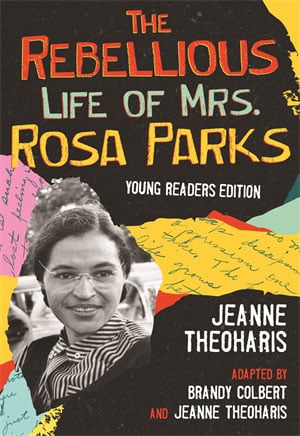
This lesson is from the The Rebellious Life of Mrs. Rosa Parks Teaching Guide for classroom use. It is part of a collection of lessons to accompany the book and film of the same name.
Classroom Stories
My students responded to this lesson with a noticeable shift in how they understood both Rosa Parks and the Civil Rights Movement as a whole. Many were surprised to learn that Parks’s activism extended far beyond Montgomery and were especially struck by the “intolerable conditions” she faced in Detroit, which challenged their assumptions that racism was primarily a Southern problem.
As they examined issues like housing discrimination, policing, and unequal schools, students asked deeper questions and made thoughtful connections to present-day inequalities, often expressing frustration but also empathy and curiosity. Overall, this lesson prompted students to see Rosa Parks as a lifelong activist and helped them recognize that resistance to injustice is ongoing, complex, and deeply relevant to their own lives.
In connection, students read The Rebellious Life of Mrs. Rosa Parks, which was especially impactful for students because it reframed a figure they thought they already knew. Many students commented that the book “changed everything” about how they viewed Rosa Parks, moving her from a one-day act of courage to a lifetime of deliberate resistance and activism. As they read, students were drawn to Parks’s persistence, sacrifices, and moral clarity, and they began to understand how ordinary people can commit to extraordinary change over time.
As we are located in Michigan and already study the Detroit Uprising of 1967, I thought it would be an effective expansion to use the “Intolerable Conditions”: Teaching About Northern Racism Through Rosa Parks’s Detroit lesson in class. By the time students are in my freshmen history class, they are already familiar with at least the basics of Rosa Parks’s story.
We began with discussing her and Mr. Parks’s move from Montgomery to Detroit due to harassment and being unable to find jobs after the Montgomery Bus Boycott. Students were quite surprised to learn just how much time Rosa Parks spent fighting racism in our own state. We discussed the hope inherent in the Great Migration then looked at Mrs. Parks’s quote about the North not being the promised land.
After examining the causes of the uprising, students engaged with Governor Romney’s speech. It did not take long for them to start noticing discrepancies between the two. Natural discussion of the accuracies and inaccuracies along with reasons why brought the whole class together. They were quite insightful in their comments.

I’m pleased to share that one of my senior students is excelling in her International Baccalaureate (IB) Diploma Program (DP) History Internal Assessment, a comprehensive 2,200-word exploration. She is effectively utilizing multiple resources from the Zinn Education Project, such as “Intolerable Conditions”: Teaching About Northern Racism Through Rosa Parks’ Detroit and The Rebellious Life of Mrs. Rosa Parks: Adapted for Young People, to thoughtfully address her Research Question: Beyond her pivotal role in the 1955 Montgomery Bus Boycott, what were Rosa Parks’s other major contributions to the Civil Rights Movement?
My 12th grader is highlighting the breadth of Mrs. Parks’s impact, emphasizing her significant actions both prior to (like her involvement in Recy Taylor’s 1944 case) and following the boycott (notably in Detroit). Her research and the consideration of diverse historiographical views showcase her development as both a researcher and writer.
I did my student teaching rotation at a high school in Detroit, Mich. While I was there, I designed a unit centered around using the story and music of Motown as a lens into the Civil Rights Movement. I wanted to help students understand the Civil Rights Movement in the north, particularly in their own city. One of the days of the unit (we had 100 minute class periods), we worked through the “Intolerable Conditions” lesson. We already had class copies of Jeanne Theoharis’s young reader’s edition of The Rebellious Life of Mrs. Rosa Parks, so students were generally familiar with the text, though hadn’t read much of it. The principal class textbook was A Young People’s History. Students also read Detroit ’67 in their English class, and our goal was to make sense of the event in more detail.
Students were first very excited to learn that Rosa Parks had spent so much of her life in Detroit. Most of them viewed her as a primarily southern figure. After reading through so many of the sources in the activity, they also, unprompted, started making connections to the Detroit they knew, and wanted to know more about how we had gotten to where we were from the world presented in the docs.


I’m so glad to see this! My own kids were able to learn about what happened in Detroit since my dad was on the team of reporters who investigated the root causes of the uprising. He shares a Pulitzer Prize with that team from the Free Press. I’ll share this with him. He’s 91 now but his memory of important events and people from his early days as a journalist are strong!
Thanks for all you do!