

By Jeanne Theoharis
The 1964 Civil Rights Act tied school desegregation to federal funding. School districts faced losing that money if they didn’t desegregate. In July 1965, Chicago parents and the Coordinating Council of Community Organizations (the CCCO, a coalition of civil rights and community groups founded in 1962 and headed by former teacher Al Raby) filed a detailed complaint with the U.S. Office of Education on the intentional practices of the city’s school segregation. They laid out how the Chicago Board of Education had violated Title VI of the 1964 Civil Rights Act — which gave the U.S. Department of Health, Education, and Welfare (HEW) the power to withhold federal funds if school districts continued to segregate.
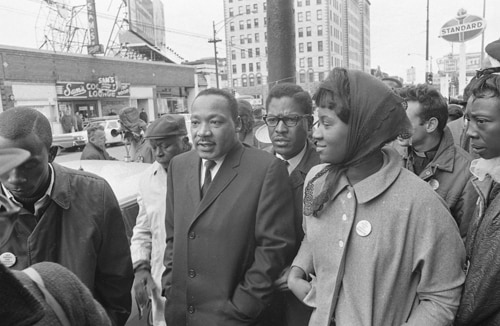
Martin Luther King Jr. in Chicago, walking with members of the East Garfield Park Community Organization. Photograph by John Tweedle, courtesy of Dianne Tweedle. Source: Oxford African American Studies Center
Chicago stood to lose over $30 million. The CCCO complaint was detailed, including more than 20 cases for further study. One example they presented was the segregation of the young people living in all-Black Altgeld Gardens projects who were not allowed to attend the other local elementary schools, just the ones in the project itself. The CCCO complaint included statistics of differential class sizes and percentages of certified teachers and the shocking fact that in Black schools, when a teacher had to be absent, only 41 percent of the time was a substitute teacher even assigned. When the Office of Education read the CCCO’s complaint about Chicago Public Schools, Deputy HEW Director Francis Keppel found it “unquestionably . . . the most detailed” one they’d ever received.
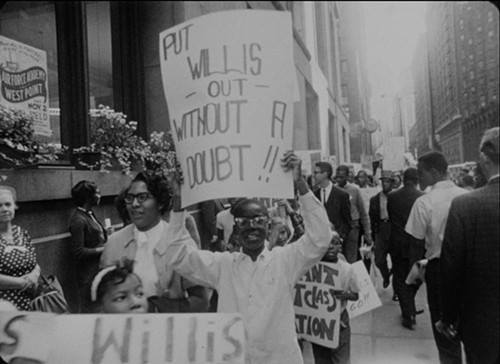
The federal government requested a host of information from Chicago’s Board of Education: racial head counts of students and teachers, per-pupil expenditures in schools, average class size, student-teacher ratios, and the method of assigning teachers. But School Superintendent Benjamin Willis and the BOE did not comply. They had a history of ignoring federal requests.
As a result, on October 1, HEW withheld those $32 million in federal funds, finding Chicago schools in “probable non-compliance.” Chicago activists like Raby celebrated. Dr. King telegrammed President Johnson praising the decision and underlining the importance of enforcing the Civil Rights Act against Northern school systems. But the Chicago Tribune, alongside most white Chicagoans, found the decision “outrageous” and slammed “federal interference.” Chicago Congressmen Roman Pucinski, Daniel Rostenkowski, and John Kluczynski, as well as Senator Everett Dicksen (who’d been crucial to breaking the Senate filibuster to get the Civil Rights Act passed), slammed the decision.
Furious, Mayor Daley got on a plane on October 3 to confront President Johnson directly and make clear this was unacceptable. Johnson was in New York to meet the pope, but the mayor confronted him and insisted that the decision be reversed, so furious that he made Johnson late to his meeting.
The next day, Johnson called Keppel and HEW secretary John Gardner into his office and “gave them unstinted hell,” according to one observer. Less than a week after it had withheld funds, on October 8, HEW released the $32 million to Chicago.
 Daley didn’t just want the money; he wanted Keppel punished. Francis Keppel was quietly moved to another position and in a few months left the federal government altogether. Raby was “shocked at this shameless display of naked political power” from Daley and the congressional delegation from Illinois — “the first to squeal like stuck pigs when the bill is enforced in the North.”
The president of the United States had halted enforcement of the Civil Rights Act in Chicago.
Find this story and many more in King of the North: Martin Luther King Jr.’s Life of Struggle Outside the South by Jeanne Theoharis.
Jeanne Theoharis is a distinguished professor at Brooklyn College. She is the author or co-author of numerous books and articles on the Civil Rights and Black Power movements and the politics of race and education. Her books include the award-winning titles The Rebellious Life of Mrs. Rosa Parks and A More Beautiful and Terrible History: The Uses and Misuses of Civil Rights History. Her most recent title is King of the North: Martin Luther King Jr.’s Life of Struggle Outside the South. Theoharis co-founded the Teach the Black Freedom Struggle class series with the Zinn Education Project and invited our staff to collaborate on a teaching guide for The Rebellious Life of Mrs. Rosa Parks book and film.





Twitter
Google plus
LinkedIn