

By Joy Ellison
On the evening of July 17, 1971, Joy Polley was enjoying a drink in a tavern in the Back of the Yards neighborhood on Chicago’s South Side. Polley was 27 years old, a Southwest Side resident, and a teacher. By the end of the night, she found herself handcuffed, humiliated, and ready to challenge a law that impacted many communities in the city, ranging from trans and queer people, to Black women, to drag queens and kings, to unhoused people: Chicago’s infamous dress restriction law, ordinance 192-8.
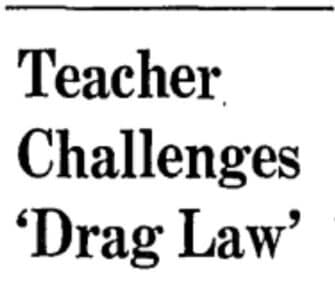 Polley said the police officer who arrested her did so because of what he called a “discrepancy in sex.” Polley was a white trans woman. Under Chicago’s local ordinance 192-8, she risked arrest at any time she left her house in feminine clothing. Located in a chapter entitled “Public Morals,” ordinance 192-8 read as follows:
Any person who shall appear in a public place in a state of nudity, or in a dress not belonging to his or her sex, with intent to conceal his or her sex, or in an indecent or lewd dress, or who shall make any indecent exposure of his or her person, shall be fined not less than $20.00 nor more than $500.00 for each offense [emphasis mine].
By criminalizing the “intent to conceal his or her sex,” ordinance 192-8 targeted not only anyone police understood as gender non-conforming, but trans women and femmes especially. In the 1970s, newspapers regularly called trans women and femmes “female impersonators” and claimed their gender expression was not a reflection of their selfhood, but merely a performance or a disguise used to commit crimes. Ordinance 192-8 codified that prevailing prejudice into law. But because of the vague nature of the ordinance, police could use it against anyone whose appearance they found unconventional or undesirable. Lesbians were regularly charged under ordinance 192-8, as were unhoused queer and transgender people. In my book The Trans Midwest: Trans Feminine Coalition Building Since World War II, I document an incident when police harassed a Black cisgender woman whom they accused of being a “female impersonator.” Ordinance 192-8 was a part of intersecting systems of oppression that included transphobia, sexism, racism, ableism and capitalism.
For trans women like Polley, the consequences of this law were devastating, but ordinance 192-8 became the basis for an intersectional movement for gender liberation. When Polley was booked, she found herself not only charged under ordinance 192-8, but also facing trumped-up charges of resisting arrest and battery. Then when word of her arrest and her trans identity circulated, Polley lost her teaching position. A simple night out left Polley unemployed and facing a difficult legal battle.
But her case also inspired solidarity from a pair of allies from very different backgrounds. Tony Johnson, a self-described Black transvestite and Margaret Wilson, a white, cisgender lesbian separatist published information about Polley’s cause in the newsletter of the Transvestite / Transsexual Legal Committee (TLC), Chicago’s first formal trans organization. Black trans women and femmes like Johnson were disproportionately impacted by ordinance 192-8 because of the intense policing of Black neighborhoods. As a lesbian and a teacher, Wilson had also run afoul of ordinance 192-8 and knew she could easily face the same employment discrimination as Polley. From very different social backgrounds, Wilson and Johnson collaborated to challenge gender restrictions as key members of TLC. Alongside Polley and others targeted by ordinance 192-8, they organized a groundbreaking movement against a problem that impacted them all.
The movement against ordinance 192-8 was ultimately effective. The officer who arrested Polley probably expected her to accept being arrested and humiliated without protest, but Polley was ready to fight. She fought her case in court and convinced the judge to strike it down. Then she went further by challenging the constitutionality of ordinance 192-8. She wasn’t the only person to do so. The Chicago Tribune reported that many trans people arrested under ordinance 192-8 responded by challenging the law’s constitutionality. In fact, an attorney for the state openly admitted that when threatened with such suits, the state usually decided to drop its case. While Polley’s suit did not overturn the law, in 1973 the very same arguments she made against ordinance 192-8 were accepted by a different Chicago judge. Ordinance 192-8 was struck down because of the resistance of Polley, Johnson, Wilson and other ordinary Chicagoans like them. Their story demonstrates the power of intersectional organization against injustices that impact many communities.
 Dr. Joy Ellison is a professor of Gender and Women’s Studies at University of Rhode Island. They are the author of The Trans Midwest: Trans Feminine Coalition Building Since World War II and several queer and trans history books for children, including Sylvia and Marsha Start a Revolution!, Willi Ninja, Vogue Legend, and Flor Fights Back. A previous version of this article appears here.






Twitter
Google plus
LinkedIn