

By J. N. Cheney
On October 9, 1912, immigrant women from Southern and Eastern Europe working in the textile mills of the small city of Little Falls, New York, walked off the job. Thus began the Little Falls Textile Strike of 1912–1913, a struggle that has been historically neglected due to sitting between the Bread and Roses Strike and the Paterson Silk Strike on the timeline of labor studies.
After enduring terrible living and working conditions, including crowded tenement buildings, improper plumbing, a lack of safety protocols, and a general sense of nativism from mill owners and landlords, the final straw for these women was when their pay was cut. This cut was in response to state legislation that lowered working hours for women and children from 60 hours a week to 54. It did not take long for the strike to garner the support of major forces such as the Socialist Party of America (SPA) and the Industrial Workers of the World (IWW). Within a few days after the walkout, members of the Schenectady, New York branch of the SPA came to Little Falls to show their support. Most notably, the branch’s biggest support of the strike was George R. Lunn, Schenectady’s first and only socialist mayor. Lunn and the Schenectady socialists helped to give the strike broader attention.

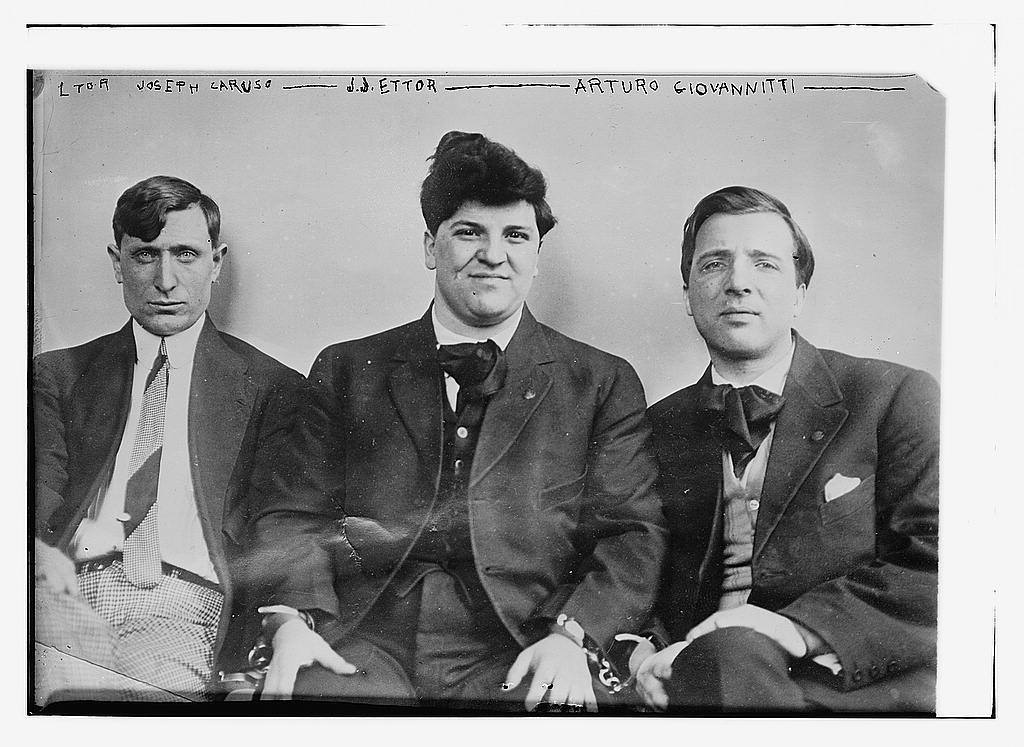
IWW members in jail in Little Falls, New York. From the International Socialist Review, January 1913. Source: Public domain
Utilizing a scantily enforced city ordinance limiting the number of people allowed at a public gathering before needing a permit, Lunn and the socialists were arrested for publicly speaking in support of the strikers outside of the mills. Lunn put out a mass call to garner further support for the strikers, leading to the IWW coming to Little Falls to lend their services. With the Wobblies’ help, the textile workers established a strike committee and formalized their demands. The workers demanded “for day workers the restoration of the weekly wage rate of sixty hours and [a] ten percent additional increase in pay. For night workers, we demand a sixty hour a week schedule and an hour at midnight for lunch.” They also demanded that all strikers be brought back to work without discrimination or retaliation.
Helen Schloss, a public health nurse employed by a group of wealthy socialites in the city who called the Fortnightly Club to investigate the city’s tuberculosis problem, was another early supporter of the strike. A Russian immigrant herself and a socialist, after seeing the first hand the horrid conditions her fellow immigrants faced in Little Falls, Schloss resigned from her position on October 18 to be able to properly support the strike effort. Schloss played a significant role in upholding the picket line and establishing a soup kitchen for the strikers.
The strikers faced opposition from local police and deputized strikebreakers throughout their fight, but the most egregious example came on October 30 when their headquarters was violently raided by the police. Police threw women off the front steps of the building, smashed the union charter, and arrested several strike committee members, even those who were not present at the headquarters, such as Helen Schloss.
The raid left a void in strike leadership, a void soon filled by IWW organizer and socialist Matilda Robbins. Under Robbins’ leadership, a defense committee was established to handle things the strike committee couldn’t, including gaining funds for legal defense and bookkeeping. Famed IWW organizer William “Big Bill” Haywood briefly lent his expertise to the fight in Little Falls, and even Helen Keller sent the strikers a letter of support and donated $87 for their efforts.
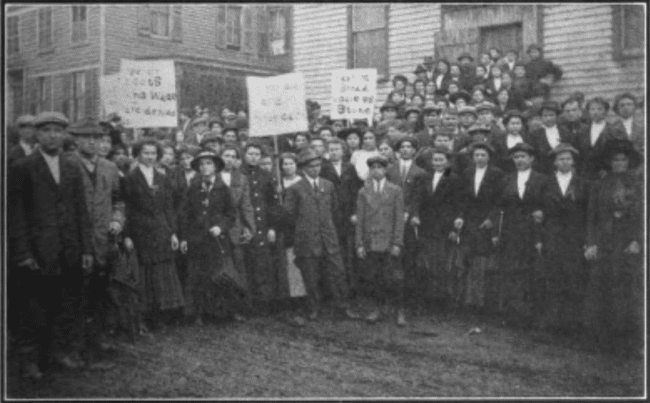
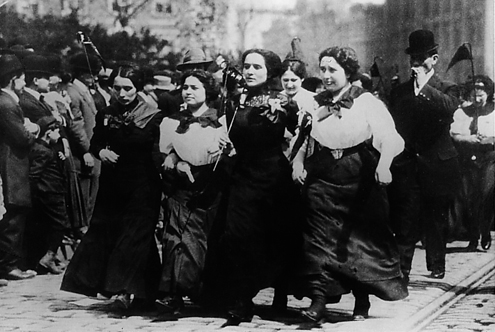
Strikers outside Slovak Hall following the raid, with Matilda Rabinowitz in the front row, fourth from the left. From the International Socialist Review, December 1912. Source: Public domain
Responding to financial problems, the union borrowed a tactic from the Bread and Roses Strike to send the children of strikers to host families in Schenectady until a settlement was won. This effort, along with the harassment they faced from the police on the way to the train station, helped give the strike a great deal of public sympathy.
The textile workers won their fight after three months of struggling, though struggles such as legal battles and mill owners violating the settlement endured for some time. Though it is not as well known as the strikes in Lawrence and Paterson, that this fight brought radical unionism and major figures in the socialist and labor movement to New York’s Mohawk Valley proves its historical significance.
 J. N. Cheney is an independent historian who focuses on the labor movement, radical politics, and community action in New York State’s Mohawk Valley, and author of the first book dedicated to the Little Falls Textile Strike, entitled Women, Immigrants, and the Working-Class Battle in Little Falls, New York: The Textile Strike of 1912-1913.
We also recommend the LAWCHA article The Forgotten Fight in Little Falls, New York by J. N. Cheney.




Twitter
Google plus
LinkedIn