
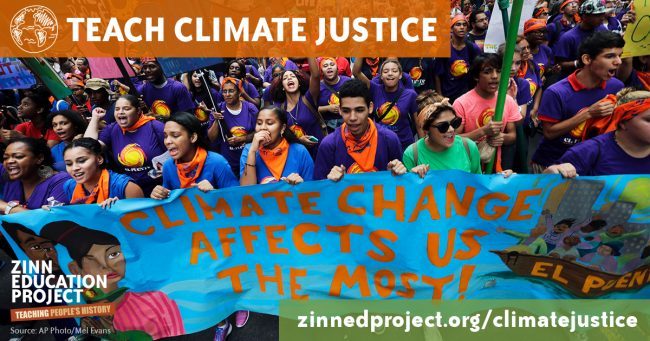
On the first day of spring this year, March 20, Yuma, Arizona, recorded the hottest March temperature in U.S. history: 112 degrees. There is much to say about how frightening this is and what the implications are. But one thing to emphasize is the urgency of engaging our students in a climate justice curriculum.
Climate justice, not merely climate literacy. We need to help students search for the causes of the crisis — and uncover its long history. Students can learn to think systemically and to recognize that the climate catastrophe is not the product simply of bad policies, but has its roots in a system that prizes profit above humanity and nature. Inequality is at the heart of this crisis — with the worst consequences falling on those who had the least to do with causing it.
But climate justice education is also activist and hopeful, emphasizing the accomplishments of people of conscience and social movements throughout history, and inviting students to see themselves as changemakers.
At our Climate Justice Campaign, we have lots of lessons and resources to help bring this curriculum to life in classrooms. Here, below, are a few.
Climate Crisis Trial Lesson
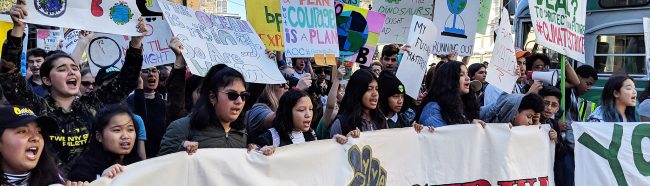
In this trial role play, students represent different “defendants,” from fossil fuel companies to governments, consumers, and the global capitalist system. All are charged with causing the climate crisis. As they debate responsibility, participants explore interconnected factors and consider what justice might look like.
This is one of those lessons teachers dream about where students are walking out the door still discussing and debating. — Brett Benson, middle school teacher, Omaha, Nebraska
The Thingamabob Game Lesson: Capitalism vs. the Climate

This playful, always-engaging activity helps students grasp the essential relationship between climate change and capitalism.
This was empowering for everyone involved about strength in numbers, recognizing true motives, thinking outside the confines of the system, and organizing. — Ann Finkel, middle school science teacher, Brookline, Massachusetts
History of the Climate Crisis
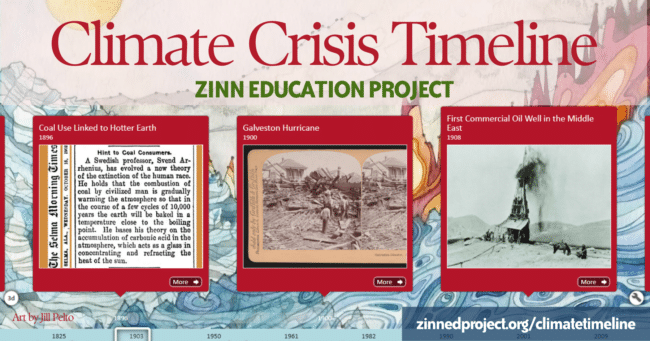
The Climate Crisis Timeline is a vital resource for history classes. It traces the roots of the climate crisis from European colonial expansion and racial capitalism, to present-day fossil fuel industry and government projects that exploit the Earth for profit. It also highlights the resistance movements that inform climate justice work today.
Environmental Cost of War
Since February 28, thousands have been killed in the war in Iran and throughout the Middle East. This war devastates ecosystems, with U.S. military activity releasing toxins, polluting air and water, contaminating soil and water, and harming wildlife.
As U.N. scientist Kaveh Madani notes in a recent Democracy Now! segment:
All the weapons that have been produced have had carbon footprints — the missiles that fly, the jets, the tanks that are burned, the oil fields that are being attacked and the gas fields that are being burned. All of these are producing a lot of greenhouse gas emissions. They are going to impact us in the long term.
Books for Pre-K–12
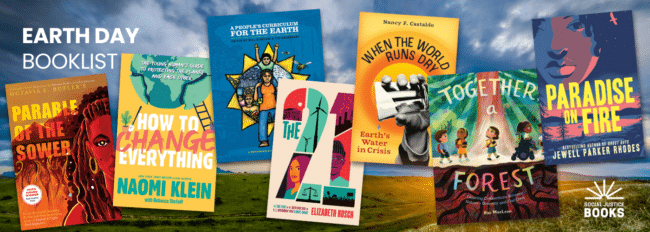
Find more lessons and teaching stories on environmental justice in the Rethinking Schools book, A People’s Curriculum for the Earth.
Plus, check out recommended books on the environment for pre-K–12 at Teaching for Change’s Social Justice Books.


Twitter
Google plus
LinkedIn