
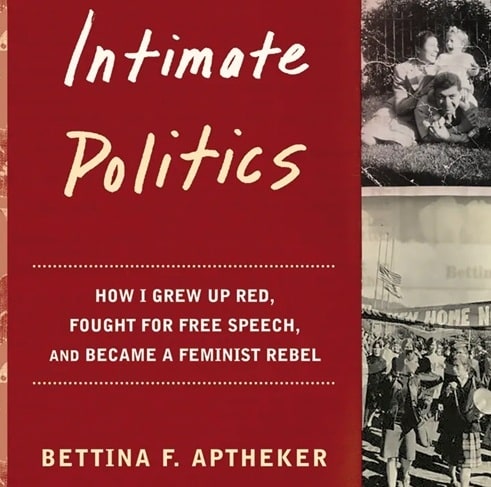
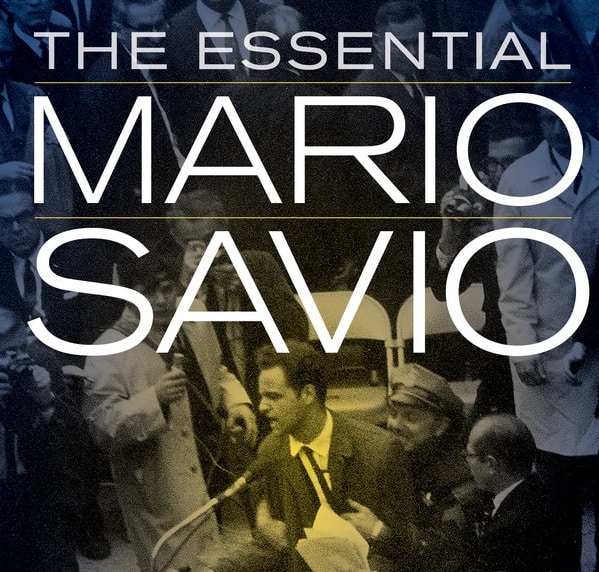
On May 21, Rethinking Schools editor Jesse Hagopian spoke with activist scholars Bettina Aptheker, author of Intimate Politics: How I Grew Up Red, Fought for Free Speech, and Became a Feminist Rebel and Robert Cohen, editor of The Essential Mario Savio: Speeches and Writings that Changed America. The workshop was co-sponsored by the University of California National Center for Free Speech and Civic Engagement and the NYU Department of Teaching and Learning.
Aptheker described her involvement with the Free Speech Movement (FSM) and Cohen traced the roots of the FSM back to the Black Freedom Struggle in Mississippi. Both addressed the legacy of the Free Speech Movement and the current free speech crisis on campuses and other public institutions.
Event Recording
Transcript
Click below for the full transcript with resources mentioned in the discussion.
Transcript
Jesse Hagopian (he/him): On behalf of the Zinn Education Project, we would like to welcome everybody here today to our people’s history class on the Free Speech Movement (FMS). My name is Jesse Hagopian, and I’m a campaign director with the Zinn Education Project and an editor for Rethinking Schools. I am here because I know that the lessons of the Free Speech Movement are urgent to our own time and struggles today, and I really want to learn as much as I can from our two experts on this struggle so that we can apply those lessons to our fights.
This class is co-sponsored by the University of California National Center for Free Speech and Civic Engagement and the NYU Department of Teaching and Learning in preparation for the 5th Annual Teach Truth Day of Action. We hope you all will join us, because across the country educators are under attack. Laws banning honest education, about race, about gender, about history, about sexuality, about justice, these laws are spreading and threatening our students, criminalizing our teachers, and denying young people the tools to understand the world. We can’t stay silent, so please join us for the national Teach Truth Day of Action and defend the freedom to learn.
Now, I am happy to welcome Bettina Aptheker, author of Intimate Politics: How I Grew Up Red, Fought for Free Speech, and Became a Feminist Rebel, and Robert Cohen, author and editor of many books, including The Essential Mario Savio: Speeches and Writings that Changed America. Thank you both so much for joining us this afternoon.
Robert Cohen: Great to be here.
Bettina Aptheker: We’re very happy to be here.
Hagopian: Well, we need you here because educators are in the struggle right now, as I alluded to in my comments, and I’m really excited for this conversation because there’s so many lessons that we need to draw out that are not just about studying the past but about learning guidelines for how we can organize our own fight. The Free Speech Movement is often remembered as a liberal fight for campus rights, but you all have really spoken so well to the fact that its origins were far more radical. Robert, you write in Freedom’s Orator, “For Savio, free speech was not an abstraction. It was a weapon with which to fight racism, poverty, and war.” So, I wanted to ask you both, how do you think the radical roots of the Free Speech Movement have been misunderstood or erased over time, and why is it important to reclaim them today?
Aptheker: I’ll give a little brief response to that excellent question. And again, thank you for having us. I think what’s most important to understand here is that there are two things that are happening in the country when the Free Speech Movement erupts. One of those is we’re right at the end of the McCarthy period, a period of intense repression against the left, and especially against Communists or people accused of being Communists, with the loyalty oaths and so forth. The other thing that’s happening is the eruption of a tremendous Civil Rights Movement in the South, which, in the context of the 1960s and where it was coming from, was profoundly radical because it was undoing a century of Jim Crow and segregation, and the whole political economy of the South, and therefore of the country. Many of us were involved in the Civil Rights Movement very directly.
I was thinking this afternoon, I was involved in picketing Woolworths in Brooklyn in 1961 in support of the students that were sitting in in North Carolina. So was Angela Davis. We were on the same picket line in Brooklyn, picketing Woolworth. So that’s how far back it goes, and for those of us that were involved in Berkeley particularly, we had civil rights actions that were taking place to end discrimination in hiring practices, first in the hotel industry in San Francisco in the spring of 1964. This is the semester before the Free Speech Movement begins, and hundreds of students participated in the Sheraton-Palace Hotel protests because they only hired people of color and Black people as chambermaids or janitorial services, and no higher positions. So there were hundreds of Berkeley students that were involved in that struggle.
In addition, in the summer of 1964, as I think many people know, some of the Berkeley students, particularly Mario Savio and Jack Weinberg, and others, were in the South and were deeply influenced by the struggle for voting rights in the South and the violence that they faced. So when we came back in the fall of 1964, as the Free Speech Movement was about to begin — we didn’t know that, but it was about to begin — we were all veterans of a movement, and we had learned a lot of organizing in that movement already. Robbie, I think you want to maybe add and comment a little bit more about this.
Cohen: Right. Basically, what you said is that the Free Speech Movement, its big innovation was taking onto campus the tactics that had been used off campus, both in the Bay Area Civil Rights Movement and in the South. That is the Black student movement in 1960, as most people know, pioneered the use of sit-ins against Jim Crow lunch counters. That was the largest civil disobedience campaign in American history. Over 75,000 students were involved in that by the end of 1960, focused on racial discrimination off campus. Those tactics were first used on campus on a mass scale during the Free Speech Movement. In a way, you could say civil disobedience was the great equalizer on campus. It gave students who otherwise would have no power a kind of power to get the administration’s attention. So that was very important.
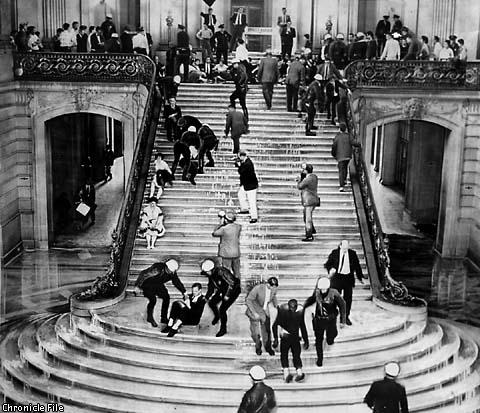
The other thing I want to mention is the Free Speech Movement was not the first time that Berkeley students borrowed the tactics from the Black Freedom Movement. In May 1960, just a few months after Black students launched the sit-in movement in Greensboro, students from Berkeley and other campuses in the Bay Area held a sit-in outside the hearing room at San Francisco City Hall when the House Un-American Activities Committee (HUAC) was conducting these hearings — red purge hearings, which were an extension of McCarthyism — and the students wanted to be admitted to the hearing room, and all HUAC would allow in the hearing room were their supporters, McCarthyites. So the students sat-in outside of the hearing room and they were evicted by the police, washed down the steps of City Hall with high-powered firehoses. That incident, where over a hundred students were arrested, helped to give Berkeley this reputation for student activism that drew students like Mario Savio, who read about it, and that drew them to Berkeley.
One last thing I’ll mention, there was a film made by the House Un-American Activities Committee called Operation Abolition, which basically tried to red bait all of the students who were involved in the anti-HUAC protest. The film was trying to convince viewers that the student protesters were all Communists or Communist dupes. And most of the students weren’t Communist. They were really upset about the violation of civil liberties by the House Un-American Activities Committee. So attempting to discredit the protesters, the House Un-American Activities Committee widely distributed this propaganda film so that it could be shown all over the US demonizing these supposedly terrible students. But the film was so clumsily made and so poorly done that students, when they saw the film (as was later explained in the documentary film “Berkeley in the 1960s”), were attracted by the student protesters and drawn to Berkeley. For example, Harvard student Frank Bardacke, who later became very prominent in the Berkeley student movement, screened Operation Abolition in the Harvard Student Union, and he said, “Shit. Why are we here? Why am I at Harvard? I should be there [at UC Berkeley].” Lots of students came to Berkeley to become activists because they’d seen this red-baiting film, and they wanted to be involved in liberating America from both racism and from McCarthy repression.
Aptheker: I just want to add that that’s one of the reasons I wanted to come to Berkeley. I was in Brooklyn, and I was applying for colleges in the early part of 1961 [and into] 1962, and I wanted to go to Berkeley because that was where it was happening.
Hagopian: And we’re so glad you did. We’re so glad you’re still telling the stories. Berkeley in the early 1960s, I think, is really a crucible of civil rights organizing and political ferment, as you all have been describing. Robbie, you wrote, “Savio risked his life to register Black voters in Mississippi in the Freedom Summer of 1964, and did more than anyone to bring forms of nonviolent protest of the Civil Rights Movement to the struggles for free speech.” Maybe you could tell us a little more about who Mario was and what made Berkeley such fertile ground for this kind of student uprising> And how did the Civil Rights Movement directly shape the Free Speech Movement? Just a little more on that history.
Cohen: Well, let Bettina talk about the Free Speech Movement’s connection to the Civil Rights Movement. Then I’ll talk about Mario.
Aptheker: Okay, so I already alluded to the fact that we had protests at the Sheraton-Palace Hotel in the spring of 1964 against the discriminatory hiring practices that was preceded by similar protests at a drive-in chain in San Francisco called Mel’s Drive-In. It was organized by a group called Youth for Jobs, which was based in Oakland and was Black-led. One of the leaders of that was a man named Roscoe Proctor, who was very prominent in the Communist Party in the San Francisco Bay Area. They succeeded in getting Mel’s Drive-In to start hiring Black young people on the counters to serve food and so forth. That was the first, and that protest also greatly affected the mayoralty election that was happening in San Francisco that fall, because Mel Dobbs, who was the owner of Mel’s Drive-In, lost that election for mayor because of his racism and because of the role he played in trying to suppress those protests.
Then we went on to the Sheraton-Palace Hotel in the spring of 1964, as I was describing, and hundreds of us were arrested. That protest was led by a young Black woman named Tracy Sims and an older white activist, Michael Myerson. I was active in the W. E. B. Dduu Bois Clubs, which was very much a part of what was called the Ad Hoc Committee to End Discrimination, [including] the NAACP, the Urban League, the Du Bois Clubs, Youth for Jobs, and so on. And the churches. And Dr. Carlton Goodlett, who was very important in Black politics in San Francisco. We won an agreement from the Sheraton-Palace Hotel. It’s almost the first affirmative action agreement that was ever instituted in the United States, and they agreed to hire Black people and people of color in all different job categories.
From there we moved on to Auto Row on Van Ness Avenue in San Francisco, where there are all the auto showrooms, and the same thing was happening there, which is that the salesmen were all white men and, again, people of color were hired in the lowest possible position. And we won that. Then the semester ended and people went south, like Robbie was saying, and others of us stayed in the Bay Area and continued organizing.
We came back in the fall of 1964 to face this decision by the regents of the University of California declaring that this strip of sidewalk on the outskirts of the campus actually belonged to them. It had been the free speech zone that we had been able to use, that we thought was owned and regulated by the City of Berkeley, and permitted freedom of speech. So that’s the link, and it’s a very, very direct link. We found out later during our trial, without a doubt, that the regents found out that they owned that strip of sidewalk from a reporter from the Oakland Tribune, which was a very right-wing newspaper at the time, an institute that they extend. They had had a ban on freedom of speech on the Berkeley campus since 1934, during the longshoremen strike, but they extended the ban now to that strip of sidewalk. So that’s how the movement started. And one last thing I want to say: We weren’t called the Free Speech Movement yet. We called ourselves the United Front, which is very significant in terms of our relationship to the left. Because this is like the popular front of the 1930s.
Hagopian: Yeah, thank you.
Cohen: There are two things I want to do. First, to just give a little background on why Berkeley became the site of 1960s America’s first massive single-campus student rebellion: the Free Speech Movement, One of the reasons was because the administration of Berkeley had a long history of restricting speech, as Bettina mentioned. The repression began way back in the 1930s, due to the UC Berkeley administration’s fear of the labor movement and the Old Left, and a new round of repression came down in 1964 aimed at Berkeley’s student wing of the Civil Rights Movement, the New Left; it went from trying to repress one to trying to repress the other. So, in 1934 there was a general strike in San Francisco and a West Coast waterfront strike and it created a Red Scare in the Bay Area. The UC administration created these rules that you could not do political advocacy on campus. So where do you do your politics? Right outside of the campus. Back then, that meant just beyond Sather Gate, the main southern entrance, which was the border of the campus. So students could only do politics off campus. So there’s more freedom off campus than on campus, right? And by the way, they banned Communist speakers, too — a ban that lasted almost three decades, as did the ban on campus political advocacy.
So, essentially what you had was a repressive administration, but a very dynamic student movement. And that could be a very explosive combination. In 1964, they took this political advocacy ban that had been on campus and extended it to this little strip of sidewalk on Bancroft and Telegraph Avenues, which was where the Sather Gate Tradition had continued because the campus expanded, and so the free speech area has been moved to a small strip of sidewalk, which was just beyond the campus entrance. In September 1964 the administration announced it was going to close down the free speech area. Why? Because this was the place from which students organized their civil rights sit-ins against racially discriminatory employers in the Bay Area. This was seen by students as an attempt to shut down the Civil Rights Movement on campus, because there had been a lot of complaints from employers, right-wing editors like Bill Knowland of the Oakland Tribune, and from politicians saying, “You’ve got to shut this down” because this free speech area had been used by students as a base to attack employers. But The students felt like, “We’re not attacking employers, we’re attacking racism.”
Essentially what happened was, the movement, as Bettina was saying, they weren’t interested in reforming the university. Initially they were trying to fight racism downtown. Why did the movement turn onto campus and free speech? Because their free speech was being suppressed, and they felt that would kill the student wing of the Civil Rights Movement.
Now, on Mario, I will say that Mario is really interesting in a number of ways. One was that he came from a very religious Catholic background. He was an altar boy. He was supposed to become a priest. It’s a very interesting story. He had a terrible speech defect, [yet] he became a great orator. But, as a kid and even to the beginning of his college years, he had a very severe stammer. It’s miraculous that he was so into the cause of civil rights and free speech that he basically was able to shed his stammer, mostly, and become a great orator. His great oratorical skill was the flip side of his disability, because for years and years he had such difficulty speaking. It was almost as if was waiting all his life to speak fluently, and now he had a cause that motivated him to overcome his stutter. It’s almost kind of a miraculous thing.
[Mario] had been involved in what Bettina was talking about, the Bay Area Civil Rights Movement. Even though he had broken with Catholicism, he was still motivated by his religious sensibility about good vs evil, and what we might term a secularized form of liberation theology, and he saw the civil rights movement as battling evil, attacking the sin of racism. When he was in jail for the Sheraton-Palace [protest], his cellmate, John King, told him about Mississippi Freedom Summer and the attempt to get rid of the restrictions on Black voting in the South. And he signed up for it. When he was down in the South he saw the way that the civil rights of African Americans were being denied. That was very meaningful to him because his own speech had been blocked by his speech impediment for years and years. For him, free speech was not just a political thing. It was deeply personal. In fact, he said that the name Free Speech Movement was a pun, because for him it was also about the free movement of his own speech. So, it’s a really remarkable story that he didn’t . . . I mean, there were a lot of great speakers, including Bettina, but Mario didn’t sound like anybody else. He studied poetry, elocution. It was as if he’d waited his whole life to speak, and when he finally could, he didn’t sound like anybody else. And his oratory was very honest and candid. He had an ability to say what everybody else was thinking before anybody else had said it, and to say it very powerfully. So I think he played a really important role.
But let me just say this, too: There was no president of the Free Speech Movement. It was a collective. It was led by a steering committee in consultation with an executive committee, all elected democratically. Bettina, in her own way, was just as important as Mario was. In fact, on some issues — I can say this because I’m Mario’s biographer — she was tactically a bit more restrained and reasonable. It’s not a one person thing, and there has been a tendency of some people to act like the movement was just Mario as the leader, and he wasn’t. It was collective, and women were important in the movement, too. We’ll get to more of that in a bit. But I just wanted to make sure that that’s out there from the outset. This was a hyper-democratic movement. And, by the way, one of the great things about the FSM’s victory was that you had a democratic movement overcoming a very hierarchical and bureaucratic administration at the university.
Hagopian: Yeah, no doubt. I mean, Mario’s speech on top of the cop car when he says,
There’s a time when the operation of the machine becomes so odious, makes you so sick at heart, that you can’t take part. You can’t even passively take part. And you’ve got to put your bodies upon the gears and upon the wheels, upon the levers, upon all the apparatus — and you’ve got to make it stop! And you’ve got to indicate to the people who run it, to the people who own it — that unless you’re free the machine will be prevented from working at all!
Aptheker: Jesse, it was in December. It was after the police car. It was on December 2, 1964, to justify taking over Sproul Hall, the administration building.
Hagopian: Yes, thank you for that timeline correction. But that speech still gives me shivers, and is still so directly applicable to our time today. I’m really glad we’re highlighting the importance of women in the struggle, because too often in our social movements women are sidelined. But, Bettina, you emerged as a key leader while navigating intense scrutiny for both your gender and your politics. As you recall in your book Intimate Politics, “I was very young, just 20 in 1964. They were almost all men, and I thought I might have something to say, and that a woman ought to get up there and say something.” So, Bettina, what did it mean for you to speak out as a young woman and a Communist during the Free Speech Movement? What challenges and possibilities did that open up?
Aptheker: I do want to say that there were many women involved in the Free Speech Movement, including speaking from the top of the police car. Jackie Goldberg is someone I particularly wanted to mention, who went on to play a tremendous role in the California State Legislature and is still a powerhouse in politics in Los Angeles. Suzanne Goldberg, also a graduate student of philosophy, played a very important role on our steering committee, but also on our negotiating committee. There were many other women involved.
But I did rise to a certain kind of prominence in all of this, and I do want to say that one of the reasons was that the day after the police car that you were referring to, when we took control of the police car and so on, Clark Kerr issued a statement in which he said that 49 percent of the demonstrators were Communists or Communist sympathizers. We were at a meeting — this was the meeting where we formulated the name Free Speech Movement, as Robbie just so eloquently placed it — and Mario read this statement from Clark Kerr, and he slapped his knee in the meeting. He said, “I know what we’re going to do. Bettina’s going to speak at the next rally.” It was because I was the one person everybody knew. I was a Communist, even though it was semi-illegal to be a member of the Communist Party. That’s another story. But among the people there, everybody knew that I was a member of the Communist Party. So that’s why I started speaking at these rallies, because of Mario’s throwing the one real Communist into the lion’s den of Clark Kerr.
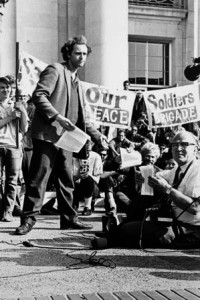
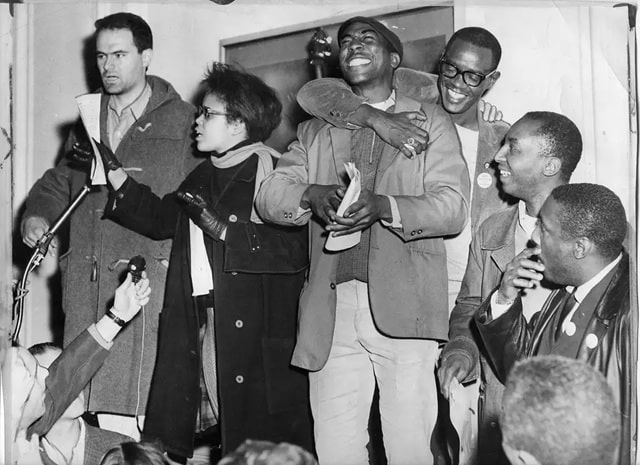
Bettina Aptheker speaking in front of Sproul Hall, December 2, 1964. Photograph by Steven Marcus. Source: Calisphere
But the thing you’re referring to, it’s from the memoir, Mario and another guy named Art Goldberg encouraged me to speak from the top of the police car, and that was the first public speech I ever made. That was when Jack Weinberg was in the car. He had been arrested by the campus police, and we had surrounded the car to not let them proceed with the arrest. We held the car for 32 hours. We used the top of the car as a kind of platform, and Mario said we should take our shoes off when we climbed up to the roof of the car so we wouldn’t damage it, which is so typical of Mario, worrying about the damage to the car. But I did. I got up there, and I made a speech, and I don’t remember most of it, but what I do remember [was that] it was at night and the television lights were in my eyes, so I couldn’t see the students in front of me. But I quoted the abolitionist Frederick Douglass and I said power concedes nothing without a demand. And when I said that the students roared back their approval of those words, an electric current went through my body. It was a tremendous moment for me, just as a human being, to feel I was seen, and as a woman in the Communist movement.
My whole life I’ve been gendered male. It had never occurred to me that I couldn’t speak, or that I couldn’t do anything, because that’s how I’ve been raised. But it was a great moment for me and I enjoyed it, of course, very much. I enjoyed feeling so, so helpful to say what people were thinking and wanting to hear. That was the start of my involvement. Then, as Robbie said, I was on the steering committee and on the negotiating committee, and Mario and I often stayed up late at night writing the text of the leaflets that would be distributed the next day.
Cohen: I just want to add that if you want to see how meaningful this was to women, remember, in 1964, there were very few women in electoral politics. It was a really, very, very sexist era. So for other women in the FSM, Bettina’s role as a speaker was very important and inspiring. If you want to read about it, Margot Adler, who used to be a reporter for NPR, has a wonderful memoir, and she also has a chapter in a book that I edited with Reggie Zelnik called The Free Speech Movement: Reflections on Berkeley in the 1960s, which talks about what an inspiration it was to see Bettina as a speaker and prominent FSM leader.The media and a lot of people focused on Mario, but Margot really felt like Bettina made this huge impact on her, and she’s not alone. So Bettina, I think, really had an impact on a whole generation of women who were able to see themselves in an activist way because of her.
Hagopian: That’s so beautiful. And thank you for taking us up on top of the cop car with you and helping us feel that electricity of the crowd roaring back after you quoted Frederick Douglass. I just got chills thinking about that, and hoping that that moment comes again very soon on a lot of other college campuses. Thank you so much for that.
I wanted to ask you about the fact that from the Cold War until the war on terror all the way to today’s curriculum bans and book bans, this repression of any dissent has evolved, but it hasn’t disappeared. So, how do you see the tactics used against the Free Speech Movement mirrored in today’s repression of student movements and educators? What’s changed and what stayed the same?
Cohen: Could just show the slides, and I can talk you through those. And then we can hand it to Bettina. What you saw in the media was a lot of hostility to the Free Speech Movement. Like, how could they be opposed to the Free Speech Movement? Don’t they believe in free speech? Well, they didn’t focus on free speech. They focused on how disruptive the student movement was. Here’s a good example on the left here. Here’s a cartoon from the San Francisco Chronicle the day after the police car sit-in. The free speech issue was seen by this anti-radical cartoonist as phony. It’s a phony free speech issue, and really in his view the FSM was about rebellion, anarchy, disrespect. And, by the way, that image, it makes the goat [who plays the role of a Trojan Horse] look like a beatnik, because that’s beatnik-baiting, sort of like hippie-baiting that came later in the 1960s or red baiting, combining it. [They were] saying, essentially, that there was no real free speech issue. These students are just making trouble and they were sloppily dressed, bearded, dirty bohemians.
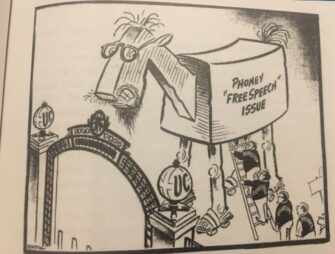
There’s a tendency to think that students should be seen and not heard. “Shut up,” like they say, the basketball players who take a dissenting political position, to “shut up and play.” With students, that’s “shut up and study,” right? They’re not obeying their elders. They’re being disobedient. Such critics are not focusing on what the issue is. In fact, they’re denying that there is a free speech issue. And there certainly was one.
 |
 |
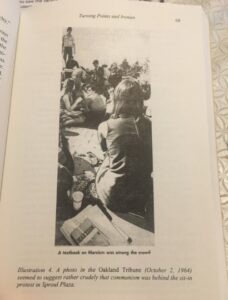
Now, in terms of tactics, if you can switch to the photos. Those are very revealing. The one on the left here — I’ll let Bettina speak to the one on the right, which is an attack on her — but this was in the Oakland Tribune, which was controlled by a right-wing publisher , Bill Knowland. What it shows is the police car blockade on Berkeley’s Sproul Plaza, and you see in the foreground, a book on Marxism, and the caption reads “a textbook on Marxism was among the crowd.” And what does that imply? That implies that the protesters are a bunch of Marxists, Communists, subversives, right? But actually that book on Marxism was required for the intro courses in political science at Cal, a fact that was conveniently ignored by this red-baiting newspaper.
By the way, that really called to mind something that happened in New York this last spring. When they cleared out the encampment [at Columbia University or NYU] the police, had seized a book from the anti-Gaza war encampment, and they showed it on TV, displaying big blown up photo of the front cover of a book on terrorism, that the NYPD presented as if it was a handbook for terrorists that was found with these antiwar protesters. Like they’re Hamas. But it turned out that it was a scholarly book, part of the Oxford University Press series, of very short introductory historical works. This was a very short, scholarly introduction to the history of terrorism. So now you move from red baiting to terrorist baiting. You don’t take seriously the movement’s opposition to the tragedy in Gaza. Instead, you make it like these are a bunch of terrorists. So in the Cold War era, 1964, the FSM student protesters are red baited, caricatured as all being evil, Communist, subversives, and now in the 21st century the students activists are again demonized as all evil, but now its as violent terrorists instead of as Communists. The other image is of Bettina, so let me hand it off to her to describe that image on the right.
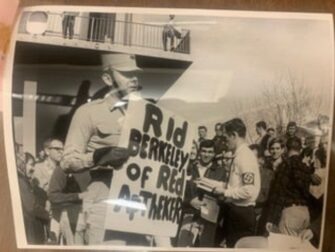
Aptheker: The image on the right was in the spring of 1965. The Free Speech Movement was over and we had been put on trial, those of us that had been arrested in Sproul Hall. Members of the American Nazi Party — you can see they’re in pretty full regalia, and you can see the swastika on the arm of one of them — picketed the Berkeley campus, right at the entrance where we had established the right to freedom of speech. You can see that one of the signs said “Rid Berkeley of Red Aptheker.” Another one of their signs, which we don’t have a picture of, said “Burn Aptheker.” This is less than twenty years after the Holocaust and the administration and the police, and so forth, upheld the right of freedom of speech of the Nazis on the grounds that it didn’t present a clear and present danger to my safety — which was undoubtedly true. But, that’s what that is an image of, and they were picketing the campus, like I said, in the spring of 1965.
Cohen: I just want to make clear that student movements — no matter what they are focused on, whether the sit-in movement, the Freedom Riders, the antiwar movement, the Free Speech Movement, the anti-Gaza war movement — they’re always unpopular with the public because of cultural conservatism. It’s very hard to get adults in the media and politicians to be fair-minded about student protests, to listen to them as opposed to jumping to some conclusion. “Kids today, they’re so terrible. They’re so disrespectful.” This is an extension of when politicians like Reagan came along and were able to take advantage of this hostility to ride that to political power by talking about how terrible student protest is – when he spoke of “cleaning up the mess in Berkeley.” And that goes on today, just it’s magnified with all these people bashing the antiwar movement as antisemitic, as pro-terrorist, when the fact is that a lot of it was just trying to stop a tragic war that was leading to massive civilian deaths that portesters saw as genocide.
Hagopian: Exactly. I mean, the students have been on the right side of history over and over, again and again. We see today students trying to raise their voice, saying, “We want our college to stop funding genocide, to stop investing in an Israeli government that is wiping out Palestinians.” A UN report just said that some 14,000 children are going to die in 48 hours from starvation. They’re cutting off food. I mean, these are just the most heartbreaking and despicable acts, and students again are rising up and using their voice to fight back. I know that it must bring joy to you all to see students rising again and being the conscience of this country again. And there are so many more lessons I want to talk to you about.
[breakout rooms]
Hagopian: Alright. We’re going to hop back to the conversation now. We’ve got so much more we could talk about, but I will start by asking you all about the ways that free speech is often invoked by conservatives in ways that obscure the power imbalances. So, Robert, you write, “By the 2000s, the free speech cause had largely been hijacked by conservatives who defended the rights of racists and homophobes while ignoring censorship of the left.” So, how should we think about the politics of free speech today, especially when it’s used to protect hate while silencing truth?
Aptheker: Well, I can say a few things about this, and then Robbie can come in on it. The quote is absolutely correct. When we recently had a commemoration of the 60th anniversary of the Free Speech Movement, the former chancellor from Berkeley, Carol Christ, was among our panelists, and she talked about the contradictions that she faced as a chancellor because she was a great partisan of the Free Speech Movement. She had a picture of Mario Savio in her office, and she didn’t want to use the police or do things that would suppress freedom of speech. But she had no choice, she said, when there were protests that led to violence, and then she had to do something to stop the violence. But she’s one of the few people in the country that did not seek the arrests of people who were part of an encampment last spring. She, in fact, negotiated with the students that were in the encampment to bring about a peaceful resolution successfully, and the regents threatened to fire her because she refused to call the police. She said, “Well, you can fire me, but I already told you I was retiring.” She called their bluff, and they didn’t fire her, and she had already announced her retirement.
But, what I want to say about this is that I hold firm to the principle that there should not be suppression of freedom of speech. There should not be this cancel culture, whether it’s coming from the left or the right. Now, most of the suppression of freedom of speech comes from the right against the left, and that’s the history of this country. And it’s been true for a very long time. But it’s also true that the right has mobilized the idea of freedom of speech in order to allow for very racist speech. I think the best way to deal with this is to affirm the principle of freedom of speech, which is that there should be no restrictions on freedom of speech other than when it can be said to cause a clear and present danger. Now you can interpret clear and present danger in different ways, but the example that the justices used is shouting “Fire” in a crowded theater in which there is an immediate danger to people. I think the best way to deal with it is not so much on social media, but by talking to people about what is being said and why it’s wrong, and why it’s racist. Or if it is antisemitic, why it’s antisemitic, and if it’s not antisemitic, why it is not antisemitic. For example, to be critical of the Israeli government is not antisemitism. I think those kinds of things are the way to respond to it. I just think that we get ourselves into a very slippery slope if we start allowing the suppression of free speech. Consider that the right has mobilized on this to censor libraries, to have books removed, to have teachers removed for teaching certain things, and so on. That’s censorship. That’s a violation of the 1st Amendment. It’s also a violation of academic freedom, depending upon where it’s happening. And I think we are in a better position if we affirm those rights in order to defend ourselves against the attacks.
Cohen: I just want to add to that there is also a lot of dishonesty about this on the right. Something that didn’t exist in the 1960s, I call it the Free Speech Hustle, is claiming that you’re being suppressed when you’re not. Milo Yiannopoulos did that at Berkeley. A number of right-wing speakers, echoed by the Berkeley College Republicans, said they never get to have conservative speakers at Berkeley. Which is nonsense. Nobody had gone to see them because they’re not interested in them. So, like Ann Coulter, if they can claim that they’re being suppressed when they’re not, then there’s a whole lot of political capital to be made from that.
The other thing I want to mention is that on the Berkeley campus a lot of the students, when the Milo Yiannopoulos thing happened, it wasn’t solely about the right-wing speaker being able to speak. It was also about the white supremacists coming to campus who are drawn by them and who are then threatening non-white students. What I’m saying is, there’s a real way that this is oversimplified and made like, “Oh, students are just very intolerant.” I agree totally with Bettina. It’s a mistake to de-platform speakers, but you have to look closely at the way things are being represented or misrepresented on campus, because a lot of times it makes it look like students are being intolerant when they’re not concerned about the idea that’s being transmitted in the lecture hall. They’re upset about what’s happening beyond the lecture hall. The whole campus is temporarily becoming a police state where people of color are afraid to walk around because these events are drawing racist people in and masses of police. It’s much more complicated than the media makes it out to be, and the media is very gullible. If somebody goads Berkeley and says, “Oh, these Berkeley liberals are intolerant,” many people are going to believe it without knowing the facts. It’s really not as straightforward and candid as it was in 1964, because you can make a big social media event no matter what the actual facts were on campus. Milo Yiannapoulos was not interested in engaging with the students at Berkeley, this right-wing speaker. He wanted a social media event to make it look like he was a free speech martyr. He wasn’t.
Hagopian: Thank you so much. We just have like three minutes left, so we’re going to have to make this very, very quick. But I was hoping you could address the fact that the Free Speech Movement offers such rich materials for the classroom, yet unfortunately the Free Speech Movement is reduced to a footnote in most textbooks. Most of the materials that teachers have to teach about this don’t explain any of the issues, even though this movement was so transformational and important in U.S. history. So, I was hoping that you could talk about some vital lessons educators should teach about this movement, and what key stories or voices are too often left out.
Cohen: Just really briefly, I want to say that not enough is taught about youth activism. Not just the Free Speech Movement, the sit-in movement, SNCC, the Freedom Rides, the antiwar movement of the 1960s, the feminist and LGBTQ movements on campus, all of these movements, even though you’re teaching young people, you don’t teach young people’s history. My students who come to my class on 1960s student activism don’t know any of this. So, for the teachers listening, I think seeing the Free Speech Movement as part of this tradition of youth and student activism that needs to be defined as part of American politics, [whereas now it] is really pretty much left out of many, many textbooks. I’ll hand it over to Bettina.
Aptheker: I think one of the great lessons we learned in the Free Speech Movement, as young people we were 20, 21 years old, was that we could change the course of history. We didn’t know that before, but we learned it. And I think that’s part of the youth activism that Robbie’s referring to.
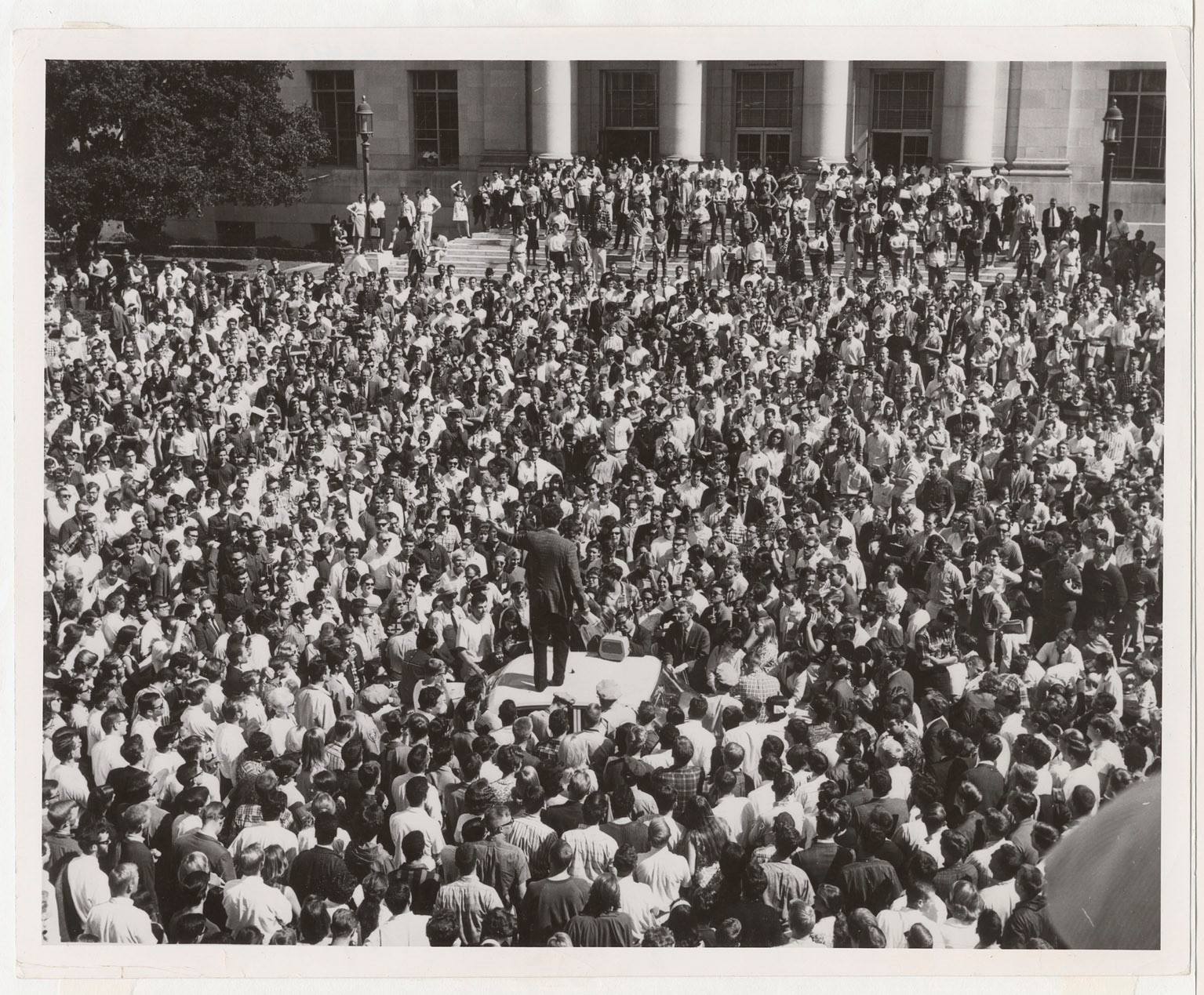
I think maybe we could end with this. When the faculty senate met on December 8, 1964, the senate meeting was the largest in anyone’s memory. It was to debate whether or not to pass a resolution that was in support of the Free Speech Movement and the principle of freedom of speech on the campus — without regard to its content, and only with regard to time, place, and manner. Thousands of us gathered outside the auditorium where this senate meeting was happening. Eventually night fell. It was a beautiful night, and they set up loudspeakers so that we could hear the debate.
I want to remind you that in 1964 there was one woman professor on the Berkeley campus, and everyone else was white and male. This is before affirmative action, before the impact of ethnic studies and so forth on the campus in 1964. So there’s mostly, not all old, but many of them very elderly, had lived through the McCarthy period, and they had lived through the loyalty oaths, and so on. So they debated, and some of the speeches were very eloquent, and it was clear that they were in defense of the First Amendment. We could hear them, and they were beautiful. And then some spoke [who were] opposed to the Free Speech Movement. Then the vote was called.
The vote, in the end, was 824 in favor of the Free Speech Movement and 115 opposed. We started to break into applause, standing out there on the plaza as the faculty filed out, and we started crying because it was such an emotional moment. As they came out we didn’t know what to do, and then we made an aisle. We parted. The students parted, so there was an aisle with students on both sides of it, and as the faculty filed out they filed between us. It was like the parting of the Red Sea. They filed between us, and we were applauding in unison like a drum beat. They were weeping, and we were weeping, and we all knew in that moment there was no doubt it was a historic moment.
We had broken the back of McCarthyism. That was it, and it was a tremendous historic moment. And I think, as teachers, if you can describe that to your students, get them to understand that we were the motive force — at 20 years old, 21 years old, we were the motive force for that moment in history. And of course it was collective, and we culminated it. But there it was a tremendous moment. And I will say one other thing. There are recordings of the faculty meeting. You can get a recording of the faculty meeting, and you can hear some of the statements that were made by the faculty in defense of freedom of speech.
Hagopian: Oh, that would be a great classroom resource. Thank you for taking us to that moment when the back of McCarthyism was finally broken, and thank you for organizing that struggle. We are all in debt to the fact that we have more space to fight and organize because of that. I just can’t thank you enough, both of you, for sharing these lessons.
While this transcript was edited, there may be minor errors or typos — if you notice something you believe to be incorrect, please contact us at [email protected].
Resources
Here are many of the lessons, books, and other resources recommended by the presenters and participants:
Lessons and Curriculum
|
|
Subversives: Stories from the Red Scare by Ursula Wolfe-Rocca COINTELPRO: Teaching the FBI’s War on the Black Freedom Movement by Ursula Wolfe-Rocca Legalize Black Education: The Long Fight for the Right to Learn by Jesse Hagopian Teaching the Fight for Queer Liberation by Nick Palazzolo |
Books
|
|
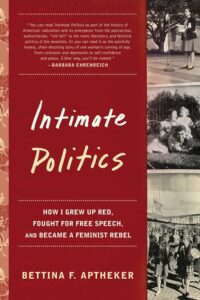
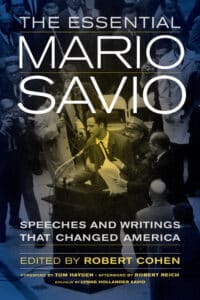
Intimate Politics: How I Grew Up Red, Fought for Free Speech, and Became a Feminist Rebel by Bettina Aptheker (Seal Press CA) The Morning Breaks: The Trial of Angela Davis by Bettina Aptheker (Cornell University Press) Communists in Closets: Queering the History 1930s-1990s by Bettina Aptheker (Routledge) The Essential Mario Savio: Speeches and Writings that Changed America edited by Robert Cohen (University of California Press) The Free Speech Movement: Reflections on Berkeley in the 1960s edited by Robert Cohen and Reginald E. Zelnik (University of California Press) |
Articles
|
|
More than McCarthyism: The Attack on Activism Students Don’t Learn About from Their Textbooks by Ursula Wolfe-Rocca (from the If We Knew Our History series) Tinker v. Des Moines: Youth Rights in a Time of Plausible Genocide by Mary Beth Tinker (Zinn Education Project) The FSM: An Historical Narrative by Bettina Aptheker (Free Speech Movement Archives; originally published February 1, 1965) The Free Speech Movement at Sixty and Today’s Unfree Universities by Robert Cohen (AAUP) Teaching about the Berkeley Free Speech Movement: Civil Disobedience and Mass Protest in the 1960’s Part I and Part II by Robert Cohen (NYU’s Metropolitan Center for Research on Equity and the Transformation of Schools) |
Archives
 |
Free Speech Movement Archives, contains FSM documents, photographs, and scholarship by FSM veterans. Queens College Civil Rights Archives, collects published and unpublished works relating to civil rights activities such as personal papers, community materials, organizational records, non-print materials, and artifacts. |
Videos
We also recommend the 10-minute PBS special, Students Led a Free Speech Movement in the 60s. Colleges Grapple With Its Legacy, which compares the FSM in 1964 at UC Berkeley to events of 2013 to the pro-Palestine protests at Columbia University in 2024.
Additional Resources
|
Mario Savio: Memorial Lecture Fund, provides information about the free speech activist as well as information about nominating students for the Young Activist Award. Free Speech Movement Documents (Berkeley 1964), offers a collection of FMS documents offered by crmvet.org. |
This Day In History
The dates below come from our This Day in People’s History collection, which contains hundreds of entries all searchable by date, state, theme, and keywords.
|
|
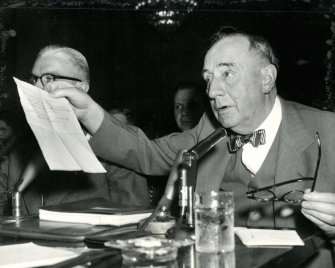
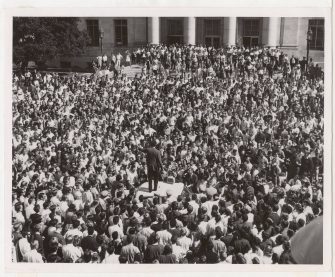
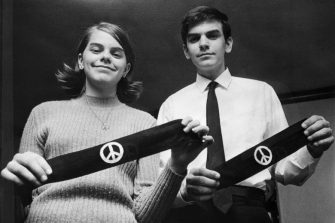
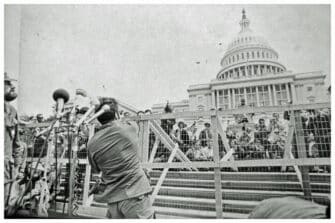
Feb. 9, 1950: Sen. Joseph McCarthy Announces “Enemies Within” March 29, 1951: Julius and Ethel Rosenberg Convicted of Espionage Nov. 13, 1953: Call to Ban Robin Hood in Indiana Schools March 1, 1954: The Green Feather Movement Launched June 9, 1954: Joseph Welch Confronts Sen. Joseph McCarthy Feb. 1, 1960: The Greensboro Sit-in Begins May 14, 1960: Firehoses Confront Free Speech in S.F. City Hall Jan. 2, 1962: NBC Bans Weavers for Refusal to Sign Loyalty Oath Feb. 11, 1963: Howard Zinn Debates Fulton Lewis III About HUAC May 28, 1963: Woolworth Sit-in in Jackson, Mississippi March 1, 1964: Sheraton-Palace Hotel Protests Oct. 1, 1964: Free Speech Movement Dec. 16, 1965: Students Suspended for Anti-War Armbands Feb. 24, 1969: Tinker v. Des Moines Case Wins Free Speech Rights for Students April 24, 1971: Anti-War Protests in D.C. and San Francisco Dec. 30, 1971: Daniel Ellsberg and Anthony Russo Jr. Indicted for Releasing the Pentagon Papers |
Participant Reflections
With more than 100 attendees, a poll of participants’ primary roles in education showed 28 percent K–12 teachers, 23 percent teacher educators, 12 percent historians, and more.
Here are more comments that participants shared in their end-of-session evaluation:
What was the most important thing (story, idea) you learned today?
I learned about the rich, DIVERSE history of campus protests and their legacy, and I got an idea for how we can teach this to our students now.
The collective (not hierarchal) nature of the FSM, and the reference to free speech as a tool, not only a right.
We need to keep this history alive and let young folks lead.
Our elders went through this before, and we will get through it again. Very inspiring!
Youth + energy + determination = change
The parallel work that we need to do and how we might structure our current work on the protests of the past because the enemy is the same.
The key role of the Free Speech Movement in breaking the back of anti-communist suppression of dissent.
That this work is living and vital. That it’s ok to humanize it by reaching deep into my bag of storytelling tools. As a teacher I usually step back to let my kids be the “discoverers” but in the amazing relatings of Jesse, Bettina, and Robbie, I am reminded that it’s ok to really personalize this work. I was already framing lessons around students to see themselves as connected to different speeches, strike and movement moments, but breaking it down further, like the story behind an assembly or photo is something I don’t do enough.
I was reminded of how these movements intersect.
The power of youth activism and the fact that it is not really taught in school.
How UC Berkeley students drew inspiration and organizing strategies from Black civil rights leaders. Despite facing significant backlash, they stood firmly on the right side of history, advocating for the protection of free speech. They emphasized that speech should not be restricted unless it posed a clear and present danger.
What will you do with what you learned?
I am even more convinced that storytelling is a power pedagogical tool. I don’t need to tell young people what to do. I can show them what others have done and they can figure out the rest.
I want to show the recording to young people at our community center.
I want to create a community of teachers and parents dedicated to making schools inclusive and who use freedom of speech to teach critical thinking skills.
I think this has helped me think about how my district needs to organize against repression right now.
I will bring this powerful history into my teacher education courses and to conversations we are having on campus about recent student activism and a violent police response that has rocked our campus.
How was the format for the class?
It all worked powerfully.
I loved the small size of the groups this time. I loved the mix of students, teachers, and social workers.
Everything was just right, and the breakout discussions were enlightening too!
Presenters
Bettina F. Aptheker is professor of feminist studies at the University of California, Santa Cruz, where she has taught one of the country’s largest and most influential introduction to feminist studies courses for twenty-four years. Her books include Intimate Politics: How I Grew Up Red, Fought for Free Speech and Became A Feminist Rebel, The Morning Breaks: The Trial of Angela Davis, Communists in Closets: Queering the History 1930s-1990s, Tapestries of Life: Women’s Work, Women’s Consciousness and the Meaning of Daily Life.
Robert Cohen is professor of History and Social Studies in New York University School of Culture, Education, and Human Development. He is an affiliated member of NYU’s History Department and a senior fellow at the University of California National Center for Free Speech and Civic Engagement. His books include Freedom’s Orator: Mario Savio and the Radical Legacy of the 1960s, The Free Speech Movement: Reflections on Berkeley in the 1960s (coedited with Reginald E. Zelnik), Rebellion in Black and White: Southern Student Activism in the 1960s (coedited with David S. Snyder), and Howard Zinn’s Southern Diary: Sit-ins, Civil Rights, and Black Women’s Student Activism, Rethinking America’s Past: Howard Zinn’s a People’s History of the United States in the Classroom and Beyond (cowritten with Sonia E. Murrow), and more.
Jesse Hagopian teaches Ethnic Studies and is the co-adviser to the Black Student Union at Garfield High School in Seattle. He is an editor for Rethinking Schools, the co-editor of Teaching for Black Lives, editor of More Than a Score: The New Uprising Against High-Stakes Testing, author of Teach Truth: The Struggle for Antiracist Education, and campaign director for the Zinn Education Project.
Twitter
Google plus
LinkedIn