
By Jesse Hagopian
On January 3, 2026, the United States launched a major military operation against Venezuela. U.S. forces conducted strikes and carried out a surprise raid in Caracas that resulted in the capture of Venezuelan President Nicolás Maduro and his wife, Cilia Flores. Following the operation, Venezuela’s vice president assumed the role of interim leader with the backing of the United States and support from Venezuela’s Supreme Tribunal of Justice, even as other political leaders in Caracas and many international observers questioned the legitimacy of the transition.
The Trump administration framed the intervention as part of a law enforcement campaign against narco-terrorism and drug trafficking, and said it was also aimed at bringing political transition and stability to Venezuela.
In public statements following the operation, President Trump and senior officials expressed intentions to manage and sell Venezuelan oil reserves, with the administration claiming that proceeds would benefit both Venezuela and the United States.
The intervention has been widely criticized both inside and outside the United States. Many legal experts and lawmakers argue that the attack lacked clear constitutional or international legal justification, prompting debate in Congress over war powers.
This episode has sparked intense global controversy — and raises fundamental questions about why the United States used military force against another nation and whose interests such actions serve.
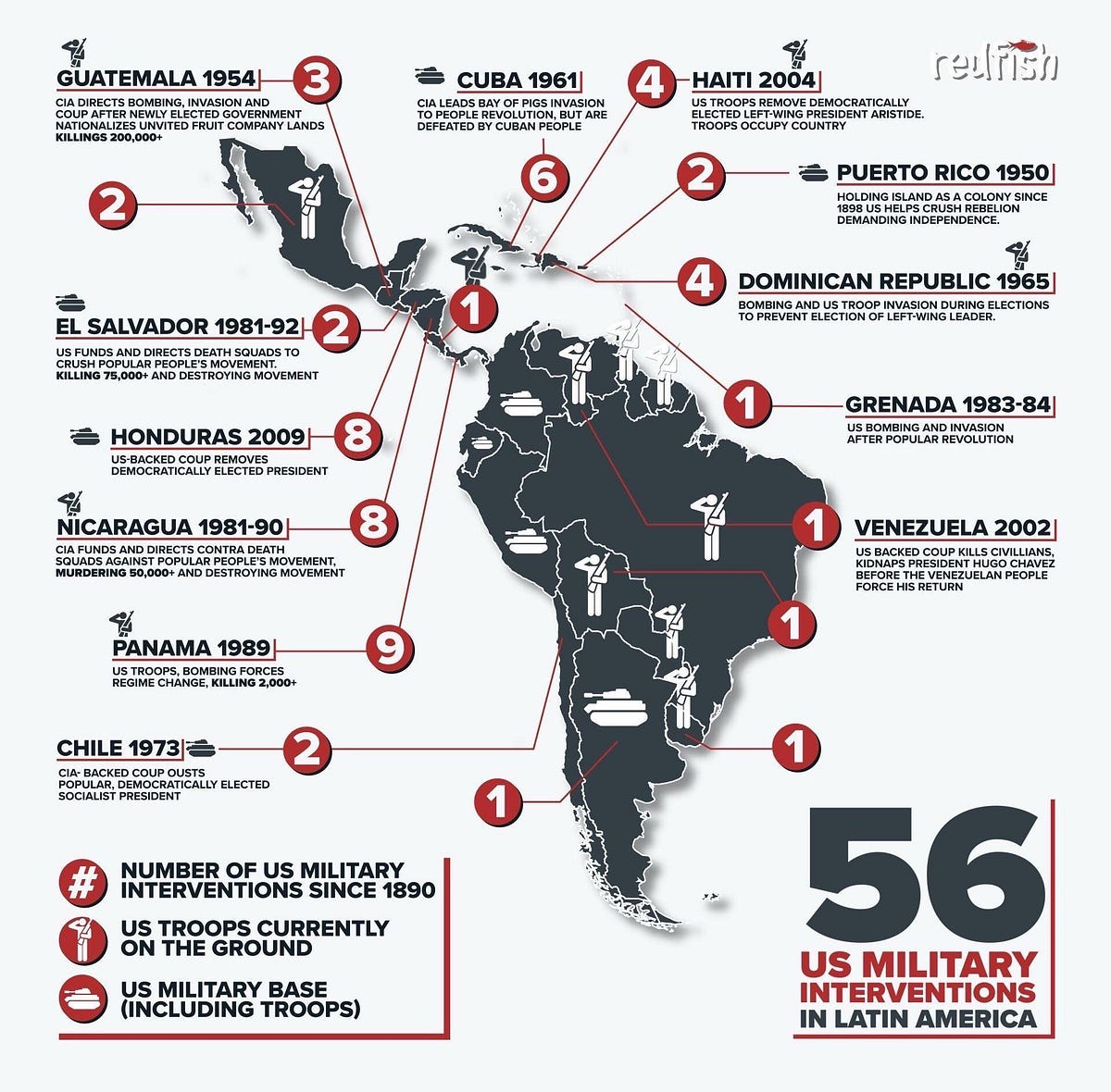
A 2024 map via Red Fish, posted from Medium.
Historically, the United States seized and colonized the Philippines after the Spanish-American War, occupied Haiti for nearly two decades beginning in 1915, and fought a devastating war in Vietnam that killed more than two million people. In Latin America, the United States has repeatedly intervened in countries such as Guatemala, Chile, Nicaragua, Panama, the Dominican Republic, and Honduras — often publicly justifying these actions in the language of security, stability, or democracy, while the outcomes and historical record show that these interventions consistently aligned with U.S. economic interests, corporate power, and geopolitical dominance.
More recently, the United States invaded and occupied Afghanistan and Iraq following the September 11, 2001, attacks, claiming it was waging a global “war on terror.” In the case of Iraq, U.S. leaders asserted that the country possessed weapons of mass destruction — a claim later proven false when no such weapons were found. From the outset of both Gulf Wars, U.S. leaders publicly framed the conflicts as matters of security, but subsequent evidence and outcomes demonstrated that control over oil resources and regional dominance were central drivers of the wars.
This lesson is designed to help students develop critical inquiry skills that are needed to make informed decisions about U.S. claims for why it launches wars.
Overview
Students are invited to explore competing explanations for U.S. intervention in Venezuela. Rather than presenting a single answer, the activity encourages students to gather evidence, identify contradictions, and assess explanations offered by different actors.
The goal is to help students better understand the motivations for the U.S. interventions in Venezuela, learn how to evaluate claims, and think critically about news. There is a glossary of terms for the teacher as a reference in case students ask for explanations.
The five major parts of the lesson are:
Introduce the central inquiry question: Why did the United States invade Venezuela?
Initial Hypotheses: Students are asked to generate hypotheses about why the United States invaded Venezuela (e.g., oil, narco-terrorism, democracy, imperialism, or mixed motives).
Gallery Walk/Evidence Gathering: Students participate in a gallery walk. During the gallery walk, students read the posted quotes with a specific purpose: determining which hypotheses each quote supports, challenges, or complicates. Along the way they answer the questions on Student Handout #1 to help them better understand the quotes.
Evaluation & Revision: After the gallery walk, students revisit their original hypotheses and decide which explanations are more or less supported by the evidence.
Written Thesis: The lesson concludes with students writing their answer to the question, “Why did the U.S. invade Venezuela?” based on their reading of the evidence and the class discussion.
Click the Download to Read in Full button to access the lesson, including the gallery walk and student handouts.
Classroom Stories
I received the email about the lesson Why Did the United States Invade Venezuela? Student Inquiry as my class was concluding their study of manifest destiny. It was a perfect connection. At the start of the lesson I shared basic background information (Venezuela’s location and the date and outcome of the invasion) and gave the students four categories (presidential powers, narco-terrorism, oil, imperialism) based upon my review of the documents. I did eliminate two documents that, while valid, did not connect to those options. We did talk about those two documents at the end of the lesson, though.
To encourage collaboration, I divided the class into four groups. Each group had a big paper on which to record the document number, the category, and a summary. There was also a copy of the glossary posted. The students rotated having the marker, and that student did not talk, but recorded the observations of their group members. They had to check in with me after each document before receiving the next one. After going through their documents, I had the group answer (on big paper) the most compelling and least accurate questions before identifying and briefly explaining which cause they chose and why.
The next step was to give each group the same colored Post-its. I told the students to put their name or initials on the Post-its and complete a gallery walk to review the findings of the other three groups. At each station, students were required to leave feedback, and I gave them sentence starters (“I agree/disagree because”; “This reminds me of ____ because ____”, etc.). Each group ended up at their original station and reviewed the information. We debriefed as a whole class, discussing similarities and differences in the quotes and opinions.
The final step was to give the students a graphic organizer by which to write an ASE (Answer, Support, Explain). The requirement was to use a minimum of three quotes, with one quote having to be outside their original group. I left up the big papers so students could revisit the quotes, summaries, and Post-its to inform their answer.
I really loved how this activity came together. I did make the adjustments because I felt the students needed more support to track all of the information within the documents. It also fit in with a new teaching strategy I was implementing. I also appreciated that the quotes came from a wide variety of sources to give many different perspectives. Thank you to Jesse Hagopian for putting this together.

I used the lesson Why Did the United States Invade Venezuela? Student Inquiry by Jesse Hagopian to enhance our unit on U.S. imperialism and foreign policy. The primary sources were a relevant and rigorous way to connect foreign policy in U.S. history to current policies.
In this unit, students are tasked with analyzing intended and unintended consequences of U.S. government decisions and policies, diving into Hawai’i, Puerto Rico, and Cuba as case studies. Students evaluate the history of these policies in the context of U.S. ideals, such as freedom and democracy. Adding this lesson on Venezuela extends the analysis so students can grapple with those case studies as more than isolated events. Connecting the intentions and consequences of the past and present invites a critical analysis of the U.S. national character across time. Pushing the exceptionalism narrative is imperative to imagining a more humanistic future for generations to come.

This was an awesome lesson!! Thank you so much, Jesse. I used it twice, both in 11th grade US History II classes at the end of a unit on imperialism. It was the perfect way to tie the concepts from the unit together and offer context to an ongoing conflict. During the first class, after five minutes of the gallery walk, I asked, “raise your hand if you’re confused” and every single hand shot up. After I explained what each question was looking for, most people got it. The second time, I explained it more clearly and projected a cheat sheet that had simple instructions for how to answer the questions throughout the class. Fewer people were confused.
During a day mostly devoted to test corrections, the people who did well on the test designed a parallel lesson for why the US invaded Iran, collecting quotes that the class could use to investigate “why did the US start a war with Iran?”
Here are the modifications I made:
Shortened a couple of quotes and took out a few
Had a support document with vocab that anyone could use
Projected a cheat sheet that had simple instructions for how to answer the questions
For one person in each class, they could use a Spanish translation of the gallery walk on a computer
Turned the class’s hypotheses into an anonymous survey that people took once they were convinced of a theory
Scaffolded the exit ticket like this:
Summarize: Why do you think the US invaded Venezuela? Include:
A topic sentence with your claim
Two pieces of evidence supporting your claim with quotes
One counter argument that includes a quote
Why the counter argument is incorrect
A conclusion sentence.
(The US invaded Venezuela because ______. One reason I say this is because ____, the (position), said ____. Another reason I say this is because ____, the (position), said ____. _____ said that _____, but ______. In conclusion, _____)
Thanks again!! This was a great lesson and fit in perfectly to the unit.
This semester I’ll be making use of your materials on the invasion of Venezuela. We start our college U.S. history course with imperialism. Students read primary sources from Columbus and de Las Casas, as well as analyzing ch. 1 from Zinn’s A Peoples’ History of the U.S.. Your lesson on Venezuela will make a great way to evaluate my students’ understanding of imperialism and to connect past and present.