
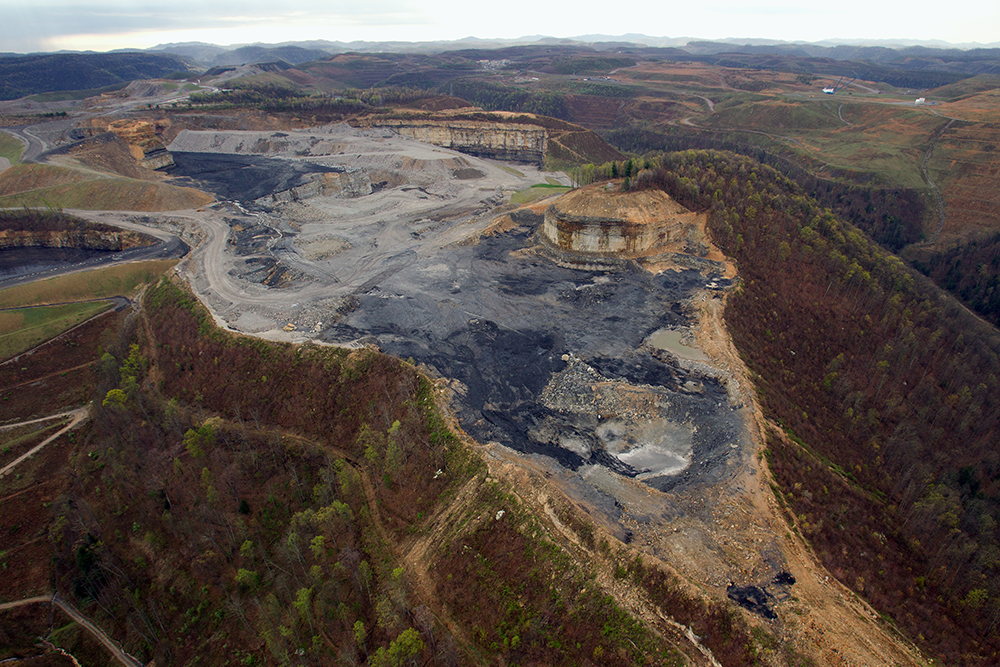
Aerial photograph documenting mountain top removal mining atop Kayford Mountain. Source: Greenpeace.
By Hannah Jones
“If you go home and don’t do anything, then I’ve wasted my time,” we heard amidst the distant hum of heavy machinery.
I heard this from anti-mountaintop removal activist Adam Hall, echoed from the late Larry Gibson as we stood on his family’s land on Kayford Mountain. We were standing in an island of trees and homes surrounded by a moonscape of leveled rubble. When I visited, I could see bulldozers in the distance, digging, shoveling, scraping away at the earth.
This is called mountaintop removal coal mining, a type of surface coal mining in which the top of a mountain is blasted off to expose the coal seam underneath. The rubble is then pushed into a nearby valley, covering streams and poisoning watersheds. Hundreds of thousands of acres of mountains and valleys in Central Appalachia have been destroyed by mountaintop removal, along with communities and lives.
Larry was a longtime activist against mountaintop removal coal mining. He had been living on Kayford Mountain his whole life, as did his father and grandfather and great-grandfather before him. When the coal company came a-knocking, Larry stood his ground, refusing to allow his home to be obliterated. His property still stands, through bullying, death threats, the murder of his dog, and more. His piece of land still stands, surrounded my strip mining.
Through his organization the Keepers of the Mountains Foundation, he would host student groups, church groups, and more to come see the devastation firsthand, and tell them his story. Visitors heard about poisoned water, coal company thugs shooting his dog and sending him death threats, centuries of political corruption, shirking of clean air and water standards, and more.
In 2010, when I was a student at Swarthmore College, a group of students visited Larry and heard his story. And as he said to most of his visitors, he told the group that his time was wasted if we didn’t do anything. As a group of impressionable students, this was a powerful call to action. And while many of us were sympathetic to sustainability pushes on campus, visiting West Virginia made it clear that composting at Swarthmore College wasn’t going to stop the coal industry. We needed to step up our game.
Download article to continue reading.
Classroom Story

This fall, I taught a community-based learning course on climate advocacy for students in grades 9–12. Designed with the foundational understanding that the climate crisis is a product of human violence against the Earth, this course used principles of peacebuilding and nonviolence to offer students a clear path forward in their activism. The course made use of a number of resources from the Zinn Education Project that helped my students connect the theories we examined with real-world examples.
We began with the Zinn Education Project’s Meet Today’s Climate Justice Activists: A Mixer on the People Saving the World. While the mixer gave us an opportunity to connect to the stories of those currently tackling the climate crisis, we also used these profiles as a way to delve more deeply into Bill Moyers’ four activist roles, which we mapped on an axis of engagement with the community versus institutions and working from more traditional or recognized forms of activism to more disruptive and innovative actions. From this model, students were able to determine what kind of activist they believed themselves to be, which helped expand our collective understanding of how social justice movements need all kinds of activists to find success.
Later on in our course, after reviewing the grand strategy and tactics of nonviolent movements, we read Hannah Jones’ article From Mountaintop Removal to Divestment: The Story of Swarthmore Students’ Fight Against Fossil Fuels as a way of mapping out how student movements take these theories and apply them to real-life situations. Our course culminated in a student-led community project where students mapped out the climate activists and allies in our local community, creating a database that drew connections between disparate parties and expanding our own definitions of what it means to be an advocate for the planet.





Twitter
Google plus
LinkedIn