

Book review by Jake Subryan Richards
In the early 17th century, deep within the palm forests of northeastern Brazil, a group of people escaped slavery and founded an independent settlement. They named it Palmares and welcomed others fleeing bondage to join them.
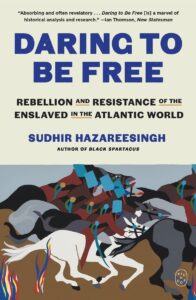 The settlers described their community as a kilombo, meaning “refuge” or “war camp” in Kimbundu. In Portuguese, the term became quilombo and was used to designate self-governing communities formed by people who escaped slavery. At its height, Palmares comprised a network of villages with a population of roughly 20,000, supporting themselves through subsistence agriculture and hunting.
One of Palmares’s principal settlements was Serra da Barriga (“Belly-Shaped Mountain”), whose contours resemble a reclining pregnant woman. The name also carried a symbolic meaning: resistance itself had given birth to a society capable of surviving repeated assaults by Portuguese and Dutch colonial forces. As the Oxford political theorist Sudhir Hazareesingh writes in his remarkable 2025 book Daring to Be Free: Rebellion and Resistance of the Enslaved in the Atlantic World, Palmares “became a magnet not only for African-born men and women seeking to escape from servitude, but also for Amerindians and poor whites fleeing from the violence of colonial society, destitutes, family outcasts, and those — such as Jews and African priestesses — persecuted for their spiritual beliefs.”
Continue reading this book review by Jake Subryan Richards here.
ISBN: 9781250448163 | Picador
Praise
Daring to Be Free is a sweeping history of the rebellions, escapes, and everyday acts of defiance by enslaved Africans and their descendants across the Atlantic world. From African battlefields and maroon strongholds to the Haitian Revolution and spiritual resistance, Sudhir Hazareesingh restores the voices and strategies of those who fought relentlessly for autonomy, dignity, and liberation. Drawing on rich archival and oral sources, he reframes abolition as the achievement of the enslaved themselves — a centuries-long struggle driven by courage, solidarity, and an unyielding will to be free. — Henry Louis Gates Jr., Alphonse Fletcher University Professor at Harvard University
Daring to Be Free is a powerful history of centuries of refusal and political imagination. Sudhir Hazareesingh weaves together eloquent reinterpretations of famous revolts and a multitude of lesser-known, revelatory examples of resistance across the Atlantic world. He opens our eyes to the communities and worlds of the enslaved and invites us to craft a different future built on these unfinished struggles for true freedom. — Laurent Dubois, author of Avengers of the New World: The Story of the Haitian Revolution
Sudhir Hazareesingh has written a magnificent history of abolition and enslaved resistance, one that takes readers across the continent of Africa, to the islands of the Caribbean, and to the northern and southern American hemispheres. Daring to Be Free proves beyond a doubt that the first abolitionists were enslaved and captive Africans themselves. Whether before or after being forcibly transported to the Americas, Black freedom fighters used their spirituality, intellectual prowess, military tactics, and networks of kinship, and the sheer force of will they never relinquished, to resist and destroy chattel slavery. No other synthesis of transatlantic slavery’s ultimate destruction can match this one in terms of the period and geographical locales covered, the number and quality of sources, or, most importantly, the author’s determination to highlight the agency and ingenuity of the enslaved people. — Marlene L. Daut, author of The First and Last King of Haiti: The Rise and Fall of Henry Christophe






Twitter
Google plus
LinkedIn