
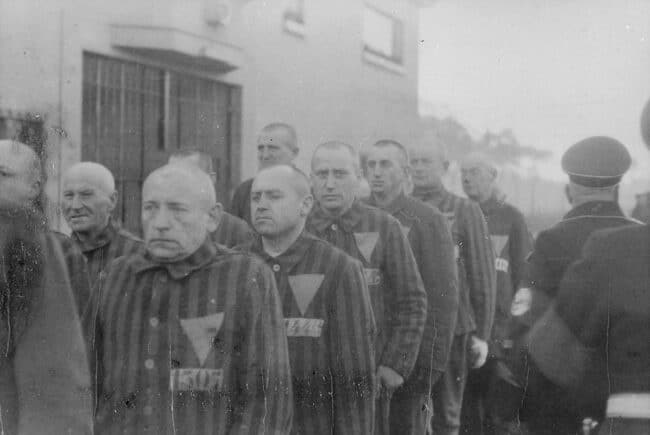
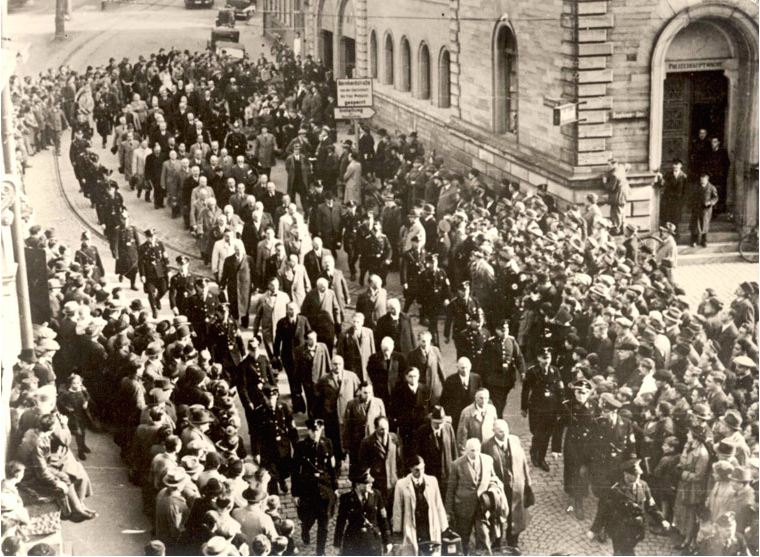
Prisoners in the concentration camp at Sachsenhausen, Germany, 1938. Source: National Archives and Records Administration (540175)/National WWII Museum
By Zane McNeill, Riley Clare Valentine, and Blu Buchanan
On April 29, 1945, U.S. forces liberated the Dachau concentration camp in Germany. However, when the Allies took control of the concentration camps, some of those interned for homosexuality were not freed but rather were required to serve out the full term of the sentences they had received under the homophobic Nazi penal code. Thousands of LGBTQ+ people were interned in concentration camps, most made to wear a pink triangle. Many of them were subjected to medical experiments, castrated, or murdered.

Memorial about the persecution of homosexuals during the epoch of Nazism. Translation of the inscription on the memorial stone: “Killed. Hushed up. To the homosexual victims of Nazism. The ‘pink triangle’ was the sign the Nazis marked homosexuals in the concentration camps in a defamatory manner. From January 1933 on all homosexual cafes around Nollendorplatz were either closed or used during raids to make ‘pink files’ (databases of homosexuals).” Source: Public domain
After “liberation,” the U.S. Army handbook for the occupation of Germany established that, while most Holocaust survivors should be released from concentration camps, “criminals with a prison sentence still to serve will be transferred to civil prisons.” Gay and bisexual men and trans women had been convicted under Paragraph 175 of the criminal code, which had been strengthened by the Nazis, and were therefore considered common criminals. Homosexuality was also against the law at that time in Allied countries, including the United States, the UK, and the USSR.
One prisoner, Hermann R., who was detained at Landsberg Fortress, southwest of Dachau, joined liberation celebrations. But two weeks later, a U.S. military commissioner told him, “Homosexual — that’s a crime. You’re staying here!”
U.S. occupation authorities kept the Nazi version of Paragraph 175 on the books, and in the first four years after the end of the war, around 1,500 men per year were arrested under it. Later, West Germany kept it as well and convicted over 50,000 men before it was finally revoked in 1969. East Germany, on the other hand, reverted to the pre-Nazi Paragraph 175 and convicted some 4,000 men before revoking it in 1968.
LGBTQ+ people were not recognized as victims of the Holocaust and had their pension entitlements as victims of fascism reduced for the time they spent interned in concentration camps, with most never receiving any compensation.
Additional Resources
Men Persecuted for Homosexual Activity Held at the Dachau Concentration Camp by Nils H. Roemer, Katie Fisher, and Yannis Soonjung Kwon (University of Texas at Dallas, Ackerman Center for Holocaust Studies)
Gay Holocaust Victims and Survivors Are Often Forgotten — We Need to Tell Their Stories by Mie Astrup Jensen (University College London)
Recounting Terror and Sexual Violence: Josef Kohout’s The Men With the Pink Triangle by Jason Dawsey (National WWII Museum)
 This post is taken from Be Gay, Do Crime: Everyday Acts of Queer Resistance and Rebellion, edited by Zane McNeill, Riley Clare Valentine, and Blu Buchanan, and published by PM Press and Working Class History.
Packed with daily snapshots of radical queer history, this book celebrates the bold, the brave, and the beautifully defiant moments that have shaped the fight for justice. By situating readers within a larger pattern of struggle, these everyday acts counter the erasure of queer people from history and serve as a reminder that our struggles are part of a broader fight against systemic violence and dehumanization. [Adapted from publishers’ description.]
Twitter
Google plus
LinkedIn