
While right-wing legislatures restrict the teaching of Black history, we are pleased to support teachers who work to teach truthfully about U.S. history.
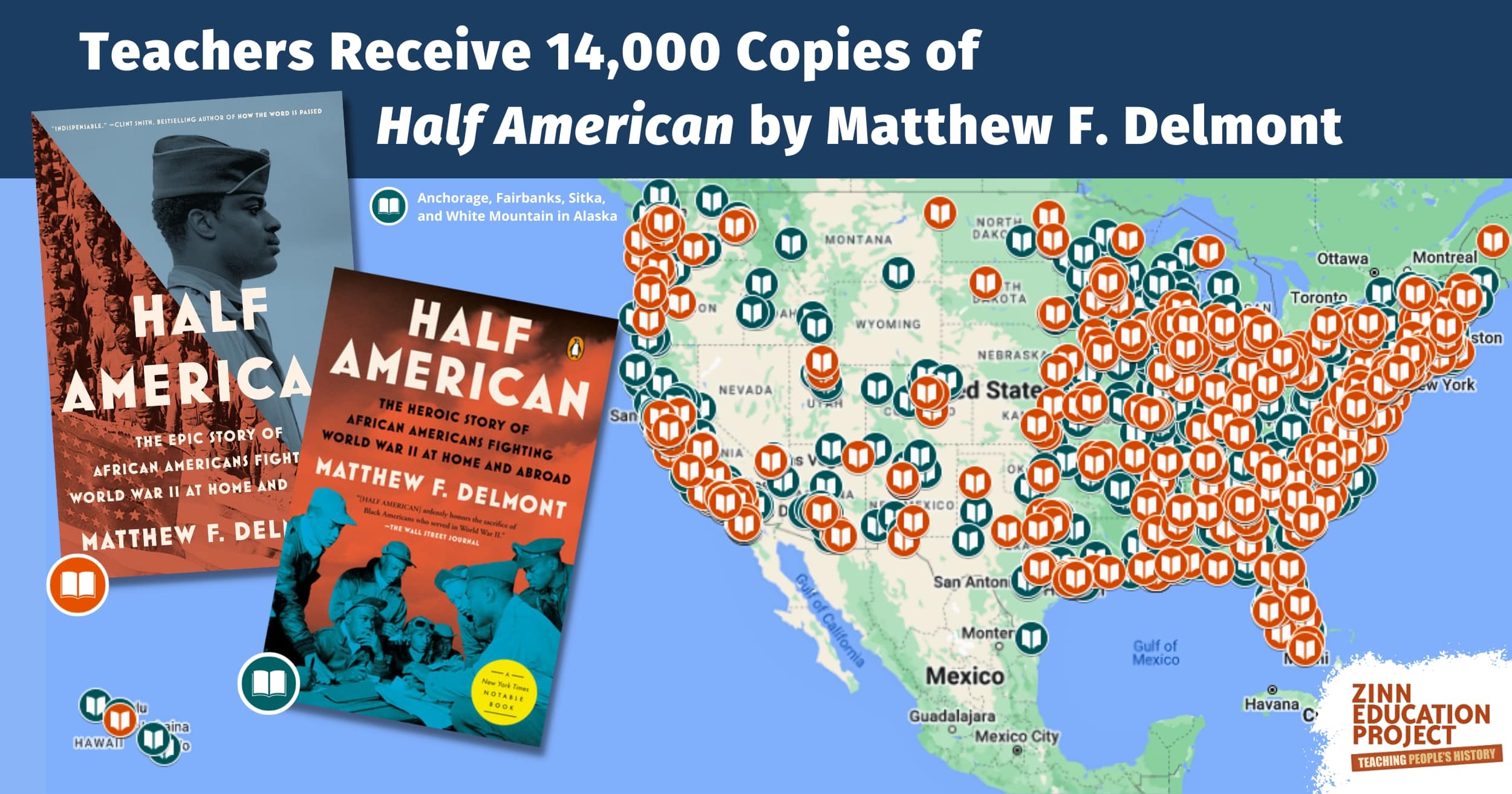
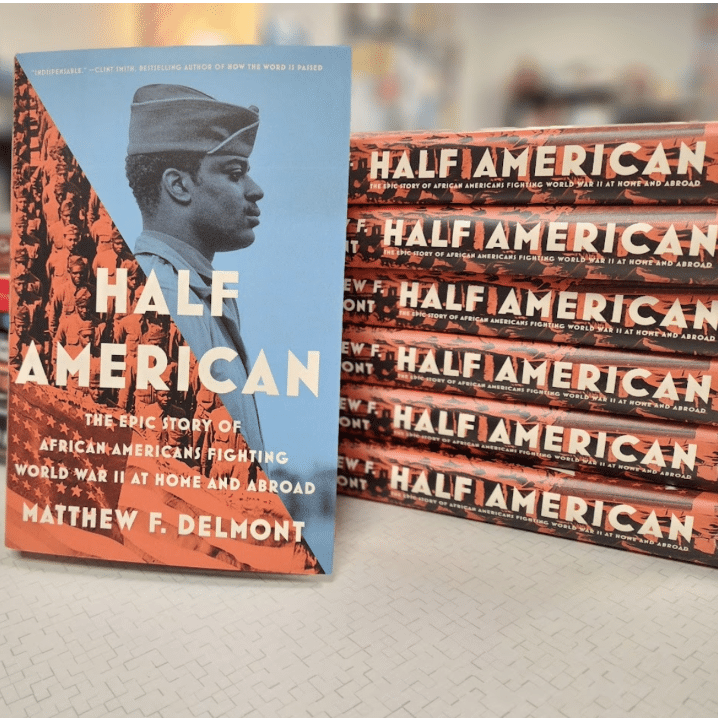
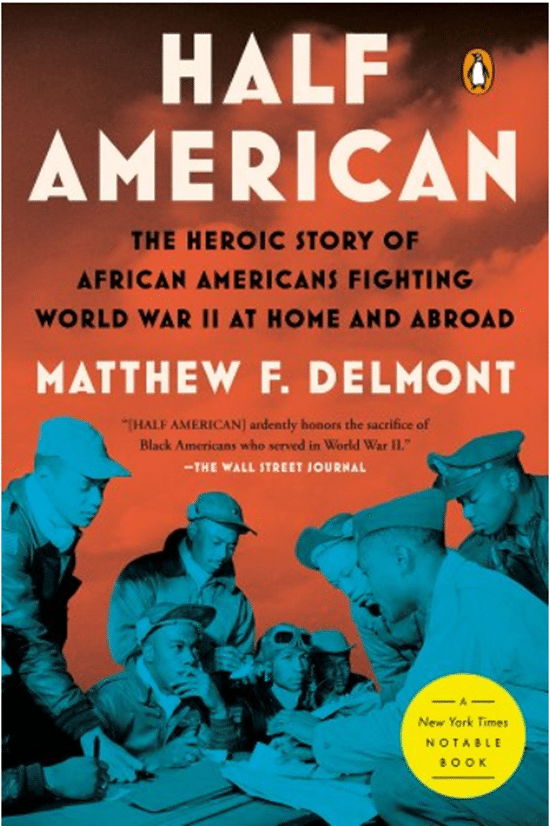
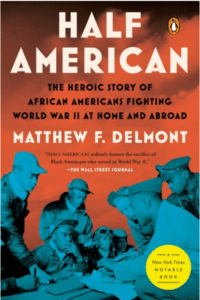 Thanks to a generous collaboration with Dartmouth College historian Matthew Delmont, the Zinn Education Project sent more than 14,000 copies of Delmont’s book Half American: The Epic Story of African Americans Fighting World War II at Home and Abroad to public school teachers, school librarians, and teacher educators. This included 4,000 hardback copies in 2022 and 2023 — and 10,000 copies of the 2024 paperback edition. He sent more since then for teachers at the NCSS 2024 and AHA 2025 conferences.
Half American chronicles the lives of African Americans who fought in World War II and in the war against racism in the United States. The book includes stories that can be woven into the curriculum of key people and events, such as: Thurgood Marshall, the chief lawyer for the NAACP, who investigated and publicized violence against Black troops and veterans; Ella Baker, the civil rights leader who advocated on the home front for Black soldiers, veterans, and their families; James Thompson, the 26-year-old whose letter to a newspaper laying bare the hypocrisy of fighting fascism abroad when racism still reigned at home set in motion the Double Victory campaign; and poet Langston Hughes, who worked as a war correspondent for the Black press.
In a class with teachers, Delmont explained the relevance of learning this history.
If we look back and think that World War II was a simpler time, or a more peaceful or unified time, it makes it seem like protests around racial justice today are surprising, or that they’ve come out of thin air. If you tell the actual history about what happened in World War II, it’s clear that these battles have been going on for generations. Part of the urgency of the Black Lives Matter movement in the last decade is that people’s grandparents were fighting these same battles in these same streets, going back to World War II and earlier.
Distribution of Delmont’s book is a direct challenge to the widespread removal of books from libraries and classrooms across the country. In late March of 2025, Delmont’s book was removed from the U.S. Naval Academy Library.
In addition to the support of Delmont and Dartmouth College for the books and shipping, individual donors to the Zinn Education Project made possible the outreach, screening of requests, and follow-up story collection.
Teaching Stories
Teachers who received the hardback edition have shared their appreciation and teaching stories, including those below. We’ll add more once teachers use the new paperback edition.
High school history teacher Amanda Sandoval was one of hundreds of educators who received copies of Half American: The Epic Story of African Americans Fighting World War II at Home and Abroad from the author Matthew Delmont and the Zinn Education Project.
Delmont’s book asks readers to rethink what they know about the war by centering Black protagonists. He writes, “Nearly everything about the war — the start and end dates, geography, vital military roles, the home front, and international implications — looks different when viewed from the African American perspective.”
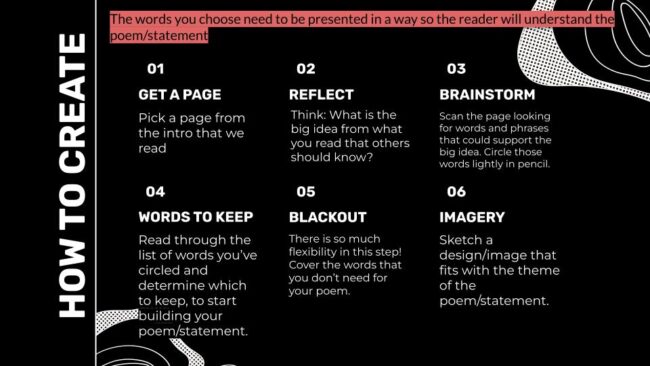
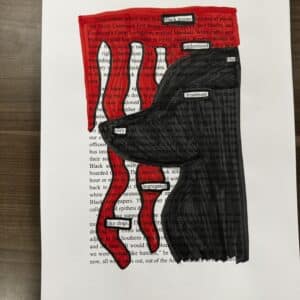
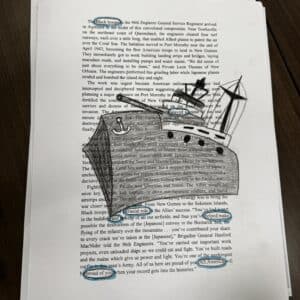
Sandoval had her students create blackout poems with the books’ introduction, making evident the power of the text.
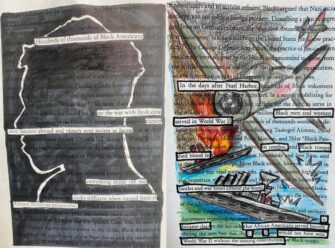
Amanda Sandoval shared the slide instructions for the blackout poetry that she used for this activity.
Reading the book Half American has changed my perspective on teaching about World War II. I had always heard the traditional narrative of how the home front came together to support the war effort, but the stories told in the book showed me the myriad ways this was not true for African Americans. While I was aware of segregation and racism in the military at this time, and the response to returning veterans like Isaac Woodard, I hadn’t realized all the ways African Americans were discriminated against, particularly with regards to the violence shown towards them and the efforts to keep them from fighting in Europe and the Pacific.
A huge “Thank you!” to the @ZinnEdProject for gifting us a class set of @mattdelmont’s newest book, _Half American: The Epic Story of African Americans Fighting WWII at Home and Abroad_. I will use it in my APUSH classes as well as my Ethnic Studies classes! pic.twitter.com/0ADtH573Jf
— Don Dumas (@don_dumas) December 5, 2022
We are currently reading Half American in our staff book club and will be meeting on Friday to discuss. We are a combination of ELA, science, math, and history teachers. I will be asking all the teachers how they can incorporate this book and findings in there every day work. Personally, I am making connections to our current curriculum and adding to my content planning notes. I can then refer to these notes as I review work with students.
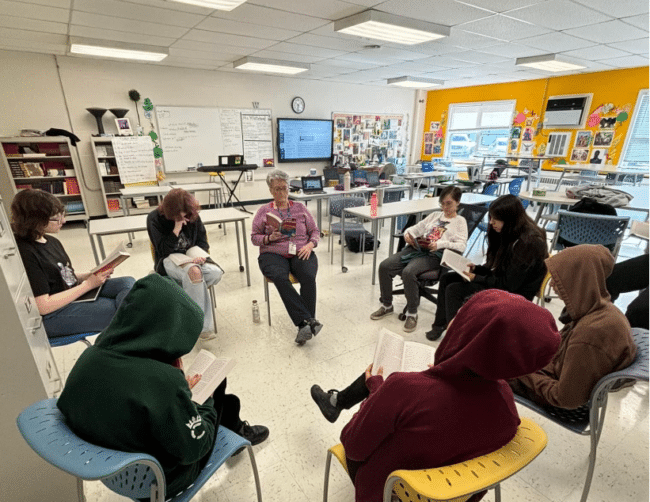
Students in my Jazz Seminar have been reading Matthew F. Delmont’s Half American: The Epic Story of African Americans Fighting in World War II at Home and Abroad to supplement our study of jazz during World War II. We also watched The Tuskegee Airmen and listened to music from the era. The combination of music, the film, and Delmont’s book has deepened students’ understanding of that time period. The students enjoy learning about topics of which they had very little prior knowledge.
I invited the students to lead Socratic seminars based on Chapter Four of Half American, with questions such as:
- Why do you think Black soldiers were targets of racial violence if they were fighting for their country abroad? What does this treatment say about American ideals?
- What was Thurgood Marshall’s role in helping Black soldiers in the U.S. Armed Forces?
- Read the following quote about Charles Hamilton Houston (Thurgood Marshall’s mentor): “Houston made public statements that Black lawyers he trained at Howard would become social engineers rather than lawyers.” What do you take the term “social engineer” to mean? Was Houston’s term apt when describing his famous pupil, Thurgood Marshall? How so? (See page 68.)
- Read the following quote: “It would be a pleasure soldiering for Uncle Sam if we were treated like humans.” Why did the government not protect Black soldiers who were training in the United States (i.e., Tuskegee, Alabama and Gurdon, Arkansas) or who fought abroad and returned to racial intimidation and violence (i.e., Isaac Woodard)?
This type of student-led learning prepares them for the community college courses they will take in their junior and senior years in high school.
The students will erect a three-dimensional bulletin board in the school hallway so that community members, parents, other students, and faculty members can learn from Half American as well. QR codes will provide access to audio files for people to hear what the students are taking from their book study.
I was able to add copies of Half American: The Epic Story of African Americans Fighting World War II at Home and Abroad to my school library collection, and also use it with 11th grade English for poetry month, using a lesson I adapted from teacher Amanda Sandoval and featured on the Zinn Education Project website.
I started the lesson by having students reflect on what they knew about World War II. After seeing that none of the things they knew were stories and history featured in the book, I then shared a few key stories and highlights from what I learned reading Half American, including the integration during the Spanish Civil War, major acts of discrimination and segregation, and the story of the Port Chicago 50. Then I had 21 excerpts from the book that showed the contributions of, and challenges faced by, Black Americans during World War II and walked through how to create blackout poetry and highlighting the main ideas of the excerpts.
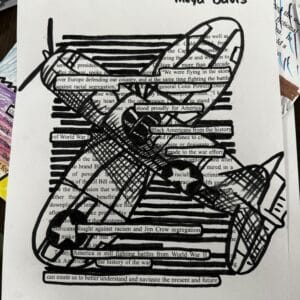
Students stayed engaged in creating their poems for the entire class period and made such beautiful and impactful works. In having students share back in small groups what they learned from each of their excerpts, almost every one of them had not heard about what they read and I taught them until that day, including the English teacher herself. (Check out the lesson, as well as pictures and blackout poems.)
 |
 |
 |

Chapter 27, World War II Action Figure Project 2024, was tailored for 8th-grade students, centering on the utilization of the novel Half American: The Heroic Story of African Americans Fighting WWII at Home & Abroad as a foundational text for their exploration. Each student delved into the life of a distinct World War II figure, ensuring no duplications within the grade. Following their research, students crafted original action figures representing their chosen WWII heroes, complete with accurate attire and three accessories reflecting the individual’s traits or experiences.
Additionally, students designed unique packaging for the action figures and developed background settings incorporating visual elements like maps, photographs, and illustrations to highlight the individuals’ significance and stories during WWII. Furthermore, students created informational posters detailing the individuals’ overall significance to the war effort and specific impacts on WWII. Emphasizing creativity, accuracy, and attention to detail, the project maintained a requirement for no spelling or grammatical errors across all components, catering specifically to 8th grade students.
We have an Emerald Book Club for our high school students. The students are learning what it was like to be journalists during World War II based upon reading Half American. The students’ comments indicated that they were learning what it was like for African American soldiers to be fighting abroad and then coming home and having a Double-V campaign.
Even the parents got involved — choosing to watch a documentary on the Double-V campaign to deepen their learning. These students are in school, so they have full loads, but they’re dedicating time to reading this book and then to join us for our monthly meet-ups to discuss. “We think our work here is done!” — Shawna Williams and Chelsea Branch, educators, Houston, Texas
Thank you for providing these books! I am so grateful. When we teach the history of humans it is crucial to call attention to the history of all humans.
— Anonymous
I read Half American to give me a better understanding of the individual stories of Black Americans who had to fight two wars simultaneously. In our world history curriculum, we talk about people from different colonies forced to fight on behalf of their colonizers during major wars, often with the promise of freedom or a better life — and after the war has ended, the promises go unfulfilled. Students are always quick to express anger at this and I wanted to help them understand that this was happening in the U.S., too, not just overseas. Particularly poignant was the chapter titled “Remember Pearl Harbor, Remember Sikeston, Too.” I teach in Missouri and being able to tell students about how this issue played out in our state helped them grasp this in a much deeper way.
I told students about Half American and recommended it to them. One student borrowed the book and read the entire thing in a weekend. Another student just wanted to read the chapter we discussed in class. I will keep promoting the book to students and colleagues!
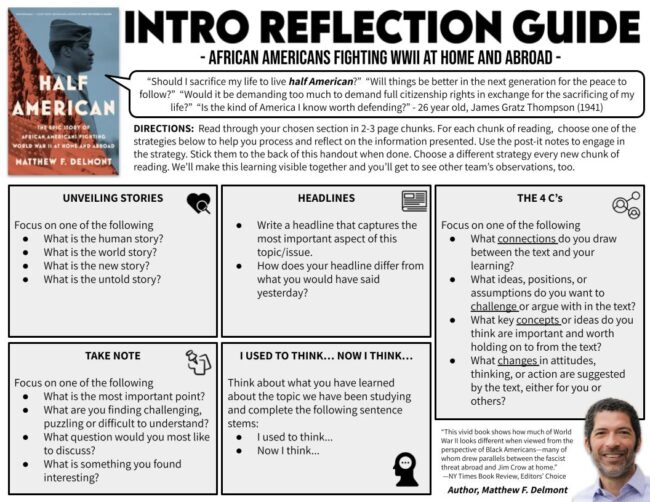
I used Half American last year and this year in what I call “Café Day.” We have a student-staffed coffee shop in our school, so I have the kids grab a copy of the book and choose a “Big Topic” that they are interested in. From there, I’ve selected smaller chunks of the chapters into subtopics, and they pick one of the subtopics to read.
I then use a wonderful graphic organizer that Amanda Sandoval created for them to interact with the text and make detailed observations every two or three pages. They do these on sticky notes, which I provide. The next day, I have each “Big Picture Topic” group meet and discuss what they thought was the most powerful moment from their chapter. After they discuss in small groups, they share with the entire class.
I had several students express interest in reading more of the book, and a few took books home, too. More than once I heard kids in groups say, “I had no idea this happened” or “this was actually interesting!” Any time I can get high school kids engaged in reading, it’s a good day. Check out the slides I used for the activity. (Credit to the first slide goes to Amanda Sandoval.)

I received Matthew Delmont’s book, Half American: The Epic Story of African Americans Fighting World War II at Home and Abroad, from the Zinn Education Project. I really enjoyed the book and wanted to share it with my students.
At the beginning of our unit on the WWII, I talked to the students about how the war, like many events in American history, impacted people in different ways and our goal was to see the war with new eyes through specific groups of people who lived it.
We started by watching an interview with Matthew Delmont about the purpose of his book and how he hoped to shed light on the vital role African Americans had in the war effort and their hope of a Double Victory. Then, at the beginning of each class period for the entire unit, we spent 15 minutes reading from the text. It was a really positive way to start and frame each class period.
We finished the unit with a culminating project that was inspired by a fellow history teacher, Amanda Sandoval. Students created blackout poems, which highlighted a major theme from the book. Each student chose one page from the book that would be the base of their poem. On that page, they selected words or phrases that supported the overall theme. Students covered the rest of the book page with an image that connected back the main idea. The only words remaining visible were those that created a new statement or poem about the African American experience in WWII.
I currently have pictures of the students’ final products on display in the hallway of our school for the rest of the student body to see and read.
I’ve used the set of 24 copies of Half American in a few ways. I used an excerpt in a lesson I created based on the book on African Americans fighting abroad. I also listened to an incredible interview author Matthew Delmont did with NPR that I added to the lesson, which the students were fascinated by, and we’ve talked about how they’ll do the same for their Internal Assessments (IAs).
Because many students want to use Half American for their Internal Assessment (IA) and many IB Theory of Knowledge (TOK) students want to use it for their Extended Essay (EE), we are using the books in the IB class I teach and the TOK class that my students take alongside mine. So, this book is being well used and well loved. In addition, I am currently working on creating a lesson around reading an entire chapter together as a class, rather than just reading an excerpt because of how much the students loved reading the excerpt and how much I really love the book.
My students and I truly do appreciate the generosity and the opportunity to receive these books. It has only served to benefit my classroom and the knowledge students have about African Americans serving in WWII and understanding inaccuracies as well as getting a look into the roles many took on to ensure African Americans are given the credit they deserve.
These books have been invaluable to me and my students. In our 11th grade AP Language class it is a challenge year after year to find high interest non-fiction books. The options are always limited and it becomes increasingly hard each year to get students engaged in reading. However, my colleagues and I have made a great effort to include more diverse text offerings to our students. Having Half American available for my AP Language class was a game changer. Students loved the book, and were recommending it to one another. I used the text in class and gave students two options to choose what they wanted to read. The 12 students in the Half American group were able to engage in deep discussions on race, injustice, and how the text impacted them. It was remarkable, and I am so appreciative to have received the books.
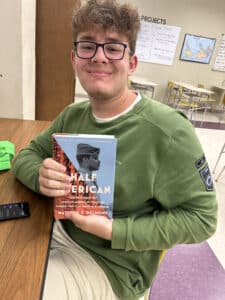
History club member Brice with his copy of the book.
Each member of our high school history club received a copy of Half American and we will use two or three in mini libraries that our club members are building for the community to promote reading and social studies literacy. In addition, a student in my history class used it as a resource for her own presentation on the Double-V campaign.
— Jon Grybos
High School U.S. History Teacher, Bloomsburg, Pennsylvania
For our sophomore-level American Cultural Studies class, my co-teacher and I incorporated Half American by Matthew Delmont into our study of World War II. We focused on the introduction to the book, reading and annotating it during class and combining the main ideas of the Double V campaign with some activities from C-SPAN and Retro Report.
Students utilized the writing and peer feedback platform Short Answer to respond to the prompt: In one paragraph, explain the goal, actions, and outcomes of the Double V Campaign.
Later in the unit, several students explored more of the book during their choice reading time and extra copies were made available for students in classroom libraries. We hope to incorporate more of the book next year. Thank you for your support of classroom teachers!
Students read Half American during a unit on WWII. This deepened students’ learning. It was an engaging and informative text. I have recommended the book to several colleagues who have purchased it. We started an educator book club. Thank you for this amazing resource!
— Anonymous
This year I had the pleasure of utilizing Matthew Delmont’s Half American: The Epic Story of African Americans Fighting World War II at Home and Abroad to supplement the district’s mandatory Patient Zero unit featuring Marilee Peters’ informational text.
In addition to critiquing and analyzing the History Channel film Tuskegee Airmen: Legacy of Courage, and utilizing several narratives of soldiers gleaned from chapter four of Delmont’s text, we conducted a “Kindness Survey” that enabled us to capture data that suggests that middle school students are more likely to reciprocate kindness being transmitted between one another than other emotions such as anger or frustration.
The narratives provided in Delmont’s Half American helped to humanize the information provided by Peters’ Patient Zero and bring the issue into students’ timeline by illustrating that these things occurred not so long ago. (My precious and precocious 7th graders believe anything before the 90s occurred during Mesopotamia times including my date of birth.) Delmont’s text, based on my observation, opened students’ eyes to how recent these experiences took place and provided them with insights into the numerous parts of our society that played a role in the injustices faced by the Tuskegee airmen by individualizing each narrative and ultimately humanizing the experience for them.
Ultimately, students arrived at the conclusion that kindness and other emotions can indeed be contagious, and that experimentation on the most at-risk individuals of our society has and continues to occur. Thanks to our multilayered approach to examining the issue, and ZEP resources, students were able to gain much needed insight into the role of government in experimenting on humans.
I’m looking forward to utilizing more chapters of the text in future units as I try to ensure all lessons and units that I teach are culturally relevant and responsive in order to gain authentic engagement from the many students I teach. Many thanks to the folks at ZEP for providing resources for teachers across the nation.
Read More Classroom Stories
The day my copy of Half American arrived, I taught a lesson on Black experiences in WWII. I teach one on one and the student was really engaged in the content, and especially interested in learning more about the fight for “Double Victory” and how Black soldiers were treated during the war. So, we pulled out the book and started flipping through it together.
Long story short, my student borrowed my copy and is now more than halfway through reading it! We check in on what they’ve learned at the start of every lesson, and I know I’m getting my book back worn in, annotated, and well loved. The student even asked about designing their own unit assessment based on connecting what they had learned in the book to what they had learned both about other experiences in WWII and also on the Black experiences in other time periods we’ve studied.
For a book to truly engage one of my students, especially one that has historically not cared about history or reading, is a true marvel to me.
We received copies of Matthew Delmont’s Half American: The Epic Story of African Americans Fighting World War II at Home and Abroad and are beginning our social studies department reading group around this book. It has been a great resource so far presenting perspectives that are often overlooked in the larger narrative about WWII. It has been influential in thinking about the resources we choose to put in front of students.
The introduction brought up an interesting point when discussing Saving Private Ryan. The opening scene of that movie is commonly used throughout history classes that discuss D-Day and World War II, but the intro brings up an interesting point and makes us reconsider the resources we use and who is centered and who is left out.
As we continue our discussions around this topic we will strengthen our content knowledge around the topic of World War II and more specifically United States and African American involvement in World War II. This book will be a valuable resource in our unit on World War II which is covered in 10th and 11th grade. It will also be helpful when thinking about the resources we choose for other topics to try and think about which stories we leave out.
The books were distributed throughout the department and to the school library. The librarian reports that it has been checked out frequently by students. In the classroom, I used large portions of it in my AP U.S. History course for my unit on World War II.
Different focused excerpts from the book included: women, Double V Campaign, employment & march on Washington, Ex Order 8802, riot, and Veterans. Students individually read their excerpts, noting 10 important details. Do their experiences represent continuity or change as compared to before the war? Place on a spectrum.
Then they met with like readings and compared, reported to the whole class, and plotted all the groups on a spectrum. Finally, they wrote a short essay on the following prompt utilizing information from the excerpts: Evaluate the extent to which African American lives were improved by World War II.
The students really enjoyed Half American. They liked the readability of the text and the subject. Many of them commented that the traditional textbook leaves out so much, and they liked learning more details. It set them up interest wise for the 1950s Civil Rights Movement lessons, and they referred back to the text during that lesson.
While discussing World War II in my U.S. history class, Half American helped expand my knowledge of the subject, so I was able to add rich and vital details about African Americans during the war. My students and I have benefited from the book. This has been a huge blessing and I look forward to adding more from the book to the curriculum in the future. Thank you.
— Anonymous

Three years ago I joined a Teaching for Black Lives study group and have been using the Stories from the Climate Crisis: A Mixer lesson and Reconstructing the South: A Role Play ever since. The lessons are engaging and have my students consider perspectives that they would not usually be exposed to. I was even able to take the Climate Change Mixer and use it to create similar assignments for other subjects or lessons that the students liked. In my experience, the Zinn Education Project encourages students to think and problem solve based on their own ability to reason. These valuable skills can carry beyond the classroom and help make for responsible citizens out in the world.
Furthermore, students have enjoyed reading Sugar, Half American, and Paradise on Fire. These stories add visibility and diversity to the classroom — something that is often hard to come by and hard to afford as a public education teacher. Anything and everything that the Zinn Education Project shares with a classroom is a vital component of that class going forward.
During my unit on World War II, my students read excerpts from Half American on the Tuskegee Airmen’s experiences with discrimination while fighting in the war. They then answered questions and discussed with partners in class.
It was an excellent way to incorporate the contributions of minorities to the war effort in an authentic way that showcased both their accomplishments and the prejudice that they felt. Discussion of minorities in the war is a specific standard for Michigan but this resource allows educators to more holistically showcase the lives of Black Americans in the war. My students were moved by these excerpts and I believe it helped them further understand the paradoxical nature of the United States’ participation in World War II.
We used the Half American books as the basis for our NCHE Rural Experience Project. Students spent six months researching, starting with the book Half American and culminating in the March program: Two Front: WWII Veterans of the Griggs Supreme Court Case.
The Museum & Archives of Rockingham County (MARC) hosted our annual program celebrating the landmark 1971 U.S. Supreme Court case, Griggs v. Duke Power Co. with a focus on the experiences of African Americans during WWII and how those experiences influenced the Civil Rights Movement. It dove into Half American with its distinguished author Matthew Delmont, as our main speaker. We also shed light on research uncovered by Griggs Project local student interns.
For the first time in my teaching career, I had students enter the National History Day Project contest, and the point of reference came from the book Half American! Thank you Zinn Education Project for helping me teach my students. And now I have another book to add to my class collection of teaching about WWI and WWII.
In my U.S. History class I teach a lesson about the African American experience in WWII using primary sources. Students read the James Thompson editorial “Should I Sacrifice to Live Half American?” from the Pittsburg Courier and the Double V campaign. Students later consider Executive Order 9981, which desegregated the military, and write their own editorial like James Thompson about racial equality in America and in the military.
The book Half American has sparked many ideas to add depth and empathy to this lesson. Additionally, the book was fascinating and engaging to read, and I really appreciate the Zinn Education Project for providing this book to me for free to add to my personal and professional library.
This lesson always sparks very good conversation about what it means to be an American and the important and unique struggle for rights minority groups like Black Americans have led. This lesson gets students to see part of the story of the long Civil Rights Movement that began well before the sit-ins and bus boycotts.
In conjunction with this lesson, I also teach one about the Japanese-American experience in WWII that adds complexity to students’ understanding of rights and freedoms in wartime and how minorities face unique challenges and experiences. All told, this book has added so much to my ability to teach a richer and more complete U.S. stories.
I used Chapter 6, Double Victory, from Half American as a supplemental reading in our unit on World War II. Students read the work independently and then we discussed, relating it to broader learning about the Pittsburgh Courier and the role of Black employees in wartime industries at Heinz, Westinghouse, and U.S. Steel.
I chose this particular chapter to share because it not only describes the dual purposes of the Double V campaign, but also sheds some light on white Americans understanding of the war. I thought that was very telling: I think many times we like to say that this was the last good war and that’s why everyone was on board, but it becomes clear in this chapter that the goals were fuzzy to many who were not particularly concerned with discrimination or Hitler’s policies. Additionally, I knew the description of the Red Cross’s policy of segregating blood would stand out to my students (and it did). This was a real illustration of how deep racism is engrained in U.S. society.
Another bonus of this chapter is that it also shows the emerging power of the Black press, in their negotiations with Sengstacke, which connected to class lessons about A. Philip Randolph, the Pullman Porters Union, and the threatened march on Washington. It’s important to me to highlight the power of social movements and the wide variety of paths we can take to make change.
Thanks for a copy of this book! I am happy to have it in my classroom library and to use it in my teaching.
A group of interested students met in our history club to read Half American and discuss it in a book club. Students were assigned a few guided questions but also encouraged to come up with their own for discussions.
— Anonymous
@ZinnEdProject Thank you for an outstanding session and for the free copy of the book. It is enriching my practice as an educator and a citizen. pic.twitter.com/L9P4BHe3Ub
— JOYCE MCCREE (@msjmccree) November 29, 2022
I first attempted to do a book study the week before Thanksgiving (short week), but the students complained the book was too long; though they did like the subject matter. So, I decided to focus on chapters 7, 3, 5, and 12 during Black History Month. It produced some amazing discussions.
Many of the students, of all races, were angry that the military didn’t allow the Black soldiers to handle weapons, and felt they were “slaves to the White soldiers” by doing their laundry, shining their shoes. They also said our government was two-faced: Talking about soldiers working together against the common enemy but having segregated quarters for the Black and white soldiers.
Before giving them their written assignment, I showed them a clip from Pearl Harbor, where Cuba Gooding Jr., portraying Doris Miller, proceeds to use the gun to fight the Japanese pilots. They were angry that the government took four months to identify and give Miller a medal for being a hero, when white soldiers received recognition right away. I later showed them that the Navy christened a frigate in Miller’s name, an honor only given to former presidents.
Since we are a secured facility (juvenile detention), I printed research for the following people: Langston Hughes, Thurgood Marshall, Doris Miller, James G. Thompson, Benjamin O. Davis, Della Raney, Private Robert Brooks, Charles McGee, Wallace P. Reed, Ella Baker, W.E.B. Du Bois, and the “Black Rosies.” They wrote an essay about one of the people: List three (or more) facts about the person, explain how his/her character enabled him/her to rise above the adversity of their community, and justify how their actions made an impact on U.S. history. Once written, they then had to present the person they researched, and in their presentation, explain why their chosen person was a hero. Almost every student stated that the fact they stood to honor and protect a country that didn’t treat them right made them heroes.
Many of the students asked why they never heard of some of these people during WWII. Many were shocked that “Black Rosies” were doing the same things as Rosie the Riveter. I will definitely present this unit again.
A student asked if he could take the book to his room to read, but there’s a policy against having hard covered books on the living units. I went to a supervisor, showed her the book and explained what I was doing, and she was impressed. She took down the information, and she said she’d look into ordering soft covered copies to put on each unit.
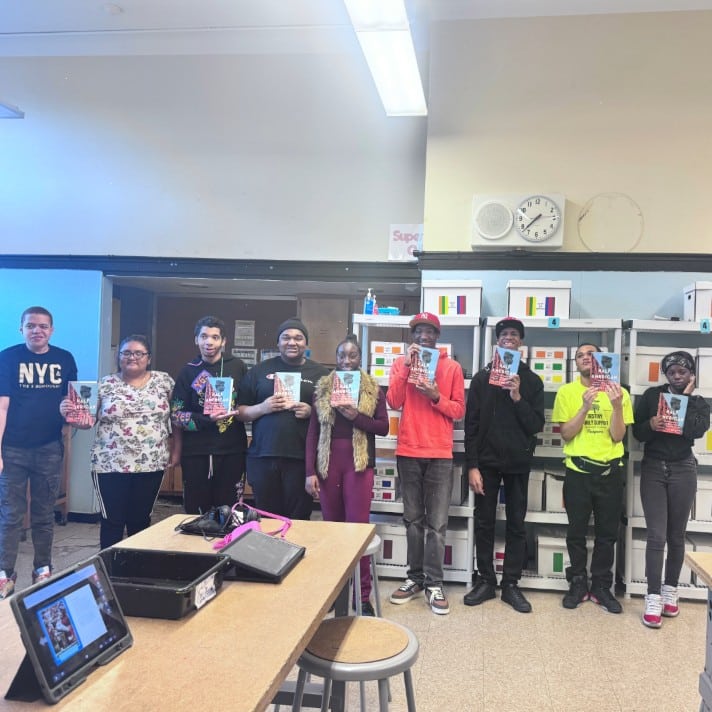
We utilized the Half American books in ELA and social studies classes for five of the classes that I see. My students needed to understand the maltreatments and horrific conditions that all of these great African American men endured. My students learned, and felt, and realized that not much has changed with regard to the treatment of African Americans, specifically in this country.
|
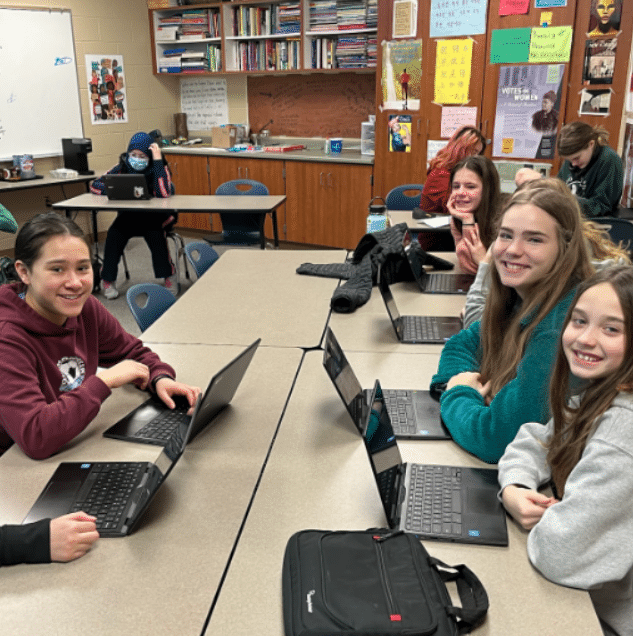
I received multiple copies of Matthew Delmont’s book Half American: The Epic Story of African Americans Fighting World War II at Home and Abroad. I teach a variety of classes, grades, and extracurriculars, so I knew I could incorporate this text in many ways.
One way I used this text was to have students read excerpts from Chapter 3, “The March on Washington,” as part of a unit about community organizing and advocating for the changes you believe are needed in your community. I paired it with the lesson on Zinn Education Project website around the various stakeholders in the DAPL debate, and a culminating assignment asking students brainstorm, write, gather support, edit, and send proposals to their school board regarding improvements they wanted to see in their own education.
In particular, a quote from pg. 62 of Delmont’s book was useful, and I returned to it many times:
For Randolph and millions of other Black Americans, the lesson from the March on Washington Movement was that ordinary Black citizens possessed a tremendous amount of political potential. The key was to harness it to fight for specific goals. “You possess power, great power,” Randolph said. “In this period of power politics, nothing counts but pressure, more pressure, and still more pressure.”
Thanks for sending these texts to me. I appreciate it!
Half American by Matthew F. Delmont has completely changed the way I teach World War II and the Civil Rights Movement in my 12th grade government class. Typical textbook curriculum teaches the Civil Right Movement as an isolated event; however, Delmont’s book taught me that the movement’s roots are with injustices and hypocrisies during World War II. Students are shocked to read the quotes from articles written by the African American newspapers that show a completely different perspective of the war (abroad and domestically) than that described in textbooks.
After reading this book, I will always teach the WWII Double V campaign in order to include these voices. A part of the book that particularly affected me was the treatment of Black troops on U.S. military bases. I was stunned by the soldier’s letter to the NAACP from Pearl Harbor prior to the attack about the treatment of Black sailors by the Navy. Again, it’s an example of how a textbook completely leaves out voices that are vital in understanding events.
We shared these books with K–12 teachers from across the country at our 4-day Civil Rights Educator Workshop in June. As a World War II museum we see the war as an important time in the movement. This book seems to work perfectly!
— Andrea Miskewicz
Executive director, Museum of History and Holocaust Education at Kennesaw State University

I recently used Matthew Delmont’s book Half American to challenge students’ perceptions about World War II. Students read the introduction and completed blackout poems. Afterwards, small groups of students were assigned a specific chapter of the book to read, discover claims made, and see how the author used evidence to support these claims.
Students were tasked with a creative way to demonstrate their learning and could choose between the following: Creating an African-American “heroes” gallery; creating a movie trailer for the chapter using WeVideo or another platform; creating an infographic to demonstrate learning by numbers; creating a digital collage; or curating a collection of additional primary and secondary sources based on original research, or a student generated idea. I was very pleased with the student engagement and the creativity used to demonstrate learning.
Delmont’s book is an incredible resource for the classroom that challenges students’ perspectives about World War II. Delmont recenters African Americans in the narrative of the war to show what it really meant for African Americans from a variety of walks of life. I highly recommend teachers consider this exquisite resource. My students encountered people and ideas that they had never heard of, and leveraged technology and creativity to produce resources that not only demonstrate but advance learning.
Thanks for sharing such a powerful and informative book!
— Melanie Zenisek
Curriculum Specialist, Arlington Heights, Illinois
This was a great read and resource on an issue that continues to be glossed over in textbooks and available curriculum. I really appreciated how thorough things were explained and how they were in chronological order. I learned a great deal to help me with my instruction around WWII and the Civil Rights Movement.
Some of the concepts filled in gaps for my content understanding. I liked the beginning chapters that connected the Harlem Renaissance and Black WWI fighters to the revolution in Spain and the rise of fascism. This was something I had no knowledge of previously. The quotes that reinforced the comparison between Nazi Germany and Jim Crow drew such a parallel that really exposes how racism was running our country in the 1930s and 1940s (and beyond). The scope of Jim Crow as it applied to industry and the military were really exposed in this reading.
I pulled many quotes to use in my classroom. The book ends by looking at the Civil Rights Movement, and I appreciated how the author included many activists, such as Ella Baker and Rosa Parks, to show their efforts started during WWII. Overall, a great read and resource on a complex issue that has been hidden from mainstream education.
My students and I read sections of Half American together, using Audible for sections of it. My students reflected on what they had read and engaged in a discussion. They were shocked to learn about how African Americans were treated and how World War II impacted the Civil Rights Movement.
— Anonymous
Our school district has banned books on the Black experience. So, we did a Zoom session with veterans and their grandchildren, nieces and nephews, and shared from the Half American’s specific parts that spoke to them or that they experienced in real life. We had conversations so that all could learn from the book and from actual life experiences of the adult to middle/high school participants.
Some of the high schoolers were considering going into the service and felt enlightened about the racism that persisted and the determination of the veterans in the story, as well as the determination of their relatives who shared that they too lived during this time period. It was a living history lesson on both levels, via the book and via accounts shared by veteran relatives.
The challenge going forward is to think of ways to persist under hardship or crisis and find ways to reinvent the self under these conditions with dignity and honor. The students were to make a dream board of a story chosen from the book, use them as a mentor for their future, and pick pictures and words or quotes that would continue to inspire them.
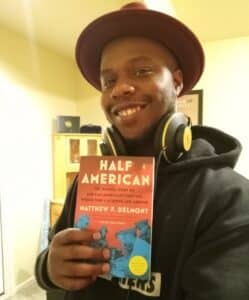
I provided copies of the books to substitute teachers at a presentation I did on cultural competency in the classroom. The teachers were excited!
— Elaine Simons
Teacher Educator, Renton, Washington
I ask my students to read a book about walking in someone else’s shoes. We discuss the issues of under-represented views and stories all year long in literature and social studies. Social studies culminates with a unit on major reformers throughout history and how they changed things.
Here is what two of my students said about Half American.
I thought it was very interesting that I had no idea about all this. I have learned about WWII several times, and have heard nothing about this. It was very interesting to read and I like the perspective. I think it is really important to learn about this.—Agatha
I thought it was interesting in the book Half American that it was Black Americans who identified the threat from fascism long before much of the rest of the nation did, and who were among the first to see the war as an existential struggle between forces of fascism against the forces of freedom, democracy, and human rights. —Makenzie
Although I was given a copy of Half American, I was not allowed to utilize it in my classroom. As a teacher who prides themselves on inclusive teaching, I was instructed at least three times this school year to ensure I am teaching about and praising white people in my class. My administrator is constantly worried about white students in my class, even though I am white myself. I am super thankful for the Zinn Education Project sending me a copy of this amazing book but in Oregon we are not permitted to truly teach about BIPOC people in our classes.
My African American students love reading about people who look like them and they share their experiences with relatives who have served in the military.
— Anonymous
In my African American history class we read and had discussion responses to excerpts from chapters 14 and 17. These chapters really underscored the important role African Americans played in the War and the terrible betrayal they received when they returned. This activity was the culminating activity of our lesson on African Americans in the first half of the 20th century.
I taught about the significance of World War II and its impact on society, then I introduced the book Half American, giving a brief overview of its themes and objectives. Students were asked to write and discuss what they already know about the experiences of African Americans during WWII. Students were able to discuss the role of the Tuskegee Airmen and limited role of African American soldiers in leadership roles. I assigned certain chapters for the students to read and then discuss with the whole group. Students also explored primary sources — including photos, letters, newspaper articles, and government documents — and analyzed the sources considering the perspective of the individuals involved, linking to the relevance of the book’s theme and the African American experiences in the book.
— Anonymous
Learn More
Listen to an interview with historian Matt Delmont in conversation with ZEP team member Jesse Hagopian in our Teach the Black Freedom Struggle online class. Excerpt below and the full class here.
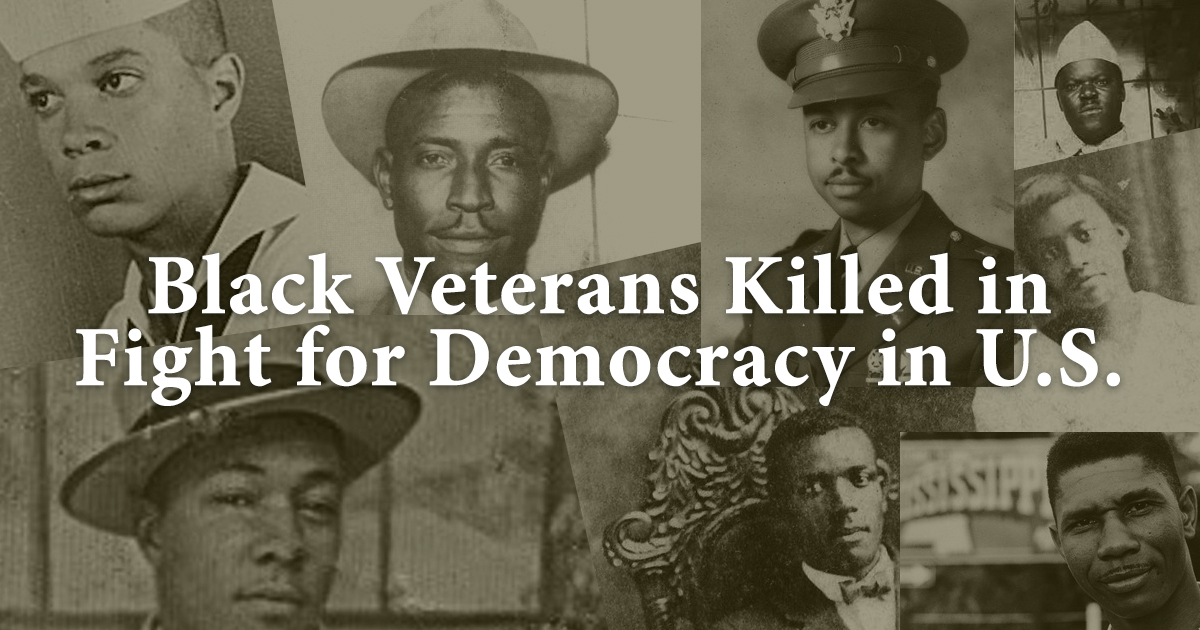


Greetings from Blackhawk Technical College in Janesville, Wisconsin. Half American is one of the most powerful and poignant books about history and the challenges and adversity faced by African Americans to ensure the promise of democracy since the inception of the nation to the present. For our Black History Month program, we will use a video about the book, with a Q & A. The second part of the program will be a presentation by Retired Major General Marcia Anderson about the history of African Americans and Military Service. Our librarian and I are working to see if we might be able to feature the book for a discussion group. I will offer use of the discussion group as credit for community engagement.