

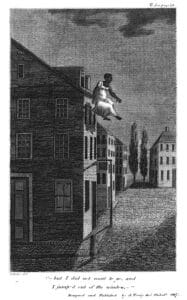
Drawing of the “F” Street Tavern from A Portraiture of Domestic Slavery. Published in Records of the Columbia Historical Society, Washington, D.C., Volume 9 (1906) by the Columbia Historical Society. Source: Public domain
In November 1815, a 24-year-old enslaved woman known simply as Anna broke her back after jumping from a third-floor window in Washington, D.C. Having survived, soon thereafter Anna was separated from her husband and four children and sold for $5 to Georgia slave traders.
In 1828, Anna, now known as Ann Williams, petitioned for her freedom in the Circuit Court of the District of Columbia, where she claimed she was unjustly enslaved. With the legal representation of Francis Scott Key, Ann Williams fought for her freedom for years, until her petition was granted on July 2, 1832, with a jury determining that Ann and her children were now free.
As Animating History notes,
Her actions to resist the breakup of her family brought public attention to the moral problem of slavery and to the desperation and terror of the slave trade. [. . .] Rather than running away, she fought slavery in one place, accumulating allies, resources, and standing in the community, and eventually, obtaining freedom for herself and her children.
Additional Resources
Anna: Historical Background by Animating History
“I Did Not Want to Go”: An Enslaved Woman’s Leap into the Capital’s Conscience by Candy Carter (O Say Can You See, Early Washington, D.C., Law & Family)
Check out the short documentary Anna, directed and animated by Michael Burton, written by Kwakiutl Dreher, and produced by The Atlantic, below.






Twitter
Google plus
LinkedIn