

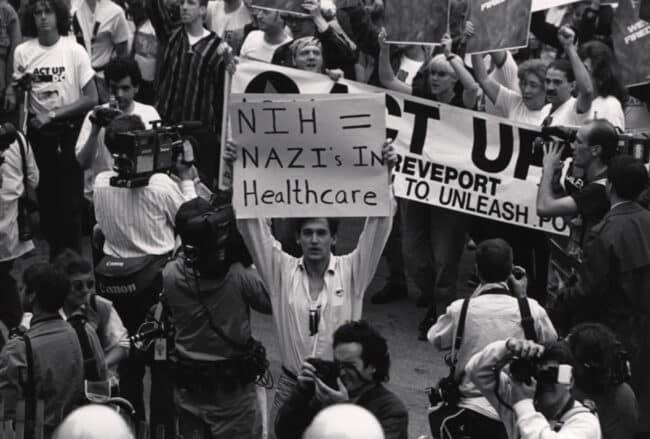
Gay rights activists at the “Storm the NIH” ACT UP action on May 21, 1990. Source: NIH History Office/Boston Review
By Zane McNeill, Riley Clare Valentine, and Blu Buchanan
On May 21, 1990, ACT UP New York organized a national action to “Storm the NIH” (National Institutes of Health) in Maryland. The protest was the culmination of months of ACT UP formally requesting Anthony Fauci, then the chief of the National Institute of Allergy and Infectious Diseases, to be a part of the government’s development process for AIDS drugs.
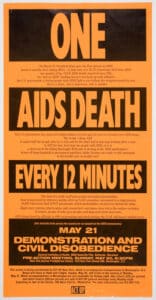
Flier for May 1990 ACT UP action at NIH, unidentified artist. Source: International Center of Photography
Over a thousand protesters arrived. Chants included “NIH, you can’t hide, we charge you with genocide.” Other groups carried mock coffins to represent the mounting death toll of AIDS. Protesters held signs reading “Red Tape Kills Us” and “NIH — Negligence, Incompetence, and Horror.” The protesters marched toward a row of police and held torches with rainbow-colored smoke. Members of ACT UP refused to leave until Fauci responded to their demands.
The official demands included testing all potential treatments immediately, devoting more research to opportunistic infections, an end to the underrepresentation of women and people of color in clinical trials, and a price reduction of AZT, the only AIDS-fighting drug approved by the FDA at the time.
A secondary goal for ACT UP’s Treatment and Data Committee was to become incorporated into government committees, where it would have more power for long-term change. The men who led the Storm the NIH action were successful in their goal to join government committees, and they developed new practices for AIDS research that continue to be used.
Additional Resources
Storm the NIH by the ACT UP Oral History Project, includes video interviews of participants
When Queers Fought the State and Won by Hugh Ryan (Boston Review)
 This post is taken from Be Gay, Do Crime: Everyday Acts of Queer Resistance and Rebellion, edited by Zane McNeill, Riley Clare Valentine, and Blu Buchanan, and published by PM Press and Working Class History.
Packed with daily snapshots of radical queer history, this book celebrates the bold, the brave, and the beautifully defiant moments that have shaped the fight for justice. By situating readers within a larger pattern of struggle, these everyday acts counter the erasure of queer people from history and serve as a reminder that our struggles are part of a broader fight against systemic violence and dehumanization. [Adapted from publishers’ description.]







Twitter
Google plus
LinkedIn