

By Jeff Smith
The 1911 strike was founded on longstanding worker grievances. As early as 1909, the workers discovered that the price of the furniture they produced had increased by 10 percent, and they demanded that their wages be increased. Some of the workers who called for the increase were fired shortly thereafter for being agitators.
The furniture workers strike began on April 19, 1911, with estimates of between 4,000 – 6,000 workers going on strike, and with thousands more in support of the strikers. Just prior to the beginning of the strike, the Grand Rapids Employers Association sent Francis Campau to deliver a message to the press, in order to influence public opinion, that workers were being treated fairly. Francis Campau was the grandson of the brother of Louie Campau, the so-called founder of Grand Rapids.
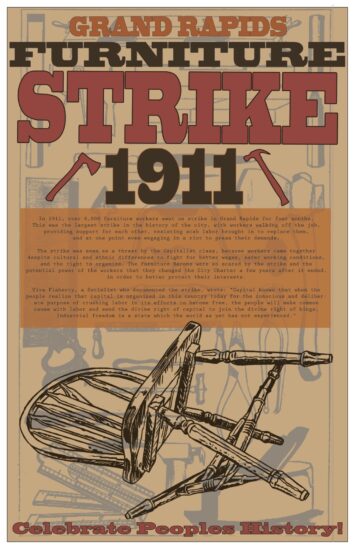
Celebrate People’s History poster for the 1911 Grand Rapids Furniture Strike. Source: Grand Rapids People’s History Project
Furniture workers, on the other hand, had a very different view of life working in those factories. One important source that reflected the worker’s perspective was a booklet called, History of the Grand Rapids Furniture Strike: With Facts Hitherto Unpublished. This document was created by Viva Flaherty, a secretary at Fountain Street Church and a known Socialist. Flaherty documented the 1911 strike because she believed that the “people of Grand Rapids are awakened and enlightened and they can be trusted with the whole truth.”
Flaherty makes it clear in her version of the story that the strike was able to endure because of the seven unions that were involved, with membership of over 4,000 workers in thirty-five shops in Grand Rapids. She also documented that the Christian Reformed Church would not grant their members the right to be part of the union, since labor rights and organizing were not “founded on divine right.”
Flaherty documents the kind of wages earned by those in the furniture industry, stating that of the eight thousand furniture workers employed in Grand Rapids, most made less than $2 a day.
The Catholic leader, Bishop Schrembs, came out in support of the strike, stating, “I consider the present labor situation in our city as a most deplorable one from every point of view.” Bishop Schrembs was later banished to the Diocese of Toledo for his solidarity with furniture workers.

The Spirit of Solidarity monument in Grand Rapids, Michigan, commemorating the 1911 Grand Rapids Furniture Workers Strike. Source: Public domain
The strike ended in August of 1911 and the workers did not win the demands they had hoped. However, they did win lots of public support. During the 1911 Labor Day parade, there were an estimated 10,000 people walking in the parade. The Grand Rapids Furniture Barons were not happy with worker demands and how much support there was from the city government. In 1916, the Furniture Barons put forward a ballot initiative that changed the City Charter from a 12-ward system to a 3-ward system, in order to consolidate their power. The current ward system we have in Grand Rapids today is a direct result of those in power punishing workers and their families.
 This This Day in History post was written by Jeff Smith, author of A People’s History of Grand Rapids. Smith has been part of social movement work for more than four decades in Grand Rapids. He co-founded the Koinonia House, which practiced radical hospitality for the unhoused and was a Sanctuary for Central American refugees fleeing U.S.-sponsored terrorism in the 1980s. Smith spent a significant amount of time doing accompaniment work in Central America and Mexico, working with and learning from movement organizers in those countries. He started the Grand Rapids Institute for Information Democracy in 1998 and the Grand Rapids People’s History Project in 2010.






Twitter
Google plus
LinkedIn