
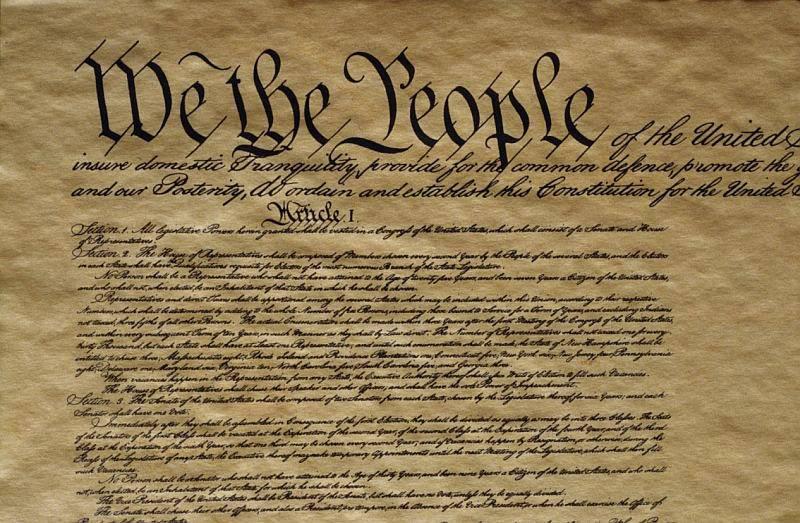
 Most U.S. history and government textbooks present the Constitution as a kind of secular Ten Commandments: James Madison brought the document from the mountain and it was Good. The books may point out that not everyone agreed on the best plan for government, but through debate and compromise “Right” triumphed.
What makes this treatment of the Constitution so problematic is its effect on students. Removed from a social context, cast as an inevitability, the document is elevated to an almost holy status, above analysis and critique. This Constitution-as-sacred-text scenario doesn’t allow much wiggle room for student reflection. Instead, the conventional curricula urge that teachers enlist students in memorizing Constitutional wisdom: What is meant by “checks and balances”? What is a writ of habeas corpus? I’m sure I was not the only student forced to learn by heart and repeat on command: “We the people, in order to form a more perfect union …” This is indoctrination not education.
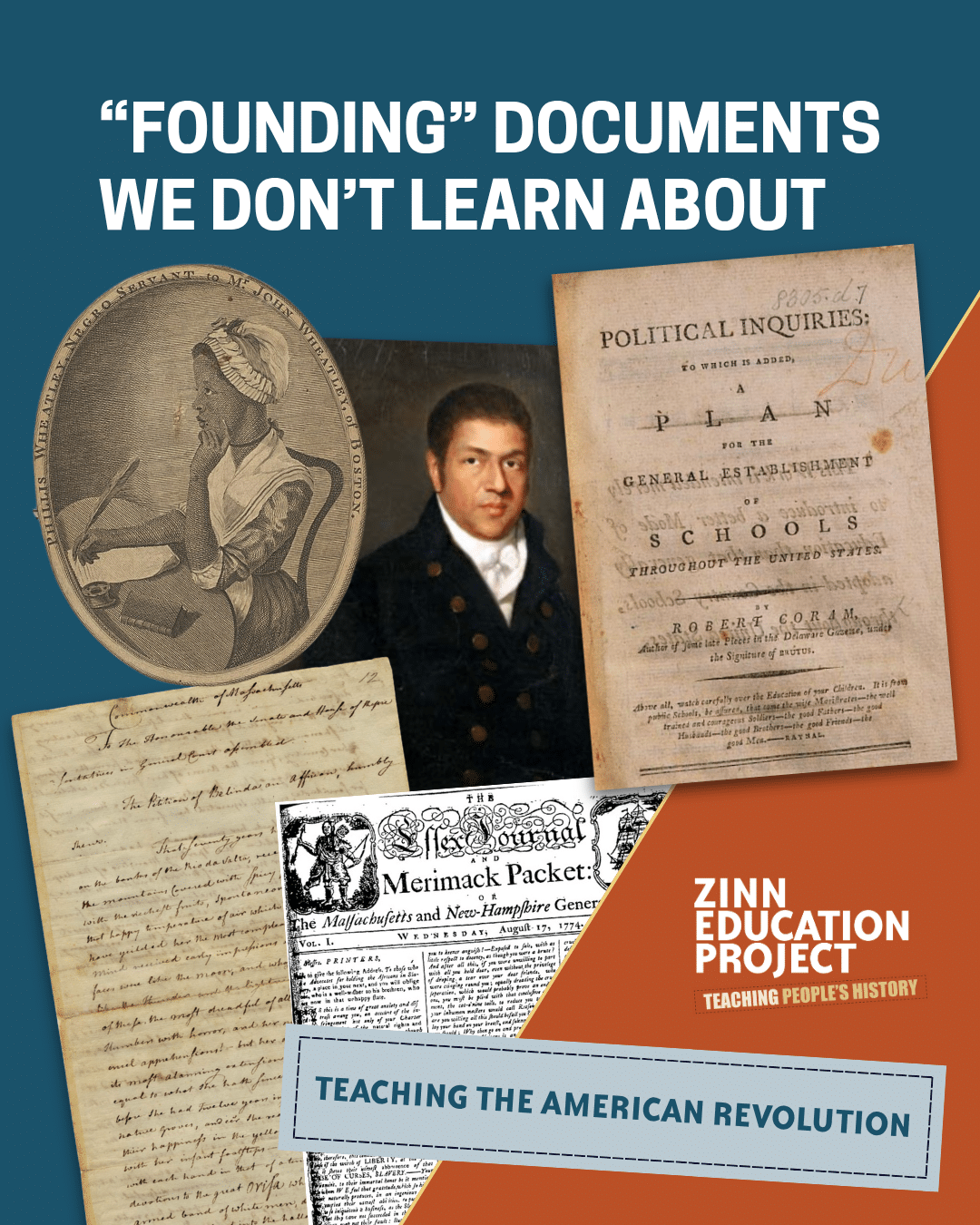
“Race, Class, and the Constitutional Convention” asks students to think critically about key issues that confronted the framers of the Constitution. But with a twist: Instead of acknowledging only the bankers, lawyers, merchants, and plantation owners who attended the actual Constitutional Convention, the activity also invites in the perspectives of enslaved African Americans, poor white farmers, and white workers. This gives students a chance to see the partisan nature of the actual Constitution produced in 1787 — “a government that will give full scope to the magnificent designs of the well-born…,” in the sardonic words included in the 1787 essay “Centinel III,” one of the documents assembled by Mimi Eisen in “‘Founding’ Documents We Don’t Learn About,” at the Zinn Education Project.
My experience is that after students have themselves engaged with key questions that confronted the “Founding Fathers,” they are primed to evaluate the original document and see what it really said — and why. Students are better equipped to recognize many of the nuances they might otherwise miss.
NOTE: This is a unit with three lessons by Bill Bigelow, “Race, Class, and the Constitutional Convention: Whose More Perfect Union?”; “The Constitutional Convention: Who Really Won?”; and “Federalist Paper #10: Suppressing ‘Wicked Projects.’”
Classroom Stories
Teacher stories about using these lessons on the Constitutional Convention. Some of the testimonials reference an earlier version of the lesson.
As an 8th grade teacher making the Constitution relevant and exciting can be a challenge. I have used Bill Bigelow’s Constitution lesson as a way to make history come alive! It allows my students to debate issues regarding race, gender, and class and see how decisions made by those in power can have long lasting consequences.

I first came across the Zinn Education Project online in 2015. At the time I was searching for lesson materials and ideas to more fully integrate social justice into my state-mandated curriculum.
The first lesson I implemented in my classroom was Bill Bigelow’s Constitutional Convention lesson. It was an instant success! In addition to giving students simulated practice negotiating and working as political actors, they engaged in critically thinking (and re-thinking) about the way the U.S. Constitution was created. Both my students and I were hooked!
The lesson was so successful, that students began consistently asking me when our next “simulation” would be. I have since used other lessons designed by Bill Bigelow, and frequently browse lesson materials at Zinn Ed and adapt them for my classes.
I am very appreciative of the resources available here for educators like myself, and the ways they have transformed my teaching and students’ learning.
I used Bill Bigelow’s new lesson, Race, Class, and the Constitutional Convention.
I have to say, it’s the most engaged I’ve ever seen my students get about the Constitution, and it really has them thinking about who benefitted from the original document and what social groups had the most say and which voices were ignored.
I want to express my sincere gratitude for the Constitutional Convention Role Play, which is part of Race, Class and the Constitutional Convention unit. As an AP teacher, it can often be a struggle balancing pacing of content with engaging opportunities to practice historical thinking that are assessed on the AP exam. My students loved the collaborative aspect of this role play. It served as a wonderful opportunity to have honest and necessary conversations about the role of race in the creation of the Constitution, a document that is typically covered as a perfect, even sacred document that is not worthy of critical analysis. This lesson was consistently referred to in later lessons on race in U.S. history by students throughout the course.
We are currently living in a period where teaching all parts of our country’s history is being restricted and even criminalized. My experience as an educator has shown me that students always yearn for the unvarnished truth in order to better understand the unique times that they are being brought up in. Critics will say that we are teaching students to hate our country by learning about these topics.
To quote Maya Angelou, “You can’t really know where you are going until you know where you have been.” To care enough to study all of the intricacies of U.S. history in order to make our country (and the world) better going forward is what loving your country should be about. The Zinn Education Project helps make all of this possible.
Bringing history alive in the classroom requires moving past the standard textbooks to explore the raw, lived experiences of the people who shaped our world. When my students and I dived into the Zinn Education Project’s role play lesson Race, Class, and the Constitutional Convention by Bill Bigelow, the entire dynamic of the room transformed. Instead of just memorizing dates, students took on the personas of different social groups from 1787, including enslaved people, small farmers, and wealthy plantation owners. Watching them passionately debate the structural inequities being baked into the foundation of American governance was incredibly powerful. They quickly realized how the mobilization of wealth and power sidelined marginalized voices, sparking deep connections to ongoing struggles for equity today.
We adapted the lesson by having students write reflective blues poetry inspired by Jesse Hagopian’s framework to channel those historical tensions into creative, personal expressions of resistance. This combination of rigorous historical analysis and artistic processing allowed them to engage not just intellectually, but with deep empathy and human solidarity. It is in these moments of shared discovery and debate that students stop viewing history as a static past and begin seeing themselves as active agents of social change. Thank you for providing such transformative, justice-oriented resources that empower educators to foster true critical literacy and honor the complex wealth of our history.

For the instruction of the Constitutional Convention and U.S. Constitution, I use The Constitutional Convention: Who Really Won? as a concluding lesson. Students are typically taught a dominant narrative that the “founding fathers” are heroic figures in U.S. history who acted in altruistic ways. By using the biographical details of the attendees and suggested questions, students realize how the convention was dominated by elite upper-class white men.
Once they’ve analyzed the composition of the convention, we then return to some of the key decisions made at the convention over slavery and 2-house legislature. By the end of the lesson, students understand how the Constitution was written to protect the interests of elite upper-class white men.
My students already learned about the Constitution and the founding of the nation in their previous U.S. history classes, but I enjoyed utilizing Race, Class, and the Constitutional Convention because it shook up a story that they were already expecting. Rather than learning about what is in the document and where it was written and signed, this lesson gives students the opportunity to zoom out and look at this sprouting nation as a whole in the context of this document.
We were able to look at who was involved in the document’s creation and drafting, what their beliefs were, and how all of this impacted the creation of our Constitution. We also looked at the other people and groups that were not included in the creation of this founding document, and even discussed how this impact can still be seen today. A wonderful resource that is worth the extra time. My students thought critically and kept up this mindset for following lessons.
The Constitutional Convention lesson had a huge impact on my students.
Many of my students are not white — Black and Latino, especially. Many of them did not have an understanding of just how biased the Constitution was. With the knowledge that we have gained from this lesson, students were able to then look at other situations that are currently surrounding us in the United States — such as the controversy surrounding Michael Brown, Sandra Bland, and the Black Lives Matter movement — with a more critical eye, understanding the kind of bias and uneven laws that founded this country and our government.
They were then better able to understand the anger and frustration that surrounds many Black communities in regard to both historical and current events.
They can now use the backdrop of the Constitution to better understand their own country, the frustration of others and what they have to do to move this country and the plight of a social justice worker forward. Most importantly, they were able to finally connect just how much history influences current events and our countries sentiments and culture.

The Constitutional Convention lesson was the most successful one I’ve done yet with my 8th graders. The students really embraced the lesson and did not shy away from their arguments and play beliefs.
The discussions got pretty heated at different points, but not so much so that we couldn’t reel things back in. There is much scientific evidence to support the idea that emotion is essential to learning, and this lesson is a good case in point.
Students were talking about the convention outside the classroom, letting students in later periods know what was about to go down, so there was a lot of excitement in the 8th grade hallway and during PE throughout the week. Students were saying those magical words “this is fun” during the convention as well (and that is great praise from middle school students).
I love the Zinn Education Project lessons because they give every student an opportunity to participate in some way. Even the students who are normally shy about speaking in front of classmates are at least engaged in the dialogue and writing notes furiously.
Despite teaching an America in History 3 (1945–present) course, I find that I am consistently coming back to our founding principles and the American Revolution. Specifically, I find myself coming back to issues of the responsibility of the Federal government to its residents/citizens, the ideals of the United States, and the importance of the Constitution (both in its limitations and its alleged guarantees).
I have utilized both “Founding” Documents We Don’t Learn About by Mimi Eisen and Race, Class, and the Constitutional Convention by Bill Bigelow (with modifications to best support my students) so I can incorporate them into my class. I want my students to be able to make these connections to the “founding” parts of our history and then also be able to make the connections to issues of race and class that we see playing out today. I especially appreciated Bigelow’s creation of the space to have students question the supposed sanctity of the Constitution. It helped my students recognize the importance of inquiry and questioning their long held assumption about authority and things they just “know”.
Zinn Education Project materials always help me with sparking that inquiry which is so important in history classrooms.
Using the “Founding” Documents We Don’t Learn About lesson, my students were fascinated to see different perspectives and viewpoints on the founding of this country — who was this country designed for and who benefitted from our founding combined with who wasn’t included and what their experiences were like.
Next we used the Race, Class, and the Constitutional Convention lesson, which allowed us to have multiple perspectives in creating a Constitution. Needless to say, having done this probably 30 times now, each class has created a vastly different Constitution. It’s amazing to see with multiple perspectives that high school sophomores and juniors have created a much more equitable Constitution than our founding fathers did.
That perspective in the founding of our country has allowed us to point back throughout the school year to these decisions as root causes of future problems our country has faced. I always enjoy when, months later, a student refers to a classmate in their frustration over our current topic (i.e. “Had we only listened to Noah during the Constitutional Convention, we would not have this issue.”).

I did the Constitutional Convention lesson with my 11th grade U.S. history students, and they were extremely engaged. The class worked in small groups, each representing different people who were present at the actual convention, as well as groups that were left out of the decision-making process.
The students debated the founding ideas of liberty and justice when evaluating how certain people or groups would have contributed to the meeting and discussing the possibilities of how the country would have been different if they had been included. It allowed students to be collaborative, develop critical thinking skills, and to think of history in a more relevant way.
The Constitution is often a challenging document to read for the students — since its language use is different to the way they speak today and it seems distant from their interests — but this activity allowed them to see this part of history in a relevant and impactful way.

After covering the Constitutional Convention and the utter lack of representation for anyone that wasn’t a property-owning white man, my 8th grade class successfully made it through the lesson Race, Class, and the Constitutional Convention.
Students were assigned into five different interest groups — northern bankers, southern plantation owners, enslaved African-Americans, tenant farmers, and lower-class workers — and they created resolutions in their interest and negotiated with other groups. During the convention, they abided by the rules of parliamentary procedure that we reviewed and they were able to successfully pass voting rights legislation for all citizens regardless of socio-economic status.
The students really ran with this and fully understood that our exercise was not historically accurate, but brought out the fact that had these groups been adequately represented in the summer of 1787, the hard-won rights of marginalized groups might have been won much sooner.
Thank you, Zinn Education Project, for this amazing resource!
One of my favorite activities from the Zinn Education Project is the Race, Class, and the Constitutional Convention. The lesson allows for students to not only use their critical thinking skills, but to challenge the traditional mythology and romanticism of American values and democracy. This lesson pairs well both in U.S. History and American Government classes, and it can be modified easily for all levels of students.
This is a fantastic activity to use at the beginning of the year, to set the stage in your classroom for political discourse and courageous conversations.
The results of our lesson about “Who Really Won?” speaks volumes to the themes of any U.S. History course — it’s hard work to face hard history. But recognizing those individuals who came together collectively to bring positive change and realize many American values for those not at the table during the convention, inspires students to embrace their own voice, courage, and responsibilities as a citizen in today’s complicated political arena.
What I really appreciated about the Constitutional Convention lesson materials is how thorough and clear they were.
I found that students were much more interested in examining the real Constitution after they had designed their own as a class. Pointing out similarities and differences between the class version and the real version made the information much more “sticky” for them.
Any time teachers have the chance to bring a historical topic “to life” like that is fantastic. I really appreciate the work that went into creating these materials.

My students were highly engaged in the Race, Class, and the Constitutional Convention lesson. It was an excellent way to cover the Constitution, given the multiple perspectives the “characters” let students view it through, and to predict how they would have represented that character if they had been part of the Constitutional Convention. Students used critical thinking and historical content to communicate with their peers about the key issues at the Convention.
I made a few adjustments that I thought could elevate the lesson. Overall, my students and I enjoyed this activity and will be using it again. Thank you for all the great resources!
More Classroom Stories
When we covered the Constitutional Convention in my 11th grade U.S. history class we ran the Constitutional Convention Simulation. We explored how different historical outcomes might have been different if everyone that had an interest in living in the U.S. would have had a seat at the table.
It was very important and striking for students to see the multiple perspectives that were excluded when arguments were being presented over what to include in the drafting of the document. Students were surprised to see what was originally written, what was taken out, and the reasons for why certain groups were taken out of the equation. It was a great way to begin teaching our Constitution unit and get students of all levels involved in a thought-provoking process such as this one. Thank you for providing such an insightful resource!
As an eighth grade Waldorf teacher, I began the year with the American Revolution. We started with the Race, Class, and the Constitutional Convention lesson to examine the country’s founding and the meaning behind “We, the people” and “life, liberty, and the pursuit of happiness.”
This was such a great resource with different perspectives. It was such a valuable tool to be able to embody the concepts that underline the American Revolution, and to set up our next block on the Civil Rights Movement. The lesson was engaging and really brought the concept to life.
Having this lesson on these burning issues helped so much to bring something engaging and relevant to the kids. Eighth graders love to argue, and this tied in perfectly to the discussions that we were having, empowering them to be specific in identifying what the founding fathers were experiencing.

I use the Race, Class, and the Constitutional Convention lesson in my classroom as a hook for a larger unit, in tandem with Teaching Tolerance’s unit “Did the Constitution establish a just government?” The students were very engaged during the activities and created a much more just constitution. Really appreciated the resource.
During the two weeks around Constitution Day, my 8th grade classes and I used the Zinn Education Project’s lessons on the Constitutional Convention to better understand the true foundations of the U.S. government. In small groups of five, they used the Constitutional Convention Burning Issues worksheets to analyze the five main social groups present in the United States in 1787. Once they understood that the “Colonists” were composed of multiple groups with different, and often opposing, interests, we turned to see what really happened.
From there, they used the “Who Really Won” worksheet to see which of the five groups got the most of what they wanted. Students grappled with the language of the Constitution, not to memorize it or learn to revere it, but to have deep knowledge of the system we wanted to criticize. We discussed how the language of the Constitution itself, legalistic and often arcane sounding, is a product of the upper class lawyers who wrote it.
Finally, we concluded with a class discussion about question five on the “Who Really Won” worksheet. We used the ZEP resource detailing the economic interests of the founding fathers to get into more detail about who really wrote the Constitution. As we did so, I instructed students to look for examples of each social group among the names and biographies of the writers of the Constitution. Quickly, students realized that there were no workers, poor farmers, or enslaved people present, and that all of the men at the Convention were merchants, bankers, or slave owners.
Our 8th grade classes decided that it was the rich who won the Constitutional Convention. Students also noticed how many of these men were lawyers, as well. Students emerged from this unit with a critical understanding of the Constitution that acknowledges the importance of items like the Bill of Rights, but also sees the cracks in the foundation of our so-called “democratic” society that are the source of many of our political, economic, and social problems today. This has set them up to analyze all the structures and functions of the government created by the Constitution with clearer eyes throughout this year and beyond.

We recently implemented the Foundations of American Democracy primary sources — the Declaration of Independence, Federalist Papers, U.S. Constitution, Emancipation Proclamation, Gettsyburg Address, and Martin Luther King Jr.’s “Letter from Birmingham Jail” — in a few of our general education courses. Though I already taught about these sources in my American History survey class (all of it in one semester), I looked toward the Zinn Education Project for new ways to teach these documents to my students.
I found the Race, Class, and the Constitutional Convention lesson plan, a unit with 3 separate lessons that my students completed together in class over a week, to be extremely useful in helping my students understand the perspectives of early U.S. settlers, including whose perspectives were considered by the framers, and whose perspectives were not.
Additionally, because there are over 80 Federalist Papers, the culminating lesson on Federalist Paper #10 in which James Madison advocated for the Constitution aided my students in understanding the purpose of the papers, and the fact that not everyone was on board with the Constitution from the start. My students were able to work together to analyze the primary sources. They learned from the lessons as well as from another and engaged in meaningful dialogue when we followed up by analyzing the sources as a class.
The Zinn Education Project has delivered time and time again the most impactful experiences for my students. They will not remember the PowerPoint info on the Articles of Confederation, but they will remember when they wrote the Constitution from the perspective of an enslaved African American or a member of the Iroquois nation using the Constitutional Convention lesson.
They understand the problems embedded into the way our country was founded AND the remarkable opportunities we have to reshape the conversation in our nation.
We used the Race, Class, and the Constitutional Convention lessons in a teen group I facilitate for homeschoolers. Our group is discussion-based and, for the most part, student-led. So the lessons were read and then used as jumping-off places for the group to share their own insights. I find this type of learning to be very effective.
They always enjoy discussing the social context in which events happened that shaped our country’s founding and these lessons were full of great discussion-evoking moments. They drew comparisons between the contentious nature of the convention with the politics of today. They appreciated the fact that in the convention, people who violently disagreed were forced to work toward a common goal. But they also decried the exclusion of women, Native Americans, and enslaved folks in the discussion. The founders, while attempting to build something new, held so tightly to British ideals around class that they really, in the group’s opinion, set the U.S. up as a place of inequality and limited opportunity.
I am a first year U.S. history teacher about to teach the flaws of the U.S. Constitution because we keep hearing “constitutional crisis” on the daily. It’s a document that was written for a select group of people who probably used “that’s a future problem” one too many times.
I want my students to understand that the document was created to ensure an equality gap, and that “we the people” aren’t who the Framers had in mind. I want my students to understand the flaws of the country and how we got to where we are (one of their semester long projects), and the role this treasured document has in our lives.
I want my students to think critically about this document. Instead of thinking of it as the end all, be all premier document making the United States the best country in the world, I want them to see how it prevents our country from constantly evolving, and how it makes it difficult for the people to enact the change that is wanted. I want my students to be able to see the promise of the document, and how it can be improved.
See how teachers in California, New York, North Carolina, and Illinois used the lesson in their classrooms:
Building alliances, making deals. 1787, a more democratic constitutional convention. @ZinnEdProject pic.twitter.com/Ss0GuMnQeu
— Lisa Steiner (@HistorySteiner) January 15, 2019
Making alliances for the Constitutional Convention! @ZinnEdProject #naplescsd pic.twitter.com/h1Miop3K5L
— Anneke Radin-Snaith (@AnnekeRadin) February 11, 2016
The People’s Constitutional Convention role play from @ZinnEdProject never disappoints! 1st period broke into applause after abolishing slavery and expanding democracy this morning, which led to a great discussion about why the oft-celebrated Framers did the opposite pic.twitter.com/yftyMxPYYC
— Tracey Barrett (@traceyebarrett) September 6, 2018
Welcoming so many new faces to our #AmericanStudies Unconventional Constitutional Convention @YorkD205 w @KellyDeloriea Thank you @ZinnEdProject and Bill Bigelow for another successful debate. Democracy is not a spectator sport! #IgniteD205 #teachingoutsidethetextbook pic.twitter.com/09SyoSv0kM
— Lindsey DiTomasso (@laldtd) September 10, 2018
Finished our @ZinnEdProject Constitutional Convention today. Students formed alliances, proposed resolutions, and voted on them #WeAreCarter #LionPride #BucklesHeroes pic.twitter.com/EpjXAocsW2
— Jessica Buckle (@JBuckLearns) August 29, 2019
We want to share your classroom story. If you use the lesson and tweet about it, consider tagging @ZinnEdProject.


Twitter
Google plus
LinkedIn