

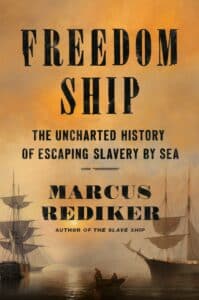
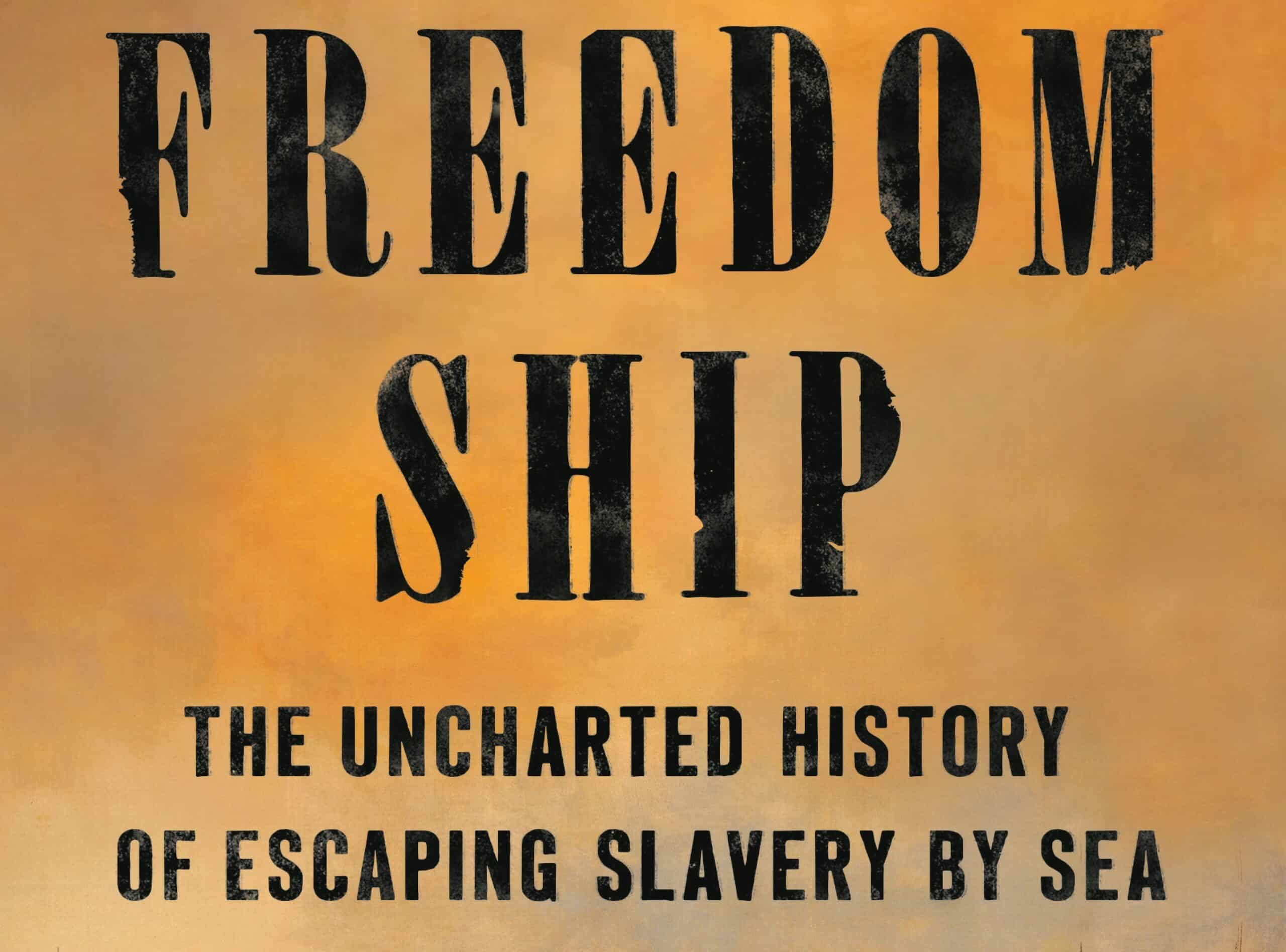
 The This Day in History post below is taken from Freedom Ship: The Uncharted History of Escaping Slavery by Sea by Marcus Rediker.
The first big political event sparked by maritime runaways in Boston was a decidedly female affair from start to finish. It began in Baltimore when two African American women, Eliza Small and Polly Ann Bates, got aboard the brig Chickasaw with forged passes. When they arrived in Boston on Saturday, July 30, 1836, their captain, Henry Eldridge, docked at a wharf, then moved back offshore and anchored, arousing the suspicion of four Black waterfront workers, who climbed into a boat to row out and investigate. Matthew Turner, a policeman representing Baltimore enslaver and Maryland state senator John B. Morris, boarded the vessel, discovered the women, and declared them to be fugitives. He asked Captain Eldridge to hold them until he returned with an arrest pant. The Black workers tried to board the Chickasaw to find out what was going on, but Captain Eldridge repeatedly drove them off. They rowed their boat around the brig and saw the women “making signals of distress to them from the.cabin windows.” A Black member of Chickasaw’s crew also signaled to the men in the boat. One of the Black workers in the rowboat, sailor Samuel H. Adams, returned to shore and secured a writ of habeas corpus.
After two nights in the Leverett Street jail the women appeared before Chief Justice Lemuel Shaw of the Massachusetts Supreme Judicial Court on August 1, in a room crowded with African Americans, mostly women, and a dozen white abolitionists, half of them members of the Boston Female Anti-Slavery Society. Judge Shaw ruled that Captain Eldridge had no right to turn his vessel into a prison and quickly discharged the womcn, all the while expecting Turner to request a new and immediate arrest under the Fugitive Slave Law of 1793.
Before the new arrest could be made, however, someone in the courtroom cried out, “Go! Go!” The women in the audience “spring from their seats in every direction,” surged forward, seized Small and Bates, and rushed them toward the exit. Two courtroom officers tried to control the crowd and recapture the fugitives as Judge Shaw himself struggled to hold the main door closed, all to no avail. An older African American cleaning woman “of great size” wrapped one of the officers in an embrace and, according to an eyewitness, “effectually prevented his interference with the fugitives.” The female rioters triumphantly carried Small and Bates out onto School Street, into a crowd of several hundred more Black protesters. Some of those who had led the liberation shed their shawls and bonnets, which Smail and Bates donned in disguise. The fugitives hopped into a waiting carriage and sped away.
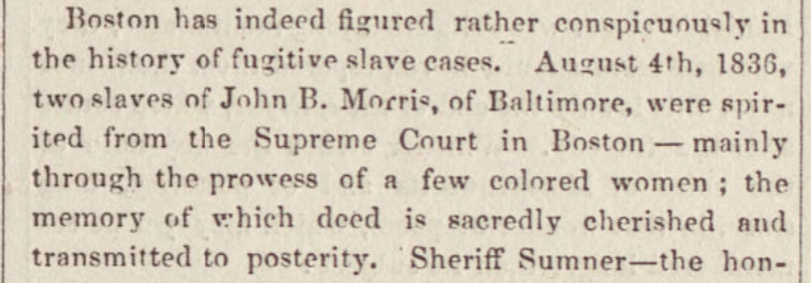
Excerpt from The Liberator describing Polly Ann Bates and Eliza Small, December 10, 1852. From Digital Public Library of America. Source: West End Museum
The women’s successful direct action caused a national stir. The Boston Courier denounced the rescue. The Charleston Courier called it “one of the most outrageous and disgraceful proceedings as even witnessed in any Court.” The Richmond Enquirer complainéd of “the mordifying spectacle . . . of seeing women, those who enjoy the reputation of being considered decent and respectable, and of possessing a modicum of modesty and delicacy with which nature is supposed to endow their sex, in the midst of a melee, and participating in the affray, we hope, for the credit of Boston, will never again be witnessed here.”
The boldness of the rescue also shocked white abolitionists. The women’s attorney, Samuel E. Sewall, later wrote, “I am sorry for the disorderly proceedings of the colored people,” while The Liberator expressed, on behalf of Garrison and the New England Anti-Slavery Society, “deep regret” and “decided disapprobation” of the “ignorant” actors. By 1852, The Liberator had caught up with the mass action from below and remembered it differently: Black abolitionist Charles B. Ray called the event something “sacredly cherished and committed to posterity.” The event stood in marked contrast to Boston’s anti-abolition riot of October 1835, when a crowd of “gentlemen of property and standing” mockingly dragged William Lloyd Garrison through the streets with a noose around his neck.
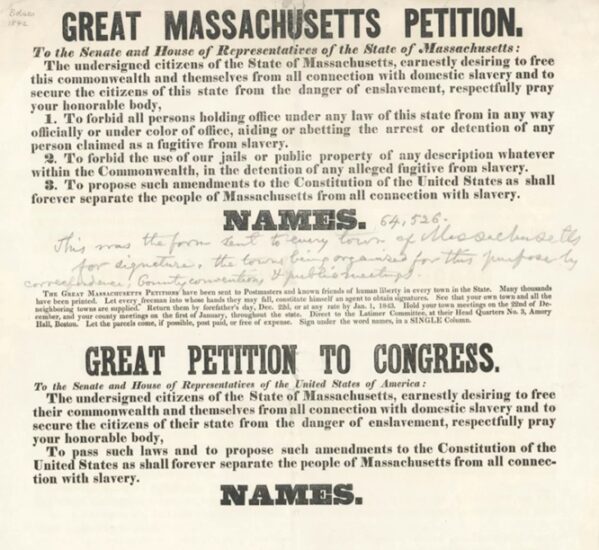
The Great Massachusetts Petition, broadside attributed to the Latimer Committee, 1842. From the Massachusetts Historical Society. Source: West End Museum
Once freed from the captain, the sheriff, and the judge, the women continued their escape through maritime circuits by sailing from Boston on to Halifax, Nova Scotia. They were never recaptured. Two female maritime fugitives, assisted by Black men who worked in the port, and in the end rescued by their Black working-class sisters in the courtroom, thus precipitated one of the first major legal confrontations over slavery and secured an early victory for the abolitionist movement. A Boston newspaper editor was left to ask, “Where is the fat, burley wench — the dusky amazon — who took such an active part in the rescue — aiding, abetting, and encouraging, by muscular strength and inflammatory language?” Southerners in Maryland and Virginia burned with rage over the successful escape, threatening to lynch Sewall should he ever venture South. In September 1836, a naval officer from Baltimore, Lt. George Adams, came to Sewall’s Boston office with a cowhide whip and “applied it eight or nine times“ to the attorney’s back in retribution for his interference with “the property of strangers.”
Related Resources
Freedom Seekers at the Leverett Street Jail: Polly Ann Bates, Eliza Small, and George Latimer from the West End Museum
Solidarity Versus Parastate by Edward E. Baptist, Cornell University, 2023



Twitter
Google plus
LinkedIn