

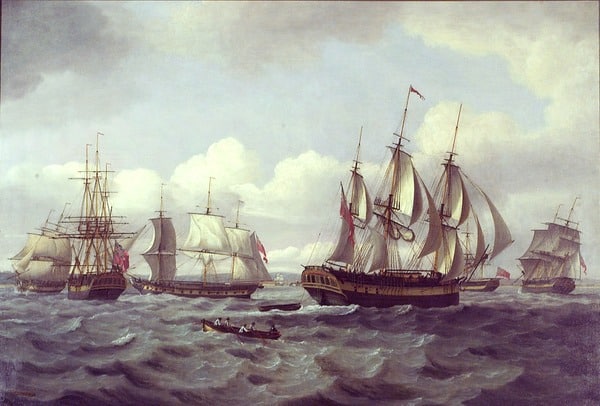
The Ship ‘Castor’ and Other Vessels in a Choppy Sea, 1802 painting. Source: Public domain
“An Act to Prevent the Importation of Certain Persons into Certain States” was passed into law on February 28, 1803.
As Mapping Deportations writes,
In 1803, a year before formerly enslaved people in the French colony of Saint Domingue declared Haiti to be a free Black republic, Congress prohibited ship captains from bringing any “negro, mulatto, or other person of color” into any state where a state law prohibited their entry.
This law targeted free Black migrants, namely Haitians, whom Southern slavers feared might sail to the United States to ignite an armed revolt among the enslaved population across the U.S. South. By the 1830s, South Carolina, Florida, Georgia, North Carolina, Alabama, Louisiana, and Mississippi had passed a set of laws known as the “Negro Seamen Acts,” which prohibited ship captains from bringing Black migrants into their ports.
According to these laws, when Black sailors and ship workers arrived in Southern ports, local sheriffs detained them in jail and charged their ship captains a fee for detaining their passengers. If ship captains did not pay the fee, sheriffs were authorized to sell the detainees into slavery.
By the time of the Civil War, Southern authorities had used the Negro Seamen Acts to arrest up to 20,000 free Black migrants, incarcerating most of them and selling an untold number into slavery.
Learn more at Mapping Deportations.








Twitter
Google plus
LinkedIn