

In 2026, many of the groups that have led the campaigns to ban books and censor history are focusing their efforts on the 250th anniversary of the Declaration of Independence. (These include the Heritage Foundation, Hillsdale College, Moms for Liberty, PragerU, Turning Point USA, and more.) We are focusing on the 250th anniversary as well. We offer lessons and campaign materials to Teach Truth about the American Revolution and founding of the United States.
To protect young people’s right to learn — and by default protect the future of democracy and justice — we need to expose the right’s agenda and be visible in our defense of teaching people’s history.
For the classroom, we offer lessons, questions for reflection, recommended books and films. To prepare for media interviews and anyone else with questions, we developed this list of FAQs and suggested responses. Find more guidance on our Teach Truth Media Guide. Let us know if you use these FAQs and if you have suggested edits or additions.
Isn’t teaching students to question the American Revolution unpatriotic?
Short answer: Teaching students to question and investigate the contradictions of the American Revolution is a core democratic practice. It equips young people to understand history, assess power, and participate in creating a more just society.
Explanation: Some people believe teachers should require students to uncritically support the U.S. government — from its founding to the present. In this view, patriotism means loyalty to authority and silence in response to injustice. The true purpose of education is not indoctrination. It is to equip students with the tools to understand and address the problems we face today: gathering evidence, examining multiple perspectives, researching historical context, reconsidering assumptions, and drawing independent conclusions. Teaching students to critically examine the American Revolution does not undermine democracy — it strengthens it.
A society that discourages its citizens from questioning its origins not only undermines democracy, it inculcates obedience. When students learn the truth about how the nation was founded — through a war preserving slavery and entrenching settler colonialism — they better understand the inequalities and conflicts of the present. Shielding history from scrutiny leaves young people unprepared to recognize injustice or learn from the past. Students deserve the truth — and the power to shape the world they have inherited.
Shouldn’t schools be teaching kids to celebrate America’s victory in the American Revolution — rather than focusing on its flaws?
Short answer: Students should learn what the American Revolution changed — rule by a king — and what it did not, including slavery, settler colonialism, and unequal political power.
Explanation: The defeat of monarchy during King George III’s era of extreme inequality and repression reshaped global politics. Students should learn about the new political and economic era the American Revolution ushered in. But students also have a right to examine the Revolution’s deep contradictions.
Many leaders of the U.S. War for Independence declared that “all men are created equal,” yet enslaved people and opposed abolition. During the war, the British promised freedom to enslaved Black people who escaped and fought on their side. For many slaveholding colonists, the threat of losing their enslaved workforce pushed them toward open revolt against Britain. Yet independence for the colonies did not mean freedom for the hundreds of thousands who remained enslaved.
Remember: the American Revolution did not introduce democracy to an empty continent. Existing Indigenous political systems embodied democratic principles that the new nation often failed to match. Long before the Revolution espoused liberty, Indigenous nations such as the Haudenosaunee Confederacy — a group of Iroquois nations — practiced collective governance, consensus, and accountability to future generations. The continent’s sophisticated political traditions were often suppressed by the new republic’s violent expansion.
Although the American Revolution didn’t free enslaved people, didn’t it put into motion the inevitable wheels of liberty that would lead to emancipation for Black people?
Short answer: No. The idea that emancipation was inevitable after 1776 is a national myth. The U.S. government protected and expanded slavery for generations after the Revolution.
Explanation: The claim that the American Revolution set the United States on an inevitable path toward emancipation is not supported by historical evidence. After independence, the new nation took deliberate steps that protected, expanded, and enforced slavery.
The Constitution reinforced slavery through the Three-Fifths Clause, which counted enslaved people as three-fifths of a person for representation and taxation. This boosted the political power of slaveholding states while denying enslaved people any rights. Although the Constitution ended the international slave trade by 1808, the domestic trade expanded dramatically, tearing families apart. Federal laws such as the Fugitive Slave Acts of 1793 and 1850 enforced the capture and return of people who escaped bondage.
Independence more deeply embedded slavery in the U.S. economy. As Eric Foner notes in Forever Free, by 1860, more money was invested in slavery than in railroads, banks, and factories. U.S. bankers, manufacturers, and insurers — most in the North — were deeply entangled in the system of slavery. Haiti abolished slavery in 1804, and the United Kingdom did so in 1833. The United States, by contrast, preserved slavery until 1865, requiring a devastating civil war to end it. Only Cuba (1886) and Brazil (1888) abolished slavery later in the Americas.
Emancipation did not arrive because liberty naturally unfolded from 1776. It came because enslaved people resisted, abolitionists organized, and mass struggle forced change. As historian Hasan Kwame Jeffries writes:
The myth of universal liberty has long obscured how democracy has actually functioned in the U.S. Across history, there has never been a time when all people enjoyed equal rights, equal protection under the law, and equal political power. Instead, the story of American democracy is one of restriction and resistance — long stretches when rights were denied punctuated by brief, hard-fought expansions led by those who refused to accept exclusion.
Honest history teaches a crucial lesson: Progress is not guaranteed, justice is not automatic, and freedom is won when people struggle to make it real.
Isn’t it unfair to judge the American Revolution and the founders by today’s moral standards?
Short answer: No. Critiques of slavery and inequality were well known during the Revolution, and evaluating the past is essential to learning from history.
Explanation: By teaching about history’s injustices, we are not condemned to repeat them. Learning from the past requires evaluating decisions, understanding consequences, and asking what should be done differently. If we refuse to assess past choices, history’s lessons are lost.
Moreover, critiques of slavery and elite rule are not modern inventions. During the American Revolution, people openly condemned slavery, class domination, and the dispossession of Native peoples.
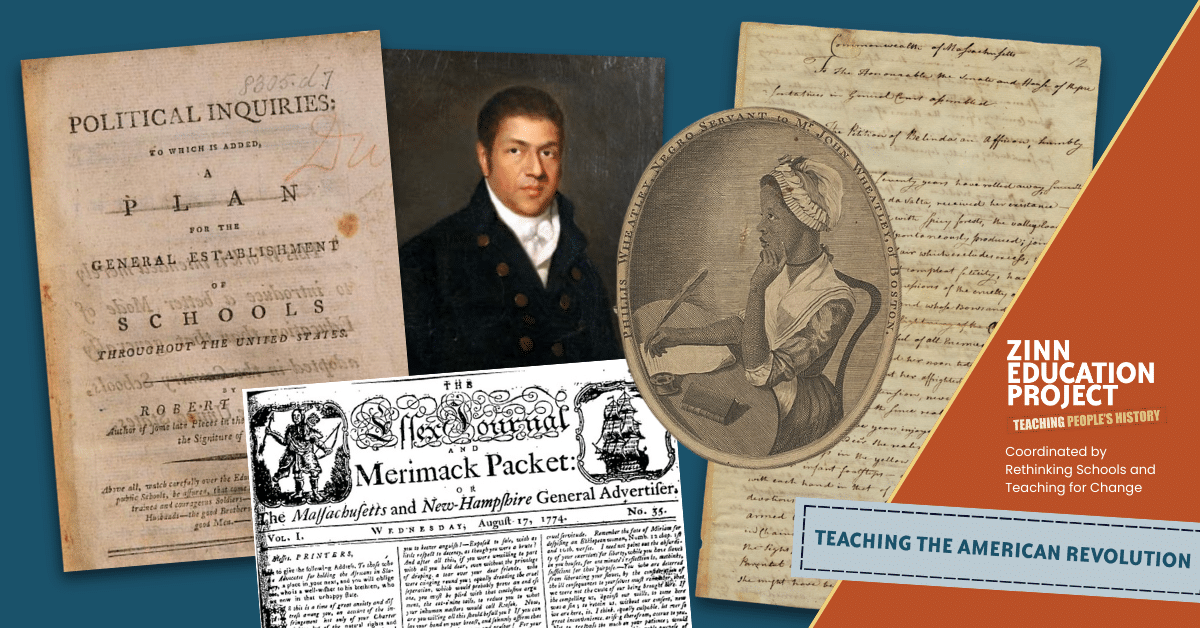
Our goal is to expose students to these stories, using lessons such as “Founding” Documents We Don’t Learn About. Dated from 1774 to 1798, the lesson introduces 26 letters, petitions, poems, essays, and declarations authored by contemporaries of the Founders; voices typically cast to the margins or wiped from the mainstream historical record. They include a 1774 document by Phillis Wheatley, a freedwoman and African-born poet, who condemned slavery as a violation of natural law. She wrote, “In every human breast, God has implanted a principle, which we call Love of Freedom; it is impatient of Oppression, and pants for Deliverance.” She also criticized colonists who “cry for liberty” from Britain while championing the enslavement of Black people.
Thomas Paine, whose Common Sense pamphlet sparked the independence movement from Britain, published an anti-slavery essay called African Slavery in America in 1775. In it, Paine condemned slavery as a moral crime. His abolitionist views angered many Revolutionist elites, many of whom defended slavery out of political and economic interest.
Enslaved people resisted in myriad ways, including filing legal suits for their freedom. Women demanded political rights; poor farmers challenged elite rule; and Indigenous nations such as the Haudenosaunee and Cherokee asserted sovereignty through treaty councils, petitions, and resistance to land seizures. These struggles were alternatives first imagined, then suppressed. History shows that the Revolution’s limits were political choices rather than destiny.
Was the American Revolution the most revolutionary of the wars for independence?
Short answer: No. Compared to other revolutions in the Americas, especially the Haitian Revolution, the American Revolution granted fewer rights and preserved slavery, racial hierarchy, and elite rule.
Explanation: The American Revolution overthrew British rule but did not abolish slavery, dismantle racial hierarchy, or embrace popular democracy. Its most celebrated texts reinforced oppression. The Declaration of Independence blamed the British Crown for allegedly unleashing the violence of so-called “merciless Indian Savages,” clearly excluding Indigenous peoples from the nation’s vision of freedom. In the same grievance, the Declaration accused Britain of “exciting domestic insurrections,” or slave revolts.
The U.S. Constitution legally protected slavery. It counted enslaved people as three-fifths of a person, guaranteed participation in the transatlantic slave trade until 1808, and required the return of escapees. These were deliberate political choices.
By contrast, the 1804 Haitian Revolution — led by enslaved people — abolished slavery outright. Haiti’s 1805 Constitution permanently outlawed slavery and affirmed racial equality. Freedom was universal, not partial or delayed. Because of Haiti’s commitment to freedom for all, the U.S. government viewed it as a dangerous example and responded with economic isolation and anti-immigrant legislation.
We invite students to do a comparative analysis of the French, Haitian, and American revolutions, using a text by historian Kellie Carter Jackson along with discussion questions. The student investigation reveals that broader equality was possible in the late 18th century — and that the United States consciously chose a more limited, exclusionary vision of government.
How do myths about the American Revolution shape our thinking about today?
Short answer: Founding myths hide how inequality was built into U.S. institutions, making present injustices seem accidental rather than systemic.
Explanation: The myth of a nation born fully democratic hides a harder truth: slavery, Indigenous conquest, and exclusion were not side effects of the founding — they were embedded in it. Teaching that freedom and democracy were innate to the nation’s birth makes current injustices appear accidental.
Learning the truth helps students see how past structures shape today’s institutions. Mass incarceration, ICE, and state violence disproportionately affect Black, Indigenous, and other people of color. Honest history helps students recognize power, ask hard questions, and imagine futures that break from a violent past rather than reproduce it.
Isn’t the American Revolution a source of inspiration for social justice movements?
Short answer: Yes — but often to highlight the nation’s contradictions. Many movements invoke its ideals to expose hypocrisy, while others reject the Revolution’s framework entirely, emphasizing that the system was built on slavery and settler colonialism.
Explanation: Throughout U.S. history, organizers, educators, and activists have used the language of the Revolution to challenge oppression. However, most founders defined freedom narrowly, securing “unalienable rights” for wealthy white men while preserving slavery and dispossessing Indigenous nations.
Still, many organizers have understood the strategic power of these ideals. Martin Luther King Jr., in his 1968 “I’ve Been to the Mountaintop” speech, urged the nation to confront its contradictions:
All we say to America is to be true to what you said on paper . . . Somewhere I read of the freedom of speech. . . Somewhere I read of the freedom of press. . . Somewhere I read that the greatness of America is the right to protest for rights. . . And so we are going on.
Other movements rejected the idea of America’s founding as liberatory entirely. Malcolm X argued that appeals to the nation’s founding obscured the realities of conquest, slavery, and racial domination. In a 1964 speech, he explained:
We are Africans, and we happen to be in America. We are not Americans. We are a people who formerly were Africans who were kidnapped and brought to America. Our forefathers weren’t the Pilgrims. We didn’t land on Plymouth Rock; the rock landed on us. We were brought here against our will. . . . We were not brought here to enjoy the constitutional gifts that they speak so beautifully about today.
For Malcolm X, the problem was not simply that the United States failed to live up to its founding ideals — it was that those ideals were never intended to apply to Black people in the first place. He emphasized traditions of international solidarity — such as pan-Africanism and socialism — as a foundation for achieving liberation, not the American Revolution.
As these examples demonstrate, movements throughout history that have sought to create a more equitable society didn’t just celebrate the American Revolution — they contested its meaning. Some by seeking to expand its promises; others by rejecting its limits outright and looking to other traditions of freedom they believed were more expansive.
Was slavery a necessary compromise to unite the colonies and win independence from Britain?
Short answer: No. I reject the premise of the question itself. The humanity of millions of enslaved people cannot be justified as a bargaining chip for political unity. Sacrificing human beings to preserve elite consensus is not progress — it is oppression. Moreover, slavery was reinforced by the Constitution and subsequent laws long after the American Revolution.
Explanation: Defenders of the founding often argue that protecting slavery was an unfortunate but necessary compromise to unite the colonies against Britain. But this framing treats slavery as a regrettable inconvenience rather than a system of kidnapping, torture, forced labor, family separation, and racial terror imposed on millions of people.
The question “Was slavery necessary?” also obscures a deeper issue: necessary for whom? Protecting slavery was necessary for wealthy elites who wanted independence without surrendering their economic power. It was not necessary for the enslaved people whose labor built enormous fortunes while they were denied even the most basic human rights.
The idea that the “anti-slavery North” reluctantly compromised with the South is historically false. Slavery existed in all thirteen colonies, and even after gradual abolition began in the North, northern banks, merchants, manufacturers, and textile mills continued to profit enormously from enslaved labor. Slavery was woven into the economic foundations of the entire new nation.
If slavery had merely been a reluctant wartime compromise — a temporary measure to unite the colonies against the British — many of the founders would have moved to dismantle it after independence. Instead, leading figures in the new nation continued enslaving people themselves and used the Constitution and federal law to protect and expand the institution for generations.
The Constitution, written in 1787 — eleven years after the Declaration of Independence — protected slavery through the Three-Fifths Clause, which boosted the political power of slaveholding states while denying enslaved people any rights. The Constitution protected the transatlantic slave trade until 1808 and required the capture and return of people who escaped bondage. These were deliberate political choices that benefited powerful elites in both the North and South.
Teaching this history honestly matters because it reveals that injustice was not inevitable. The founders were not trapped by history; they made political decisions about whose freedom would count, whose wealth would be protected, and whose humanity would be sacrificed.





Twitter
Google plus
LinkedIn