

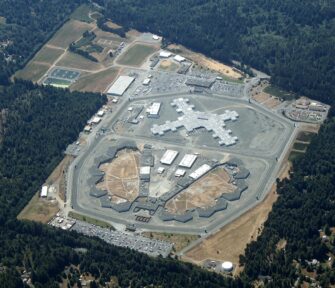
Aerial phtograph of Pelican Bay State Prison, taken July 27, 2009. Source: Public domain
Hidden among the redwoods that cover the northern coast of California is the state’s most secure maximum-security prison, Pelican Bay State Prison, which was designed to hold prisoners in long-term solitary confinement. Built in 1989, Pelican Bay has more than a thousand isolation cells in its Secure Housing Unit, or SHU, where prisoners have spent decades confined alone for alleged gang affiliations.
It was here, in the Pelican Bay SHU, that four prisoners organized a state-wide hunger strike in 2013 to protest indefinite time in the SHU, as well as other inhumane conditions and abuse. These same prisoners had orchestrated two separate hunger strikes in 2011, neither of which led to any reforms or improved conditions.
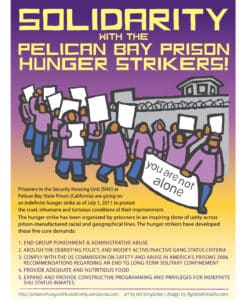
“Solidarity with Pelican Bay Hunger Strikers” by Rini Templeton & Melanie Cervantes. This poster was made in support of a July 2011 hunger strike at Pelican Bay that preceded the 2013 hunger strike. Source: Justseeds
On July 8, 2013, an estimated 30,000 prisoners across California prisons refused their meals, sparking a massive hunger strike that continued until early September. Many prisoners also refused to go to any work assignments or enrolled classes.
According to Benjamin Wallace-Wells, speaking with NPR’s Terry Gross,
These four men who led the hunger strike — Todd Ashker, [allegedly] of the Aryan Brotherhood, had the initial idea; Sitawa Jamaa, who is allegedly from the Black Guerilla Family; and Arturo Castellanos, allegedly a senior leader of the Mexican Mafia; and Antonio Guillen, allegedly one of the three “generals” of Nuestra Familia — they were put together in basically the same space years ago, in 2006, and it took five years for them [to] come together.
In addition to the hunger strike at Pelican Bay, prisoner-led hunger strikes were also happening at the time at Eloy Immigrant Detention Center in Arizona and Guantanamo Bay Detention Camp, the U.S. Naval Base in Cuba. Rory Carroll at The Guardian notes that “[i]nmates in two-thirds of the state’s 33 jails, as well as four out-of-state jails, started refusing meals.” The hunger strikes created a space for unity among races — something not common in the carceral system — which, in turn, helped the hunger strikes spread rapidly throughout prisons.
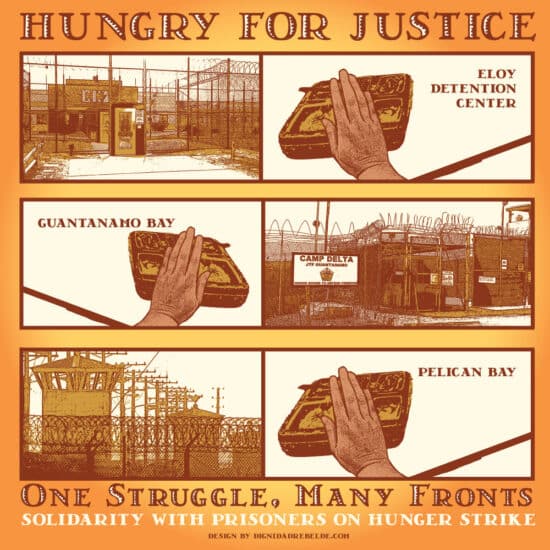
“Hungry for Justice” by Melanie Cervantes. Source: Justseeds
On July 22, 2013, Billy “Guero” Sell, a prisoner on hunger strike at Corcoran State Prison in California, died after his requests for medical attention were ignored for days. By the first week of September, Paige St. John at the Los Angeles Times reported that “nearly 10 protesters a day were collapsing or otherwise required medical care.”
St. John further writes that prisoners brought the two-month hunger strike to an end “without winning major concessions on solitary confinement conditions — their main grievance — but with the promise of legislative hearings on the issue.”
Additional Resources
 Flying Kites: A Story of the 2013 California Prison Hunger Strike by Stanford Graphic Novel Project (Haymarket Books) [Note: This book is accessible for grades 7+]
23/7: Pelican Bay Prison and the Rise of Long-Term Solitary Confinement by Keramet Reiter (Yale University Press)
How 4 Inmates Launched A Statewide Hunger Strike From Solitary by Terry Gross (NPR’s Fresh Air)
The Plot From Solitary by Benjamin Wallace-Wells (New York Magazine)
California Prisoners Launch Biggest Hunger Strike in State’s History by Rory Carroll (The Guardian)
Inmates End California Prison Hunger Strike by Paige St. John (Los Angeles Times)
California Prison Officials Retaliating Against Hunger Strikers by Sal Rodriguez (Solitary Watch)
The Strike, a 2025 PBS documentary directed by JoeBill Muñoz and Lucas Guilkey. Watch the trailer below.




Twitter
Google plus
LinkedIn