

In an unanimous 9–0 decision, on March 9, 1964, the Supreme Court ruled in the case of New York Times Co. v. Sullivan that the First Amendment protects newspapers that print inaccurate statements, as long as no “actual malice” was intended. This landmark decision upholding freedom of speech provided protection for journalists and media publications, severely limiting public officials from suing for defamation.
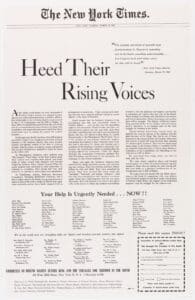
A full-page newspaper advertisement published in the New York Times on March 29, 1960. It was paid for by the Committee to Defend Martin Luther King Jr. and the Struggle for Freedom in the South. The advertisement was also used as an exhibit from the court cases Abernathy v. Patterson (1961) involving Martin Luther King Jr. and New York Times Co. v. Sullivan (1964). Source: Public domain
In a NPR Fresh Air interview, New York Times editor David Enrich explained the decision,
Sullivan was a decision that the Supreme Court issued in 1964. And without going into the very kind of colorful, interesting backstory of that, the outcome of the case was that the Supreme Court ruled that if you were a public figure or a public official, to win a defamation case, you need to prove not only that someone got their facts wrong and that you were defamed. You also need to prove that whoever wrote those words or spoke those words did so knowing that what they were saying was false — in other words, lying — or that they acted with reckless disregard for the accuracy of what they were writing. And that set a high bar for public figures and public officials to clear, and that was by design.
The Supreme Court wrote in Sullivan and then in some subsequent decisions that there is a great public interest that dates back to the founding of the United States in having unfettered speech and debate and argument about matters of public importance in this country. And their argument was that if you have potentially ruinous litigation hanging over your head every time you speak critically about a powerful person, you’re going to self-censor or you’re going to be sued into oblivion. And both of those outcomes ran counter to what the First Amendment guaranteed about free speech and freedom of the press.
Additional Resources
In the Democracy Now! interview below, watch David Enrich on the right-wing plot to erode press freedom by overturning the NYT v. Sullivan libel case.
Actual Malice: Civil Rights and Freedom of the Press in New York Times v. Sullivan by Samantha Barbas (University of California Press)
New York Times v. Sullivan: Civil Rights, Libel Law, and the Free Press by Melvin I. Urofsky and Kermit L. Hall (University Press of Kansas)
“Can the Media’s Right to Pursue the Powerful Survive Trump’s Second Term?” by David Enrich (New York Times)
Below, watch a quick and animated explanation of the landmark Supreme Court case provided by Landmark Cases in a Nutshell.



Twitter
Google plus
LinkedIn