

On February 28, 1950, 86-year-old civil rights activist Mary Church Terrell and three friends — all Black except for one white man — were refused service at Thompson’s, a popular restaurant chain on 14th Street in Washington, D.C. For the next three years, this test case made its way through the courts, ultimately reaching the Supreme Court, which, on June 8, 1953, ruled unanimously that segregation in D.C. restaurants was illegal.
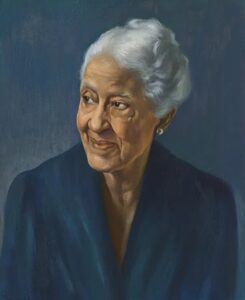
A portrait of Mary Church Terrell in 1946 by Betsy Graves Reyneau. Oil on canvas. Source: National Portrait Gallery, Smithsonian Institution
Terrell moved to Washington, D.C. in 1889, as a high school teacher who quickly became the first Black woman to be appointed to the D.C. Board of Education. Terrell also served as a delegate at the International Council of Women in Berlin in 1904, was a founding president of the National Association of Colored Women (NACW), and a founding member of the National Association for the Advancement of Colored People (NAACP).
As the Equal Justice Initiative highlights, “This ruling only applied to Washington, D.C.; it would take over a decade, with the passage of the Civil Rights Act of 1964, for segregation in public restaurants to be outlawed across the United States.”
Jackie Mansky writes for Smithsonian Magazine,
Never one to stop her advocacy work, Terrell spent her 90th birthday that year testing Washington, D.C.’s segregated theater policy. She and her three guests were all admitted to see The Actress at the Capitol Theater without any trouble. Washington’s movie theater managers, unwilling to have their own Supreme Court case on their hands, had gotten the message. As Dennis and Judith Fradin wrote in Fight On!: Mary Church Terrell’s Battle for Integration, within the next few weeks “virtually all of Washington’s movie houses had opened their doors for everyone.”
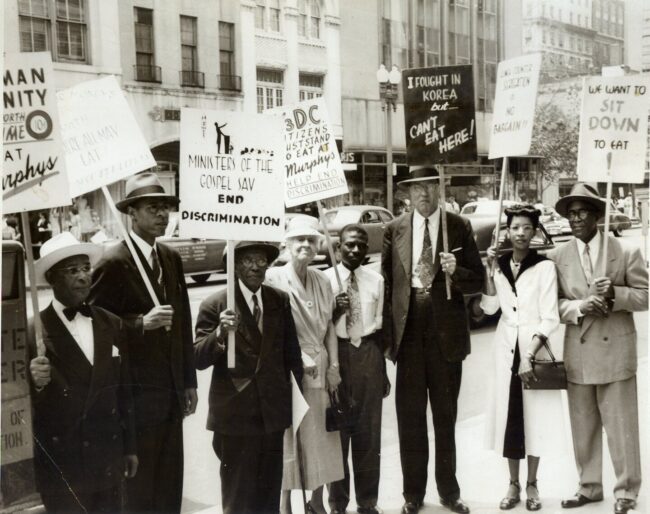
Mary Church Terrell (fourth from left) and others picketed Murphy’s five-and-dime in the early 1950s because its lunch counter did not serve African Americans. Source: D.C. Preservation League, courtesy of the Moorland-Spingarn Research Center, Howard University Archives
Additional Resources
How One Woman Helped End Lunch Counter Segregation in the Nation’s Capital by Jackie Mansky, Smithsonian Magazine
Just Another Southern Town: Mary Church Terrell and the Struggle for Racial Justice in the Nation’s Capital by Joan Quigley, Oxford University Press
A Colored Woman In A White World by Mary Church Terrell, Humanities Press International





Twitter
Google plus
LinkedIn