

In January 1976, workers at the Lucas Aerospace Corporation in Birmingham, England — facing defense cuts and increasing layoffs — came up with a plan to save not only their jobs, but their livelihoods and the company itself. Shop stewards proposed an Alternative Corporate Plan, better known as the Lucas Plan, which called for producing socially useful technologies and products rather than technologies and products used for waging wars.
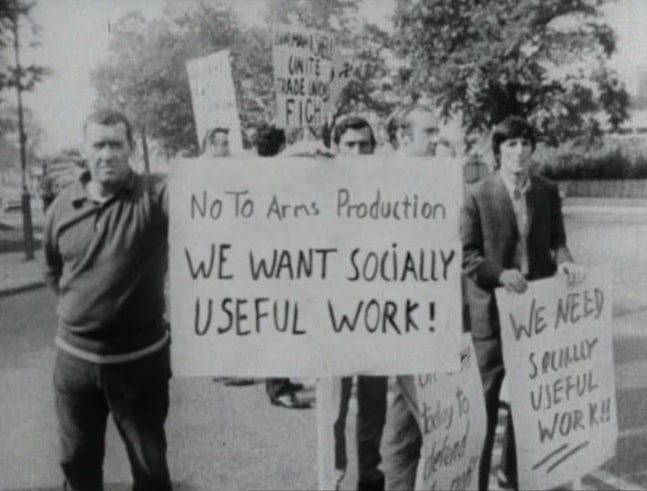
Lucas Aerospace workers call for the production of socially useful work. Photograph from LX Filmes. Source: The Guardian
Grace Blakeley writes,
The ideas workers proposed were divided into five categories: “medical equipment, transport vehicles, improved braking systems, energy conservation [and] oceanics”. Some examples included expanding production of kidney dialysis machines, constructing wind turbines, researching solar cell technology, and developing a hybrid power for cars. These were extraordinarily radical and farsighted ideas at a time when human-induced climate change was only first being discussed. Notably, none of the ideas was related to military technology, which had thus far been a major part of the work done at Lucas: the workers were turning their backs on the production of destruction.
Describing the Lucas Plan, Laura Flanders writes:
The workers who built Britain’s warplanes in 1976 had a problem. Their factory was about to close. Instead of conceding to a “downsizing,” they did something radical: they drew up a plan. Not a grievance or a strike notice, a plan; 150 products their hands and minds could make instead of fighter jets: solar panels, kidney dialysis machines, vehicles for people with disabilities, electric buses. “Socially useful work,” they called it. It became known as the Lucas Plan.
Nobody in power listened — with one significant exception. Tony Benn, then Energy Secretary in the Labour government, didn’t just listen. He was the one who issued the challenge: if closure is coming, what’s your alternative? He gave the workers the prompt that produced the plan and then watched as the Treasury, the corporate interests threaded through a nominally Labour cabinet, and the institutional gravity of government itself, overrode him. The plan was shelved. Many of the workers were eventually let go. Benn spent the rest of his long political life (one of the longest-serving figures in British history), radicalized in part by exactly that experience: being in the room, having power on paper, and losing anyway.
And yet, fifty years later, people are still talking about the Lucas Plan. They’re still teaching it, still asking: what if?
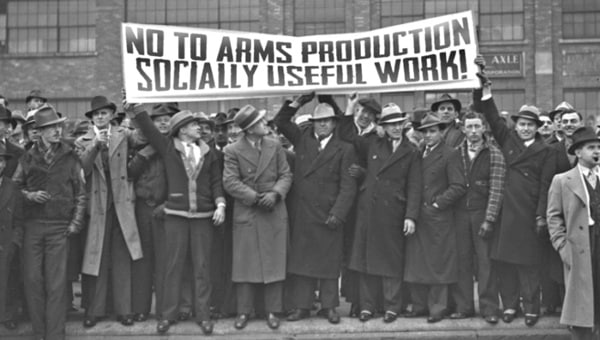
Source: Socialist Project, The Bullet
Additional Resources
Lessons From the Lucas Plan: How Workers Can Fight Climate Change and Militarism by Sammy Albright (Socialist Alternative)
The Lucas Plan: What Can it Tell Us About Democratising Technology Today? by Adrian Smith (The Guardian)
The Lucas Plan – An Idea Whose Time has Come? by Dave King (Science for the People)
Lucas Plan, four different essays at Libcom
The Lucas Plan at 50: A Radical Investment in Society, Not the War Machine by Laura Flanders & Friends. Watch the documentary below.
The Story of the Lucas Aerospace Shop Stewards Alternative Corporate Plan, an Open University documentary. Watch the documentary below.
Lucas Aerospace Workers’ Plan to Diversify Into Socially Useful Products 1970s: A Documentary by Paul Lashmar. Watch the documentary below.





Twitter
Google plus
LinkedIn