
How would you spend $1 million in your neighborhood? What would be your priorities?
Students can be invited to imagine how their city’s money should be spent, and to realize that city budgets are not neutral documents.
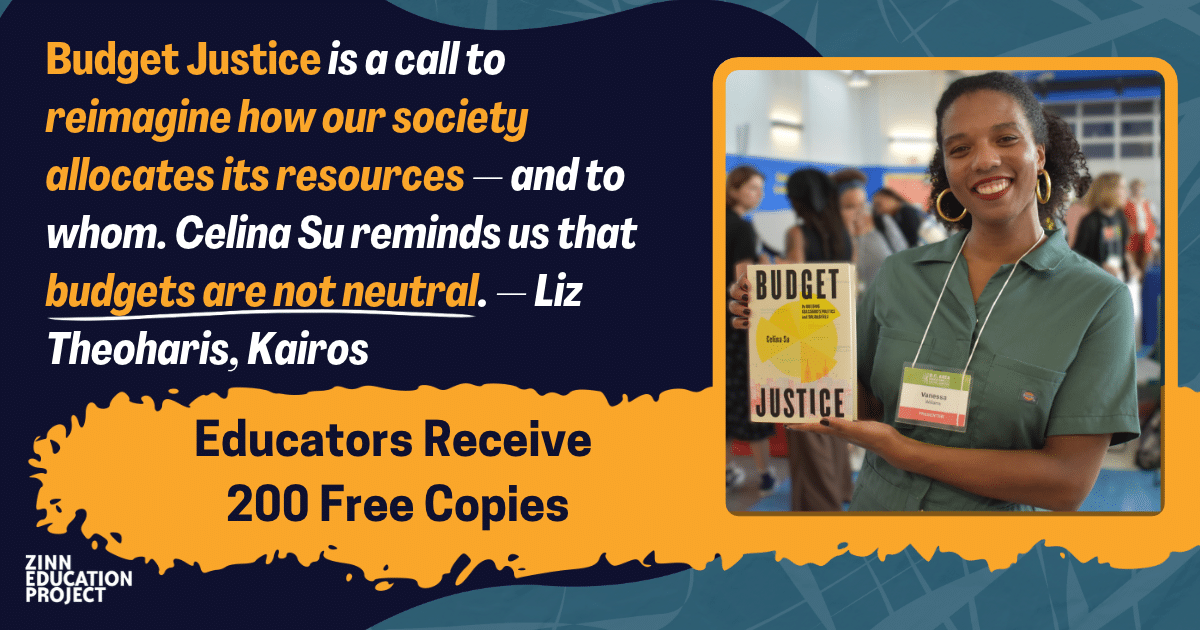
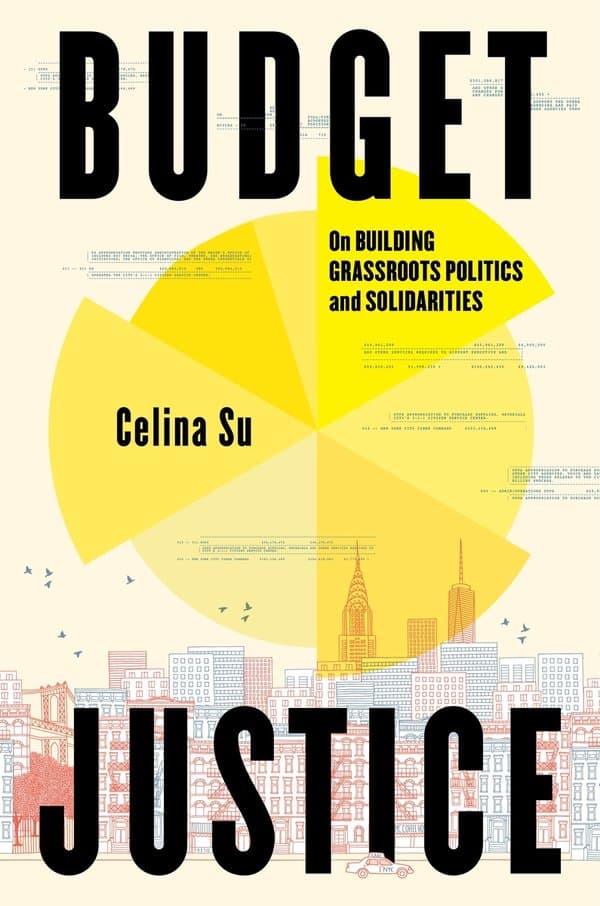
To help students explore that topic, teachers requested copies of the new book Budget Justice: On Building Grassroots Politics and Solidarities by Celina Su.
The Marguerite Casey Foundation donated copies of the book to organizations designated by Su, who selected the Zinn Education Project and The Debt Collective. Su recognizes the importance of young people being informed about — and, in return, engaging or even reshaping — the public policies that govern their lives, and working together for a future in which they can truly thrive.
Budget Justice is an informative text for civics, economics, U.S. government, and history classes. As the publisher notes,
Amid political repression and a deepening affordability crisis, Budget Justice: On Building Grassroots Politics and Solidarities challenges everything you thought you knew about “dull” and daunting government budgets. It shows how the latter confuse and mislead the public by design, not accident. Arguing that they are moral documents that demand grassroots participation to truly work for everyone, the book reveals how everyday citizens can shape policy to tackle everything from rising housing and food costs to unabated police violence, underfunded schools, and climate change-driven floods and wildfires.
Drawing on her years of engagement with democratic governance in New York City and around the globe, Celina Su proposes a new kind of democracy — in which city residents make collective decisions about public needs through processes like participatory budgeting, and in which they work across racial divides and segregated spaces as neighbors rather than as consumers or members of voting blocs. Su presents a series of “interludes” that vividly illustrate how budget justice plays out on the ground, including in-depth interviews with activists from Porto Alegre, Brazil, Barcelona, Spain, and Jackson, Mississippi, and shares her own personal reflections on how changing social identities inform one’s activism.
Here are some of the reasons teachers gave for requesting the book.
I will be teaching economics in a rural school that is 95% white students. One of my goals for the course is to deepen my students’ understanding of the long term impacts of economic decisions in the US. I also intend to help them see the ways in which they can foster economic equality. I am also teaching a section of sociology and I think this will work well with our inequality discussions. — high school social studies teacher, Penn Yan, New York
I could use Budget Justice to help students connect government budgets to the realities of our rural, low-income community. Students could examine how our local government spends money and identify issues that directly affect their families and neighbors, such as road maintenance, public transportation, housing, food access, schools, healthcare, or job opportunities. Because many students may feel that government decisions are far removed from their daily lives, I would have them imagine how they would divide a limited community budget and explain which needs they would prioritize and why. This could lead to discussions about fairness, civic participation, and how ordinary people can have a voice in decisions that affect their community. The lesson would also give students an opportunity to recognize the strengths and challenges of their rural community and think creatively about how they could contribute to making it a better place. — high school social studies teacher, Elizabethton, Tennessee
I work with students advocacy groups who are often learning lessons of city budgets the hard way. I would be interest in learning about ways to support students as they are dreaming big ideas that need budget support to implement. DC has a new administration coming in to office and I think there is some real power for influencing the budget. Now seems like a great time to be thinking about this with young people. — high school program coordinator, Washington, DC
Having access to students outside of the classroom in spaces like the Black Student Union, the Model Gary Student Convention, and a Saturday Freedom School offer opportunities for honest, solution-minded budget learning and discussions. Getting students to see themselves as part of the solution is a primary goal. Many of my students today have ideas and critiques of the current system, but they often lack the internal confidence to see their ideas as worthy content in the public domain. This book will encourage teachers and enable students to take more agency in their lives. — high school social studies teacher, East Orange, New Jersey
Working with many teachers across multiple schools in Orleans Parish and serving as Vice President of Community Engagement at our local Teacher’s Union (United Teachers of New Orleans)- I think this book could be a really important tool for teachers and educators. Budgeting and mondy can be a source of shame for adults which often leads to neglecting it or making decisions that could be harmful in the long run. In learning to teach our young people about justice in budgeting and how systems are often set up to fail us- I think it could be healing for adults to learn about themselves in this system as well. — teacher educator. New Orleans, Louisiana
I would invite students to imagine that they have a voice in deciding how their city spends its money and ask them to consider which services, programs, and community needs they would prioritize. This provides an opportunity to help students understand that a city budget is more than a collection of numbers — it reflects choices about who and what receives public resources. Students could examine competing priorities such as schools, parks, public safety, transportation, housing, and social services and consider who benefits from those decisions and who may be left out. Exploring budgeting in this way can help students see the connection between public finance, equity, and civic participation while encouraging them to think critically about how government decisions shape their own communities. — high school media specialist, Kent, Ohio
I would love a copy of this book to use to support our students’ participation in the NYC Civics for All Participatory Budgeting project this year. Students will receive a sum of money and need to work democratically to decide how to spend the money for the benefit of our school community. This book would be a wonderful resource to enhance student learning. — middle school social studies teacher, The Bronx, New York
I am interested in receiving a copy of Budget Justice by Celina Su because it would help me teach my 6th-8th grade social studies students that government budgets are not just about numbers — they reflect what communities value and who has power in decision-making. My students are at an age where they are starting to ask important questions about fairness and how government affects their lives, but traditional civics curriculum often makes budgets seem boring or too complicated for them to understand. This book would give me concrete tools to show students how budgets impact their own neighborhoods and how ordinary people can participate in budget decisions through participatory budgeting processes. I could use real examples from the text to help students analyze where money goes in our city and state, compare those choices to what they see as community needs, and understand why some voices are heard more than others when budget priorities are set. — middle school social studies teacher, Albuquerque, New Mexico
Su has prepared a discussion guide which offers an overview of the contents and topics for the classroom.

Twitter
Google plus
LinkedIn