

Nearly 5,000 Black Americans were lynched between 1890 and 1960. Over forty years later, Sherrilyn Ifill’s On the Courthouse Lawn examines the numerous ways that this racial trauma still resounds across the United States. While the lynchings and their immediate aftermath were devastating, the little-known contemporary consequences, such as the marginalization of political and economic development for Black Americans, are equally pernicious.
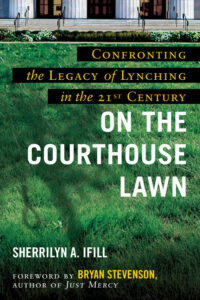 On the Courthouse Lawn investigates how the lynchings implicated average white citizens, some of whom actively participated in the violence while many others witnessed the lynchings but did nothing to stop them. Ifill observes that this history of complicity has become embedded in the social and cultural fabric of local communities, who either supported, condoned, or ignored the violence. She traces the lingering effects of two lynchings in Maryland to illustrate how ubiquitous this history is and issues a clarion call for American communities with histories of racial violence to be proactive in facing this legacy today.
Inspired by South Africa’s Truth and Reconciliation Commission, as well as by techniques of restorative justice, Ifill provides concrete ideas to help communities heal, including placing gravestones on the unmarked burial sites of lynching victims, issuing public apologies, establishing mandatory school programs on the local history of lynching, financially compensating those whose family homes or businesses were destroyed in the aftermath of lynching, and creating commemorative public spaces. Because the contemporary effects of racial violence are experienced most intensely in local communities, Ifill argues that reconciliation and reparation efforts must also be locally based in order to bring both Black and white Americans together in an efficacious dialogue. [Adapted from publishers’ description.]
ISBN: 9780807023044 | Beacon Press
Praise
As has been powerfully detailed in Sherrilyn A. Ifill’s extraordinary work on lynching, there is an urgent need to challenge the absence of recognition in the public space on the subject of lynching. — Equal Justice Initiative
A sobering and eye-opening book on one of America’s darkest secrets. A must read for anyone willing to examine our history carefully and learn from it. — Professor Charles J. Ogletree, Jr., executive director of the Charles Hamilton Houston Institute for Race and Justice
A thoroughly researched, unflinching account of the ugly history of the Eastern Shore’s early-twentieth-century lynchings. — Petula Caesar, Baltimore City Paper
Elegantly written and persuasively argued . . . Ifill explores the possibilities and offers concrete advice on how truth and reconciliation could be widely employed in the United States. — Mary Frances Berry, Geraldine R. Segal Professor of American Social Thought and professor of history, University of Pennsylvania
This pathbreaking book by Sherrilyn Ifill shows how the ugliest messages from our racial history and politics can hide openly in the public square. Her unflinching memory restores hope for the common good. — Taylor Branch, Pulitzer Prize-winning author of Parting the Waters






Twitter
Google plus
LinkedIn