
By Cierra Kaler-Jones
This lesson is part of a suite of activities developed to accompany How the Word Is Passed by a Zinn Education Project curriculum collective.
 Schools have historically been sites of forgetting, where whitewashed, sanitized versions of history that privilege the dominant narrative are uplifted, and rich legacies of resistance and collective struggle are erased. For example, the young people I learn alongside and I learned together about Tulsa’s Greenwood District, known as Black Wall Street. We were frustrated that we never learned about the bustling, prosperous area of economic growth and culture, only about how a mob of white supremacists perpetrated devastation and violence against the community.
As one of the young people, Mackenzie, said, “I feel like it was erased from textbooks because it was something good Black people did. Textbooks should explain that Black history is full of success.” The narrative was focused on the community’s demise at the hands of white rage, without also telling the stories of Black community members and their creativity, imagination, and ingenuity.
By encouraging young people to not only be curious about the histories that live within their own lineage, but to also bring that knowledge to the classroom, we can create space for remembering. The act of remembering taps into what students know from their communities, elders, and ancestors. It reminds us of what we know from what has been passed down to us, despite how school policies and curricula may suppress the enactment of that knowledge.
History is not only around us, but within us. It is not something that takes place just in textbooks or “out there,” but rather something we make each day. History is etched into the fabric of our loved ones’ beings, and we can breathe life into the stories that make up the essence of who we are individually and collectively by exploring our stories, communicating them, and passing them on.
Classroom Stories
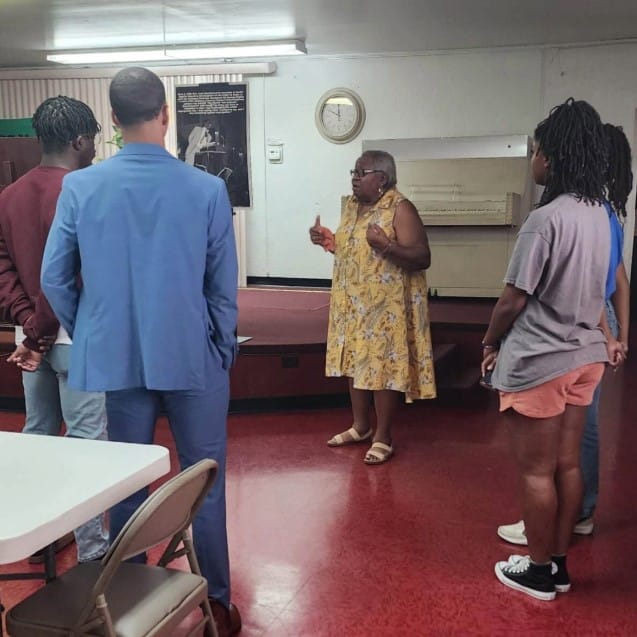
The Alabama African American Civil Rights Heritage Sites Consortium (AAACRHSC) recently revamped its Gateway Youth Program. The program is designed for 10–12th graders in Birmingham, Montgomery, Selma, and the Black Belt to spend six weeks at either one of our historic sites learning a public history skill or six weeks working directly with me to develop a travelling exhibition series. Those students also had homework each week to help support their exhibit research. Each cohort is to use primary source material, including oral histories, to build their narrative, and we visit sites to learn about interpretation and memory.
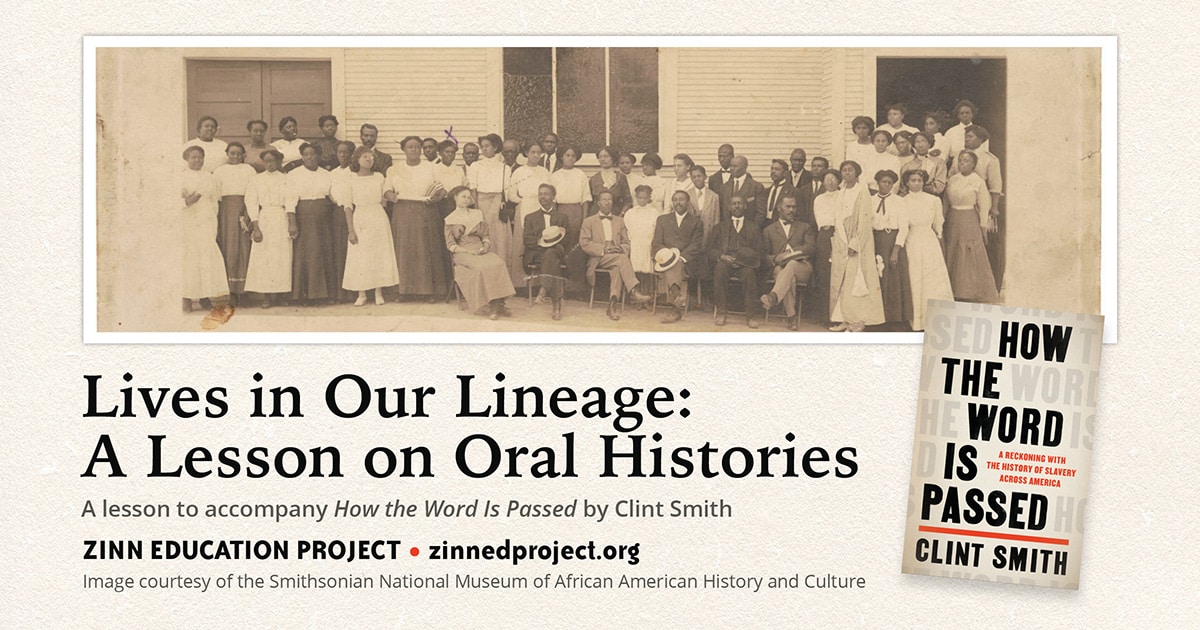
The curriculum includes the use of our own archive of over 100 oral histories with civil rights foot soldiers, and we are able to emphasize the power of these and others and genealogy as a truth telling and community action tool. Lives in Our Lineage: A Lesson on Oral Histories, based on the book How The Word Is Passed, help guide students on the use, how history can misuse first-person accounts, and how important they are in our historic and interpretive spaces.
This summer, as my daughter prepares to enter 8th grade and take on a heavy load of high school-level courses, I’ve been encouraging her to explore on her own and nurture her curiosity for the unknown. We’ve had many conversations about how our families often don’t talk much about the past and how that silence can leave generations with unanswered questions. To help her begin filling in some of those gaps, I downloaded the lesson Lives in Our Lineage: A Lesson on Oral Histories.
What has come from it has been beautiful. My eldest daughter has been spending time sitting with her elders and listening — not because she has to complete an assignment, but because she genuinely wants to know more. Aware that some of her elders are not comfortable being recorded, she simply listens. I told her that the stories I remember most are the ones my elders shared directly with me, the stories that felt like gifts entrusted to a single listener.
My great-uncle once told me, “You don’t need a driver’s license to drive; you just need it when you get caught,” after I failed my driver’s test more times than I care to admit. She loves that story and laughs every time I tell it. Now she has a growing collection of stories of her own. Her curiosity is being fed, her family connections are deepening, and she is learning patience, empathy, and the importance of honoring the voices and experiences of those who came before her. The lesson has become so much more than a lesson.
Twitter
Google plus
LinkedIn