

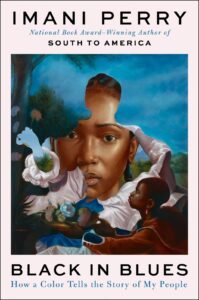
 Throughout history, the concept of Blackness has been remarkably intertwined with another color: blue. In daily life, it is evoked in countless ways. Blue skies and blue water offer hope for that which lies beyond the current conditions. But blue is also the color of deep melancholy and heartache, echoing Louis Armstrong’s question, “What did I do to be so Black and blue?” In this book, Imani Perry uses the world’s favorite color as a springboard for a riveting emotional, cultural, and spiritual journey — an examination of race and Blackness that transcends politics or ideology.
Perry traces both blue and Blackness from their earliest roots to their many embodiments of contemporary culture, drawing deeply from her own life as well as art and history: The dyed indigo cloths of West Africa that were traded for human life in the 16th century. The mixture of awe and aversion in the old-fashioned characterization of dark-skinned people as “Blue Black.” The fundamentally American art form of blues music, sitting at the crossroads of pain and pleasure. The blue flowers Perry plants to honor a loved one gone too soon. [Adapted from publishers’ description.]
ISBN: 9780062977397 | Ecco
Praise
Touching on a range of historical, artistic, musical, and literary references — from the color’s significance in Yoruba cosmology to the blue candles used in hoodoo rituals to the ‘tremor’ of the “blue note’ — Perry illuminates how the color has been variously associated with mourning, spiritual strength, and forces of freedom and oppression. — New Yorker
ast, multifaceted and enchanting. . . . Black in Blues also gave me a renewed sense of direction, a clarity of purpose. Here it is: Hold fast to beauty. It has everything you need. It has everything we need. — Minnesota Star Tribune
Black in Blues is a stunningly original journey in search of the historical origins of the very soul of African American life and culture. Along the way, Perry shows, with telling detail and in engaging prose, how ‘The Blues’ became Black, and how Black people became ‘Blues People.’ — Henry Louis Gates, Jr.







Twitter
Google plus
LinkedIn