
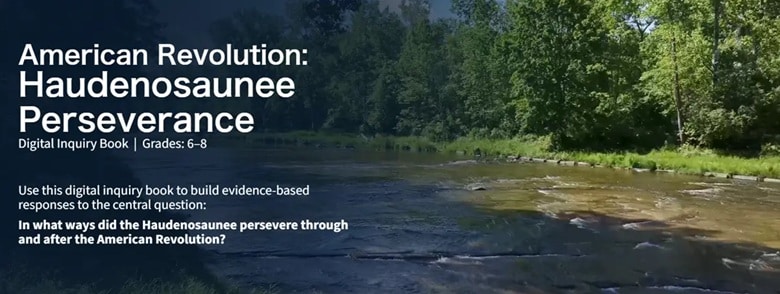
Created as part of the National Museum of the American Indian’s Native Knowledge 360° initiative, American Revolution: Haudenosaunee Perseverance helps students build evidence-based responses to the central question: In what ways did the Haudenosaunee persevere through and after the American Revolution?
This digital collection includes five chapters and a summative assessment, including instructions, printable materials, videos, collages, and more.
Classroom Story
I used the American Revolution: Haudenosaunee Perseverance digital collection as a structured, interactive unit that guided students through the historical experiences of the Haudenosaunee in a clear, chronological way. Each chapter functioned like a mini-investigation, where students engaged with video interviews, maps, and primary and secondary source documents to build their understanding.
For example, during the “Haudenosaunee Lifeways” chapter, students analyzed images and read excerpts describing daily life, then compared those practices to modern communities to make connections about governance, family structure, and environmental stewardship. I paused frequently for discussion and used guiding questions to push students to think critically, such as asking how geography influenced Haudenosaunee culture or how their political system compares to the United States today.
As the unit progressed into more complex topics like conflict and invasion, I had students work in small groups to analyze documents and develop claims supported by evidence. For instance, in the “War Comes to the Haudenosaunee” and “Invasion” chapters, students examined different perspectives from historical accounts and created short arguments about the causes and impacts of conflict. We also incorporated real-world connections by discussing how Indigenous groups today continue to advocate for sovereignty and land rights. The unit culminated in an evidence-based argumentative essay where students used multiple sources from the chapters to support their claims, mirroring the type of critical thinking and writing skills they will need in real-world contexts like civic discussions, legal arguments, and evaluating media.
Twitter
Google plus
LinkedIn