

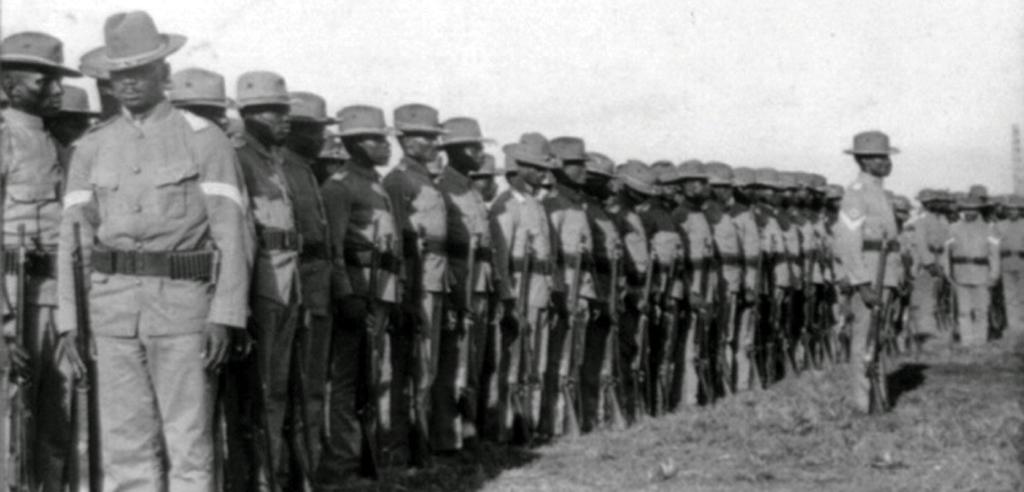
Following U.S. imperialist wars in Cuba and the Philippines at the turn of the century, Black soldiers returned home to bases where they were met with Jim Crow discrimination and racist violence. This was the case for the first battalion of the Twenty-Fifth Infantry, a segregated unit that was sent to Fort Brown in Brownsville, Texas in late July 1906.
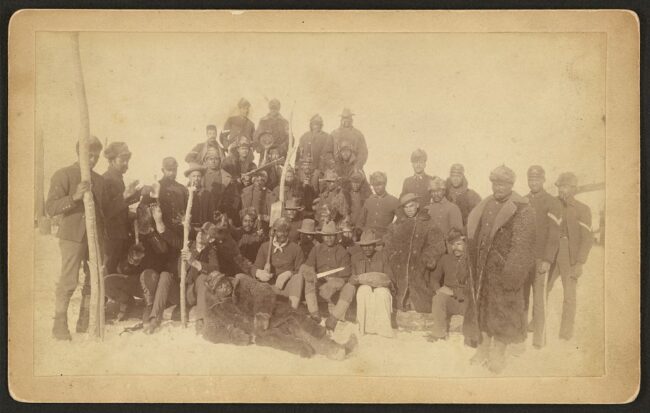
Soldiers of the Twenty-Fifth Infantry at Fort Keogh, Montana, in 1890. Source: Public domain
Richard Wormser writes,
Confrontations between white citizens and the soldiers started immediately after they arrived. Local merchants refused to sell the soldiers food or items. One citizen severely beat one of the soldiers after blaming him for allegedly brushing up against a townswoman on the sidewalk. A customs officer accused another of being drunk, and pushed him into the river while he was trying to get back across the bridge from a rest day in Mexico. The soldier could not swim and nearly drowned before others reluctantly fished him from the water.
Events escalated quickly on August 12, when a white woman was reportedly raped, and the following evening, August 13, when a white bartender was shot and killed and a white police officer was wounded. Despite clear evidence of a frame-up, without a trial or an opportunity to confront their accusers, 167 Black infantrymen were discharged without honor by President Theodore Roosevelt because of their alleged conspiracy of silence.

“Remember Brownsville” broadside. 1906. Source: Public domain
Roosevelt’s Special Order discharging the soldiers was met with public outcry, yet despite pleas from prominent African Americans and congressional investigations into the Brownsville Affair in the following years, Roosevelt’s orders stood.
The publication of John D. Weaver’s The Brownsville Raid in 1970, combined with renewed public pressure, led to a new U.S. Army investigation that, in 1972, reversed the order of 1906, thus expunging the records of the 167 soldiers. However, as Julia Bricklin points out,
[. . .] the DOD [Department of Defense] made it clear that there would be no financial compensation available to these men or their families.
Additional Resources
The Brownsville Raid by John D. Weaver
The Brownsville Redemption: Theodore Roosevelt’s Wrongful Disgrace of the All-Black 25th Infantry in Brownsville, Texas, 1906 by William Baker
The Brownsville Raid of 1906: A Historical Overview by Garna Christian (Texas State Historical Association)
Black Americans In the U.S. Military From The American Revolution to the Korean War: The Brownsville Incident and Teddy Roosevelt by David Omahen (New York State Military Museum and Veterans Research Center)



Twitter
Google plus
LinkedIn