


Angelo Herndon, 1932. Source: Public domain
D.D. Guttenplan and Randall Kennedy write for The Nation,
Angelo Herndon was a Black coal miner turned Communist activist who was repeatedly “arrested, convicted of vagrancy, and incarcerated” for his efforts to educate and mobilize workers. In 1932, he helped organize an interracial protest against a county decision to cut off relief for the poor. But it wasn’t simply the protest that led to his chain-gang sentence — it was Herndon’s possession and distribution of Communist literature, which authorities used to charge him with inciting insurrection.
After five years of imprisonment and escalating legal battles, on April 26, 1937, in the case of Herndon v. Lowry, the U.S. Supreme Court determined in Herndon’s favor, releasing him from prison and finding the Georgia law used to convict him as unconstitutional.
Dr. Timothy C. Shiell notes that Herndon v. Lowry was “the first decision to unite the pursuit of African American civil liberty and civil rights, thereby creating a platform later Civil Rights Movement cases involving freedom of association, protest marches, sit-ins, and more could build on.”
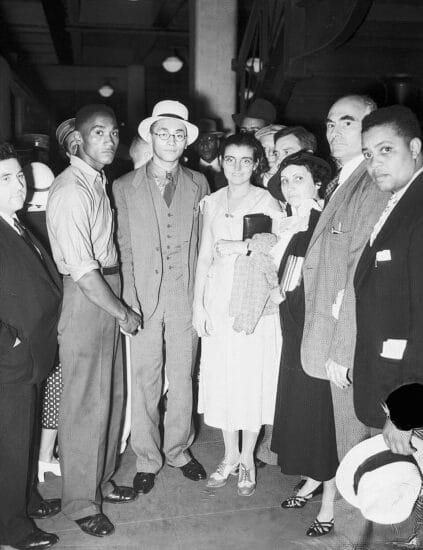
A group of Communists and sympathizers welcome Angelo Herndon to New York City after his release on bail from the Georgia State Prison. The group includes Scottsboro Case witness Ruby Bates and Communist leader Robert Minor. | Location: Penn Stations, New York City, New York, USA. Source: Public domain
Additional Resources
 You Can’t Kill a Man Because of the Books He Reads: Angelo Herndon’s Fight for Free Speech by Brad Snyder (W. W. Norton & Company) (read an interview with the author at Georgetown Law)
Let Me Live: The Angelo Herndon Case and the Radical Politics of Free Speech by Randall Kennedy (The Nation)
The Story of One of the Most Important Free Speech Cases of All Time by D.D. Guttenplan and Randall Kennedy (The Nation Podcast)
Herndon v. Lowry (1937) by John R. Vile (Free Speech Center at Middle Tennessee State University)
Never Forget Herndon v. Lowry (1937) by Timothy Shiell (Journalism History)




Twitter
Google plus
LinkedIn