
The Constitution is the highest law of the land. Most social studies and civics curricula elevate it further still — to an almost holy status, above serious analysis and critique. But young people deserve a critical and nuanced exploration of this rule book that touches all of our lives. They deserve to probe fundamental questions like: What rights are included or left out of the Constitution? Who wrote this document, and who did they write it for? Does the U.S. constitutional system support a multiracial, democratic society?
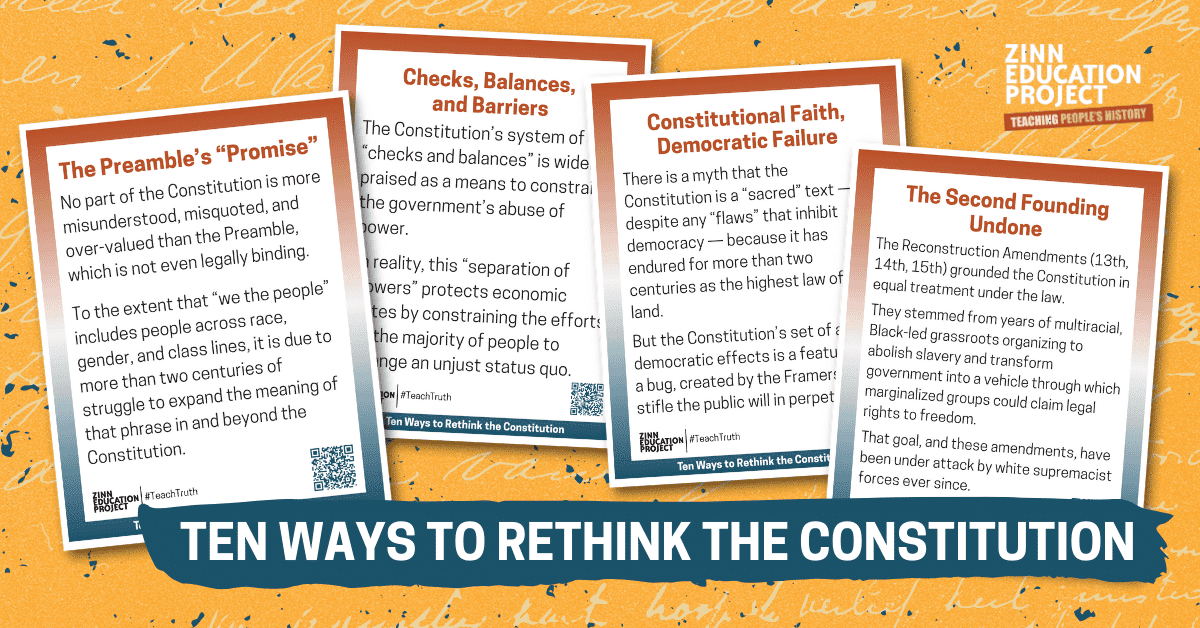
To assist with efforts to teach truthfully — and invite inquiry — about the Constitution, we offer 10 ways to rethink this founding document. The list below can be used for discussion, and to critique whitewashed narratives peppered across curricula and public life. (The points are available as a gallery walk.)
1.) One Vote, Unequal Value: The Constitution’s system for representation and voting is organized around states — not people. This system overrepresents parts of the country with disproportionally white residents, and disempowers the country’s multiracial, largely urban majority.
For example:
-
-
- In the Senate, each state has equal representation — two senators — regardless of population size. Compare California and Wyoming. Because each state gets two senators, a resident of Wyoming has more than 65 times greater representation in the Senate than does a resident of California.
- The Electoral College — not the popular vote — elects the president. In this system, the number of electoral votes each state casts to determine the president is equal to that state’s number of senators and House representatives. The Founders created the Electoral College system to prevent democracy — and, specifically, to cater to enslavers in the South. It allowed wealthy white men to count disenfranchised groups in their population tallies in order to drum up more representatives for themselves in the Electoral College, and then vote against the interests of those disenfranchised groups. Consider the three-fifths clause that “counted” each enslaved person as three-fifths of a person in tallies for congressional representation.
- This system where some people are tallied for “representative” population but barred from voting continues today with discriminatory strategies for voter suppression, like cuts to early voting, obstacles to registration, arbitrary voter ID laws, and disenfranchisement of incarcerated people.
-
2.) Rights for Property, Not People: The range of formal rights listed in the Constitution is minimal. Most of the “rights” in the Constitution are “negative liberties” that constrain what the government is allowed to do to people — with a special focus on protecting property.
-
- “Property” in the Constitution has included everything from land, to people held in bondage, to the national economy. The Framers inserted numerous rules to protect all forms of “property” held by economic elites against democratic control.
- In contrast, some constitutions list “positive liberties” that give people legal power to act in ways that protect their freedoms. Positive liberties are, for example, labor protections or even the right to dignified work, environmental protections, women’s rights, and rights to housing, health care, and education.
- For examples of positive liberties in other countries’ constitutions, see Chile’s Chapter III: Constitutional Rights and Duties or South Africa’s Chapter 2: Bill of Rights. For examples in the United States, look at state constitutions like the 1868 constitutions forged in the aftermath of the Civil War.
3.) Built to Block Change: It is very difficult, by design, to formally change the Constitution. Many people try to make valuable, popular reforms to the Constitution, but are blocked by the constitutional system they seek to improve.
-
- To amend the Constitution requires support from two-thirds of both houses of Congress and then three-fourths of the states. Law professor Aziz Rana calls this “the hardest constitution in the world to amend.”
- Rana explains that the “extreme obstacles to any mass constitutional amendment process effectively funnel constitutional politics back into the Supreme Court and the federal bench — further emphasizing the importance of who controls the judiciary.” Consequently, many small, popular, worthy reforms — creating short judicial term limits and larger constitutional courts, abolishing the Electoral College, fighting gerrymandering and partisan election interference — are largely blocked by the constitutional system they seek to improve.
4.) A Constitution for the One Percent: The Constitution was written in secret by 55 wealthy white men to serve a tiny minority — men like themselves — and clamp down on the rights of everyone else. They replaced the Articles of Confederation with the Constitution in 1787 to quell the power of Black, Native, and working-class white people agitating for justice.
-
- Political science scholar Robert Ovetz describes the Framers as a small group of wealthy white men who sought to suppress:
- “Unified Native American armed resistance to violent settler encroachments on their lands west of the Appalachians and in Georgia, Virginia, and Pennsylvania.”
- “Slave uprisings that were becoming ever more frequent, especially after thousands went over to the Loyalist side during the Revolution.”
- “Small farmers, debtors, laborers, mechanics, and sailors who challenged their exclusion from the state governments and suffered under onerous tax and debt collection policies, and insisted they be changed.”
- An immediate catalyst for creating the 1787 Constitution was the Framers’ fear of another “Shays’ Rebellion,” at a larger scale. Scholar Daniel Bullen explains that the dominant story of Shays’ Rebellion was, and still is, “that we need a strong federal government to protect us from the threat that regular people might stand up for their rights — instead of the people’s story: that people need to band together to protect themselves when their government acts against their interests.”
- Unlike the Articles of Confederation, the Constitution allowed the Framers to raise a standing army to seize land and crush rebellions, strengthen the institution of slavery domestically and abroad, and generally consolidate power by designing a government that impedes democratic control.
- Political science scholar Robert Ovetz describes the Framers as a small group of wealthy white men who sought to suppress:
5.) The Preamble’s “Promise”: No part of the Constitution is more misunderstood, misquoted, and over-valued than the Preamble, which is not even legally binding. To the extent that “we the people” includes people across race, gender, and class lines, it is due to more than two centuries of struggle to expand the meaning of that phrase in and beyond the Constitution.
-
- It expressed what many people “would like the Constitution to be and do, even though in reality it does something very different,” explains Robert Ovetz. To the Framers, “we the people” that the Constitution was designed to serve were white, wealthy men like themselves.
- But because the Preamble was written in broad, lofty language — not in dry legal terms like the rest of the Constitution — it is easy to mistake it as a beacon of freedom for all, regardless of race, class, gender, or sexuality.
6.) From Revolution to Repression: The Constitution repealed the Declaration of Independence’s promises of equality and the right to revolution — and enshrined the license to oppress enslaved and Indigenous peoples.
-
- The Declaration of Independence emphasizes the word “equality” and argues that governments derive their powers from “the consent of the governed.” It also insists that “whenever any form of government becomes destructive to these ends, it is the right of the people to alter or to abolish it, and to institute new government.” These rights are nowhere to be found in the Constitution. Instead, the Constitution criminalizes the right of revolution as “treason.”
7.) Checks, Balances, and Barriers: The Constitution’s system of “checks and balances” is widely praised as a means to constrain the government’s abuse of power. In reality, this “separation of powers” protects economic elites by constraining the efforts of the majority of people to change an unjust status quo.
-
- “The conventional wisdom says that checks and balances forestall the abuse of power. But our particular system constrains the public far more than it constrains elites. By obstructing ambitious political changes, it enables those who benefit from the status quo to protect their powers and privileges. Instead of celebrating this structure, we should recognize that ordinary Americans have been trying to overcome it for two centuries. That, in turn, requires expanding our understanding of checks on power,” explains political science professor Lisa L. Miller. Read in full.
8.) Constitutional Faith, Democratic Failure: There is a myth that the Constitution is a “sacred” text — despite any “flaws” that inhibit democracy — because it has endured for more than two centuries as the highest law of the land. But the Constitution’s set of anti-democratic effects is a feature, not a bug, created by the Framers to stifle the public will in perpetuity.
-
- As Aziz Rana explains, “there is a sense that the document’s very longevity speaks to the need to hold firm to its text and structures. . . According to this sentiment, the document is our safety blanket. The fact that it has weathered incredible national storms — the Civil War, the Great Depression — means that we should be deeply hesitant to seek its basic overhaul. Without a shared acceptance of the text, whatever its flaws, perhaps even worse fates could befall us.”
- Even as some people criticize the anti-democratic aspects of the Constitution, Rana notes that many still “profess an abiding faith that the very same document and institutions will save Americans from authoritarian entrenchment.” But this Constitution worship ignores how its problems are not merely unintended consequences. Instead, “these effects can be seen, at least in part, as a product of the framers’ own hostility toward real democracy.” Their framework “systematically disadvantages those with the fewest resources, while allowing those with power to use a fragmented political system to quietly preserve their own interests.”
9.) The Second Founding Undone: The Reconstruction Amendments (13th, 14th, 15th) grounded the Constitution in equal treatment under the law. They stemmed from years of multiracial, Black-led grassroots organizing to abolish slavery and transform government into a vehicle through which marginalized groups could claim legal rights to freedom. That goal, and these amendments, have been under attack by white supremacist forces ever since.
-
- As the Zinn Education Project’s Teach Reconstruction report explains, these amendments “fundamentally transformed the nature of citizenship and the powers of the federal government itself. They outlawed slavery, established birthright citizenship, demanded equal protection of the laws and due process of law for all people, and banned racial discrimination in the right to vote. The amendments explicitly gave Congress the power to enforce these principles.
The Reconstruction era was, as historian Eric Foner put it, the nation’s second founding. . . . Yet, soon after their enactment, the Supreme Court interpreted the amendments extremely narrowly and Congress retreated from its commitment to using them to protect Black people and democracy itself from white supremacist terrorism.”
10.) Beyond the Framers’ Intention: It is worth defending an inclusive vision of the Constitution that evolves far past what the Framers intended. At the same time, it is crucial to explore more expansive ways to protect human rights and build multiracial democracy than what the Constitution offers.
-
- Law professor Madiba K. Dennie argues that “we can choose to interpret the Constitution so that it serves all of us — guided by the Reconstruction Amendments’ revolutionary purpose and their expansive conceptions of liberation and egalitarianism.” By contextualizing demands — to housing, to healthcare, to climate justice — as rights “in terms of the government’s foundational obligations to the people, [we] can appeal to broader audiences, open up new avenues for persuasion and mobilization, and bridge the divide between how elites conceptualize the law and how regular people experience the law.”
- Aziz Rana notes that there are big, essential questions around the Constitution that rarely make it into popular discussion: “Does the constitutional system as a whole provide an effective instrument for organizing a multiracial and genuinely democratic society? How else might Americans envision their basic institutions and rights — and how would we get from here to there? How can we encourage greater political openness to constitutional change?”
This content is available as a free downloadable gallery walk for classrooms and public events.
Credits
This framework was prepared by the Zinn Education Project team. The following scholars’ works helped inform, and are quoted, in the framework:
Daniel Bullen, on Shays’ Rebellion
Madiba K. Dennie, The Originalism Trap: How Extremists Stole the Constitution and How We the People Can Take It Back
Lisa L. Miller, “The Dead End of Checks and Balances”
Robert Ovetz, We The Elites: Why the U.S. Constitution Serves the Few (The first sentence in #5 includes a direct quote from Ovetz.)
Aziz Rana, The Dig podcast: “Settler Empire” and The Constitutional Bind





Thank you for your interest in the gallery walk. You can download the posters from this page: https://www.zinnedproject.org/materials/constitution-gallery-walk/
This is great! Where can I get the posters that are posted on the Ten Ways to Rethink the Constitution Gallery Walk?