
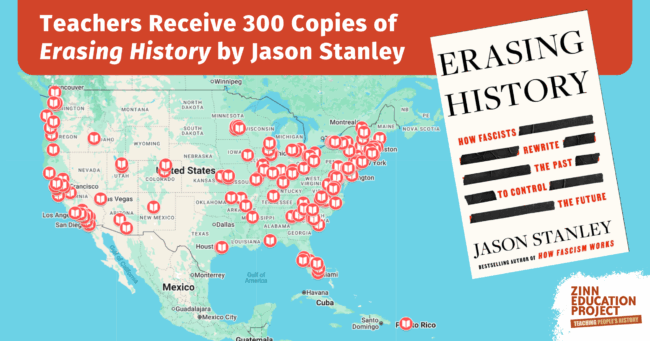
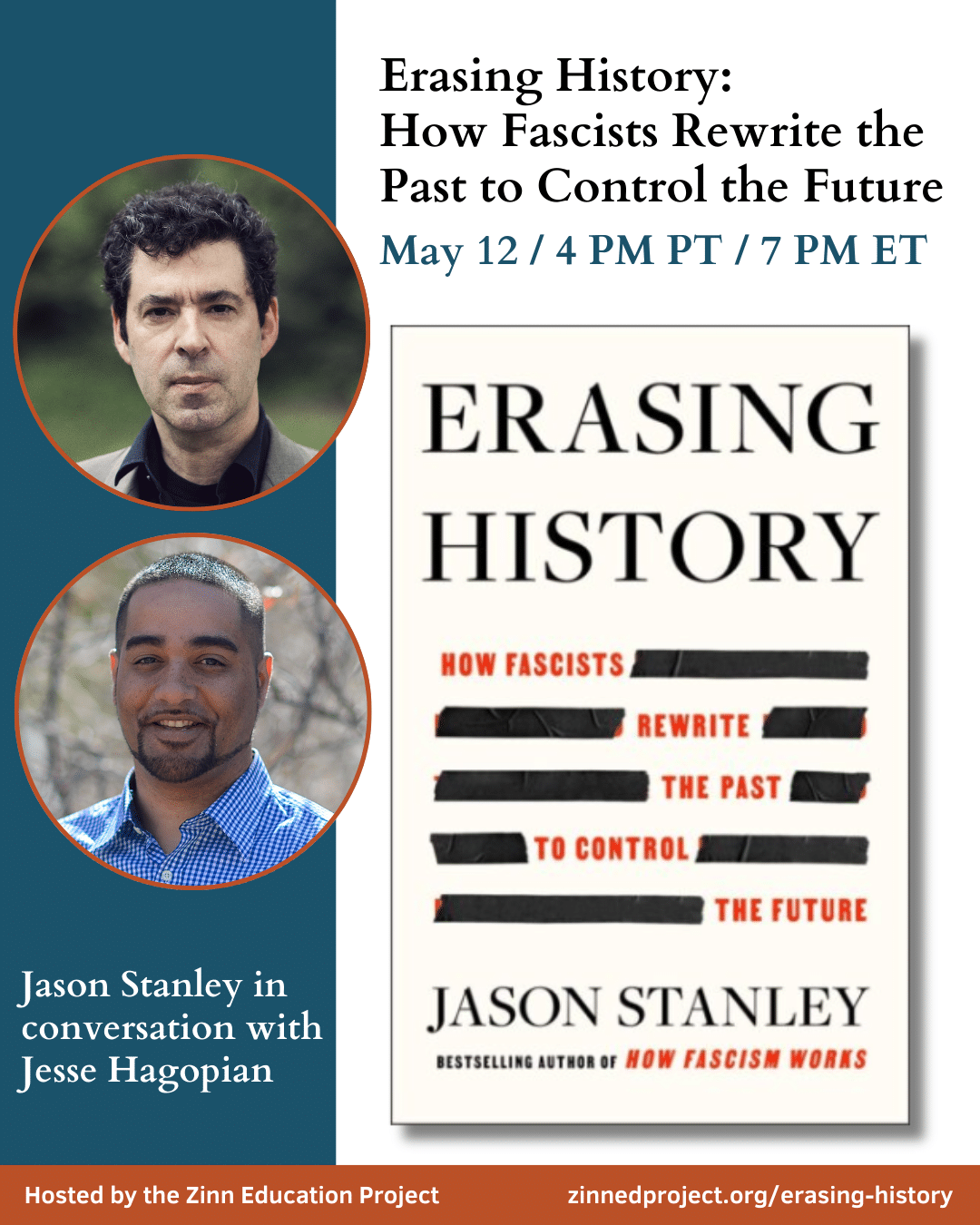
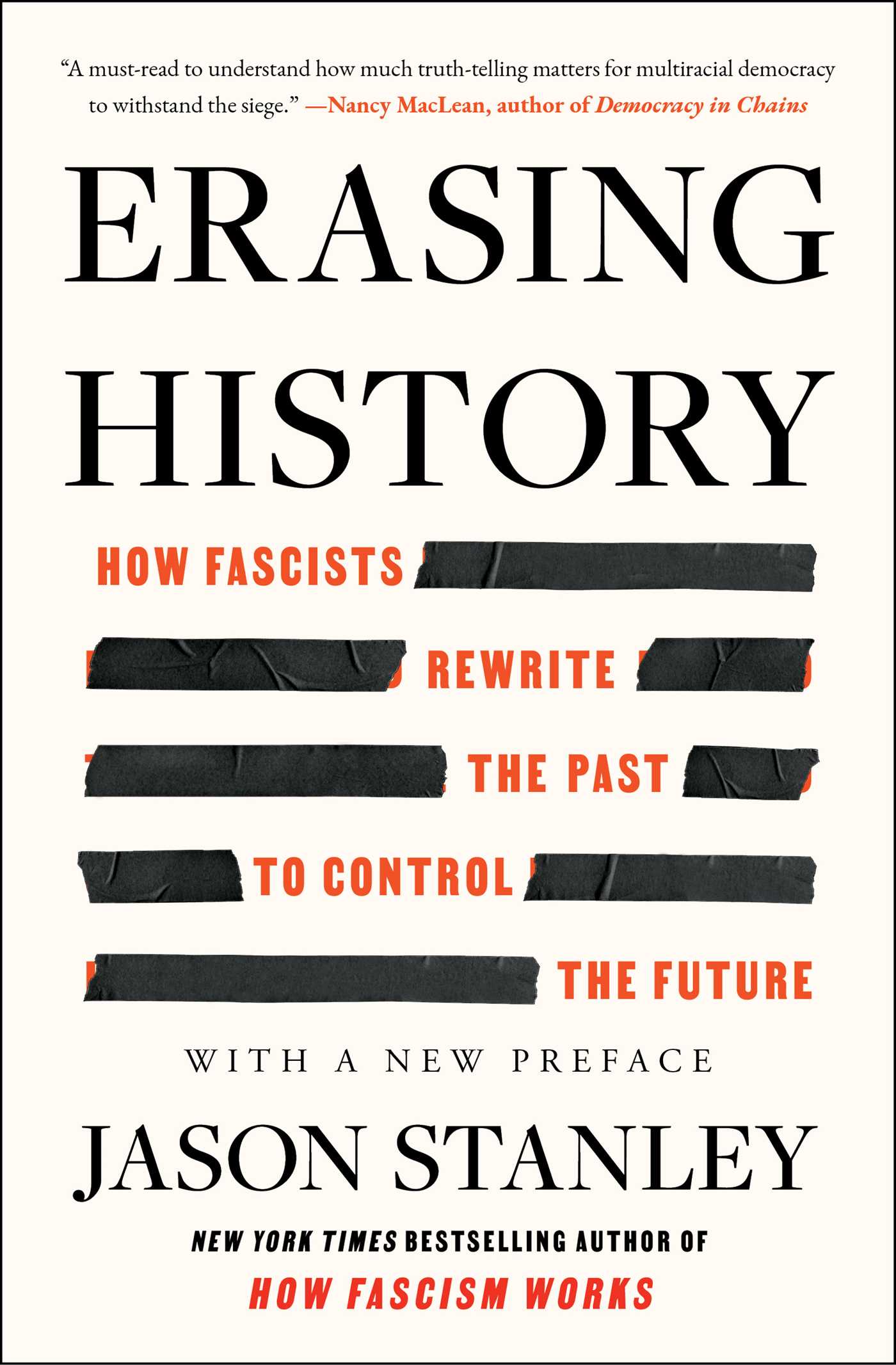
In preparation for the 5th annual Teach Truth Day of Action, Jason Stanley joined the Zinn Education Project’s Teach the Black Freedom Struggle online series to discuss his book Erasing History: How Fascists Rewrite the Past to Control the Future and the role of educators in the fight against fascism. In conjunction with the class, One Signal Publishers donated 300 copies of Stanley’s Erasing History for educators actively defending the right to teach truthfully.
These are teachers, who as Stanley writes,
[are] on the front lines of the war to defend progressive education, seeking to preserve the history of resistance against hierarchies of class, race, and gender against those who aim to erase it.
Teachers who received complimentary copies of the book shared their appreciation and teaching stories, including those below.
I knew that we were under a fascist regime, but this book really illuminated how strategic fascists are as they use propaganda, the erasure of history, and attacks on the LGBTQIA+ community and other already marginalized groups, in order to shore up power. This book has strengthened my resolve to continue to fight the Trump regime’s attacks on our schools, teachers, and students. — Michael Rebne, high school teacher, Roeland Park, Kansas
Erasing History is a readable and invaluable book for teachers who are concerned about the impact of the Trump administration on the future of education in this country and the survival of democracy in America. — from review in NJCSS Journal by Alan Singer, university professor, Glendale, New York
Erasing History was an amazing read. It provided a new depth to the lengths that administrations go in an attempt to limit the educational reach and how that yields to a snowball effect for everything from racism to sexism and misogyny to the economics of a nation. The book was very insightful. While I was reading it, I took it everywhere because I didn’t want to put it down. Because of that, I got a lot of questions about the book, which sparked some interesting conversations. — Shannan Day, high school teacher, Jackson, Mississippi
As an APUSH teacher, Erasing History is an excellent aid in helping students understand the concept of historiography. The book is incredibly relevant during discussions around slavery, the Civil War, and current events. I’m hoping to include excerpts in my lessons next year and possibly assign certain chapters as extra credit reading. — Jake Sikorski, high school teacher, Rochester, New York
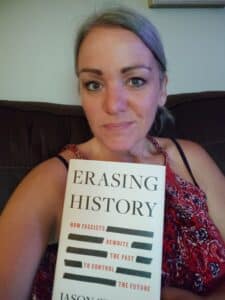
Heather Smith
Erasing History made me think about how my town’s local history is told, marked on our landscape, and what stories are forgotten or not marked.
I took the book everywhere as I was reading it, displayed it in my classroom, and showed it to friends who I thought would be intersted. I’ve used the book to point out the history being erased in our town and why we organized a teach truth walk for the Teach Truth day of action. — Heather Smith, elementary school teacher, Youngstown, Ohio
Awesome book! Erasing History prompted discussions about efforts to silence identity groups because of fear and the way people are perceived and treated due to hate. We learned how to resist efforts to dismiss us. — Andrea Wilson-Harvey, teacher, New Castle, Delaware
Erasing History is a book that makes accessible the long and global history of powerful people misshaping history to serve their ideological ends. In doing so, it makes plain the power that accurate histories have to embolden work today for a more just world. While unflinching, it supports its arguments with scholarly rigor. I look forward to using excerpts of the book with undergraduate students. — greg wickenkamp, teacher, Iowa City, Iowa
I will use excerpts and ideas from Erasing History with fellow researchers and educators in professional development. I am also including this in my professional development plans for in-service K–8 teachers. — Allison Ward-Seidel, curriculum specialist, Charlottesville, Virginia
Erasing History beautifully explains the tools of fascism. I plan to share a summary with my teacher book groups.— anonymous
Erasing History has been key in stimulating conversation in a teacher-led study group amongst teachers and administrators, and even amongst students pursuing education as their future career. — Zainab Jabak, high school teacher, Houston, Texas
Erasing History gave me a new perspective on how easily important stories can be lost or intentionally left out. It made me reflect on whose voices are represented in the materials I use. I plan to use short excerpts to spark discussion with my students about bias in history. This will also be a great resource to share with colleagues during curriculum planning. — anonymous, New Jersey
I remember during a town hall on October 23, 2024, when running for the presidency of the United States, Vice President Kamala Harris was asked if she thought that Donald Trump is a fascist. “Yes, I do,” she replied. Now, reading Erasing History, I can see all the behaviors and decisions that can give anyone reason to say the same.
In his clear, exemplary and analytical writing, Jason Stanley explains how we can all see the way fascism is showing up now in the United States and how democracy is really at risk in this current presidency. From the attacks on education, curriculum, and books; the removal of the narratives of marginalized people from institutions nationwide; etc., it becomes clear that these are the actions of fascism.
This book is a highly recommended must-read for anyone who cares about our democracy. I am eager to share this with our Teaching for Black Lives study group. — Ina Pannell-Saint Surin, retired teacher, Brooklyn, New York
Erasing History is an eye opener. The background history and its relationship to the present situation are profound and clear. The author explains and describes what has happened and what is going to happen if we, the people, let the fascists rule. I have not used it in my courses yet, but I have shared it in daily conversations with my colleagues and closest friends. Some have already ordered it. — Margarita Marichal, teacher educator, San Juan, Puerto Rico
Erasing History was fascinating to read. I teach English and have recently begun teaching humanities, incorporating history and English. I’m not a history buff, so reading this book gave me much needed context for the world we live in and the changes we are seeing at the political level. There were pages that I bookmarked so I can include specific passages in both my global studies and American studies classes this fall. It is important to me that students see the throughlines in history — that they learn cause and effect and how nothing happens in isolation. This book provides support for some of these throughlines. As my high schoolers are really becoming aware of the world and their place in it, it is important that they have this information. I want them to enter the world having more knowledge and ability to critically question the world than I had at their age. I don’t want them to be 40 years old and just learning this information like I am! — Kristen VanderRoe, high school teacher, Moseley, Virginia
This book gave me more effective ways to explain fascism and its effects in a way students will understand. I’ll use excerpts from it in future lessons where it’s applicable and hopefully students will be better able to describe and pinpoint fascism. I posted a story on my social media profiles that I was reading it. I will be adding it to my Goodreads yearly report and rate it as well. — Danielle Dewesee, high school teacher, Chicago, Illinois
Thought provoking. — Bethany Forrester, elementary school teacher, Colbert, Georgia
More well-rounded background knowledge for my teaching! — Kirsten Jensen, teacher educator, Bellingham, Washington
Jason Stanley’s expository writing style and plain language has made learning about authoritarianism very clear and understandable.
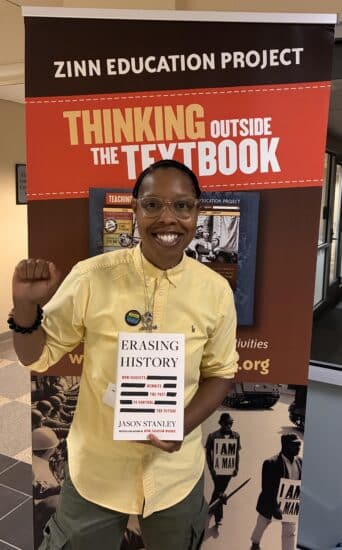
Jessica Rucker
I will be teaching an Introduction to American Studies course to first year college students this fall and the themes of facist education that Stanley described are directly aligned with themes of the discipline of American Studies. Specifically, notions of national greatness, national purity, national innocence, gender roles, and racial hierarchies. For now, I am using the text to help me understand how education/education systems have been used to establish a domineering political culture and around the world so that I can challenge my students to think critically about their daily lives and the daily lives of everyday ordinary people.
Stanley does a great job of making it clear how a culture of fear and intimidation are created to prevent truth-teaching and teaching a people’s history of the United States and of the world. Moreover, the book is helping me take seriously my role and committment as a Black teacher — Black not merely as a racial identity catergory, but as a political identity category. Like Dr. Jarvis Givens’ Fugitive Pedagogy, Erasing History reminds me that my choices both shape and make history, inside and outside the classroom. I am a political actor and what I choose and choose not to teach takes sides and so I choose not to erase history, but instead teach a people’s history (as Howard Zinn encourages us to do). — Jessica Rucker, college instructor and doctoral student, Washington, D.C.
Thank you for sending Erasing History. I purchased additional copies for graduating seniors and I brought the book to a National Abolition Hall of Fame and Museum cabinet meeting (in which I sit on) in Peterboro, New York. I intend to adjust some of the rhetoric that I use around this topic. I would like to call out the presence of fascism in other places besides Nazi Germany. — Jessica Harney, high school social studies educator, Camden, New York
View this post on Instagram
I loved that the book incorporated parts of Jason Stanley’s autobiography, mixing it with a slew of case studies. It’s the perfect book to own because you undoubtedly will want to go back to various moments of time and various regions that established authoritarian regimes in our current political moment.
I shared the Memorial case study in Russia with the Stone Mountain Action Coalition. SMAC wants to change a state-run park that protects the largest Confederate Monument in the world to be more inclusive and accurate in its depiction of the past. A group of locals and Sons of Confederate Veterans refer to us as “the silent Taliban.” The demonization, imprisonment, and eventual dissolution of the Memorial in some ways are incomparable to SMAC’s opposition. However, such rhetoric in the case of the Memorial actions show the lengths that supporters of authoritarian propaganda will take to ensure its longevity. — anonymous, Georgia
This is a fantastic book. Although much of it wasn’t new to me because I study the issues Stanley wrote about, I found his overall framing and examples wonderfully insightful and important. Undoubtedly, I’ll be citing Erasing History in my own writings. — anonymous, California
I plan to share excerpts of Erasing History with my students in College American Government. The text is timely and encourages good conversation. — anonymous, Kansas
I have only been able to read the first few chapters of Erasing History so far and I have had a great many moments where I had to pause and reflect on what this means for our education system. I have had many ideas and knowledge reinforced, but I have also been compelled to reexamine some of the materials that we are using in school. I think it would be wonderful to utilize this book for a study group with teachers. — anonymous, Kansas City, Missouri
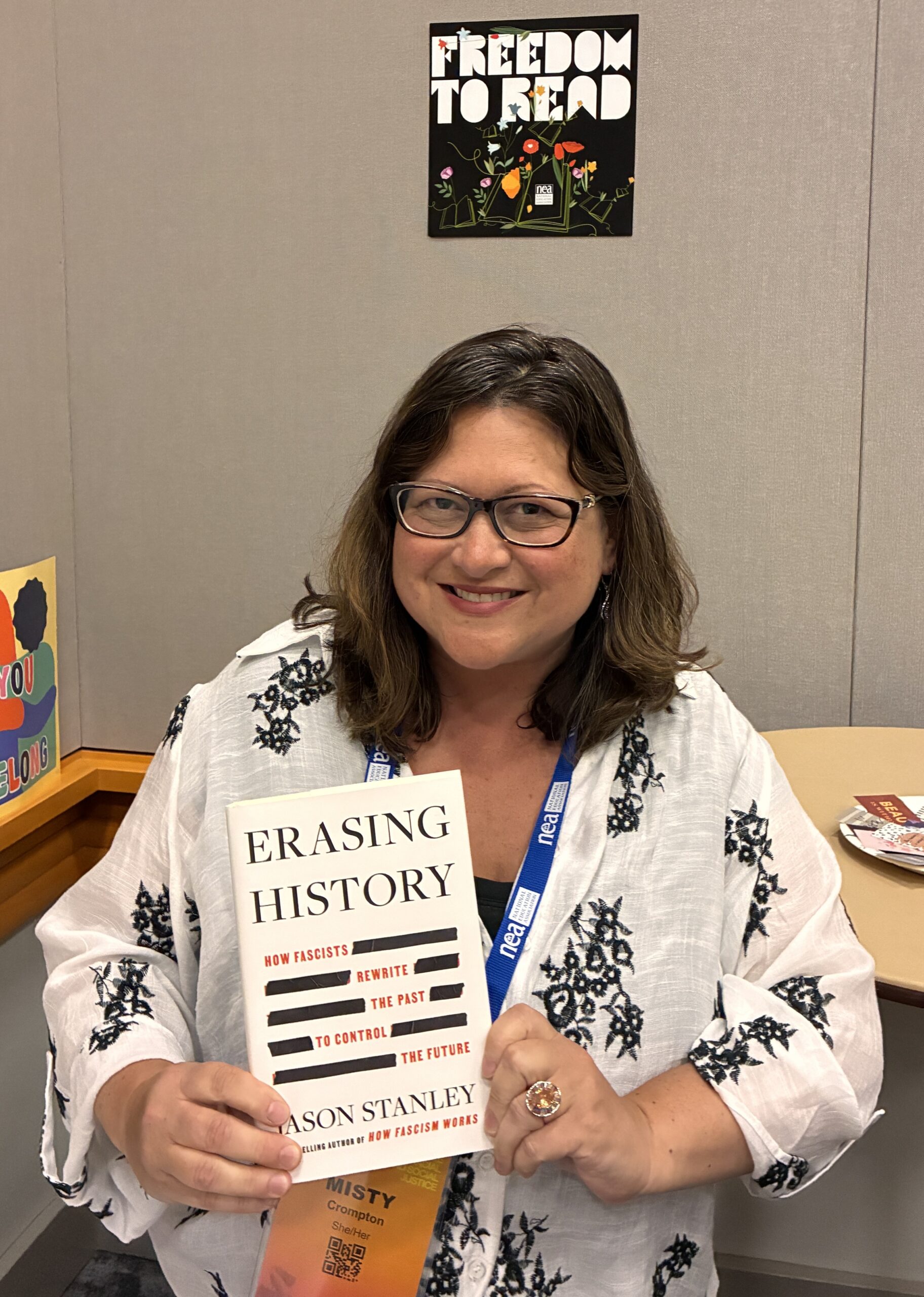
Misty Crompton
One of the teachers who received the Erasing History is New Hampshire middle school teacher Misty Crompton who was targeted by right-wing school board candidates during the 2020-2021 school year.
Undaunted, Crompton has hosted Teach Truth events and signed the Teach Truth pledge, writing,
I am signing this pledge because I am deeply disturbed by both the attempted culture war and censorship being thrust upon schools and other organizations all across the nation. The teaching of truth to people of all ages is essential so we can examine our past and create a society focused on progress.
Crompton’s story (along with many others) is recounted in Trouble in Censorville: The Far Right’s Assault on Public Education and the Teachers Who are Fighting Back.
Erasing History was on display at conferences and Teach Truth events, including at the NEA Conference on Racial and Social Justice in Portland, Oregon.
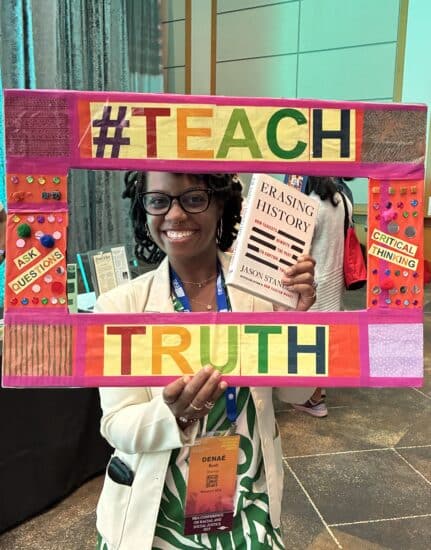 DeNaé Bush, NEA director of the Missouri National Education Association with a copy of Erasing History. |
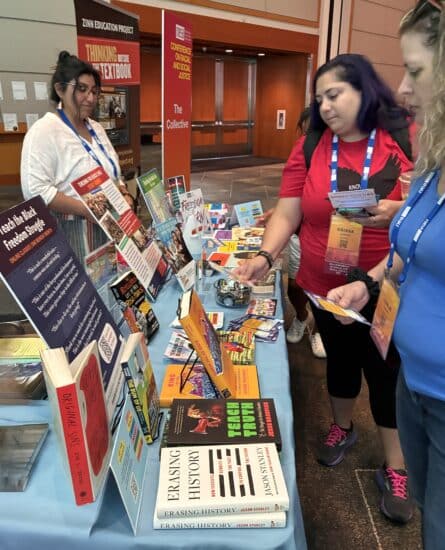 Julia Salcedo at the Zinn Education Project table with resources about the Teach Truth campaign (including Erasing History), Teaching for Black Lives study groups, and Teach the Black Freedom Struggle class series. |

Twitter
Google plus
LinkedIn