

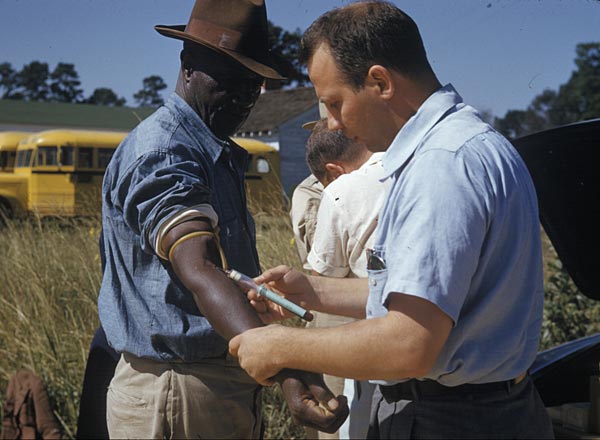
An African American male is tested and treated during the Tuskegee Study of Untreated Syphilis in the Negro Male. Source: Public domain
By Gretchen Kraig-Turner
n my classes I encourage students to revise their lab reports and essays, and like most teachers I also do minor tweaks of my lessons from year to year. But large-scale overhauls of my favorite lessons are more difficult and less common. A mixer I wrote (published in Rethinking Schools in 2016) on the United States Public Health Service (USPHS) Untreated Syphilis Study at Tuskegee (formerly known as the Tuskegee Syphilis Study) got such an overhaul for dual purposes — to teach virtually and to center resistance and agency over victimization.
This study followed approximately 600 African American men from Macon County, Alabama, from the early 1930s until it finally ended 40 years later after an article came out exposing how these men were denied treatment — including penicillin, which was widely available since the mid-1940s. Of the men, 399 had an active syphilis infection, and by the late 1960s at least 28 but possibly up to 100 had died from syphilis. While the study was originally funded by a philanthropist from Chicago to look for treatment or a cure, the USPHS altered the design to be a “study of nature” and not an experiment. Dr. J. E. Moore, a textbook author on STIs from the time, wrote that “syphilis in the negro is in many respects almost a different disease from syphilis in the white,” and Dr. O. C. Wenger, a doctor from Hot Springs, Arkansas, wrote that the USPHS study “will emphasize those differences.” Dr. Thomas Murrell, a key USPHS doctor in the study, spelled out a primary reason the study became what it was: “So the scourge sweeps among them. . . . Perhaps here, in conjunction with tuberculosis, will be the end of the negro problem. Disease will accomplish what man cannot do.” This study is a primary example of medical racism and is still under-taught in both science and social studies classrooms.
In the original lessons, my students did a mixer, taking on the roles of people involved. They played the white doctors who engineered the study to withhold antibiotics from African American men suffering from syphilis. They played the men themselves, learning about the lack of medical care in rural and segregated Macon County, Alabama, and how the men eventually found out that this decades-long study did not involve any actual treatment for a curable disease. They played the role of Peter Buxtun, a whistleblower with the USPHS, and Jean Heller, a journalist who broke the story in the early 1970s. The students then wrote a testimony from the perspective of one of the roles to be delivered at the congressional hearings that followed Heller’s article. I taught this as an introduction to bioethics in a biotechnology class with juniors and seniors. When I wrote this lesson I taught at Jefferson High School, a school in Portland, Oregon, that at that time had a predominantly African American student population. I now teach in rural northwest Washington at a Title I high school where students of color make up approximately 55 percent of our population, with about 45 percent identifying as Latinx.
When school and professional development went online in the spring of 2020, I taught this lesson to science teachers around the country who were looking for lessons that highlight social justice. I began to revise the lesson hoping to find a format that would work on Zoom — but the renewed discussion about Black resistance and agency in the wake of the 2020 Black Lives Matter protests also encouraged me to take another look at the lesson’s content. I wondered whether the previous version of the lesson focused too much on the men in the study as victims. I wanted to emphasize how the men in the study made efforts for justice that led to major changes in the way medical research is conducted, including the establishment of the National Commission for the Protection of Human Subjects of Biomedical and Behavioral Research as part of the National Research Act. The lesson still needed to detail the pain these men suffered from being in this “study” unwittingly and the human rights violations perpetrated by the doctors but also allow students to see the complexity of people simultaneously being victims and fighters for change.
Continue reading and find additional teaching materials at Rethinking Schools.
Gretchen Kraig-Turner teaches in northwest Washington in a community surrounded by farmlands, the foothills of the Cascades, and the Salish Sea. In between teaching, raising two great kids, and gardening, she is co-editing an upcoming science book for Rethinking Schools.
 This lesson is in the Fall 2024 issue of Rethinking Schools. Subscribe to the Rethinking Schools magazine today.






Twitter
Google plus
LinkedIn