
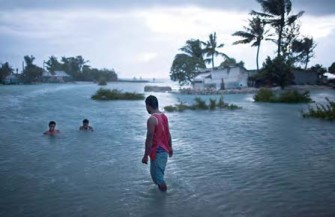
Photo by Ciril Jazbec.
This country has been the basis of my being. And when it’s no longer there, you know, it’s unthinkable.
Ueantabo Mackenzie’s haunting words in the PBS NOW documentary Paradise Lost shook me. I knew I wanted to teach a unit on global warming, especially after participating in the Portland-area Rethinking Schools curriculum group, Earth in Crisis. I didn’t have to be convinced that students need to learn about global warming. It’s one of the defining issues of our time. But Mackenzie’s message startled me: Global warming is here, right now, and it is uprooting people and destroying nations today, starting with Mackenzie’s home on the island nation of Kiribati (pronounced KIRR-i-bahs).
 I grew up thousands of miles from Kiribati in Arizona. My memories of the changing seasons usually boiled down to something like a shorts season and a jeans-with-sweatshirt season. So in the mid-1990s, when I started learning about climate change and global warming the danger seemed remote and distant. What difference can a degree or two really make, I thought. At the time I didn’t grasp the rippling effects of global warming, including sea level rise, melting glaciers, and crop failures.
As I was planning my global warming unit — which I first taught to a freshman global studies class and later to a senior humanities class — it was important to ensure that my students didn’t miss the point as I had. I didn’t want them jumping straight into an investigation of the connections between carbon dioxide and rising temperatures, I didn’t want them getting mired in the muck of political debates and international summits — without first hearing about stories like Mackenzie’s. I wanted them to see that, beyond the environmental damage, global warming is about people. Ultimately, I wanted them to care.
Download lesson to continue reading.
Classroom Story
Using the Brady Bennon lesson Paradise Lost: Introducing Students to Climate Change Through Story changed how my students engage with climate change. We live here on Hawai’i Island and climate change affects us, too. We bypassed the usual data to ground our unit in aloha ʻāina (love of land) and wahi pana (legendary place). Students recalled their cherished places, a family loʻi kalo or surf break, creating “found poems” that show land is identity, not real estate.
Watching the Kiribati documentary, the threat became real to us. Students were able to link Kiribati’s rising tides to Hawai’i’s crises: North Shore erosion, saltwater intrusion, and compromised highways. This sparked an important dialogue on land rights and ‘climate gentrification,’ and displacement otherwise known as Priced out of Paradise.
To counter the climate crisis, we focused on Indigenous resistance. Inspired by the Pacific Climate Warriors, students researched local activism, from the Red Hill fuel leaks to restoring loko iʻa for food sovereignty. This narrative approach turned climate science into kuleana, inspiring them to protect the land.
A student quote during this lesson: “The aina is our kueana (responsibility) to care for like a little sister.”

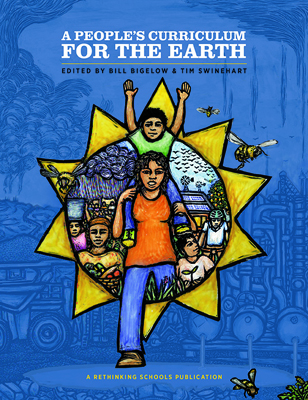
This teaching activity was originally published by Rethinking Schools and is included in their book, A People’s Curriculum for the Earth.




Twitter
Google plus
LinkedIn